


The Decadent Movement was all but spent by 1900, and even critics at the time said it had been exhausted by a single novel, Against Nature, by J.-K. Huysmans, sixteen years before. A few works appeared as codas later — such as Thomas Mann’s Death in Venice in 1911 and Leda Without Swan by Gabriele D’Annunzio in 1913 — and one can imagine the Decadents admiring the Ballet Russes of Diagilev, which took Paris by storm in 1909, the tango craze in Paris, London, and New York of 1913, and the imaginative films of George Melies, dramatized in Martin Scorsese’s film Hugo.
But change had come so fast in real life and seemed to quash the quest to find an artificial paradise through drugs, art, and mystical escapism. The years leading up to the Great War saw the proliferation of electricity, telephone, phonograph, cinema, and motorcar, not to mention the first flight of the Wright Brothers.
All the contemporary movements also lost steam: dandyism and aestheticism in England, Symbolist painting and poetry in Belgium, and the French Occult Revival in the realm of esotericism.
It was as if, to use the famous Decadent cliché, there was nothing left to say. Which is where we are with this series — at least for now.
And so, some final thoughts.
As one of the artistic hallmarks of Decadent style, let’s weave a florid tapestry of themes for a crescendo, starting with, in the words of Julius Evola, the “woman problem,” a major preoccupation of the artists and writers of the Decadent Movement.

The most sensitive of them began to turn their male gaze away from the fair sex, which was dubbed the “New Woman” in popular media of the times and femmes fatales in the imagination of Decadent authors and painters (the entire scope of this trope is given an exhaustive Marxist treatment in Bram Dijkstra’s 1986 study Idols of Perversity: Images of Feminine Evil in Fin-de-Siècle Culture).
This is the same era that bequeathed Pierre Loti’s 1887 novel Madame Chrysanthemum, about the love affair between a Western man and Japanese woman, which influenced Giacomo Puccini’s 1904 opera Madame Butterly.
One hundred years later, I went down a similar path: precisely at the time I was discovering the Decadent authors, I intuited that something was “wrong” with Western women. They did not seem interested in being my guide, muse, angel, and support on my vision-quest for a destiny that would involve scraping the dome of the heavens to discover what lay behind. But, as Oswald Spengler writes in 1919, it’s actually men’s fault, for “Man makes history, woman is history.” Women from the East provided the temporary solution of receptive and pleasant feminine companionship at the turn of the millennium for myself and many others.
While commoners and prosperous bourgeois remained entranced by the women of the Belle Époque — understandably, as it was Western Woman at her most alluring, just look at the drawings of Charles Dana Gibson and Howard Chandler Christy — sensitive artists and visionaries found their polarity switching from the material realm of human coupling to a longing for union with the divine, and the blending of mysticism and eroticism is the Decadent Movement’s flip-side of the femme fatale.
In search of a solution to the “woman problem,” the most soul-troubled men turned away from the loud suffragettes of the era, passing Eastern femininity as well, and discovered ancient paths leading to spiritual “occult brides,” as Evola elucidates for us in various books, from Revolt Against the Modern World to his work on the Grail legend and the Mysteries of Eros.
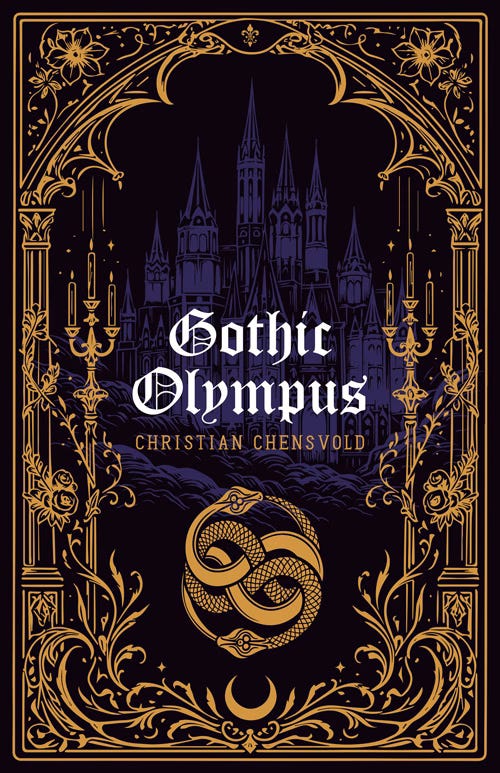
Here the initiate into Heroic Spirituality uses his erotic vital energy (vril, in the 19th-century novel from Bulwer-Lytton) for spiritual ascension and restoration of the Primordial State of unity in which all his energies, as reflections of his maker, are active. Julien Stanwyck in my new book Gothic Olympus goes through this process, and eventually wins a bride on the subtle plane who will be there to meet him in the afterlife and go on with him to further adventures, having maintained his consciousness across the threshold of mortality.

When a mysterious inheritance leads Julien Stanwyck from the murky clubs of New York to the absinthe-soaked cabarets of fin-de-siècle Europe and the ruins of a family château, a drama of infernal torments and divine fury rattles the cage of the modern world.
Gothic Olympus launches the reader into the phantasmagoric odyssey of one man’s mission to reawaken the old gods and defy the onslaught of demonic collectivism and matriarchal tyranny. It follows Julien Stanwyck’s alchemical transformation from a pale, scrawny, angry young man into an Olympian sovereign who conquers death with the sword of Achilles, wins a goddess for a bride through initiation into the Mysteries of Sex, and travels through earthly and celestial realms to fulfill his destiny.
A mythopoetic allegory for the twilight of Western Civilization between the Belle Époque and the present dystopia, Gothic Olympus detonates the postmodern abyss through a pulse-pounding concoction of dark humor, occult wisdom, and virile spirituality, weaving Julius Evola’s revolt against the modern world with elements of steampunk, dark fantasy, and Decadence.
Through the magic mirror of Stanwyck’s trials and adventures, Gothic Olympus is a riveting tale of heroism, a summons to metaphysical awakening, and a daring vision of the greatest force the world has ever known: European man’s imagination.
In one key text, the longing for mystic rapture is combined with the rapid technological development of the era. And so in addition to the influential “Spirit Love” tale by Gautier and the ghost romances of Victor Emile Michelet, we get the 1886 novel The Future Eve — not eve as in evening, but the Eve of the Bible — by Villiers de l’Isle-Adam, which involves the hiring of Thomas Edison to create an automaton modeled on the hero’s feminine ideal.
So yes, in this age where men are “walking away” from women, it is absolutely possible to create the feminine ideal that has haunted their imagination, according to ancient doctrines and the divine right of anyone who attempts and succeeds in the endeavor. What Jungians fail to consider in their writings on anima integration is whether this anima is more than just an aspect of a man’s psyche, but right would be a cosmic flower made of light, capable of being fecundated and given a life of its own.
Consider what metaphysical truth lies hidden inside the story from the Hebrew tradition that the original human, Adam Kadmon, was an androgyne, and that the Eve principle was taken from his left rib, resulting in the two earthly genders. From the Hellenic tradition, consider that when Zeus wanted a daughter — Athena, for which Athens is named — he pulled her out of his head. And finally, note that the axis between Heaven and Hell is vertical, and seeking to integrate one’s being in order to “mate” with the Supreme Creator is diametrically opposed to engaging with an AI-created girlfriend meant to stand as a substitute for a human female. The first instance stems from the desire to transcend what is human to embrace the divine, while the latter is spawn from the frustrated desire to embrace what is human and substituting something synthetic.
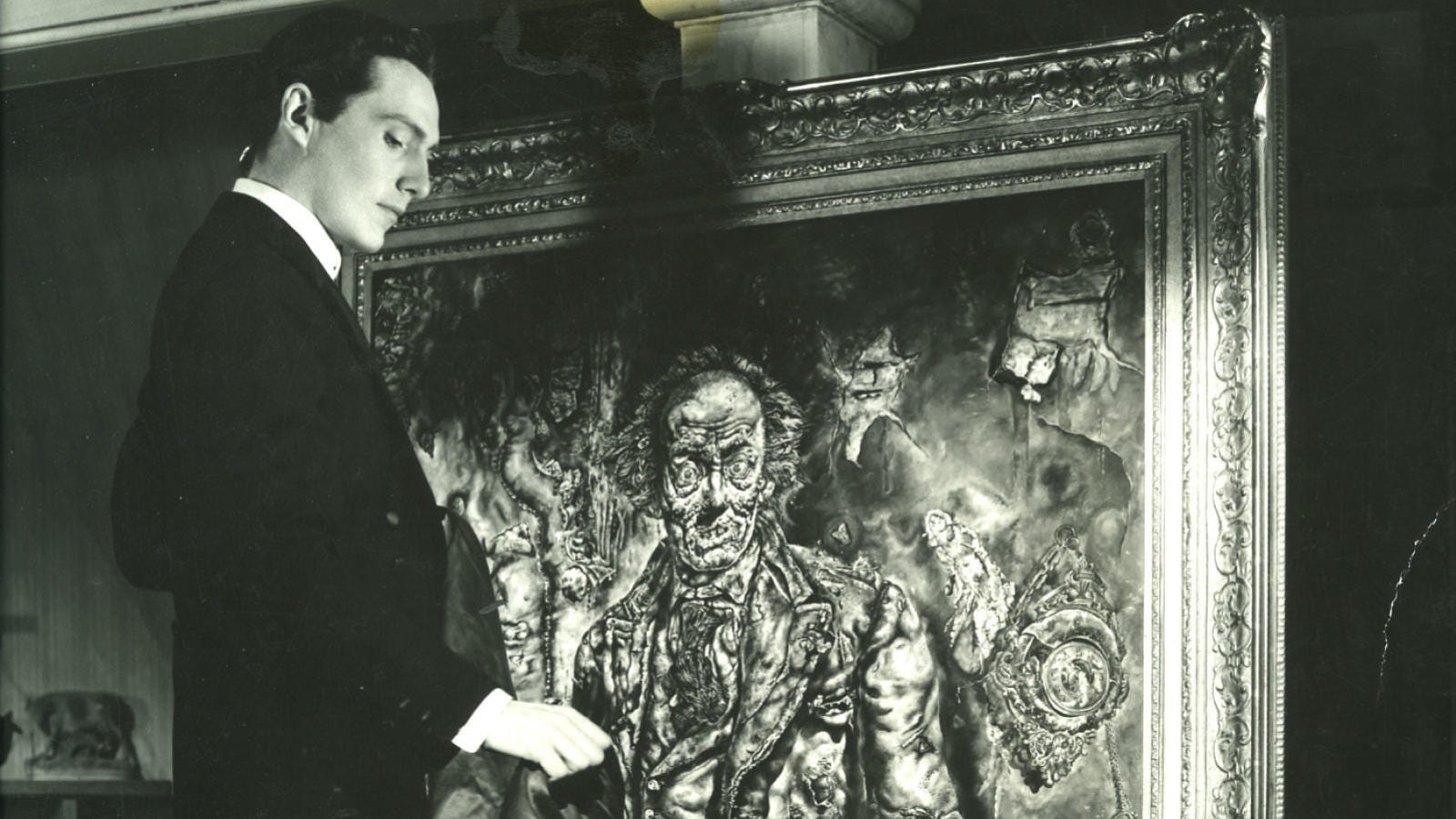
And now let’s tie this tapestry together with reference to one last work whose central symbol stands for the present state of Western man, having thrown away everything over the past 125 years and now gets to reap the extinction-facing crisis he has sown for himself. Oscar Wilde’s 1895 novel The Picture of Dorian Gray is a work of late-Victorian pop fiction filled with fashionable Decadent tropes. The plot involves a handsome lad who, through a diabolic deal, never grows old, while a portrait of him reveals all the horrible sins and debaucheries of his cursed soul.
In our dreary, end-times age, without love (the principle of higher bonding), sex (the principle of fruitful creation), hedonism (pleasure, named for the Greek figure Hedone), and voluptuousness (eroticism cultivated as an art form), we find ourselves in an era that encapsulates the great Decadent theme of sterility, as the weary Decadent male mantra “I am the last of my kind” becomes “My bloodline ends with me” in 21st-century feminist nihilism. For of all the tragedy that has befallen Western man, perhaps none is more disheartening than the destruction of the beauty of Eros — who lives on as a main character and driver of the story in my Gothic Olympus.
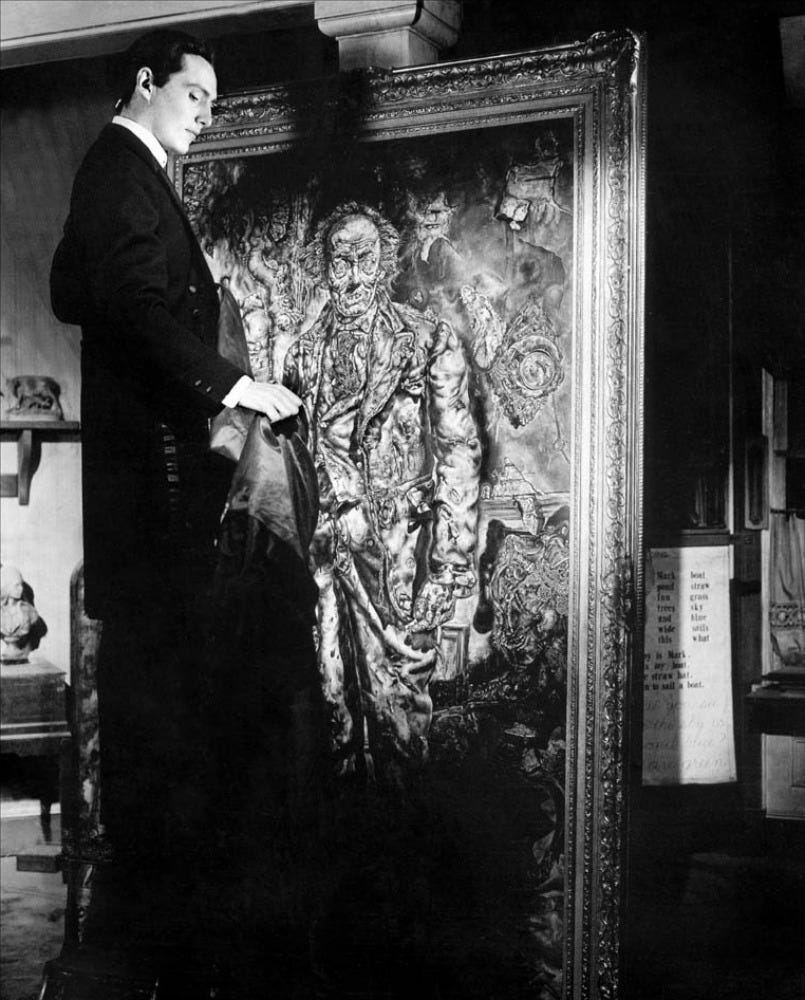
To perform an Internet search using the slightest imaginative erotic keywords is to stare into the very pit of hell. And so Dorian Gray’s portrait, pictured here from the 1945 film adaptation, serves as a fitting close to this series, an all-encapsulating selfie of Western man in 2026.
READ MORE:
Christian Chensvold’s Gothic Olympus is hot off the press from Arktos and available on Amazon.
EXPLORE Christian Chensvold’s Decadent Chronicles series, brought to you by Arktos Journal:
7: LARP Against the Modern World

e