


The literature of the fin de siècle mostly portrayed artists and aristocrats perishing amid the onslaught of democracy and capitalism. Some quietly faded away — usually into despair, perversion, and madness — while some exploded in an operatic grand finale, as in the sensationalist works of authors such as Jean Lorrain and Rachilde.
But the year 1899 also gave birth to the term “superhero,” which is a far more germane concept in the battle to save Europe on the streets of cities and in the hearts of men. Begin by recalling everything you’ve learned from Julius Evola about the Golden Age versus the Kali-Yuga, when — as he explains in the opening of Ride the Tiger, for example — all previous norms are to be considered void. In the battles to come, you are not going to be a knight fighting other European men of honor as in the battles, jousts, and duels depicted in the film Excalibur from 1981. You’re going to be battling inferiors.
I propose a primary orientation for approaching the urban skirmishes of the future, a Gothic martial art for the 21st-century fight to save Europe, capable of making its practitioners go beyond themselves through the mystery of a stimulated imagination wielding its ability to access latent powers from the archetypal dimension. Let’s begin by defining what this fighting style is not.
In addition to not fighting against fellow Europeans of high rank, you will not be fighting to save your homeland like a UFC professional. Such fighters are highly trained with absolute respect for the skill of their opponent, and are fighting in what is still a sporting event with a referee, audience, and prize money.
Next, moving from professional to the level of what we’d call a “street fight,” you must not sink to the level of the inferior opponent, which is the entire meaning of qualitative distinction and everything Evola has so painstakingly elucidated for us about the spiritual nature of true superiority. The collectivist peoples of the Southern Hemisphere who have invaded Europe often adopt low postures in preparation to fight, taunting the enemy while shifting from side to side, enacting low, sub-personal, and telluric energies.
But the subsequent danger is attempting to rise above this savagery through ego inflation deriving from the desire to prove something to the enemy — as well as oneself. Such egoic rage can pull even King Arthur off balance, as Sir Lancelot warns in their first meeting, and leads to Arthur’s breaking of Excalibur, which could only be mended through the dark, primordial energy of the Lady of the Lake.
We must understand that what will be most effective at supra-human assistance from the ancestral dimension, woven into the fabric of the blood, will not be a Golden Age fighting style of the Medieval period or Ancient Greece. We live in the Dark Age, and the proper fighting attitude requires dark energies that are pulled down, to use Evola’s favored term, “from above.”
READ MORE:
The new expanded edition of Julius Evola’s Metaphysics of War is out now!

Initiates will immediately know the difference between projecting outwards and expanding the body’s inner energy field — the aggressive “puffing up” or ego inflation — and drawing down, or summoning with the purpose of wielding, a supernatural dark energy that has been discovered and harnessed in one’s being through initiation.
The “Becoming Ghost Rider” clip on YouTube, complete with Carmina Burana-type minor-key choral soundtrack — is a good dramatization of the agonizing inner process of discovering this energy and seeking to control and integrate it.
In Gothic Olympus, my new occult novel out from Arktos, the hero Julien Stanwyck uses sexual energies to reach the level of transformation needed to become his own version of a dark superhero. Evola elucidates the use of sexual energy for initiatic purposes in his book The Metaphysics of Sex, and the novel attempts to dramatize the process of isolating the body’s two currents — positive and negative, or ida and pingala in the Vedic tradition — and then clashing them together in the spiritual craft of alchemy in order to possess the quintessence superpower, which is symbolized by the double-ouroboros depicted on the book’s cover.

When a mysterious inheritance leads Julien Stanwyck from the murky clubs of New York to the absinthe-soaked cabarets of fin-de-siècle Europe and the ruins of a family château, a drama of infernal torments and divine fury rattles the cage of the modern world.
Gothic Olympus launches the reader into the phantasmagoric odyssey of one man’s mission to reawaken the old gods and defy the onslaught of demonic collectivism and matriarchal tyranny. It follows Julien Stanwyck’s alchemical transformation from a pale, scrawny, angry young man into an Olympian sovereign who conquers death with the sword of Achilles, wins a goddess for a bride through initiation into the Mysteries of Sex, and travels through earthly and celestial realms to fulfill his destiny.
A mythopoetic allegory for the twilight of Western Civilization between the Belle Époque and the present dystopia, Gothic Olympus detonates the postmodern abyss through a pulse-pounding concoction of dark humor, occult wisdom, and virile spirituality, weaving Julius Evola’s revolt against the modern world with elements of steampunk, dark fantasy, and Decadence. Through the magic mirror of Stanwyck’s trials and adventures, Gothic Olympus is a riveting tale of heroism, a summons to metaphysical awakening, and a daring vision of the greatest force the world has ever known: European man’s imagination.
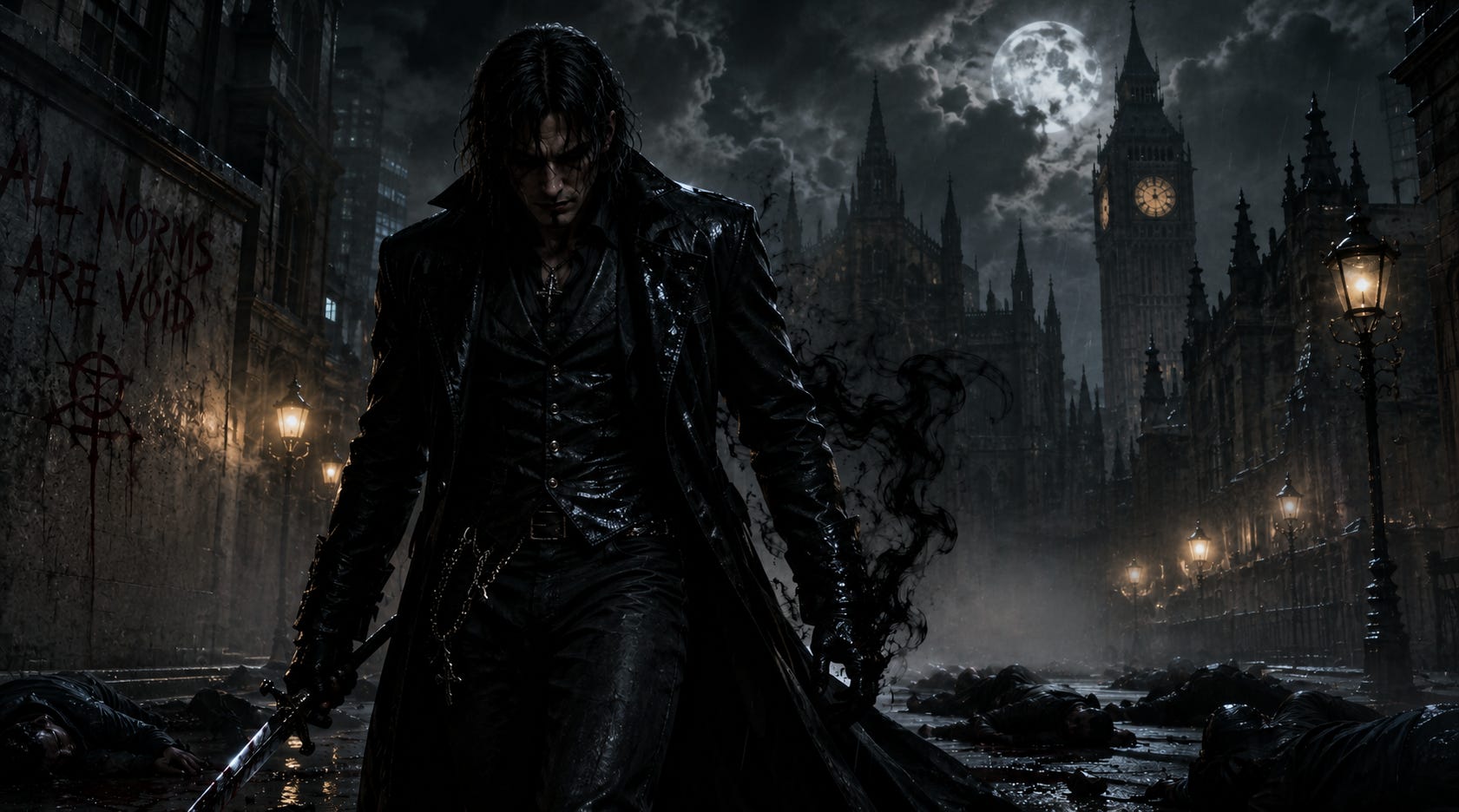
Powered by this ancestral energy, what would a Gothic fighting style actually look like? The creative artists behind Gothic character art and cinema draw their inspiration from the same archetypal frequency, and dark superheroes such as the Crow, Ghost Rider, and various iterations of Dracula have one thing in common in their posture, movement, and fighting style: contempt.
In the worlds these characters inhabit, they are fully aware of possessing superior powers. They are dvija or twice-born, which Evola has taught us is the distinguishing feature of aristocratic beings who are warriors, heroes, mages, and kings. They are men of a spiritual race who are conscious of being immortal and therefore have no fear of death, and who view the enemy as something beneath them. The chin is tucked and the hands are low and coiled, as if supernatural forces were at their fingertips. There is no attempt to intimidate the enemy, for these Gothic superheroes have completely transcended the earthly ego. They don’t try to be fearsome, they are fearsome by the very nature of their being.
When writers, actors, directors and choreographers create a fight scene for such characters, a clear pattern emerges. They approach the enemy without any technique or stance, but stride forward with a sense of absolute sovereignty of the will and the intention to defeat as quickly and effectively as possible. There are contemptuous forward kicks, brutally efficient sword stabs, and an enemy is more likely to be swatted across the room than hit with a jab-cross-hook. Grabbing the enemy’s hair and shoving his head into the nearest hard surface is another end-it-fast technique, and everything is executed with a sneering superiority and ice-cold determination.
Examples include the “opera fight scene” from the 2024 version of The Crow, available on YouTube, and the “Dracula destroys soldiers” scene from the new Luc Besson film, as well as various scenes from the Underworld franchise.
Words are a form of magic that shape reality — the logos, or “In the beginning was the Word” — and the term “fight” does not adequately describe the Gothic martial art I’m seeing in my imagination. Batman, the Dark Knight of Gotham, invokes the need to build his persona on an “elemental” force — choosing the symbol of the bat, the nocturnal beast associated with the vampire legend — and on evocative word energizing. This approach to confrontation is something more like “thrash” or “violence,” in which all system and technique has been surmounted by the singular determination to destroy the enemy.
Superhero films should not be mocked, for although they were born in the 20th century, the age of the masses, they serve, however inadvertently, the great secret of man’s ability to access higher dimensions of reality and harness the energies he finds there. Likewise, cinema is one of European man’s great art forms, and its creators — consciously or not — depict eternal truths forever renewing themselves across the shifting sands of history.

As the character Ra’s Al Ghul — leader of the vigilante League of Shadows in the Batman universe that destroys decadent societies — puts it, “What you really fear is inside yourself. You fear your own anger, the drive to do great or terrible things.”
Christian Chensvold is a college fencing champion who at the age of 47 commenced fight training in a New York park with a member of the Italian mafia. Today he trains Don Quixote-style, “tilting at windmills” in the forest with a wooden sword, and fights for Europe on the causal plane. His novel Gothic Olympus is hot off the press from Arktos.

Don’t miss out: get Gothic Olympus for 20% off during the Arktos Summer Sale!
READ MORE of the Decadent Chronicles series, brought to you by Arktos Journal: