


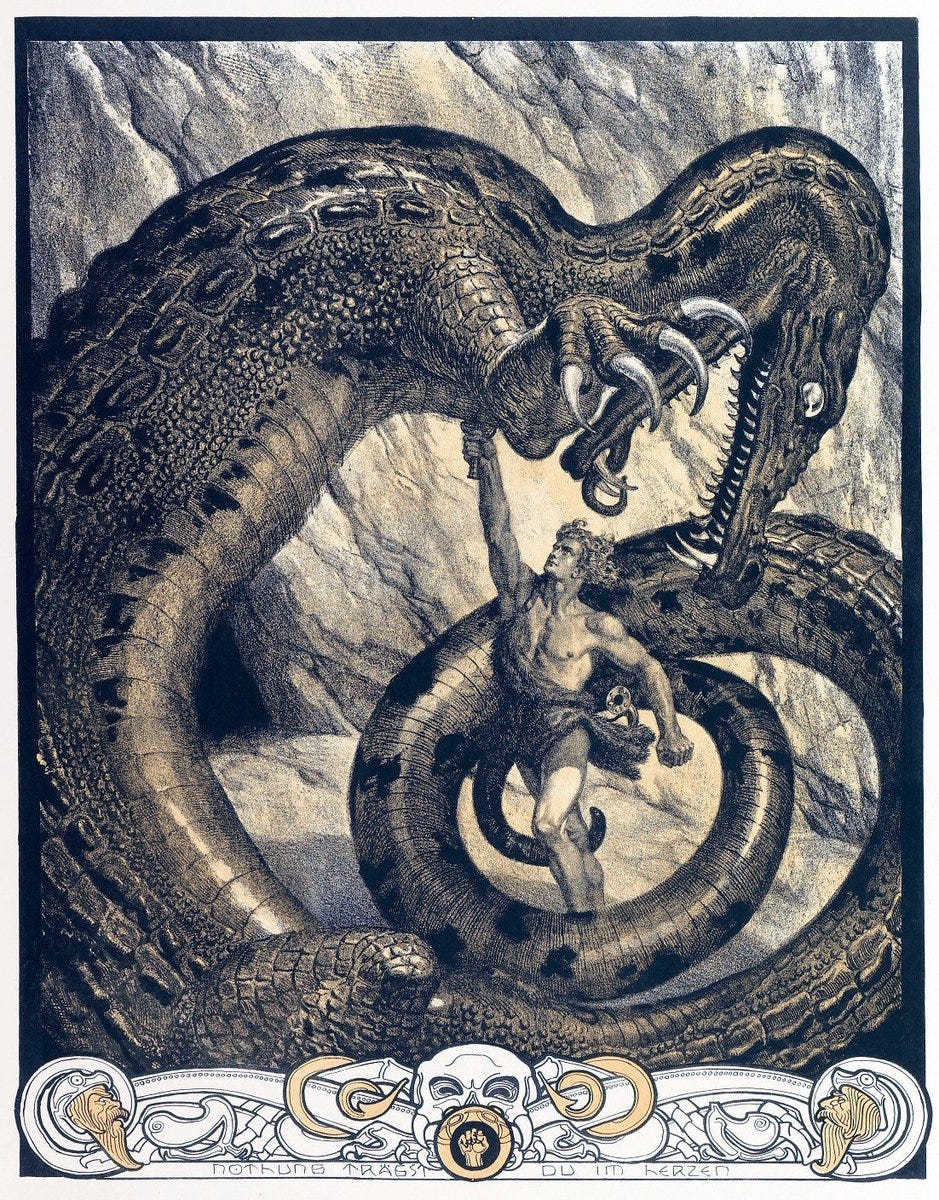
Christian Chensvold evokes Achilles and Siegfried as mythic templates for rekindling heroic spirit through ritual and imagination in an age darkened by decadence and decline.
Also read parts one, two, and three.
I’ve been searching the web for an image from Wagner’s opera Siegfried while listening to his “Siegfried Idyll” from 1870, a subtle and dreamy piece he wrote as a gift to his wife, based on musical themes from the third installment of his Ring cycle. I finally found the illustration, which was executed in 1914 by an artist named Franz Stassen. As King Triopas of Thessaly says of Achilles at the start of the film Troy, “I shall remember the name.”
But what do the Bronze Age warrior Achilles and the Germanic Siegfried have in common, besides being heroes with fair eyes and fair hair, and who thus spring from the same cosmic well?
They both went through my mind as I soaked up the sun while reading Evola’s Revolt Against the Modern World for the hundredth time. Two ladies dressed up with hats and jewelry, which added seriousness to their activity, set up a tent around their iPad by the swimming pool, forming a makeshift altar, and followed along to an aquatic exercise routine with props they’d brought. The women had used their imaginations to impose an internal vision upon material reality. All that was missing was invocations to Apollo, sovereign of the sun, and Poseidon, lord of the waters.
In the poolside ruminations they inspired, the most impossible thing in 2025, I thought, would be finding a kindred spirit who would instantly accept an invitation to go to the forest, set up an altar at the base of a tree with wine and bread, olives and figs, and burn a stick of incense to the memory of Achilles. We would employ technology for a sacred purpose, and play on our phones the scene of Achilles training with his cousin Patroclus for inspiration. With our imagination fired, we’d then imitate the immortals, which is the Traditional man’s deepest instinct (see the essay “Deification as a Core Theme in Julius Evola’s Esoteric Works” by Hans Thomas Hakl), and train with wooden swords we’d made ourselves.
When I took up fencing in 1988, this was not an impossible dream. Back then it was not hard to find men who approached the art of swordsmanship with imagination and historical reverence — even in a suburban California city. But today even groups that specialize in rapier-and-dagger training and Historic European Martial Arts are filled with men who cannot hold themselves with the basic dignity my grandmother demonstrated while baking apple pie.
The purpose of imagination-fueled ritualized action is not its effect on the body, obviously, but the soul. A physical workout may leave you feeling strong, but a workout with a transcendent purpose — such as imitating the gods and schooling the spirit for the defense of your ancestral homeland from savage invaders — leaves one feeling like a hero created by Zeus for the struggle against Hesiod’s Age of Iron, also known as the time of decadence.
The Decadent Movement of 1880-1914 — which analyzed the states of mind that come with consciousness of civilization peak and impending decline — is in many ways a genre of failure, of impuissance in the language of Baudelaire, or the “gospel of inaction” as an American satirist said at the time. Only a small number were able to soothe their troubled souls by becoming Catholic mystics or esoteric initiates. Most remained imprisoned by the very materialism and affluence they chastised, and this double-edged sword is a key characteristic of the Decadent sensibility.
But the Decadent Movement represents the agon, or struggle, of the second Indo-European caste, that of the noble warrior aristocrats, and its regression to the third caste of middle-class consumers and capitalist tycoons. We who are living through the regression of the third to the fourth — the caste of dystopian serfs and third-world migrants — see the necessity of some form of action, for transforming ourselves, what Evola called the “radical destruction of the bourgeois” that still lives in us.
“You must become incapable of pleasure that does not include imagination,” wrote the Decadent author Josephin Peladan in 1892. Playing make-believe Achilles fight-training with Patroclus, or Siegfried slaying the dragon Fafnir, trains our minds and strengthens our souls for the trials to come. The Apollonian light from above grows stronger in our hearts, and the primordial serpent of chaos, of castrating matriarchy and hero-thwarting collectivism, is flushed down and away along with everything else that is earthly and impure.
~
Christian Chensvold is a college fencing champion, third-generation astrologer, founder of Dandyism.net (2004), and author of The Philosophy of Style (2023) and Dark Stars: Heroic Spirituality in the Age of Decadence (2024). He is currently writing a work of 21st-century mythology, a Hyperborean Gothic fantasy that seeks to inspire Europa at the time of its greatest crisis.