


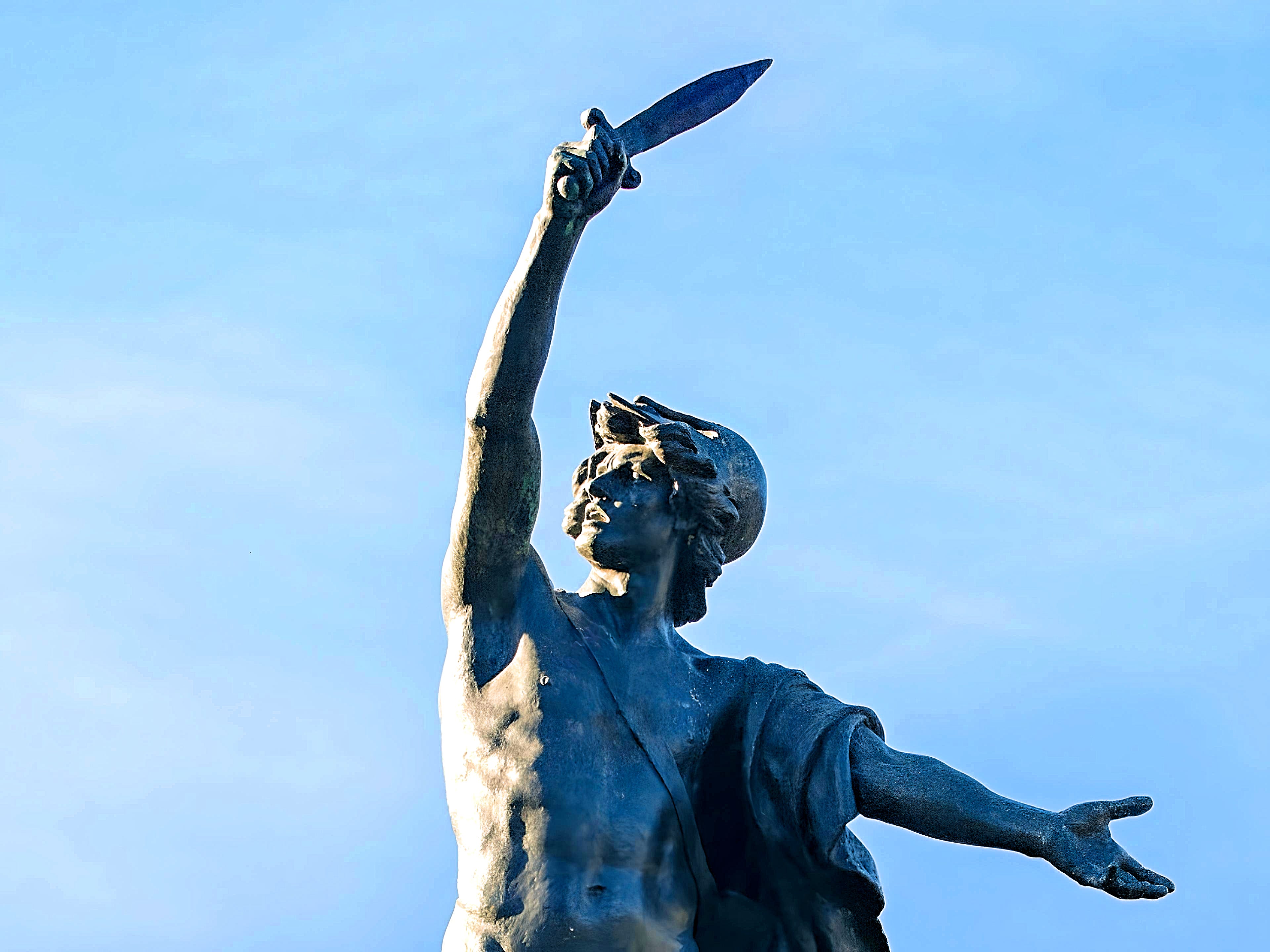
Guillaume Faye argues that the power of tradition is essential for an adventurous future for Europe, which must preserve its ancient cultural heritage amidst the challenges of modernity.
This is the twelfth part of Guillaume Faye’s essay ‘The New Ideological Challenges’, published in 1988. Also read parts one, two, three, four, five, six, seven, eight, nine, ten, and eleven.
If one recognises the Faustian capacity for asserting the human ego as the driving force of history, one also understands that superhumanism, in relation to temporality and its apparent determinism, can attain a state of freedom, even liberation. To the Faustian and superhumanist consciousness, the past never appears abolished. According to this view of history, the power of tradition is indestructible. It can resurface at any time, even centuries after its apparent demise.
Like memory, like a nightmare, or a charming dream that haunts one once more despite being believed forgotten, tradition remains an inexhaustible refuge, eternally present, eternally foundational, a latent power amidst the real, amidst the weakness of the passing present. Therefore, regardless of the vicissitudes of today’s ailing Europe, we must preserve our ancient traditions, especially the strongest among them — those that are peculiarly ours and cannot be taken from us, such as the imperial myth, the Greek poets and philosophers, the monuments of literature and architecture erected by our ancestors to serve as inspiration, as a refuge in times of need — a day which has now come. ‘Exegi monumentum aere perennius’1, wrote Virgil.
Let us become aware that in this 20th century, the ‘progressives’ and the ‘revolutionaries’, the worshippers of the present and at the same time the undertakers of the past, have brought forth the most senile, the coldest, the least adventurous civilisation in history: the civilisation of global bourgeoisification and the regressive entrance into the future!
Despite its pathological technological vibrations, despite its feverish pursuit of micro-innovations, this civilisation creates nothing historical. To create, one must be conservative. Those who truly cling to tradition have a three-dimensional view of time, relying on a past, on a tradition that is always present and alive to them, which they can now project into the future. The progressive can establish nothing and create nothing because he views the past and tradition as dead and abolished. He relies on sand — on the illusion — and this illusion consists of building on the pure present, that is, on the ephemeral itself.
The progressive revolutionary — whether Marxist, social democrat, human rights utopian, or monomaniac of the informational globalisation (MacLuhan’s myth of the ‘global village’) — starts from a zero point in history (‘now’), from which everything is possible if one disregards the experience of the past and the forces stored there. Starting from such a zero point, however, means condemning oneself to end in zero, condemning oneself to the stagnation of history, as the fate of this world since 1945 sufficiently shows, where the status quo, the general disillusionment with progress, and the collapse of the great universalist ideals form the backdrop for the indifference and lack of will of our contemporaries — despite the advances of an increasingly meaningless technology.
The revolutionary conservative remains within history, and thus his activity remains future-founding, future-open. The progressive, who desires and believes in the end of history, agrees instead with the reactionary traditionalist in choosing stagnation, as for him the past is merely a corpse, only one that is mummified.
As the modernity of the West has proven to be a dead end, only the shock of the past, the recourse to the past, can grant Europe an adventurous future — provided that this ‘past’ is not that of Judaeo-Christianity and its humanitarianism but rather the reactivation of that ‘other past’ of Europe, which Nietzsche was the first to fully bring to consciousness. In light of this other past (the pagan-Ghibelline past that runs through our entire history and even operated within the so-called ‘Catholic’ institutions), modern technology must be reconsidered. This technology, whose nonsense is evident to all today (because it is driven only by the ideology of individualist prosperity, by the ‘humanitarian’ project of domesticating the species), will rediscover its meaning when subjected to the demand recognised by Nietzsche: that of the enlightened rule of the will to power of creative personalities, whom Nietzsche calls ‘aristocracy’.
(translated and annotated by Constantin von Hoffmeister)
Latin: ‘I have erected a monument more lasting than bronze.’