Recurring across the publications of Arktos Journaland the pages of Arktos books is the recognition — the reaffirmation — that civilization is a matter of the longue durée, or the long-term unfolding and enduring of values, forms, and peoples.
As Rose Sybil has consistently illustrated throughout her writings featured in Arktos Journal over the years, contemporary debates on seemingly “new,” “modern,” or even “postmodern” topics — such as gender and sex and abortion — need to be explored in the light of the “long view” of our civilizational heritage, including our most ancient myths, archetypes, and traditional social structures.
In this first part of her new essay, Rose Sybil approaches one of the most daunting and pressing issues of our day: the rise and pervasion of technology. In her characteristic blend of terminological creativity, personal experience, and wide-ranging references, she shows how the answers to problems like those posed by technology lie not in one or another opinion or phobia, but in recollecting the vast cycles of our civilization from prehistory to the present. Only with the deep past and the horizons of the future in mind can we seize the present moment with all of its challenges.
You’re here reading the fascinating works of Rose Sybil thanks to the efforts, care, and space of Arktos Journal. To help our journal as well as the authors and ideas we share endure, consider becoming a paid subscriber — or pick your next thought-provoking reading from the Arktos catalogue.
Titanic Technique and the Technological Inflection Point
Part 1
by Rose Sybil
In my youth, I was a strong supporter of Uncle Ted. I believed we could solve modern ills simply by reversing technological development. There is a powerful temptation to retreat into an earlier time, yet this way of thinking is linear. It rejects the purpose of cyclical time and the meaning formed through the process itself. Rejecting technology does not defeat the titanic elements, of which Prometheus represents only one form. Mistaking tools for Technique merely pushes this force into the shadows beyond perception, where it continues shaping human organization unseen. Belief in victory over titanic forces through rejection of their tools is an illusion.
We must continually reconquer titanic forces in the image of creation itself. The original sacrifice of all-powerful, formless potentiality first manifested as matter. The titanic and chthonic elements were broken apart by the gods and reshaped into new complexity. Matter grows toward the sky through this process, reuniting with and holding Divine consciousness through the layering of forms. The Sacred does not reject the parts of the Jotun or the monster it conquers, nor does it seek the impossible abolition of the titanic. It constrains these forces and reshapes them into higher structure with greater coherence.
It is not tools or technologies that possess us, but rather their effect on human organization, shaping it from the shadows. Technology is born of war or through existing as apex predators. When given to over production, consumption, and to distance from life it creates a consuming void.
From the shadows, this void of Technique shapes human organization and interactions. By naming Technique as the elusive essence of the titan, we bring it into the light. Only then may we dismember its organization of mankind, integrate its tools within proper bounds, and transform this titanic system into Divine Order.
Creation and Destruction as a Primordial Evolving Spiral
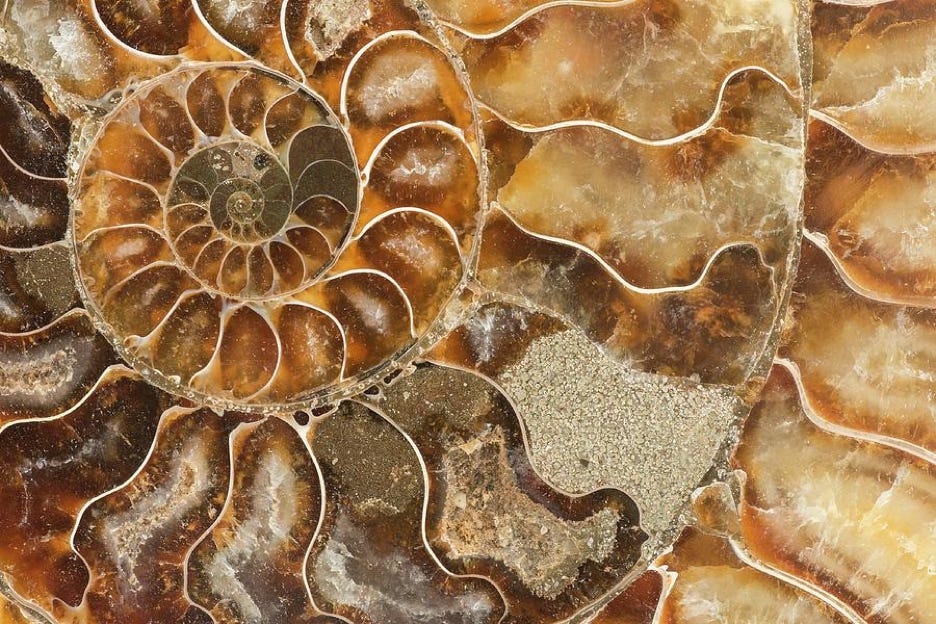
In the dark beginning, there was formless, unmanifested, all-powerful potential. Part of its power was sacrificed to manifest the physical world. This yawning gap appears in both Norse and Greek creation, a rupture from which opposites attract and clash through continual cycles of growth. The cyclical nature of life is not a circle returning to an identical origin; it unfolds as a spiral, expanding outward in cycles of ever-increasing complexity through creation and destruction.
Chaos and darkness are continually shaped into order by light. Order degrades over time, collapses, renews through destruction, and begins again at a further point outward on the spiral. Eros appears as an ordering principle within primordial chaos, driving opposites toward transformation and differentiation. This force operates at both microcosmic and macrocosmic levels, as we reflect the cosmos and the cosmos reflects us.
The same principle appears in the Vedas as Kama. In Vedism, Kama acts as the primordial driver toward manifestation, fertility, and order. It is the longing and desire to create form and meaning from formless potentiality. No direct equivalent survives in Norse mythology, yet the unification of opposites implies an attracting and contrasting force. This suggests that the driving force of desire persists, even if unnamed.
Even non-theistic traditions such as Daoism recognize spontaneous generative processes that drive multiplicity. This inherent life force unfolds into existence and complexity. From oneness and formless full potentiality emerges duality. These opposites bear inherent attracting and repelling properties, generating synergism that propels life forward.
Theism begins with the sacrifice of the giant, an all-encompassing result of the void’s manifested contrasting synergism. Ymir precedes the first gods and is sacrificed by them to form the world and cosmos. Though described as male, Ymir reproduces asexually.
Purusha serves as a more complex parallel within Vedism, the all-encompassing giant of everything that ever was or will be. Purusha exists first beyond sexual differentiation or binaries. He then epitomizes the masculine, unchanging principle and illuminating light.
Purusha was both the sacrificed and the sacrificer that generates the cosmos, elements, social orders, animals, the Vedas, and the earth. His sacrifice distinguishes feminine and masculine principles. Purusha embodies the primordial state of Being as the witness of Prakriti’s feminine Becoming; his presence catalyzes her unfolding. Neither is created, but together they embody creation, with destructive cycles being part of the layering of reality. Their synergism allows the formation and generation of physical reality and primordial evolution.
Greek creation mirrors this structure, first with chaotic matter as the feminine principle and Eros as the masculine force driving her change. The entire cosmos, experience, and unfolding of meaning arises from the synergism of the feminine principle being drawn to life and animated by the masculine principle’s proximity, witnessing, and experiencing of her.
Thus, the sacred process of evolution exists as a primordial manifestation of divine differentiation within the physical world. The myths born from it are generative and formative, projecting future states within the spiraling cycle from the past. This spiral does not arise from lifeless matter, selfish rationalism, or opportunistic impulse as materialism claims. It must not be stripped of its mythic origins that hold real events and direction. Yet, it must also not be rejected through dualistic framing where traditionalism reacts against material evolution by denying primordial evolution. Cyclical time exists not as eternal return to the same point in a circle, but as a spiral, layered through contrasting, attracting, creative, and destructive forces, returning toward familiar forms while generating new layers of complexity and states of meaning.
The Golden Age, Titanomachy, and Sapience
As a child and adolescent I had many formative experiences in the ocean, with my grandmother most always present. For this, I named her my “ocean water grandma.” The ocean was exhilarating, calming, a place of adventure and reflection. I would sit out in the water with the sound of waves and the salty breeze rolling over me. Later, she chose the ocean as half of her grave in honor of those shared experiences. I returned there many times to grieve on tumultuous days, cutting through waves by kayak or swimming. Over time, my grief softened into reflection. I began seeking the greater swells of the ocean to float in contemplation and visit my grandmother. The ocean became a respite from the world, like a childhood home to return to.
Desiring time away from the madness of California while shortly back, I sought this solace. When I arrived at my favorite beach, people were clearing the water. A massive mineral deposit release had just begun, attracting the entire food chain. Upon entering the water, I came into contact with more sea animals than in my entire life before that combined. Fish of every size covered the water. Otters, pelicans, and sea lions swam around me while seagulls circled overhead. As time passed, their numbers increased. Everything fed upon each other in an ecstatic release of energy so strong that it was palpable in the air. Nothing expressed fear; life and death flowed into one another with ease.
They were so entirely consumed with each other that I went completely unnoticed. These creatures are usually acutely aware of human presence and withdraw or become standoffish. I was close enough to reach out and touch them without notice. I became the witness and benefactor of this energy release without participation. I sensed sharks below, yet knew they too were absorbed in the feast, oblivious to my existence. Hours later and miles out, I encountered dolphins. They definitely noticed me. Unlike the other animals, I recognized sapience in dolphins. They were witnessing this event consciously, absorbing the energetic release with me.
In my Lost Heroic Age Series I describe how apex evolve on the edge of the food chain, propelled by love, bonds, and sacrifice. This edge of the spiral is upheld by a layering of all past forms of Being and Becoming. I will not repeat what was written there, but highlight this ecstatic feasting expereince as a microcosm of primordial energy shaped into higher order. Upon reflection, this experience revealed itself to me as a glimpse of the Golden Age. It mirrored Hesiod’s description of immediate renewal, abundance, and absence of fear.
The Titanomachia occurred after man reached sapience. In all creation, higher complexity must subdue and subsume the chaotic forms it arises from and stands upon. The reign of the gods begins with man’s sapience of this — no longer existing solely within evolution as an animal, but reaching the point where man embodies divine consciousness. He becomes the witness behind experience, able to confer meaning as a co-creator. Sapience is both creative and destructive. It initiates a new outward spiral of Ages or meta-zeitgeists, each containing microcosms of the whole.
Sapience allowed the physical world to hold conscious reflection. It enables contemplation of meaning and advanced tools. These correspond to different aspects of the brain as a conduit. The period of Divine fire and the onset of sapience marked an extreme advancement of man, both spiritually and physically. Man transformed into a full apex, no longer a scavenger or small-scale hunter dependent upon titanic forces. He began to perceive stories within living reality. Deities appeared in all of nature around him. Meaning followed freely within living spiritual reality. He overcame monsters and chthonic elements through the hunt. The hunting instinct holds the original capacity to perceive myth and spirit alive in the world, unfolding everywhere.
The Creative Impetus, Competitive Impetus, and the Consuming Void
The Competitive Impetus contains all things borne of competition. Leaps of innovation are forged in war and later developed into consumption in each Age of the cycle. This process has accelerated with every technological revolution. Fighting and martial arts belong to the Competitive Impetus, though there is crossover, as many aspects of competition are rooted in the Creative Impetus. The healing dimensions of martial arts arise from the Creative Impetus; they hold a holistic vantage that integrates the whole system. Innovation itself is ultimately rooted in the Creative Impetus, because the foundational systems of thought that allow innovation to occur are acts of creation. Even in war, the spiritual aspects of it are the root that competition extends from though this has been increasingly lost in modern warfare. As apex beings, we compete at the edge of the food chain, existing on the frontier of primordial evolution, but it is eros that drives this evolving. Thus the relationship between the Creative and Competitive Impetus is how they are understood.
The Creative Impetus encompasses all aspects of life that maintain a living chain of context, wonder, and creation. Spiritual practices, the arts, native songs born of living myths and lived experience, birth, identity, healing arts, and much more are contained within the Creative Impetus. Philosophy and spiritual practice belong to this domain as well, as they seek to understand the world and relate to the divine. This excerpt from Polemos: The Dawn of Pagan Traditionalism demonstrates the integrative foundation (Creative Impetus) underlying mathematics and the sciences (Competitive Impetus):
“Asserting itself to be exceptional and exclusive, Modernity creates its own version of the history of science and artificially dates the branches of knowledge that have emerged in the modern era back to the ancient philosophers and sacred sciences. For instance, the roots of mathematics and physics are traced back to Pythagoras and Archimedes, while the vertical dimension of Pythagoras and the Pythagoreans is left out, castrated. From the powerful and strict school of Pythagoras, maximally closed from the profane and where numbers were perceived as sacred and divine, only mathematical laws and multiplication tables remain.”
When the innovations of the Competitive Impetus are severed from their creative origins, they are applied in a purely consumptive manner to all people. This runs counter to apex function, which requires intensified competition within a species or among subspecies. Taking the tools of competition, removing them from their spiritual and creative roots that they were meant to protect, and then distributing them indiscriminately to all of mankind creates an inversion and collapses them back upon their own creative foundation.
This inversion first appears in the myth of Promethean fire: the removal of the gods from their gift, which is then used to make tools that no longer sharpen apex competition but instead remove humanity from the life-and-death cycle through the agricultural revolution. The same pattern emerges again in the Iron Age of currency, when the innovations of war are fed into trade systems that interconnect the entire world through consumptive networks. These are all manifestations of the consuming void, an act against life itself.
The Ages of Man
Small-scale hunting allowed for the unfolding of sapience. It provided a greater capacity to hunt and cook meat in a positive feedback loop. More animal food intake allowed for larger and more complex brains, and stronger bonds formed through overcoming as apex. Everything that evolves us physically also advances us spiritually, and spiritual sacrifice is what propels the edge of the food chain.
This current Age of dysgenics and mass hominid expansion represents simultaneous physical and spiritual devolution. The Golden Age existed as perpetual Spring, with feasting, divine fire, and life in communion with living deities present everywhere. It carried an ecstatic feeling. Modern man cannot imagine how saturated with life the world once was, since the agricultural revolution altered the landscape so completely.
The inherent temptation in creation is the material void, which seeks stasis. Various Titans express this differently. The devouring mother manifests it by collapsing cycles of meaning on themselves, while Prometheus reflects the desire for ease and distance from the life-and-death cycle. Fire was a divine gift, given as man achieved sapience as an apex predator. It was taken away by Prometheus’s trickery that usurped ritualized gratitude towards the gods. He returned fire in a form that distanced humanity from the formative processes that created sapience. Fire once enabled man to compete at the edge of the food chain; later it forged tools that severed him from those formative processes and its living chain of context. This paradox recurs whenever competitive innovation is used for accumulation or trade, and warriors become displaced from rulership. I wrote about the competitive and Creative Impetuses in part six and seven of TheLostHeroicAge series.
Prometheus deceived Zeus to take away the praise of his gifts to man as god, then stole fire back to return it to the people without its spiritual origin. Pandora followed as punishment, releasing material mimetics and their ills upon mankind and ushering in the Silver Age. Sapience allowed man to distance himself from the unfolding divinity of the sacred hunt that brought his apex nature into Being. Stone tools, hardened by fire, enabled vast advancements in agricultural life. Prometheus is credited with teaching man the seasons and how to plow. By removing fire from the divine element and placing it in Promethian, tools became dual-natured: they could serve competitive, apex functions or divert humanity toward decadence and materialism. The Promethean fire displaced the Competitive Impetus toward accumulation, making man a beast of burden more than an apex.
Rose Sybil discusses how empathy, protective care, and the capacity for thinking in terms of the apex are a crucial part of European consciousness and community, contrasting the dysfunction, guilt, and offloading which liberal ideology turns into self-hatred and xenophilia.
Agricultural life closed man off from apex existence and from the gods present within nature. Hyperproduction in the Silver Age, like the height of summer, mirrored winter’s hyperconsumption in the Iron Age. Gods ceased to exist as living realities and became abstract and transactional, displaced into hoarding and excess. Modern claims that electrotechnology are uniquely harmful compared to agriculture are false: it changes faster but both are detached from the true apex essence of the divine in man. Whenever tools serve consumption rather than competitive apex function, the Devouring Mother emerges, and Behavioral Sink follows.
This pattern appears clearly in demographic anthropological studies of early agricultural states, where centralized provisioning suppressed male competition and consolidated reproductive access, explained in this article:
“This society [silver age] has many similarities to ours, not in the sense of a feminist paradise as envisioned by Marija Gimbutas, the kind of academic who stocks books in ‘independent bookshops that sell enamel pins,’ but in the sense in which the vast majority of women were provided for by the state and reserved for use by the state. We infer these relations from research that suggests that after the advent of agriculture, in every area of the globe, only 1 in 17 men reproduced compared to every woman. The centralizing and binding systems of administration that rose with agriculture created hierarchies where a few powerful men were capable of sequestering the majority of women for their exclusive access.”
These massive systems of polygamy, rather than having a masculine character, are organized around feminizing principles of control and surveillance. They require systemic suppression of male impulse toward challenge and reproduction. They exist only within sedentary societies with centralized food control. Ostracism equals death. Exit becomes impossible. Powerful men rule. Women remain under protection of powerful men. Proximity to power produces religious structures of opinion and taboo, similar to wives of wealthy men working within non-profits and NGOs, similar to childless middle-class women becoming social workers.”
In this manner, the Silver Age at the height of agriculturalism mirrors Modernism within the Iron Age. When existence becomes distanced from living gods and overcoming the food chain as apex, man ceases to function as apex. The gift of sapience and reflective understanding of gods and meaning then folds inward, consuming itself. The Competitive Impetus of tool innovation exists to serve the gods in the image of creation, then without gratitude to the gods the material void draws it into ease and distance from life. Mass hoarding of material wealth during agricultural summer reveals the paradox of tools: when innovations born of war or hunting, i.e., the Competitive Impetus, do not protect or uphold the Creative Impetus, but are subsumed to the consuming void in a manner that harms both the Creative and Competitive Impetus.
What role do warriors and war play in a healthy traditional society? How can the warrior ethos re-inform and revive our societies today? Julius Evola’s Metaphysics of War — fresh off the press in a leather-bound limited edition from Arktos — was and remains the essential reading on this front.
This unique collector’s edition is limited to only 100 copies, some of which are still available for readers in the US and Europe. Claim yours!
The advancement of metals for agricultural civilization produced greater weapons, and expanded trade through ship advancements. Masculine competition as apex reemerged, countering the Devouring Mother and suppressive structures imposed upon young men. Civilizations had accumulated immense wealth. Surplus men were displaced toward trade or the protection of trade. War emphasis escalated and more meat consumption returned, as Hesiod describes. The Bronze Age functioned as an overcorrection from the Silver Age detachment. It temporarily stalled extreme decadence in civilizations beyond Europe.
Exclusion of capable males eventually enabled escape through the advancement of the agricultural tools that had controlled and bound them, as we now see with the internet at the end of this Age. Overcoming the material void marked the emergence of the Heroic Age of Europe within the broader Bronze Age. The Heroic represents full actualization of man within Divine Order. The Trader reduces the warrior into a mercenary appendage of trade, rejecting full development and actualization. Heroic cultures establish Progenic Hierarchy, with men ruling directly as a unified body. Trader cultures hinder boys through customs designed to consolidate power at their expense and everything collapses into zero-sum dynamics.
Perseus seeded the Heroic Age by overthrowing false order: hyperproductive hoarding civilization and polygamous excess. He reestablished direct rule of man as apex and founded Divine Hierarchy with mimetics of synergistic reverence. The broader world continued folding toward the next technical rupture within the Bronze Age. This culminated in the Iron Age through the revolution of currency.
Each technical revolution enables the titanic force to reorganize humanity against its own emergence as a sapient apex with the possibility of being overcorrected for. Myth at the end of the Heroic Age shows this infection spreading with heroes returning to mercenary roles. Tools themselves did not create the collapse. The Heroic Age wielded agriculture and bronze properly, confined to its rightful domain, not used to sever spiritually formative processes.
Lycurgus recognized money as a breaker of bonds, and the defining revolution of the Iron Age. He minimized exchangeability of currency to create a miniature Heroic Age within the metazeitgeist. Divine Order was reforged through Progenic Hierarchy. The wolf sacrifices for the pack, not the herd. War within post-Lycurgian Sparta mirrored the natural rhythm of hunt or frontier adventuring among gods as apex. Their war did not subsume existence but functioned as a spiritual process, unfolding excellence within man and sapience. Liberty for the hero meant freedom from Silver Age labor, from the sacrifice of boys to the power of old men, from mercenary subordination to trade, and the freedom of self-determination as a whole ethnos through direct apex competition with the surrounding world.
Eventually, titanic technique reshaped external conditions once again, engulfing them. The material void first entered through borrowed money to wage war against Athens. Then holding the decadence of Athens destroyed Sparta, not an external enemy. Technique can be delayed only temporarily because others advance within each age’s dominant technique. Excessive consolidation follows. Reversion to previous technological forms remains nearly impossible and comes with excessive sacrifice of sons against the surrounding void, only to be subsumed again.
Earlier tools were equally titanic and must be overcome by the divine force driving evolution. This process is not random. It does not return humanity to a lost Golden Age. The titanic exists at all times. Desire to return to a past Golden Age rejects the cyclical spiral of development that has come at the cost of immense sacrifice. To lose the technological inflection point is to lose the accumulated meaning and sacrifice required to reach it.
To be continued in Part 2…
For more musings by Rose Sybil and to stay tuned for Part 2, subscribe to Arktos Journal:
If yes, be sure to check out the Arktos classic by Raido: A Handbook of Traditional Living, published in two volumes: I. Theory & Practiceand II. Style & Ascesis.