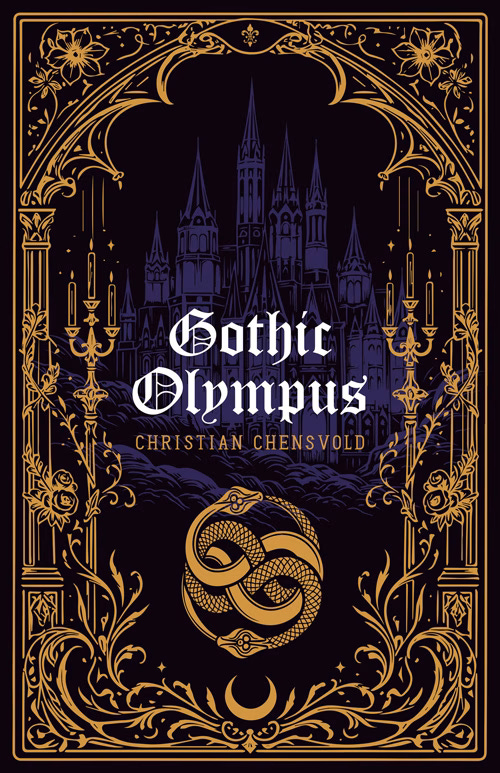
From Christian Chensvold, the author of Gothic Olympus, hot off the press from Arktos, comes this 10th installment in the Decadent Chronicles series, summoning us to explore the depths and heights of the existential situation facing the European soul amidst the modern hellscape.
Decadent Chronicles 10:
Anywhere Out of This World
I like to spend time in the cemetery because I feel like the dead are the only people who understand me. My soul belongs to the 1890s, to Parisian parlors where decadent dandies and femmes fatales exchange absinthe-flavored kisses. In my twenties I hermetically sealed myself in this world and ingested enough books, movies and paintings for it to run on auto-pilot in my imagination like a steampunk aero-plane on the wings of fancy.
And now, with the West facing its greatest crisis, this incredible period — of unrivaled opulence contrasted with the sense of impending doom — serves as the foundation of this very column.
I didn’t choose this world; it chose me. And that’s probably because one of the recurring themes of the era is the sense of having been born in the wrong time.
In reaction to changes brought about in the wake of the Industrial Revolution, poets, artists and penniless aristocrats from ancient families whose blood had grown thin and fortunes even thinner sought escape from everyday life through occultism, mystical erotic imaginings, refined pleasures inspired by corrupt and ancient civilizations, myths of gods and monsters, and the dark caverns of the subconscious. These aristocrats of the soul of the Decadent Movement, like the penguin that has captured the spirit of Western men, sought to forge an ancient path to higher truth. The central work of the period, after all, is J.-K. Huysmans’ 1884 novel, often translated as Against the Grain, whose rallying cry echoes Baudelaire’s longing for states of mind that are “anywhere out of this world.”
A lone penguin who leaves his group to march into the unknown, heading out into the horizon towards distant mountains — this clip extracted from Werner Herzog’s Encounters at the End of the World has suddenly become a viral meme.
A tiny few with the means and temperament have always been able to live as wealthy eccentrics walled off from the outside world. Ludwig of Bavaria became the Fairy Tale Prince, self-isolated in a dreamworld of legend, building flamboyant castles that later served as models for the architects of Disneyland. Michael Jackson created his own hermitage-amusement park called Neverland. Both the king of pop and king of Bavaria were touched by madness and died before their time, but one can nevertheless admire their ingenuity.
Most of us cannot completely sever ties with a world gone mad, however, and are forced to adopt coping strategies for navigating it. In fact, given the topsy-turviness that grows more disorienting with each day, you may be at higher risk for going crazy by NOT retreating to your own private dreamworld.
There are four paths for dropping out of society marked with the footprints of those who’ve hiked these roads before. We’ll start with art, whether creation or appreciation. Through the suspension of disbelief, art transports you to other worlds. You can probably remember seeing a film so powerful that it took time to readjust to reality. In the 2004 film Being Julia, Annette Benning plays a stage actress in the 1930s who recalls the wisdom of her acting coach, who told her that her world is the theater and that for her the outer world does not exist. The moment she forgets this is the moment she ceases to be a great artist.
The realm of nature provides out next time-tested escape route. Here a Gestalt shift in perception reveals that Mother Nature is a dimension of reality entirely separate from 21st-century civilization. Take a stroll into the woods, find a spot beside the warbling waters, and evoke a meditative state in which the tendency to automatically equivocate nature and society is revealed as an illusion. The sound of passing cars with their mufflers and stereos, the wandering zombie-like people, the garbage and graffiti — all that merely belongs to the realm of the social organization at this particular moment in time. It is now held in stark contrast to this other world that lies before you, the world of sunlight and cloud, of tree-roots climbing out from creek-beds just as they’ve done for millions of years, of dragonflies and butterflies and flowers swaying in the breeze. One world is temporary, the other eternal; one lesser, the other greater.
The spiritual path, our third escape route, passes through nature in search of what lies beyond. This is the path of the Buddha, a prince who renounced his palace and family to wander for six years, starving himself until he could find the answers he sought, and of Jesus of Nazareth, who provided the world stage with the tragic drama of a spirit-filled individual against the powers of society. In the confrontation between Jesus and Pontius Pilate, as interpreted by philosopher of history Oswald Spengler, never before had the world of fact — Roman civilization, social order — squared off in such opposition to the world of Truth, and a man who dared to say that his kingdom was not of this world. “The unthinkable as a certainty, the supernatural as a fact, a world that is non-actual but true,” writes Spengler, “Jesus never lived one moment in any other world but this.”
Lucius Beebe may have been an urbane bon vivant, but in the grand scheme of things perhaps not so different from the spirit seeker, as he too sought a personal paradise beyond time and place. Beebe belongs to the fourth means of escape, that of time travel to an age which the soul feels it more properly belongs. Beebe landed on the cover of Life magazine in 1937 dressed like a gentleman of 40 years earlier with top hat and watch fob. As man-about-town columnist for the San Francisco Examiner, Beebe became a character from the Old West, spending his days sipping cocktails from the comfort of the Virginia City, the private railcar he and partner Charles Clegg purchased in 1954 and rode back and forth through the Rocky Mountains, cut off from the world of suburban sprawl and Cold War paranoia.
These four paths can be undertaken to varying degree in order to maintain one’s sanity and follow one’s personal star when faced with the encroaching demands of the collective. All it takes to make your great escape is a certain magical formula.
Creativity is fueled by a blend of two cosmic forces: will and imagination. It is what gave life to all fortunes, empires, inventions and works of art. This magic combination can also transform your life into whatever you want it to be. Huysmans’ seminal Decadent novel introduced the archetypal anti-hero who retreats from society to live in his own dreamworld.
“He believed that the imagination could provide a more-than-adequate substitute for the vulgar reality of actual experience,” Huysmans writes. “In his opinion it was perfectly possible to fulfill those desires commonly supposed to be the most difficult to satisfy under normal conditions, and this by the trifling subterfuge of producing a fair imitation of the object of those desires..... By transferring this ingenious trickery, this clever simulation to the intellectual plane, one can enjoy, just as easily as on the material plane, imaginary pleasures similiar in all respects to the pleasures of reality.”
The novel Somewhere in Time, source of the popular 1980 film adaptation starring Christopher Reeve and Jane Seymour, can be read as a metaphor for augmenting reality through auto-suggestion. The protagonist falls in love with the image of a woman who lived 80 years before in the Edwardian era. To unite with his dream lover, he goes into ever-deeper meditative states until he actually arrives in her place and time. Think of it as actively engineering a dream which goes on to run itself just like a normal dream, which is experienced as if it were real.
“Dropping out” implies escape by sinking below, since dropping something sends it downward. What we really want is liberation by rising, to be physically in the world, since we have no choice, but to mentally be not of it, to be oriented to the superior principles of art, nature, spirit or golden age. This is why imagination is so important, because the realm in which imagination operates is actually superior to the world of actuality. According to ancient doctrines, material reality is only the realm of effects, not of causes, which come from a higher reality of laws and principles. And imagination is the primary mediating faculty between them, and the instrument by which fantasy can turned into reality, even if that reality operates primarily on an invisible plane.
In the world of today there are times when it feels like some kind of tidal wave is cresting and you’re trapped in its shadow. And while I’m a creative idealist when it comes to personal destiny, I remain a pessimist in regards to external conditions. The forces of contraction and dissolution in play are cosmic, irreversible and unstoppable. The polarization on social and political issues is irreconcilable, and the battle lines being drawn will be with us for the rest of our lives.
The Stoic philosophers taught that we cannot control external circumstances, only our reaction to them. Contemporary conditions are not something that can be conquered, but they can be internally overcome through Herculean effort. You’re pinned and powerless and then suddenly something inside you ignites, something you didn’t even know was there, and you flip the opponent over. Now you’re on top, where you can breathe and see the sky. This inner act comes from the depths. It is the source of all hero mythology in which the individual slays the dragon that wants to castrate him back into place among the blob-organization of his peers, the undifferentiated mass without names or faces.
Desperate times call for desperate measures, and it’s likely that the degree of inner counterbalancing necessary to keep our spirit free may need to be much more extreme than anything we’ve even conceived of yet. As for me, I still feel like my only real friends are dead authors and fictional characters. But when I imagine telling them that, they just reply, “Then how lucky you are to have us as lifelong companions.”
***
When a mysterious inheritance leads Julien Stanwyck from the murky clubs of New York to the absinthe-soaked cabarets of fin-de-siècle Europe and the ruins of a family château, a drama of infernal torments and divine fury rattles the cage of the modern world.
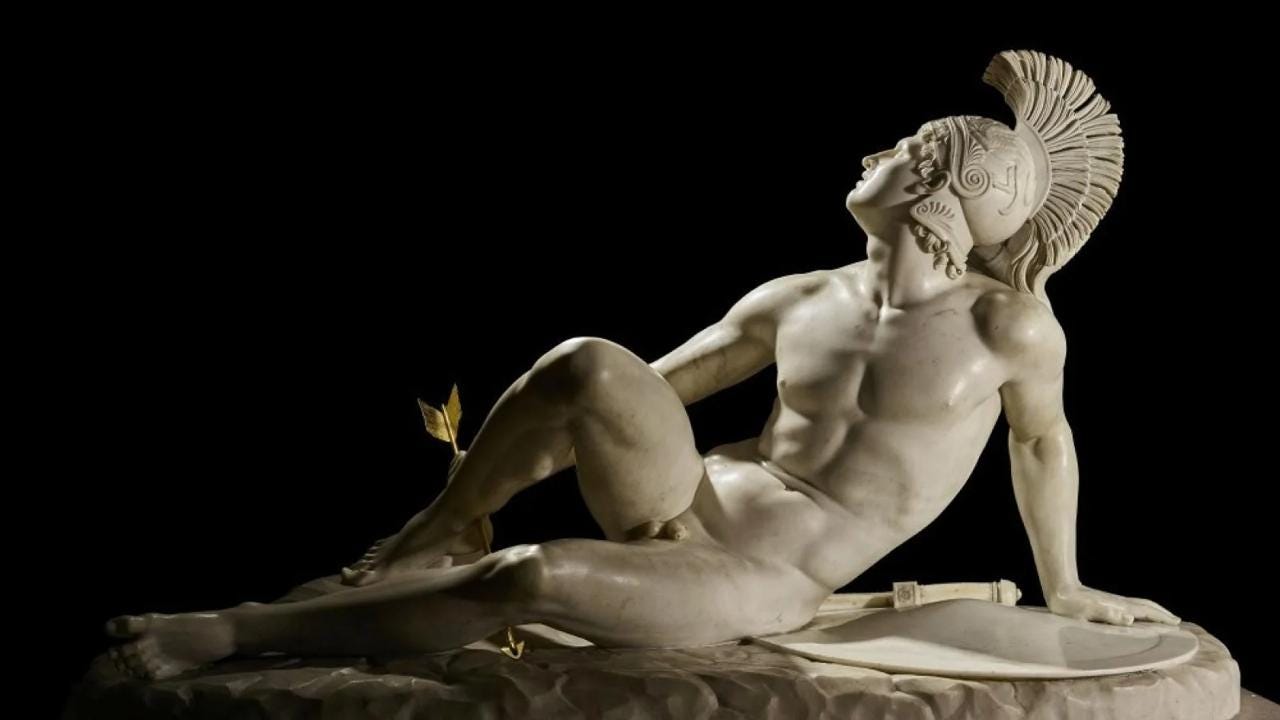
Gothic Olympus launches the reader into the phantasmagoric odyssey of one man’s mission to reawaken the old gods and defy the onslaught of demonic collectivism and matriarchal tyranny. It follows Julien Stanwyck’s alchemical transformation from a pale, scrawny, angry young man into an Olympian sovereign who conquers death with the sword of Achilles, wins a goddess for a bride through initiation into the Mysteries of Sex, and travels through earthly and celestial realms to fulfill his destiny.
A mythopoetic allegory for the twilight of Western Civilization between the Belle Époque and the present dystopia, Gothic Olympus detonates the postmodern abyss through a pulse-pounding concoction of dark humor, occult wisdom, and virile spirituality, weaving Julius Evola’s revolt against the modern world with elements of steampunk, dark fantasy, and Decadence. Through the magic mirror of Stanwyck’s trials and adventures, Gothic Olympus is a riveting tale of heroism, a summons to metaphysical awakening, and a daring vision of the greatest force the world has ever known: European man’s imagination.
Explore the Decadent Chronicles series, brought to you by Arktos Journal: