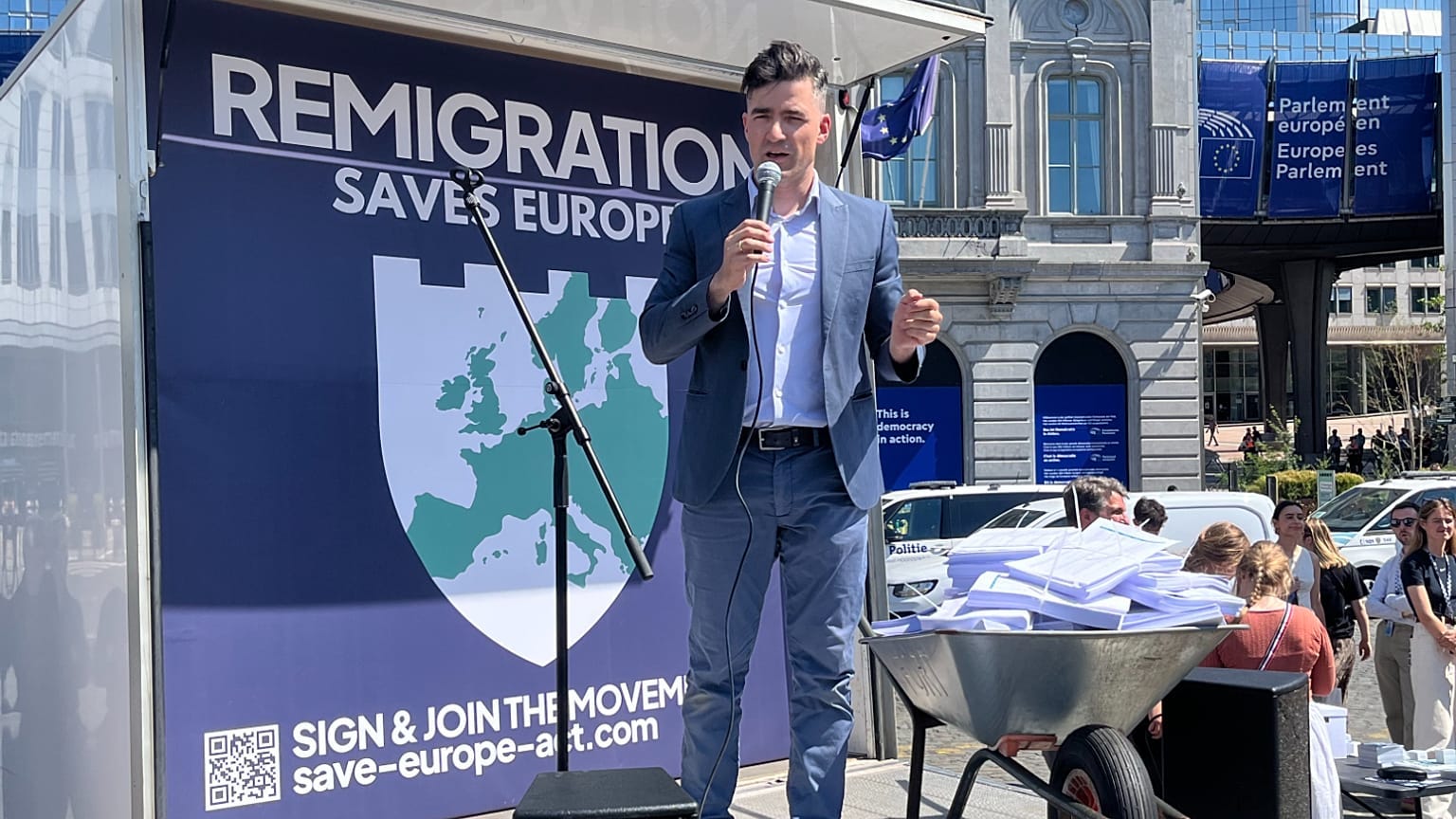
In this exclusive interview with Arktos Journal, conducted by Alexander Raynor, the Austrian Identitarian Martin Sellner explains how a perceived lack of political representation led him to advocate remigration as a practical strategy for reversing the effects of mass immigration through legal and political means. He outlines the core arguments of his book Remigration, lessons from European history, the outcomes of the 2026 Remigration Summit, responses to critics, and reasons for optimism about the shifting public debate and younger generations.
Alexander Raynor: Mr. Sellner, you’ve been a prominent voice in the Identitarian movement for over a decade. What initially drew you to these ideas, and how did your personal journey lead to focusing so intently on the concept of remigration as a practical solution?
Martin Sellner: What initially motivated me to found the Identitarian movement in Austria was a big lack in representation. There was a huge silent majority and many young idealists, but no platform that could channel this energy into effective, nonviolent action.
I encountered the term “Remigration” through the French Identitarian and New Right tradition, and we gradually developed it into a broader political strategy. Mass immigration is created by political decisions, border policies, asylum rules, welfare incentives, citizenship laws, etc. It follows that these developments can also be reversed through political decisions.
Remigration became the logical conclusion of our work because it unites many symptoms into a practical program. It answers the question that the mainstream Right avoided for decades: not merely how to slow immigration, but how to reverse its accumulated consequences peacefully, legally, and over time.
AR: Your new book Remigration, along with Jean-Yves Le Gallou’s book of the same title, which you wrote the foreword for, lays out a detailed blueprint for addressing Europe’s immigration challenges. For readers unfamiliar with it, could you summarize the core argument and why you believe voluntary returns of unassimilated migrants, paired with renewed national confidence, represent a humane and realistic path forward?

What if the issue of our century isn’t managing migration, but reversing it altogether? What if we could replace the Great Replacement with a Great Remigration?
As mass Third World immigration floods Europe and North America, threatening to forever dissolve thousands of years of European heritage, remigration has become one of the central ideas and urgent imperatives on the political agenda. In a Europe that has made permanent immigration a non-negotiable norm, Jean-Yves Le Gallou’s Remigration: For a Europe for Our Children reverses the perspective by reviving a forgotten principle: the right of peoples to remain themselves in their own lands.
In this visionary yet straightforward manifesto, Jean-Yves Le Gallou presents the intellectual roots, historical precedents, and political and legal frameworks for remigration in the 21st century. Identifying the means by which globalist elites have facilitated the Great Replacement through administrative fiat and judicial dictatorship, Le Gallou shows how remigration is not only a matter of saving the lifeblood of European civilization, but is necessary to restore popular sovereignty and security in the public sphere.
Written as both diagnosis and rallying cry, Remigration puts forth a radical yet sensible alternative for today’s world and for generations to come.
Remigration is available from Arktos in paperback and ebook and on Amazon in paperback.
MS: The central argument is that immigration is not an irreversible force of nature. It is the result of laws, incentives, institutions, and political choices. Those choices can be changed.
Remigration is not one single measure, and it is not a chaotic push for collective expulsion. It is an umbrella term for a coordinated reversal of migratory flows. It begins with secure borders and the enforcement of existing return decisions, but it also includes the return of illegal migrants and rejected asylum seekers, the reform of residence and citizenship law, and generous incentives for voluntary return.
Voluntary return is particularly important. Many people living in Europe retain strong connections to their countries of origin. A serious policy could offer financial assistance, professional support, housing programs, or help with establishing businesses after return. That can be more humane for the individual and less expensive for the receiving country than decades of dependency, alienation, and social conflict.
READ MORE:
“Identitarians of all countries, unite!”

In this interview with Breizh-Info, Jean-Yves Le Gallou makes the case for remigration as an urgent civilizational necessity, laying out a step-by-step framework for reversing immigration flows across Europe.
Remigration: The Reconquest of Meaning

“Without saints, without heroes, without kings, history is unintelligible.”
AR: Your book draws on historical patterns, the “politics of guilt,” and demographic realities. What key evidence or examples from Europe’s recent history do you think most strongly support the need for remigration policies today?
MS: There are some primary lessons Europe’s recent history has taught us. Firstly, temporary migration becomes permanent: the guest-worker programs of the 20th century were presented as temporary economic arrangements. Instead, temporary workers became permanent populations, followed by family reunification and continued immigration. The European East must not follow that path!
Second, there are limits to assimilation. Assimilation cannot compensate indefinitely for the scale and speed of migration. When large parallel communities develop, the pressure is reversed: institutions and culture begin adapting to the immigrants rather than newcomers adapting to the country. We now see reverse assimilation of Europeans converting to islam!
Third, the core is guilt. The politics of guilt has made Europeans afraid of even defining their interests as and ethnic group. These are interests that every other civilization regards as normal. Borders, demographic continuity, and cultural majorities are treated as morally questionable concepts. The result is political paralysis. Remigration begins by rejecting that paralysis. Reject white guilt and embrace your heritage.
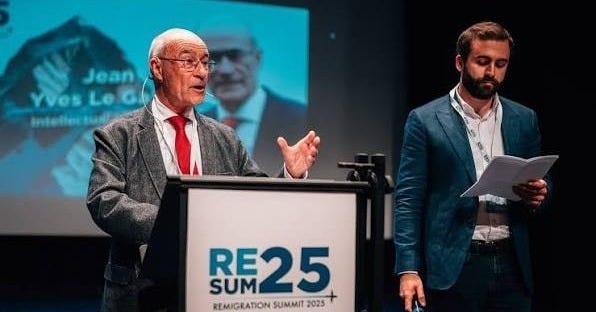
AR: In May 2026, you helped organize and spoke at the Remigration Summit in Portugal, which brought together activists, thinkers, and figures from across Europe and the United States. What were the main takeaways from the event, and how did it build momentum for these ideas?
MS: The most important result was that remigration is no longer merely an internet debate. It is developing into an international field of political work. The main conclusion was that we already possess many of the individual instruments required. What has been missing is coordination and the “Resum” is providing this. Another important takeaway was that each country requires its own roadmap. Portugal, Germany, France, Italy, Austria, and the United States have different legal traditions, demographic situations, and political opportunities. The principles can be shared, but their implementation must be national. For this, exchanging experiences is crucial.
AR: At the summit, there was discussion around initiatives like the Institute for Remigration and broader policy proposals. How do you envision translating these discussions into concrete political action across different European countries?
MS: The Institute for Remigration is intended to provide the intellectual and lobby infrastructure that has been missing. The Left has spent decades building institutes, NGOs, academic networks, legal organizations, and professional campaign structures. Our side has often relied on isolated politicians and spontaneous and underfunded activism. The Institute’s task is to raise remigration to a scientific, legal, and strategic level. The objective is to move remigration through three distinct phases: from taboo to debate, from debate to policy, and from policy to implementation.
AR: Critics often portray remigration as extreme or unrealistic. How do you respond to concerns about feasibility, legal hurdles, or potential social tensions, and what models give you confidence that it could work peacefully?
MS: The first response is that the present system is itself extremely unrealistic. Refusing to change direction does not prevent conflict; it merely postpones decisions until the situation becomes more difficult. Remigration is the only way to prevent a civil war.
Also, voluntary departure should be prioritized wherever possible. This is not an extremist invention. The International Organization for Migration (IOM) has operated assisted voluntary return programmes for decades, and European institutions already provide return counselling and reintegration assistance. In the US in 2025, we saw 1.9 million self-deportations. This can also work in Europe.
Remigration: Returning to Ourselves

Issue no. 220 of Éléments is devoted to “remigration” — a concept that is progressively gaining ground in French and European political discourse. A range of figures from the dissident political and cultural world were asked to respond to the question: “Do you think ‘remigration’ is possible and desirable, and if so, in what form and under what conditi…
AR: With your book now available in English, how do you see these ideas resonating outside Europe, particularly in places like the United States facing its own border and integration debates? Do you see parallels or lessons that apply universally?
MS: Europe and the United States are not identical. America has a different history with immigration. However, the fundamental questions are universal:
Do you have a border, or can anyone enter?
Is citizenship a serious political bond or merely an administrative document?
How many and which foreigners can a society stomach, and can a people decide who may enter and remain?
Europe offers the United States a warning. Once replacement migration is tolerated for long periods, temporary exceptions become permanent rights. Also, the United States demonstrates that political direction matters. Border enforcement and deportation priorities can change rapidly.
AR: Looking ahead, what gives you hope that a “cultural reconquista” or demographic stabilization is still possible in Europe, and what role do you see for younger generations or new movements in achieving it?
MS: My hope comes from the speed with which political taboos are collapsing right before our eyes. Ten years ago, remigration was virtually absent from mainstream discussion. Today it is debated in parliaments, newspapers, courts, and international conferences. The Save Europe Act has gathered 600,000 Signatures in just two months.
The younger generation is particularly important because they experience the results of mass immigration directly, facing housing pressure, fragmented schools, and declining security. They are less emotionally attached to the political taboos of the post-war establishment.
A cultural reconquista does not mean nostalgia or a return to a frozen past. It means rediscovering and reigniting an eternal flame. Our ethnocultural continuity must live on.
Interview conducted by Alexander Raynor