




Continued from Parts 1 & 2

7. Niklas Luhmann and the Autopoietic Nature of the Liberal-Capitalist System
What could a relatively unknown German theorist of “social systems,” writing before mass immigration became a central political issue, teach us about White ethnocide? Although Niklas Luhmann produced a large body of work—sixteen of his books have been translated into English—and has been praised as “the closest the social sciences have come, in a long time, to an actual thinker,” he remains largely unknown outside a narrow circle of systems theorists. Most educated Westerners, if they have heard of him at all, know him only through his 1971 debate with Jürgen Habermas.
Because Luhmann accepted Talcott Parsons’s view that the object of sociology is to explain how society maintains order and reproduces itself, and because in the post-1960s mainstream sociology was already committed to progressive activism, Luhmann came to be widely regarded as a conservative defender of the status quo interested in the orderly functioning of societies, receiving thereby far less attention than countless third-rate Leftist theorists offering to “emancipate humanity.”
In Germany, however, public and academic admiration for the undeniable theoretical sophistication of Luhmann’s work began to grow in the late 1980s. As Habermas came to be regarded as the “state philosopher” of institutionalized progressivism, a growing number of younger academics turned to Luhmann precisely because they found his systems theory more original and less subservient to the standard progressive claim that the purpose of sociology and education is the endless “radical critique” of “oppressive conditions.”
Now, while Luhmann accepted Parsons’s premise that society is a system whose continuance must be explained, he rejected Parsons’s claim that order is maintained through a shared culture, arguing instead that order is maintained through the ongoing self-reproduction of differentiated function systems, each operating according to its own cognitive codes. He argued that the defining characteristic of modernity was the differentiation of society into multiple “autopoietic” (self-reproducing and operationally closed) institutional systems. Luhmann borrowed the concept of autopoiesis from the Chilean biologists Humberto Maturana and Francisco Varela, who first elaborated it in the late 1970s and early 1980s as an answer to the question of what constitutes the defining characteristic of living systems. The term combines two Ancient Greek words, auto meaning “self”, and poiesis meaning “creation” or “production”.
Focusing on the living cell, Maturana and Varela define an autopoietic system as
“a closed topological space that continuously generates and specifies its own organization through its operation as a system of production of its components, and does this in an endless turnover of components.”
The cell, in other words, is an autonomous system with a capacity to produce and continuously regenerate its own components, organize them into a coordinated whole, and thereby maintain itself as a distinct unity without assistance from another external system.
The key point here is that anything a cell (or system) does is determined by its internal structure (the components inside the cell and the relations among them). While autopoietic systems exist within environments that shaped them, they are operationally autonomous. Maturana and Varela thus came up with the term “structural coupling” to designate the selective exchanges between a system and its environment (which includes other functionally differentiated systems), where each system produces “irritations” or perturbations inside other systems, without losing its identity or operational autonomy.
Luhmann transferred the theory of autopoietic biological systems to social systems, arguing that modern society is characterized by the functional differentiation of relatively autonomous subsystems (economy, law, politics, science, education, mass media, art, religion), each of which operates according to its own internal binary code and discourses. For example, science operates on the code true/false, the economy on payment/non-payment, politics on power/no power (or government/opposition), and the media on information/noninformation. A function system can be identified only to the degree to which it has differentiated itself from its environment and from other systems.
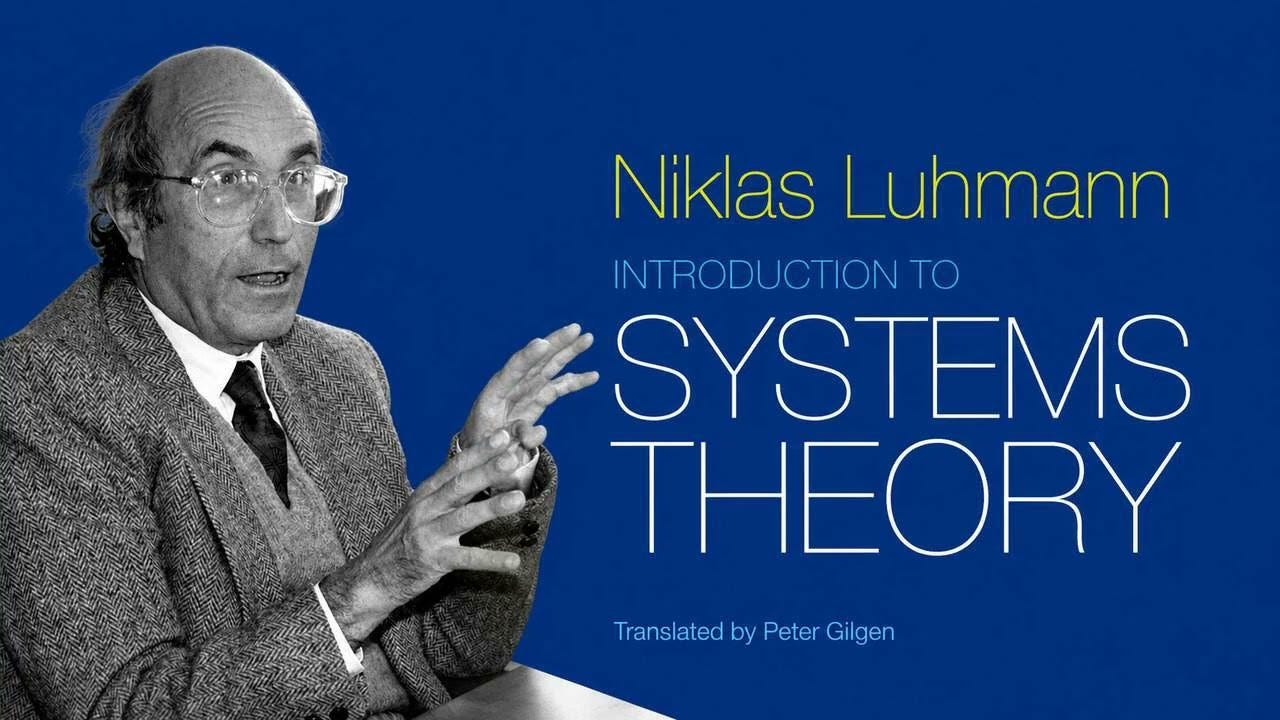
This is what Luhmann means when he writes, in a highly erudite lecture course subsequently published under the title Introduction to Systems Theory (2015), that “a system is the difference – the difference between system and environment”.
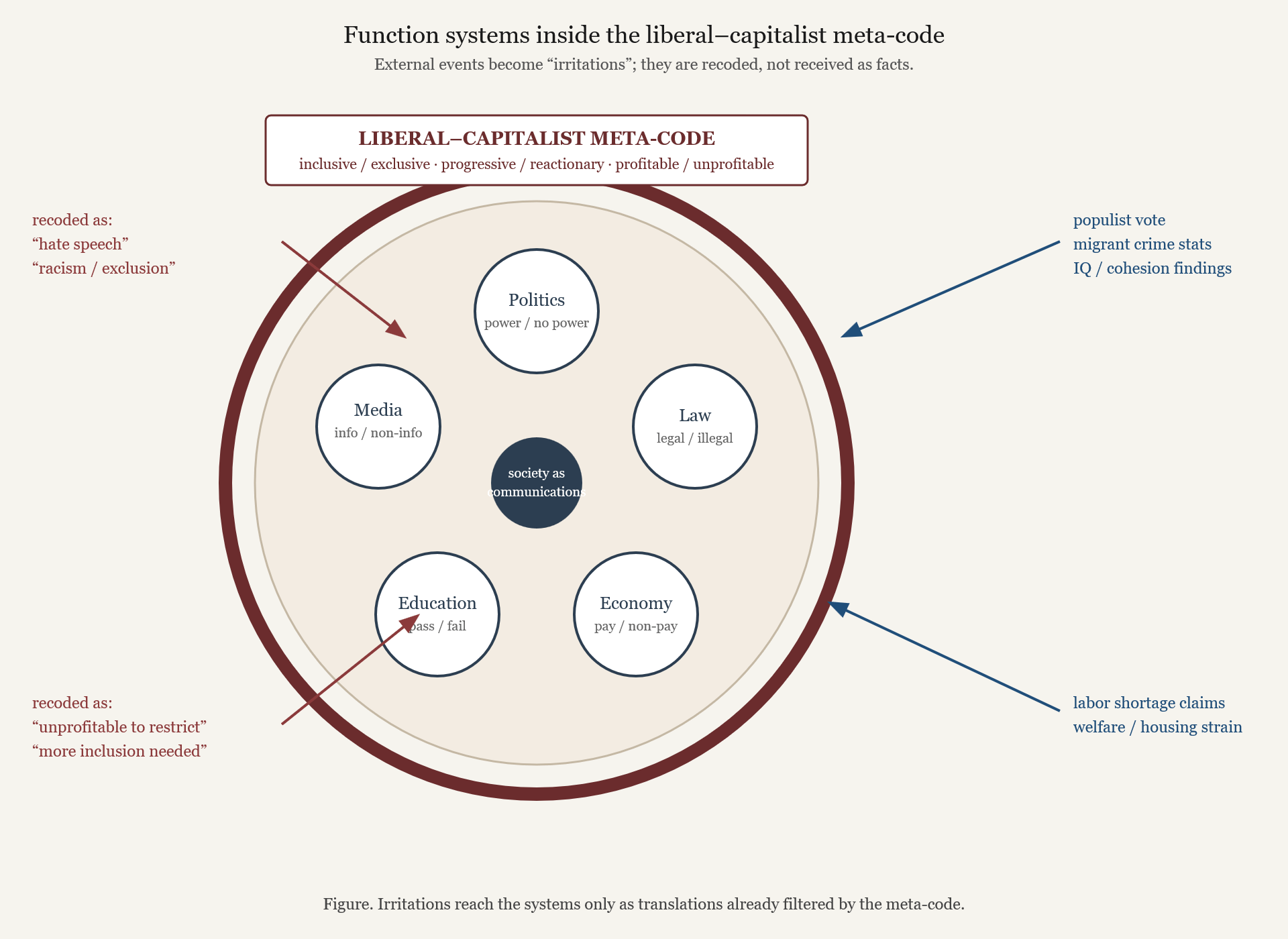
Function systems differentiate themselves, and attain “operational closure,” when they develop a specialized discourse, pedagogy, key texts, organizations, and experts that shape how problems are framed, how judgements are reached, and how events are conceptualized. The internal operations of social systems, accordingly, occur through communications, not metabolic processes. The systems reproduce themselves by linking communications to communications according to their own binary codes and discourses, remaining operationally closed while remaining open to irritations from their environment. These irritations are processed only insofar as they are translated into the code of each system.
There is no overriding system, no state power or theocratic order, that regulates the cognitive dynamics of the individual systems. Cognition is always specific to each system. Luhmann admits that he is a “radical constructivist”. This may seem odd given the associations of systems theory with science and objectivity. According to him, however, each systems produces knowledge through its own operations, not by mirroring the world as it is in itself. When he writes that the code of the function system of science is true/false, he means what the scientific community itself means when it communicates in terms of a specific methodology characterized by logical consistency, controlled observation, and empirical testing. Science applies this methodology to the slice of the world it is concerned with. This code is not arbitrary; thus, papers are accepted or rejected in referred journals, or experiments are validated or rejected according to whether they meet (or fail to do so) this experimental criteria.
Although every system is aware of its “environment” and interacts with other systems (including biological systems and psychic systems of thoughts and emotions), external events only produce “irritations” that the system translates according to its conceptual apparatus. As Hans-Georg Moeller quotes Luhmann:
“Every function system can only perform its own function. No one can in the event of a crisis or on a continuing or supplementary basis sit in for another one. When there is a government crisis, science cannot help out with truths. Politics does not have its own means to create economic success – as much as it may be politically dependent on it and as much as it pretends to be able to do so. The economy can let science take part in the conditioning of money payments, but it cannot produce truth with all the world’s money. Through financing one can attract, one can irritate, but one cannot prove anything. Science honors financing with ‘acknowledgments,’ not with provable argumentation.”
Science, therefore, cannot determine the nature, or constitute the foundation, of the other systems. Politics does not become true or false because a paper published in a referred science journal says that a government policy counters the findings of genetics. Likewise, a law does not become legal or illegal because it goes against the standards of the system of education. Each system uses its own code. Evolutionary psychologists who claim that they have discovered the “foundations” of society are stepping outside the system of science, as if science can occupy a position “beyond all systems”. Science is incapable of observation “without itself being a system”:
“namely, a system with a network of communication, a system with certain institutional arrangements, a system with certain value preferences, a system with individual careers, and a system that depends on society”.
Scientific knowledge is possible precisely because the system of science is “operationally closed” with its own methodology, expertise, and focus on certain aspects of reality. It is impossible to observe “the entire world” as it is in itself. Luhmann’s systems theory does not make any such transcendental claims. His own theory, he writes is “second-order observation”. By this he means that as a systems theorist he observes how other systems observe without claiming to dictate how any other system should function. Systems theory itself operates inside the function system of science and its code; it does not stand outside society, but is a construction of reality from the perspective of systems theory.
Luhmann saw this differentiation as the great achievement of modernity in its allowance of social complexity and prevention of total domination by any single logic, as happened in pre-modern stratified societies or totalitarian Communist regimes. Under conditions of functional differentiation, society becomes largely indifferent to traditional forms of identity. As Hans-Georg Moeller writes in his introduction to Luhmann, “it does not matter which region, religion, or race functions — as long as it functions.” Modern function systems are thus, in principle, open to everyone and do not discriminate on the basis of race, religion, or ethnicity because they operate according to functional rather than traditional or ascriptive criteria.
Although Luhmann did not write specifically about mass immigration or liberal progressivism, his framework offers powerful conceptual tools for understanding the resilience of the fused liberal-capitalist order. One must be careful, however, in applying, without reservations, Luhmann’s model toward understanding the current dynamics of the Western world. He tended to treat modern society as a neutral, technocratic system of differentiated codes without adequately appreciating the inherently progressive nature of modern liberal society, particularly from the 1960s on, and how this progressivism has penetrated and coordinated multiple subsystems. While he does recognize social movements like environmentalism and welfare programs, he treats them as “irritations,” rather than as central to progressivism.
I will employ his theory to argue that in the contemporary West, liberal universalism no longer functions as a mere critique, but as a widely shared meta-code inscribed into the supposedly neutralized codes of the subsystems. The ability of progressivism to become a meta-code should not be difficult to envision, since the major subsystems of Western modernity were themselves shaped by classical liberal principles. Thus, the economy was shaped by freedom of trade, property rights, and freedom of contract; the legal system by equality before the law, contract law, maritime law, corporate law, and the like; and the educational system by the ideal of open inquiry and the liberal arts. Once these systems had been constituted along liberal lines, with their ideal that everyone should enjoy equality of liberty, the conditions were set for the post-1960s version of liberalism to act as an overseeing meta-code across all sub-systems.
READ MORE from Arktos:

In the new global era, the peoples of the Earth find themselves under the monstrous tentacles of a techno-economic system which sees only numbers. Spawned by the American mercantile order but now supplanting it, this system uproots, domesticates, and homogenizes national identities, replacing them with an anonymous global society under “scientific” management. Instead of nations and cultures, histories and visions, only consumers and “standards” remain. This mindless, self-serving system gnaws away at consciousness and the will to live. In exchange for cubicles, cars, and TV shows, it kills peoples, deletes history, and smothers destiny.
Faced with this totalitarian spectacle, which dresses itself in the virtues of human rights and socio-economic well-being, Guillaume Faye summons us to pinpoint the system’s workings, decode the pitfalls of modern ideologies, and defend the right of peoples to be themselves and go their own ways.
The Ethnocide System, the first magnum opus of one of the most provocative and inspiring masterminds of the New Right, now translated into English for the first time, is a tour de force of the desperately needed showdown between the peoples of Earth and the globalist machine.
Today, this meta-code is powerful enough that even “objective” science, with its commitment to the true/false code, now faces prohibitions on research into racial or IQ differences. Scientific American and Nature, two of the leading science journals, explicitly refuse to publish or even consider race-realist research. More recently, in August 2026, the New England Journal of Medicine published an article claiming that the questioning of Jason Arday’s credentials was an instance of racial persecution (despite the decisiveness of the evidence showing that he was a plagiarist with a CV full of falsehoods, which violated the modern code of the education subsystem).
We are past the relatively sane and neutral world of Luhmann’s time, when universities still retained, despite their liberalism, a commitment to meritocracy and to the pure code of education/non-education. The majority of universities now declare that one of their key missions is diversity, equity, and inclusion. It is almost impossible now for a professor (or a graduate student seeking an academic position) to question the merits of mass immigration, feminism, or racial integration. The economy continues to operate on the code of profitable/unprofitable, yet businesses are expected to adopt progressive stances on race, gender, and immigration. The legal system still distinguishes legal/illegal, but the content of law is heavily shaped by civil-rights doctrine, anti-discrimination rules, and equity considerations. In this sense, liberalism behaves as a self-referential, self-reinforcing meta-system that keeps the subsystems “progressive” in their operations. It has established its own meta-binaries across all the systems—liberal/illiberal, inclusive/exclusive, progressive/reactionary—structuring their internal operations and actions.
To be clear, functional differentiation still prevails; no function system controls, dictates, or acts on behalf of any other. Science cannot prescribe its way of doing things to politics any more than politics can prescribe to science the direction of scientific research. My point is that the specific codes of all the subsystems in the progressive West operate within a meta-liberal post-Fordist order.
Luhmann underappreciates this meta-moralizing power because he understands liberalism primarily as a “semantics” invented to fit the requirements of functional differentiation rather than as an ideology with independent moral force. He regards the language of universality, human rights, personal freedom, and individualism as simply the most suitable semantics for a society no longer organized by hierarchical or stratified principles. As he writes,
“Freedom and equality are now [semantically established] because all limitations and inequalities are set up only by the codes and programs of the individual function systems since general directives for the whole of society no longer exist.”
He notes further (as cited by Moeller) that
“new principles of inclusion are sought and found that are given the names of freedom and equality and that take on the form of civil or even human rights… Equality means that no other principles of inclusion are accepted besides those determined by the function of the systems themselves.”
This perspective explains why it largely escapes his attention that liberalism may constitute a meta-code with its own cognitive construction of reality. Ironically, in some of his writings he does sense the extraordinary power of this ideology, even describing the ideas of human rights as the “true” fundamentalism of our time that semantically grounds the structures of contemporary society.
The case of contemporary China further demonstrates the limits of the reductionist claim that liberalism is merely a “semantic” by-product of modern functional differentiation. China is already a highly modern, functionally differentiated society in which markets operate according to the economic code, and education and science largely follow their own respective codes. Yet China is definitely not liberal in the Western sense. A strong ruling party maintains overarching control, prioritizes ethnic homogeneity (even Han supremacy), and subordinates the subsystems to nationalist goals.
This demonstrates that functional differentiation does not inevitably produce openness, universalist inclusion, or indifference to race and ethnicity. Given that Luhmann’s research was almost entirely focused on Western modernity, perhaps we should not be surprised that he missed the dynamic reality of liberalism and capitalism, like a fish in water.
Despite these drawbacks, Luhmann’s concepts of autopoiesis and operational closure remain extremely valuable. His theory elucidates how social subsystems such as politics, law, media, education, and the economy are self-referential, and how they process external “irritations” or events like grooming scandals, populist revolts, or Black violence, through their cognitive structures and internal codes (filtered through the progressive meta-code) rather than viewing “reality as it is,” or as critics of immigration claim it to be. It teaches how institutions prioritize self-reproduction, systemic continuity and cognitive coherence, over solving external “real” problems.
Reading Luhmann allowed me to see with keener eyes how the fusion of liberal universalism and capitalist optimization has become an autopoietic mega-system. It reproduces itself through institutions, law, media, NGOs, and corporate incentives. This is the “deep liberal state” that everyone talks about, but which no one explains.
8. The Path-Dependent Civilizational Trap of the West
The Great Replacement is now on a path-dependent trajectory that will be extremely difficult to reverse. The concept of path-dependency is relatively common in the social sciences. It describes institutions or patterns of development in which past decisions constrain or define later ones, locking systems into old and inefficient ways of doing things simply because changing course has become too costly or difficult.
The trap the West is experiencing, however, is different. It is dynamic and optimizing. The West remains highly effective (compared to other nations) at generating short-term economic growth, opportunities for elite status, openness to multiple lifestyles, entertainment, and self-reproduction. The problem is that the Western promise that multicultural capitalist optimization would overcome the ethnic conflicts that have “plagued humanity” is generating exactly the opposite result: increasing ethnic tensions across the West, grooming gangs in the UK, disproportionate Black violence in the US, permanent welfare dependency, no-go zones, and migrant assaults throughout Europe. Instead of creating a new world order of racial harmony, it is systematically undermining the demographic and cultural foundations of European societies.
Many dissident analysts reject the idea of a path-dependent trap. They are guided by the Platonic ideal that if only people are educated about the costs of immigration, the liberal establishment would eventually “see reason” and change course. This expectation rests on an outdated understanding of what liberalism has become. We are no longer in the world of classical liberalism. The liberalism that ushered in the 1700s and 1800s, eloquently embodied in the writings of Voltaire, Denis Diderot, Jeremy Bentham, and John Stuart Mill, was oriented toward criticism of tradition, church authority, hereditary privilege, and obscurantism. It truly cherished reason, evidence, and reform.
By contrast, progressive liberalism, especially since the post-1960s and the post-Fordist era, has largely abandoned that critical spirit when it comes to its own (institutionalized) values. Its supposed pluralistic tolerance has become a self-righteous and authoritarian mode of thinking. This attitude was already implied in John Rawls’s belief that liberal societies cannot be fully neutral, that they must actively propagate attitudes of diversity and tolerance across all major institutions while systematically discouraging and marginalizing illiberal or traditional norms. It is implied in Jürgen Habermas’s argument that liberal values are already built into human communication itself, which aims at “mutual understanding” and the creation of a public sphere in which individuals rely on their rational capacities freed from the “distorted communication” of illiberal traditions and particular ethnic groups.
Liberalism is dedicated to the expansion of equality of rights among all social groups and the dismantling of sexist, ethnocentric, Islamophobic, or nationalist prejudices. Its claim that the good life emerges from the propagation of diverse cultural and sexual lifestyles makes it inherently antagonistic to outlooks rooted in ethnic particularism, biologically established sexual identities, or “rigid” traditions. For this reason, inconvenient facts that point to major failures in multiculturalism are not treated as evidence of failure, but are interpreted, rather, as proof that the progressive project has not gone far enough, or as that society needs to improve its behaviours through further “re-education.” The system is no longer primarily seeking truth in the Enlightenment sense.
This is why Niklas Luhmann’s concept of autopoiesis is so useful for understanding the path-dependent trap. The main goal of Western institutions is not to maximize truth or the culture of Whites. These institutions are designed for economic growth, the actualization of its progressive ideals, and self-reproduction. This is why the system is so reluctant to speak openly and honestly about the failures of multiculturalism. It processes migrant problems and populist reactions as “irritations” or perturbations through its own binary codes (racist/anti-racist, progressive/reactionary, legitimate/illegitimate), treating them as further confirmation that more anti-racism, more diversity training, or more suppression of “hate speech” is needed.
Operationally closed systems cannot directly interfere with the operations of other systems. What happens in one system does not bring about a determinate reaction in another; it can only produce, in the words of Luhmann, “irritation” and “resonance.” Each system constructs its own observations according to its cognitive apparatus and binary code. Thus, when a migrant crime is reported, the legal system evaluates it not only in terms of whether a law has been broken but in terms of whether criticism of immigrants creates a “hostile and discriminatory climate” for “minorities”. The legal system is not designed to investigate the merits of immigration. The mass media is designed to offer information and reports of news (that draw an audience) without deviating from the liberal meta-code. It deems any information that focuses on the criminal behavior of particular immigrant or racial groups as either “discriminatory” or as “irresponsible” information that undermines the multicultural cohesion. This was notoriously evident when the editor of The Economist accused Elon Musk (earlier this year) of creating tensions and undermining integration efforts with his X postings about migrant crimes. Similarly, the political system tends to interpret rejection of multiculturalism as a threat to integration and to order itself, since the code of the system is power/no power within the meta-code of peaceful integration of diverse cultures. In the Western world of our times, the maintenance of order coincides with the maintenance of the progressive project.
The popular argument that what is currently occurring in the West is primarily the result of “Bioleninist” or “Communist” voters and leaders does apprehend some proximate aspects of Western politics today. It can’t be denied that a sizable proportion of leftist activists are no longer motivated by a desire to make Western societies more functional but, rather, by a resentful desire to see stable White communities dismantled. This explains why these groups persist with their “destructive” policies, like blaming “institutional racism” for Black assaults and thievery, calling for more Muslims, Somalis, and Haitians despite repeated evidence of high welfare costs, nepotism, and violence.
However, as I see it, this mindset has itself been generated—and is now reinforced—by the progressive meta-code that treats White racism as the supreme evil, holds that Whites are still unfairly gaming the system for their own benefit, and blames them for the wars and inequalities of the world. Radical activists sincerely feel they are justified in their vindictiveness. Moreover, now that large non-Western populations are inside the system with full political rights, at the same time that they are categorized as victimized “minorities”, while having strong in-group racial identities, we cannot but expect an increase of statements such as the one Hasan Piker made a few months ago: “We’re here to destroy the White race, bitch”.
We need to be careful, however, not to lose sight of the fact that the West is still controlled by business elites, a managerial educated class, trained scientists, and lawyers. While excessive wokeness and equity mandates can have deleterious effects on business maximization, the West still innovates in technology, finance, consumer culture, limbic business, and now AI. What needs to be understood is how this dynamism is framed within a liberal order that associates the continuance of multiculturalism with the preservation of order. Even when elites privately sense that something has gone badly wrong, that the post-WWII promise of harmonious diversity has instead produced persistent racial tensions and populist backlash, it can’t contemplate turning the ship around. The Western multicultural system is now deeply path-dependent.
But how exactly does this trap operate? First, as Milton Friedman famously put it, “the sole social responsibility of the firm is to maximize profits,” which in the post-Fordist age entails importation of immigrant labor. The costs in welfare, the loss of cultural identity, and the migrant violence we read about at X are either spread out over large populations or not inconsistent with GDP maximization. The people who benefit right now (corporations, politicians, academics, entertainers, NGOs, and non-Whites) don’t really feel those costs in their daily lives.
Second, liberal universalism has turned diversity and non-discrimination into the most sacred values. It is extremely hard for someone to build a career or profession while advocating openly for remigration, race realism, or White identity. The elites would rather ignore information about failures of multiculturalism than admit that culture and ethnicity matter, that Blacks and many immigrant groups don’t integrate well, that social trust has deteriorated, and that liberal multiculturalism is therefore based on fundamentally flawed premises.
Third, whole industries and professions have been incentivized to support the status quo: diversity consultants, immigration lawyers, refugee organizations, corporate HR departments, and large parts of the welfare state, including schools and universities. Politicians get praised for sounding humane (even conservatives strive to look “compassionate”). Businesses get “flexible workers”. NGOs and academics get funding and moral prestige. Changing this path would require dismantling entire institutions and eliminating the careers of millions who are heavily invested in the system.
Fourth, the ethnic composition of a large number of Western cities is already demographically locked in. In the metropolitan cores where capital, media, universities, and political power are concentrated—in cities like Houston, Miami, Dallas, Detroit, Philadelphia, Atlanta, London, Paris, Birmingham, Toronto, Malmö, Stockholm, Rotterdam, Amsterdam, Vienna, Frankfurt, Vancouver, Manchester, Leicester, Brussels, Auckland, Sydney, Melbourne, and a growing list of others—the native White population is either aging rapidly or reproducing well below replacement.

The next generations that will shape the next decades are already substantially more diverse. This non-White population not only has full legal rights, but rapidly growing political influence. Once a city becomes majority non-White, local politics, school boards, the concerns of police departments, and government departments at large tend to favor the new diverse citizens. Any attempt to bring about a serious program of remigration would bring about widespread court challenges, intense media reactions about “ethnic cleansing,” and major economic disruptions.
It is getting worse. The trap is now being strengthened and deepened by the fusion of limbic capitalism and artificial intelligence that will make escape even harder. The regular style of control involving deplatforming and financial exclusion (executed through conventional administrative, legal, and corporate decisions) is already being supplemented by more effective AI tools for surveillance, content moderation, algorithmic personalization, and synthetic media designed to shape public opinion and to control the wiring inside the brain of the masses. We may be heading into an AI-limbic technocratic trap of atomized race-mixed individuals combined with Chinese methods of control but without ethnic cohesion.
9. Can the West Escape the Trap?
The intention of this article is not to instill pessimism and defeatism. Its purpose is diagnostic. It is focused on identifying and explaining the root causes of the current trajectory of the West. From a Luhmannian perspective, it is naïve to believe that society can be redirected simply because enough people discover the negative facts about diversity, “as if society were not a system.”
If we agree that social systems operate autopoietically, it follows that they cannot be steered from the outside simply because a party eliminates DEI in some institutions, abolishes the teaching of transgenderism in primary schools, or takes a tougher stand on black criminality. The election of a populist party (on its own) can only “irritate” the liberal-capitalist order or alter the “environment” (via new regulations on immigration, or legal constraints on the excesses of wokeness) to which other systems respond. It cannot, however, override or impose an alternative comprehensive worldview upon the economy, law, media, or education. These systems will continue to operate according to their own discourses, as they are filtered through the prevailing liberal meta-code. The capitalist economy will remain operationally closed, processing events according to its own code of profitability versus unprofitability in the age of post-Fordism.
Many popular alternative explanations fall short because they lack an adequate theoretical grasp of society as a structured order of systems. Insofar as they assume that “society consists of concrete human beings and relations between human beings,” without seeing that individuals act under the structural imperatives of function systems, they treat the great replacement as the product of particular intellectual elites or particular leaders, and thus as mere ideas or leaders that could be reversed or replaced by electing new elites or by persuading those in power with better ideas. Luhmann’s theory, however, teaches that the communications and operations that reproduce the function systems are not the products of individual subjects.
From this Luhmannian perspective we can see that while Nathan Cofnas’s critique of the “equality thesis” is factually true, it naively assumes that current elites can be rationally persuaded to reject the belief that all human groups are biologically equal and to adopt race realism independently of the institutional imperatives of liberalism and the structural dynamics of post-Fordism. Christopher Rufo focuses on civil rights law and DEI as the primary problem, believing that repealing them would restore color-blind meritocracy, while ignoring the institutional logics of demographic replacement. Helen Andrews’s article on “race communism” explains well how the redistribution of positions and resources by race no longer makes sense in an American nation that is now populated by millions of non-White immigrants without a past experience of slavery or discrimination and where Whites are set to become a minority. Yet she assesses this problem from a strictly ideological and legal perspective, assuming thereby that a solution can be found through the mere revocation of old civil rights legislation. Gad Saad’s simple theory of “suicidal empathy” offers a truncated psychological account of the “WEIRD” psychology of Whites, which he wrongly assumes to prevail among Westerners in general, including Jews and non-Whites, even though only Whites exhibit a characteristically weak ethnocentric disposition. Saad’s approach, moreover, remains at the individual level and implies that Westerners can gradually be persuaded to become less sympathetic simply by reading him. These approaches, all in all, treat the problem primarily as one of bad ideas, bad laws, or personal inclinations, underestimating the path-dependent and autopoietic character of the regime.
Jared Taylor is right that Helen Andrews ignores the empirical reality of IQ racial differences and therefore underestimates how hard it is to restore color-blind meritocracy in a society that is now thoroughly multiracial. We need to ask indeed: why has the liberal order, across the entire West and not merely the United States, so consistently refused to absorb the findings of behavioral genetics and psychometrics? Clearly, it is not lack of awareness; research on IQ differences has been public for decades. Universities have the resources to discuss those findings openly.
My view is that race realism can’t be popularized for the simple reason that it is incompatible with the institutional realities of a society dedicated to liberal multiracialism. Steven Pinker seems to have sensed this when he recently adopted the position, despite being an Enlightenment liberal and a defender of free inquiry, that it is better not to popularize Black–White IQ differences in the public sphere, because the social costs would outweigh the gains. Even though he is the most famous critic of blank slatism, and does not deny IQ differences between racial groups, he seems to recognize, even if only tacitly, that in a society already committed to multiracial liberalism, open acceptance of group racial differences would result in the widespread belief that Black individuals are members of the “dumb race”. Race realism cannot be construed as a merely neutral theory, as Bo Winegard would like it to be. In its implications, it is a direct attack on the sacrosanct liberal meta-code that all humans, regardless of race, have equal dignity. It does not matter if the classical liberal insists that he judges individuals on the basis of merit alone and recognizes that there are Blacks with a high IQ. The reality is that full meritocracy in a multiracial society inevitably entails de facto racial ranking.
Kevin MacDonald’s work deserves open discussion for its scholarly substantiveness and historically grounded arguments. MacDonald argues that Jewish intellectual and political movements, such as Boasian anthropology, Freudianism, Frankfurt School critical theory, multiculturalism, and Neoconservatism have played a disproportionate and leading role in undermining Western ethnic cohesion. He places particular emphasis on the Jewish leading role in the implementation of the Celler Immigration Act of 1965, among many other ideas and policies that “serve Jewish group evolutionary interests” while demonizing any expression of White identity. He frames this as a “group evolutionary strategy” rooted in Jewish ethnocentrism and high verbal intelligence. In his later work Individualism and the Western Liberal Tradition, MacDonald clearly argues that Jewish promotion of universalism and multiracialism appealed to Whites precisely because these ideas resonated with their historically rooted individualism and low ethnocentrism.
However, it seems to me that as much as MacDonald understands that the inordinate role of Jews requires an understanding of the Western liberal tradition itself, his critique remains primarily ideological and focused on individual actors.
What Luhmann has conveyed to me is that social systems cannot be derived from the intentions of persons or groups. When politicians, judges, company managers, or professors speak or act, they do not communicate as self-legislating individuals in terms of their personal conscience, religious values, or “greedy” interests. They do so as occupants of positions through which the social system reproduces itself. The style and tenor of communication may vary from one person to the next, but this does not mean that newcomers can recode the systems. In the course of time, we see generations of individuals passing through the same positions, reproducing the systems, not remaking them anew.
While MacDonald’s account goes deep into the evolutionary selection of individualist behavioral traits among prehistoric Europeans, and while it explains a whole host of cultural and political dynamics in American society (Israel lobby, the inordinate influence and spread of many radical leftist movements, Hollywood, and other topics), it lacks a deep analysis of the economic and institutional structures behind the diversity regime. Jewish influence is minimal in many Western countries outside the United States, France, and the UK, yet we find similar patterns of mass immigration driven by native business associations and progressive groups. The disproportionate influence of Jews is better framed within the prior institutional logic of liberal universalism and the post-Fordist capitalist logic.
But what about the common complaint that mass immigration was never demanded by the native population through any clear democratic mandate, that it was a project orchestrated by elites? This view also ignores the systemic institutional dynamics of our times. The elites who initiated diversity “from above,” and the generations who continued to enforce it thereafter, were/are reproduced inside the same liberal institutions. The systems of law, economy, education, and media, and the liberal meta-code, continue to process claims against immigration from non-White nations as morally illegitimate, and the “newcomers” as necessary for the functioning of the economy. From the beginning, elites have been of the opinion that opposition to diversity is a temporary situation that an education in progressive values, combined with economic growth and a new generation of “open-minded” diverse individuals, would eventually overcome.
By examining this debate, from a Luhmannian perspective, I have come to the conclusion that reversing this order will require a prolonged sequence of cascading events and crises leading to major ruptures capable of undermining the liberal meta-code itself and the institutional conditions under which liberalism reproduces itself.
There are three potential rupture points in the Western order:
Economic or Energy Breakdown: A severe, prolonged economic collapse and energy crisis could make the current model unsustainable. The question is how large this crisis would have to be to break the system. The 2008 financial crisis, seen as the greatest since the Great Depression of the 1930s, barely disrupted the system; it was absorbed through bailouts, political consensus across party lines, and the attribution of blame to isolated personalities, without leading to fundamental policy reversal. It is worth remembering that the Great Depression did not push the West out of its liberal-capitalist path, but instead accelerated its progressive dynamic. It seems that only a much deeper crisis, or the simultaneous occurrence of crises in other systems, would be required. Would there be viable political parties with extensive networking across the systems of society capable of exploiting such a chaotic breakdown and redirecting one (or two or three) Western nations out of their current paths?
Geopolitical or Military Defeat: What about a major external shock such as a double strategic defeat of NATO and the US military in both Iran and Ukraine-Russia? The post-WWII liberal international order is built on the perception of Western (especially American) military and technological supremacy. Simultaneous failure against Iran and a loss against Russia would no doubt constitute major setback for liberal NATO and American power. It could ignite further populist anger, intensify questions about the “incompetence” of liberal elites, trigger energy shocks, and undermine the notion that liberal interventionism is the best way to create a “rules-based international order”. However, it is hard to conceive how the systems of politics, education, law, media, and the meta-code of liberalism in the domestic sphere would break down from such defeats. Previous disasters (Vietnam, Iraq, Afghanistan) were absorbed without any serious abandonment of liberal interventionism (other than policy changes away from outright nation-building projects). This is not to deny, however, that additional defeats of the magnitude of Iran and Ukraine would likely bring about the end of American unipolarism and the consolidation of multipolarity.
Major Legitimation Crisis: What if enough native Europeans (including growing segments of the middle class and cultural producers) lose faith in the moral legitimacy of the diversity project? Jürgen Habermas teaches that a legitimation crisis occurs when a society’s institutions lose public trust, undermining their perceived right to govern even while they retain political power and legal authority. We can envision a situation in which sustained, visible failures of mass immigration, such as continuously high welfare costs of migrants, persistent migrant violence, rising native discontent with the loss of national and cultural identities, and other problems eventually result in widespread erosion of the liberal ideals of diversity. We could anticipate a situation in which widespread acceptance of arguments such as Kevin MacDonald’s on Jewish influence, or the case for race realism, could undermine the dominant post-WWII moral narrative about “anti-racism” and “ethnic nationalism is evil,” thereby undermining double standards against European ethnic identity.
Of the three rupture points, I am inclined to believe that a deep legitimation crisis offers the best realistic chance of breaking the trap, because it directly attacks the moral and ideological meta-code sustaining the system. Luhmann’s theory of the mass media system offers useful insights here. As he observed, “Whatever we know about our society, or indeed about the world in which we live, we know through the mass media.” The media is “structurally coupled” to many other systems in that it constructs a common reality (or “environment”) that politics, law, education, and the economy largely take as given. The media, as Luhmann explains, is always observing, and reporting about “the observations of the other systems”. It is not oriented toward consensus or problem-solving; rather, it continuously generates novelty, conflict, moralization, and drama. The media system accelerates the tempo of society by continuously providing new irritations and new information.
If the media aimed for total consensus, it would lose one of its essential functions, as happened in the Soviet Union, where the media eventually lost all credibility and popular attraction. As Luhmann observes, in liberal societies “viewers are not expected to join in any consensus of opinion. They are at liberty to agree or disagree.” This is, I would add, intrinsic to liberal pluralism and its cultivation of multiple lifestyles, which generates a permanent state of diverse opinions, notwithstanding the liberal dislike for “illiberal” views. Luhmann is persuasive in arguing that, when the media world is taken in its totality (not only news but books, magazines, videos, and podcasts), it “contains and reproduces differences of opinions in plenty,” offering audiences conflicting views, different values, and choices. This allows for a “restless,” contested reality with opportunities for dissidents to challenge the liberal order, to create exciting alternative perspectives that draw attention.
The position of the media as a common environment for all the other subsystems, combined with its dynamism, thus makes it a unique platform for change. If dissident voices, media like X, and powerful figures like Elon Musk, succeed in undermining the information monopoly of progressives, they may be able to create a strong counter-narrative. Musk is not your average libertarian; he has adopted many populist ideas in his call for remigration and his rejection of “anti-White” narratives. He has genuinely widened the Overton window. The media, particularly through X, may thus afford dissidents, independent thinkers, alternative media, and so-called “cultural creators” significant opportunities to bring about a legitimation crisis.
10. Conclusion: Media, Legitimation, and the Possibility of an Overdetermined Rupture
We must avoid false hopes, however. The media is only one system among others, which means that even if dissident voices and platforms seriously augment their influence, the other subsystems will continue to construct their own reality according to their own codes and discourses.
There are, moreover, inherent limitations in the capacity of the media to generate a cohesive social movement capable of reversing our current trajectory. This is what Luhmann’s complete theory, as articulated in The Reality of the Mass Media (1995), shows. The media, by its very nature, is not meant to generate a cohesive world view that would be required to counter the institutionalized power of liberalism and limbic capitalism. The media is structurally geared to select information with the qualities of surprise, conflict, quantities (about crimes, inflation, immigration, drug addiction) without much context, stories that are scandalous and point to norm violations, and that entail moralization, celebration or condemnation of personalities. It is not designed for sustained analysis and elaboration of plans to bring about institutional change.

X itself thrives on excitement, conflict, personality contests, and limbic stimulation. Most participants, including many dissidents, are primarily concerned with the number of followers and their own personal popularity, unconnected to any mass movements. They are, in other words, all too liberal. X both reflects and stimulates this individualism through its monetization and its limbic system of likes and reposts. Its founding principles remain structured by the liberal meta-code.
A legitimation crisis requires elite dissent inside other function systems: inside universities, corporations, legal institutions, the administrative state, and parts of the economy. There is, as of now, no comprehensive counter-ideology in the West, no counter-elites, and no kinship network standing outside the system from which liberal modernity, with its total control of all subsystems, even X, can be redirected away from its current trajectory. Fascism was tried and defeated. Traditionalism is unrealistic in a White population that is epigenetically WEIRD.
Does this mean that we are stuck with only minor populist reforms?
I believe that one of the ways the current path-dependent trap could be broken is through a situation in which things “skid out of control.” This can happen through a cascading sequence of failures and crises in which multiple systems begin to fail simultaneously, producing what the structuralist Marxist Louis Althusser called an “overdetermined” revolutionary rupture, a situation in which contradictions accumulate across the economic, political, legal, media, and cultural subsystems, seriously undermining the liberal meta-code.
Here is a scenario in which the trap may be broken. Due to increasing failures of immigrant integration and growing rejection of the multicultural narrative, a strong populist party comes to power in a major European country. Let’s use Germany’s AfD as the most likely real case example. Alice Weidel has said that in the first hundred days her party will “close the borders, eliminate social benefits for migrants, and carry out Germany’s largest deportations” of illegal and undocumented immigrants. Such a government might indeed carry out a program along the lines set down by Martin Sellner’s Phase A (“Immediate Stabilization of Asylum Chaos”): close national borders and increase security forces to prevent entry of undocumented migrants, “stop abuse of asylum system,” and repatriate illegals.

During this initial phase, these measures are implemented so that they are still processed through existing legal and administrative codes, without targeting legal immigrants, invoking race realism, or identifying citizens in terms of their “Germanic” ancestry. Nevertheless, these moderate measures agitate the radical Left, the woke media, universities, courts, political parties, and segments of the bureaucracy. There is a concerted condemnation of these measures as “existential threats” to “democracy and freedom” that “cannot be tolerated in an open society.” This intensifies polarization, court challenges, street protests, and elite resistance, leading thereby to the beginnings of the cascade.
The AfD, however, not only remains determined to go through with its remigration policies, but it then implements Sellner’s Phase B, “Repairing the Migration System,” and perhaps more. It calls for an end to “legal replacement migration,” termination of “all residence permits for migrants who burden [Germany] economically, financially, and criminologically,” and starts to push for German pride and abolition of multicultural programs. A remigration department is created, with a dedicated staff in charge of remigration flights. The AfD starts to ban Islamic minarets, imposes dress rules in public institutions, and condemns “parallel societies.” More than this, it decides to take legal and punitive actions against “woke extremists” who destroy property, burn things down, and disrupt the functioning of institutions, with thousands actually incarcerated for “illegal activities.”
This is the point when the cascade really starts: when the AfD starts to recode German society, by remigrating settled citizens and giving preferential treatment to citizens of German ancestry, and implementing a program of public de-Islamization. These measures lead to extreme polarization.
As this polarization grows, the diversity regime’s failures coincide with (or are preceded by) the onset of a geopolitical rupture, such as the defeat of NATO in Ukraine, along with the breakup of NATO, leading the AfD, or other populist parties, to formally abandon liberal unipolarism in geopolitics. At the same time, or around the same time, an economic recession hits, after prior decades of environmental policies and growing AI unemployment, coupled with the determination of Muslims to preserve and expand their “parallel” Islamic communities, a housing crisis in the major cities, and continuing sexual migrant violence. Native German populations, especially working and middle classes, grow more impatient and complain that the reforms are too slow or not strong enough. Calls for the remigration of millions spread from the fringe to mainstream discourse in the media.
A full legitimation crisis hits Germany and other Western nations. Community trust collapses; schools cannot perform properly due to racial, cultural, and religious tensions. Non-Whites start to promote the creation of parallel political orders operating on their own. In fact, we can speculate that in other European nations the elections of populist parties would come in the wake of, or together with, the rise of more “Mamdani-type” figures, explicitly acting in racial ways, attacking Whites as Whites, winning local and then national offices, openly advocating for their in-group interests. Defections among members of the professional and business classes finally begin, with the authority of the state fragmenting. The media system, operating according to what Luhmann calls its “selectors” (conflict, norm violation, moralization, novelty), amplifies every incident.
Violence, previously sporadic, increases on both sides. Alternative media, with a mass following, document the daily failures of diversity, how most non-Whites are not interested in integration, and how they are actually organizing as a political force to take power. The liberal meta-code can no longer control the narrative; its legitimacy erodes among growing elite segments of the native population. At this point, or as these events are unfolding, more “extreme” elements within the AfD gain popularity (or more determined populist parties gain in popularity in other Western nations, even gaining power at various levels of government). More radical policies are implemented, such as concerted actions against “Islamization” and parallel societies, outright rejection of multiculturalism, and mandated financial incentives for millions of immigrant citizens to remigrate. White identity politics spreads.
Eventually, multiple pressures converge. Economic recession, geopolitical setbacks, energy shocks, bringing about a full legitimation crisis within the liberal meta-code. Non-White political organizations, parties, and street movements grow more confrontational, interpreting White identity politics as an existential threat that can only be met with escalating violence. Native White populations, feeling demographically and politically cornered, realize that their “backs are against the wall.” White parallel institutions, self-defence networks, and more radical political organizations, start to spread. The progressive meta-code finally loses its capacity to reframe events. Elite defections become widespread. Members of the security forces, army and police, local administration, businesses, schools and universities, and mainstream media producers start choosing sides based on racial interests. The old liberal consensus collapses.
At this point, the situation resembles Althusser’s overdetermined crisis in which no single contradiction is decisive, but their “condensation” leaves a power vacuum with a chance for populists and German nationalists to take full power. The political system can no longer process the conflict through normal elections and legal procedures. Violence becomes more organized, resembling the “civil-war” situation outlined by David Betz, with major cities sliding into political warring zones (“feral cities”), and the state losing effective control of the rule of law.
Thus, what began as limited populist reforms has “skidded out of control” into a true revolutionary situation.
Of course, we can’t assume that this condensation of crises will automatically translate into a new ideological meta-code. A new meta-code would have to be constructed before or at least emerge from within the “overdetermined” crisis itself, otherwise the economy, law, and other remaining administrative and educational systems and organizations would continue to process events according to their own liberal logics. There would have to be a cultural revolution, a sweeping set of transformations of the existing subsystems. The “overdetermined crisis” could well generate liberal emergency measures and imposition of a full authoritarian order, rather than yielding to an ethno-national revolutionary transformation.
It might indeed be the case that a populist party, recognizing that events are “skidding out of control” if it presses too hard, risking a destructive civil war, settles down for moderate policies, such as the ones visible under Trump and among other populists. This would mean limiting itself to the removal of illegals with criminal records, cutting back on legal immigration, and cultivating a stronger sense of civic nationalism. It would also entail cutting back DEI and racial preferences; and reasserting color-blind meritocracy and individual rights. That is, it would limit itself to measures that could be handled by the existing legal, economic, and political codes, and the liberal meta-code itself — and that could easily be reversed as a more liberal party gets back into power with the support of immigrants.
We could witness a scenario in which populist or strong conservative governments spread across the West, determined to meet populist expectations beyond past conservative leaders, because they finally realize that the only way a “multiracial democracy” can be successful is through greater public safety, less welfare dependency among migrants, less anti-White narratives, and less economic hardships for the native populations. These governments would allow European nations to preserve some degree of their ethnic and cultural identities without trying to reverse the reality of multiracialism, aiming to create a more manageable liberalism, and thereby avoid risking a bloody civil war.
This ending brings to mind the words of Antonio Gramsci:
“The old is dying and the new cannot be born; in this interregnum a great variety of morbid symptoms appear.”
READ MORE from Ricardo Duchesne, brought to you by Arktos:
"While autopoietic systems exist within environments that shaped them, they are operationally autonomous."
To be "operationally autonomous" while structurally dependent is not only a logical contradiction, it is an empirical impossibility. If the environment is the condition of the possibility for the existence of X, then X can not be operationally autonomous. If the environment is removed, X ceases to exist. If X is shaped by an environment, X must possess attributes that permit it to interact with that environment. X does not live in a vacuum. Also, meaning is not reducible to function nor can function subsume meaning.