“Society is the result of its own operations and not of operations that take place elsewhere.”
— Niklas Luhmann
Introduction
The aim of this paper is to explain why the complete diversification of White-created nations is now on a path-dependent course, and why rational arguments or a change of government, taken by themselves, will not reverse it. Reversing this path would entail a cascading sequence of crises (in combination with extreme polarization) in which the institutions that reproduce replacement begin to break down.
There are two questions at hand. First, what ultimately lies behind the “great replacement”? Second, what would have to happen for Western nations to leave a path that has already produced, or will soon produce, non-White majorities in most of their major cities?
No other subject in our time carries greater historical and political implications. Historians and social scientists still argue over the origins of agriculture, the fall of Rome, the causes of the First and Second World Wars, the Industrial Revolution, and the rise of modern science in Europe. The scholarly world, however, thinks it is morally inappropriate to discuss what it identifies as either a “conspiracy” or a “racist” subject unbecoming of “serious” academics.
The result is a lack of scholarly studies on this subject. The arena of debate is occupied primarily by half-baked notions of a secret “Kalergi Plan,” a deliberate plot by elites to destroy the West through “bio-Leninism,” an attempt to import a new electorate, a psychological “malfunctioning” called “suicidal empathy,” or an unwillingness by conservative elites to accept race realism or the critique of the “equality thesis”.
While some of these explanations bring out important secondary or proximate factors, they remain undeveloped theoretically. The one explanation with substantial scholarly qualities is Kevin MacDonald’s thesis on the disproportionate influence of American Jews in the promotion of multiculturalism and of the idea that ethnic nationalism by people of European ancestry is a form of “neo-Nazism”. But, as I will explain later, even though MacDonald goes deep into the evolutionary selection of individualist (liberal) behavioral traits among prehistoric Europeans, he tends to reduce economic, political, and ideological structures to the choices of individual actors and groups. Like almost every theorist in Western academia, he treats society as persons making decisions, with Jews pursuing in-group interests and promoting Leftist ideas, without examining the institutional conditions that reproduce and validate decisions and actions.
My thesis is that the ultimate reason for the demographic replacement of White people lies in the structural, self-reinforcing fusion of two logics: (i) liberal universalism, which delegitimizes ethnic particularism and prohibits state preference for any one culture in favor of pluralism; and (ii) post-Fordist (including limbic) capitalist optimization, which demands flexible, low-cost, compliant non-Western labor and consumers, expanding global markets and short or medium term economic gains. It is my view that these two logics have merged into a path-dependent trap that is quite effective at achieving GDP growth, opportunities for businesses, and careers for politicians and intellectuals, including feelings of moral validation, at the same time as it systematically undermines the ethnic and cultural foundations of European societies.
In formulating this thesis, I draw on the work of Niklas Luhmann (1927–1998), recognized by many as “Germany’s most prominent and controversial social theorist” of the post-WWII era. Luhmann developed a comprehensive model of modern society as composed of “autopoietic” (meaning self-reproducing and operationally closed) institutional systems organized through functional differentiation. For him, the defining characteristic of modernity is not science or liberal democratic values, but the differentiation of society into function subsystems (politics, economy, education, art, law, and so on). No one system holds the key to the nature and dynamics of the other systems. Rather, each subsystem is relatively autonomous, operating according to its own “binary code” in terms of what it deems to be positive and negative for its functioning. For example, the economy operates on the code of “payment/non-payment,” science operates on the code of “true/false,” politics on “power/no power” (or “government/opposition”), law on “legal/illegal,” and the mass media on “information/non-information”.
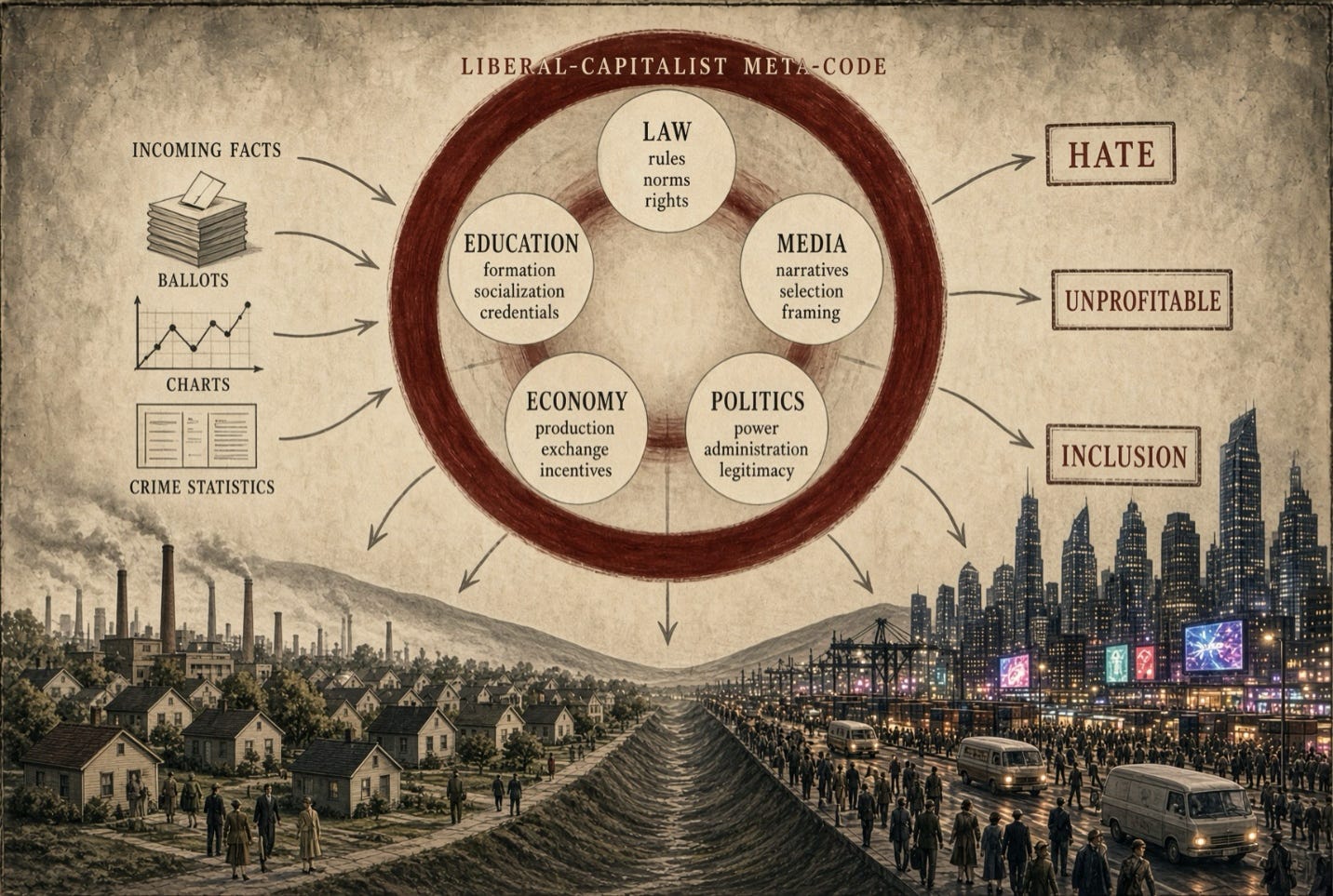
Although Luhmann treated these subsystems in neutral, or strictly functional terms, without focusing on either the role of political values or the dynamics of capitalism, his framework has clarified for me how contemporary Western liberal capitalism functions as a meta-code infusing or imbuing the multiple subsystems. Liberalism and capitalism permeate, with their own dominant moral binaries (racist/anti-racist, tolerant/intolerant, profitable/unprofitable, optimizing/suboptimizing, progressive/reactionary, fact/conspiracy, inclusion/exclusion) across these systems, filtering and ordering their operations. My point is not that liberal capitalism nullifies Luhmann’s original codes, but that it acts as a meta-code.
This essay accepts Luhmann’s core insight that societies are not constituted by individuals acting on the basis of their personal motivations, interests, and choices; rather, societies consist of subsystems, each of which constructs reality, and self-reproduces itself, according to its own cognitive structure. I rely on this insight to explain how liberal capitalism acts as a tacitly accepted background reality, ensuring that the subsystems produce and reproduce themselves not only according to their own codes, but according to the meta-codes of liberalism and capitalism. While these systems (the economy, law, politics, science, education) are cognitively open (and do take into account external events, what other subsystems are doing, as well as the totality of society, including events that counter their cognitive structures, such as disproportionate black or immigrant criminality, mounting populist opposition, or reports that diversity weakens community cohesion), they interpret those “irritations” through their internal codes, and through the liberal-capitalist meta-code, in such a way that these irritations are securely incorporated without undermining the functioning of society.
As Luhmann explains, systems operate “autopoietically” or through their own internal codes and cannot therefore be directly controlled from the outside. Populist proposals may cause “perturbations” in the economy, the law, or the political system, but they are processed according to the respective codes of these systems; and, or so I will add to Luhmann’s theory, the overarching liberal meta-code. It is not that liberal elites act as unthinking automatons. On the contrary, progressive liberalism involves a self-aware, ideological commitment to the elimination of traditional “prejudices” and the expansion of personal choice and diversity. Many elites genuinely believe in this project.
What Luhmann’s systems theory explains is that the dynamics of the subsystems are already operationally structured by their own codes and discourses. Events that are perceived as a challenge are therefore processed in ways that either reproduce the existing order or do not threaten it. Similarly, each new cohort of judges, managers, journalists, and professors is socialized into the respective discourses of the systems. That is, they take up predefined roles and views within the systems. While variation in personal tone, style, and emphasis is allowed in this “individualist” order, the recoding of the system, and the meta-code, is prohibited. Using this theoretical approach, I will explain why the “great replacement” is path-dependent.
I add, then, to Luhmann’s theory that modern society is functionally differentiated the idea that the modern West is also a liberal and a capitalist civilization. This economic system and this ideology developed together and are now fused into a single, self-reinforcing system. In the Fordist phase (1945–1975), this fusion largely benefited native White populations, delivering affluence, rising real wages, high homeownership, and stable families and communities within relatively homogeneous nations still anchored by pre-liberal norms. The crisis of Fordism in the 1970s activated a transition to a post-Fordist multicultural and limbic capitalist regime. In this new order, liberal progressivism and capitalist optimization continue to reinforce each other and to act as a meta-code for the subsystems, but with the key difference that in this new order the liberal meta-code acts to delegitimize ethnic and cultural particularism, while the capitalist meta-code demands flexible, cheaper immigrant labor to deal with high-wage unionized labor and White low fertility rates. The Western social system as a whole is now operationally structured to favor both diversity as a moral good consistent with liberal pluralism, and high supplies of immigrant labor that optimize post-Fordist production.
This post-Fordist regime, I will explain, contains a deep structural contradiction. It rests upon the historically peculiar “WEIRD” psychology of European peoples characterized by low ethnocentrism, high impersonal trust, and impartiality, while systematically empowering non-Western groups that operate according to particularistic kin-selection and ethnic nepotism. The result is a system that delivers optimization through GDP growth, rising incomes for the elites, as well as opportunities for those well connected and incentivized by the regime, but that is nevertheless incompatible with the biological and cultural civilizational survival of European peoples.
I will articulate this thesis in several sections. I will first explain the nature of the two logics of liberal progressivism and capitalist optimization, and then trace their fusion through the crisis of Fordism and the rise of the post-Fordist multicultural regime. I will then offer reasons why immigrant labor meets certain key optimizing criteria of post-Fordist capitalism. I will show that the main promoters of immigration in the West are both progressives and business organizations. I will examine Luhmann’s impressive systems theory and how the liberal meta-code operates across law, media, education, and politics. This will set the groundwork for why I think that popular alternative explanations for demographic replacement are flawed or preoccupied with short-term factors.
Finally, I will explain the nature of the path-dependent trap the West is facing, how it absorbs and reframes populist irritations (and whatever failures the order exhibits in terms of welfare costs and grooming gangs) within its own codes, making reversal extremely difficult. I will show why Luhmann’s theory affords us with an excellent perspective of the nature of this path-dependency. In the conclusion, I will consider the possibility of escape through major economic or geopolitical crises, a deep legitimation crisis, and an “overdetermined” rupture in which multiple subsystems fail simultaneously.
1. The Two Logics: Liberal Progressivism and Capitalist Optimization
(A) Liberalism
Liberal ideology seeks a political and public sphere grounded in universal principles that apply equally to all humans, irrespective of ethnic ancestry, sexual identity, and cultural background. It is committed to the extension and maintenance of equal individual rights grounded on the moral principle that every person possesses the inalienable freedom to choose their own values, religious convictions, and personal self-expression. The role of government should be to protect and expand these rights, rather than to impose any substantive vision of the good life or what the preferred lifestyle should be. Liberalism enables diverse individuals to pursue conflicting doctrines and modes of living within a public political framework of mutual tolerance and respect.
A key dimension of liberalism, which its foremost theorists either miss or neglect to emphasize, is that although this ideology advocates universal principles for humanity as such (rule of law, equal rights regardless of race, sex, and religion), the underlying psychology of liberalism is itself culturally evolved and historically peculiar to European peoples. This ideology is not rooted in human nature. All human societies, including pre-liberal Western societies, were based on particularistic, kin-based norms (in which kin members are treated differently from outsiders). Only Western peoples developed a “WEIRD” psychology, as Joseph Henrich puts it, with population oriented toward impersonal trust and cooperation with strangers, abstract analytical thinking rather than ingroup “prejudicial” thinking, voluntary or civic associations based on contract and merit, rather than restricted to kin members or individuals born with a privileged status. In this sense, liberal societies presuppose, for their proper functioning, people who are well socialized with this WEIRD psychology.
Contrary to the common perception that liberalism is strictly a “relativist” or “neutral” ideology that does not seek to impose a particular way of life, this ideology is morally committed to remaking society and the world in its own image. It is an ideology with a moral dynamic that necessarily conflicts with traditionalist ways rooted in ethnic identities, kinship obligations, or any worldview that restricts “the right to choose”.
Liberalism, in other words, contains a progressive dynamic in its striving to “emancipate” the public sphere from “backward” beliefs, discriminatory policies, or inherited hierarchies. It even seeks to “emancipate” individuals from whatever personal (xenophobic, sexist, homophobic) prejudices they may have. It actively socializes children to become open-minded and respectful of diverse lifestyle choices, while marginalizing or confining to the private sphere those perspectives, such as ethnic nationalism or cultural traditionalism, judged to be incompatible with equal rights. This means that liberal societies have an inherent inclination to dissolve ethnic preferences, ingroup cultural attachments, and “sexist stereotypes” in favor of racial and sexual diversity.
The constant debate between those who insist liberalism is pure relativism and those who increasingly see it as totalitarian misses the dual character of this ideology. Liberalism is simultaneously relativist and absolutist in (i) its advocacy or allowance of multiple religions, philosophies, hobbies, and identities in personal relations and private associations—including illiberal ones—and (ii) its determination to create a strictly liberal political sphere which excludes illiberal politics. In many ways, dissidents have largely accepted this state of affairs in their every day lives: “I will not submit to liberalism! I will be a Nietzschean in my thinking and style of living!” or “Let me live traditionally!” Liberalism is not threatened by such private acts of defiance; it encourages it, while continuing to dominate the public sphere.
Liberalism has not been superseded by some new ideology called “cultural Marxism,” “wokeness,” “postmodernism,” or “race communism”. It remains the reigning ideology of the West, with intellectual roots that are deeper and richer—in terms of major thinkers and institutional history—than those of conservatism, fascism, or communism. Its lineage stretches back to foundational figures such as John Locke, Adam Smith, and John Stuart Mill, articulated by generations of political theorists, legal philosophers, economists, social scientists, artists, and European nationalities.
The commitment to universal values, pluralism, equal rights, and diversity has been mainstream across Western academia and elite circles for decades, articulated by the most institutionally established philosophers and scholars of the 20th and 21st centuries. Academics who accept the central tenets of progressive liberalism, including the celebration of diversity and the repudiation of White identity politics, now control virtually all universities in the West, along with thousands of journals, magazines, and academic societies.
Karl Popper’s book, The Open Society and Its Enemies (1945) played an important role delegitimizing ethnic nationalism and “closed societies” based on fascist and communist values. Isaiah Berlin’s popularization of the argument that there are multiple, incommensurable values and ways of life, and that liberal societies should encourage diverse forms of self-expression, rather than impose a single moral vision, persuaded many that multiculturalism was a natural ally of liberalism.
John Rawls (1921-2002) provided the most sophisticated post-WWII justification for the claim that the public sphere should remain open to multiple cultural viewpoints. His argument that freedom and justice are possible only if citizens accept that the state itself must remain liberal, and that children must be socialized in schools to be “open-minded” and to reject “intolerant” ideas, is widely accepted as the best defence of Western liberal societies.


We could name many other prominent thinkers—Joseph Raz, Will Kymlicka, Charles Taylor, Martha Nussbaum, Amartya Sen, and Steven Pinker—who, despite differences in emphasis, with some defending the “absolute truth” of Enlightenment rationality and others celebrating its relativist openness, have all argued in favor of the “moral superiority” of cosmopolitanism, diversity, and equality of rights. We could name as well prominent post-modernists like Jacques Derrida. While Derrida rejected the universalist pretensions of Enlightenment liberalism, his later works on “hospitality,” cosmopolitanism, and his overall deconstruction of hierarchical binaries have been interpreted as calls for the inclusion of the immigrant “stranger” and the displacement of “rigid” national or ethnic identities — in the name of a more progressive form of liberal pluralism.
For all the intense debates we have witnessed over the past decades between “conservative” Enlightenment liberals, deconstructionists, post-colonialists, communitarians, and individuals from numerous philosophical schools, they are all on board with ethnic pluralism.
Now, while it is true that classical liberals and many libertarians continue to insist that liberalism attaches rights and moral worth only to individuals and not to racial or ethnic groups, and therefore reject progressive identity politics, calling it “race communism,” the fact remains that contemporary classical liberals have no principles by which to oppose immigrant diversity. They actually endorse high levels of immigration and diversity on individualist and optimizing grounds; and remain in principle (with their abstraction of individuals from nationality, culture, and race) indifferent to the replacement of White majorities. Moreover, my key point stands that the historical evolution of liberalism has generated an institutionalized meta-code that is progressive, and which treats diversity itself as a moral imperative.
Suffice it to say a few extra words about Jurgen Habermas (1929-2026), judged by many, including conservatives, as the most sophisticated philosophical defender of liberal universalism, and foremost critic of postmodernism and traditionalism. In his last book, Also a History of Philosophy (a massive three-volume work, published in German in 2019-2021), he attempts to reconstruct the entire history of Western philosophy from a post-national, post-metaphysical, cosmopolitan point of view. He insists that the core achievement of the West is the progressive “uncoupling” of reason from particular traditions, religions, and ethnic identities. He sees the “Enlightenment project” as unfinished and argues that the West should strive for greater universality, inclusion, and transcendence of parochial national identities toward the creation of a “post-national” and “post-metaphysical” form of solidarity based on “communicative rationality” (open “democratic” dialogue and reason-based consensus). Western nations, if they are to live up to liberal universalism, must overcome ethnic attachments for a new “constitutional patriotism”. As a recent article in The European Conservative magazine happily expressed it, Habermas developed the most “ambitious post-national argument for political allegiance rooted in constitutional principles rather than ethnic mythology.”
In short, it is progressive liberalism – and not postmodernism, existentialism, communism, wokeism, atheism, Protestantism, or any other school of thought – that dominates the Western world, the very psychology of its citizens, its intellectual history, institutions, governments, educational and legal systems.
(B) Capitalism
Capitalism, despite its variety of national forms, its mixture with higher or lower degrees of Keynesian government spending, still remains the dominant economic system across the West. The key to understand about this system is that it has undergone a profound evolution in the last century. The capitalism that Max Weber (1864-1920) famously described in terms of the Protestant ethic of frugality, savings, deferred gratification, and stable family formation has been largely superseded.
In the post-Fordist, limbic age, capitalism has morphed into what Jean-Joseph Goux called a “general economy of unlimited circulation.” Utility, scarcity, and rational calculation have given way to excess, waste, instant gratification in global megacities. Capitalism no longer primarily relies on the disciplined “bourgeois” subject who saves and invests; it actively encourages, rather, deracinated global citizens with a high marginal propensity to spend their earnings on pleasure and excitement.
This alteration, however, should be interpreted as a transformation of capitalist optimization rather than as a negation of it. From the standpoint of current businesses, the cultivation of excess and immediate gratification is rational in that hedonistic consumers have a higher marginal propensity to consume, which amounts to higher consumption of fast food, dating apps, pharmaceuticals, streaming, gambling, cannabis, and what businesses dedicated to spectacles offer.
In post-Fordist times, as we will see in Section 2, profits are indeed increasingly derived from financial speculation, debt, asset trading, real estate, and from businesses dedicated to entertainment, rather than “useful” material goods alone. This is not to deny that post-Fordist capitalism continues to depend on entrepreneurship, scientific knowhow, high-tech education, and continuous innovation.
To be clear, capitalism, as such, does not aim to realize the ideals of progressivism. It merely requires the social and psychological conditions that allow calculative rationality to flourish. Yet, in both its meritocratic and consumerist forms, capitalism does exhibit a powerful “elective affinity” (to use a Weberian term) with liberal institutions. It reliably produces progressive outcomes even though its motives remain purely calculative rather than ethical.
By favoring individual talent over ethnic loyalties, by applying universal rules over ingroup favoritism, and by doing away with customs and institutions that curtail the mobility of resources and labor, capitalism actively selects for the universalistic personality that liberalism celebrates. Likewise, by rewarding consumers who are reckless in their spending and crave immediate pleasures and dopamine hits, capitalism favors diverse and rootless urban populations over stable, frugal communities in traditional White towns. In this sense, the two logics—liberal progressivism and capitalist optimization—are distinct yet mutually sustaining.
This optimizing logic finds strong support among leading libertarian and free-market economists. Bryan Caplan, Alex Nowrasteh, Tyler Cowen, Walter Block, Michael Clemens, Gary Becker, and Julian Simon have long argued for high or open immigration on grounds of economic efficiency and individual liberty. These libertarians are, in Antonio Gramsci’s lexicon, the “organic intellectuals” who have given coherence, self-awareness, and rationale to the benefits of the capitalist logic in the post-Fordist age. Caplan advocates for full open borders, arguing that it would dramatically increase global wealth. Nowrasteh, Senior economist at Cato Institute, dedicates much of his research trying to show that large-scale immigration brings greater prosperity. Cowen argues for more immigration (particularly high-skilled) on both economic and humanitarian grounds. Gary Becker, a Nobel Prize winner, is well known for his thesis that labor mobility across the world is economically beneficial.
For all their insistence on individual merit and their opposition to progressive “race communism,” these thinkers welcome demographic diversity and vehemently reject White identity as “fascist” precisely because they evaluate people only as individuals rather than as members of a collective cultural heritage. These names, and many others working for organizations like the Cato Institute, Reason Foundation, or at the IMF, the World Bank, and numerous university departments, identify open borders with freedom of movement and individual rights. Major business associations in the United States, and across Europe, as we will see in Section 4, eagerly lobby for higher legal immigration and “guest-worker” programs.
2. The Crisis of Fordism and the Shift to Post-Fordist Multicultural Capitalism
The replacement of Whites can’t be understood without an adequate grasp of the transition from a Fordist to a post-Fordist liberal capitalist regime. During the Fordist phase of capitalist accumulation (roughly the 1940s–1970s), the two logics operated in a way that was greatly beneficial to the native White populations of the West. Fordism was a regime of mass production of standardized goods for national markets, supported by high unionized wages, strong labor unions, government investment, and Keynesian management policies designed to balance supply and demand. Within this regime of accumulation, the progressive logic of liberalism delivered general prosperity for Whites, including the expansion of social safety nets, greater access to cheap university education, high rates of homeownership, and stable family communities.
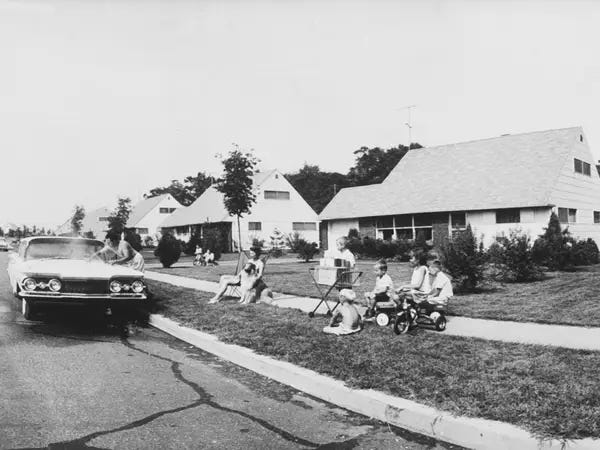
This Fordist order did not require large-scale immigrant labor. The postwar Baby Boomer generation, with their large families and good incomes, supplied a sufficient working class and consumer population within relatively homogeneous nations. This order fostered national cohesion, cultural identity, and widespread social mobility while supporting major public infrastructure projects such as highways, schools, and universities. During this phase, in the unfolding of the progressive logic of liberalism, Western societies were still regulated by certain “pre-liberal” norms: the belief that a family consists of a father and mother with children, that premarital sex should be avoided, that marriage is sacrosanct and divorce is selfish, that the man is primarily responsible for family provision, that Western societies are Christian or founded on Christian values and of European ancestry, and that they show some deference and attachment to established hierarchies, institutions, and governments.
By the early 1970s, however, the Fordist model began to break down. Fertility rates had started to decline considerably, domestic markets were becoming saturated, and Western economies faced stagflation, declining profitability, and intensifying global competition from newly industrializing Asian nations. Excessive union activism, significant wage increases, and rigid labor structures further undermined the competitiveness of Western businesses. The liberal capitalist West adapted by transitioning to both a post-Fordist neo-liberal order and a more progressive multicultural order.
Neoliberalism began to attain hegemonic status from the mid-1970s onward, influencing political decision making across the West. Its core claim was:
“human well-being can be best advanced by liberating individual entrepreneurial freedom and skills within an institutional framework characterized by strong property rights, free markets, and free trade.”
In the United States, for example, think tanks such as the Heritage Foundation, the Cato Institute, the Institute of Economic Affairs, and the American Enterprise Institute actively propagated this project and helped create a strong consensus in favor of post-Fordist policies.
These policies entailed, in the main, the pursue of cheaper inputs by businesses, greater flexibility, and access to new markets by building global supply chains, outsourcing production overseas, and shifting toward “flexible accumulation.” They entailed, moreover, moving away from “rigid,” unionized 9:00-5:00 labor toward part-time, temporary, and contract work, including decentralized production using “just-in-time” techniques and subcontracting.
During the 1990s there was a major economic modification across the West from manufacturing to services, finance, and high-tech industries, leading to the dominance of transnational finance capital, where profits derived from asset trading, debt, hedge funds, and speculation, rather than just industrial capital, assumed increasing significance. This transition was eventually accompanied by heavy reliance on information technology, automation, microelectronics, and digital tools.
Multiculturalism began to take hold together with the consolidation of neoliberalism — though this has not been a subject of study by any theorist of post-Fordism. The adoption of multiculturalism was not a product of “cultural Marxists” taking control of the public sphere, but the direct institutional expression of liberalism’s pluralist logic. Liberal communitarians like Will Kymlicka, recognized as the most important theorist of multiculturalism, successfully persuaded politicians from all persuasions that, just as the liberal state should not impose any religious beliefs upon its citizens, it should not mandate any dominant culture; instead, it should guarantee a public sphere in which individuals of diverse religious and nationalities enjoy equal rights to express their preferred customs and beliefs in a state of mutual respect. The intended aim of this multicultural liberalism, as it came to be institutionalized in a variety of ways across the West from the 1980s on, is not to promote group-oriented non-Western cultures as such, but to overcome “past discrimination” against non-Western or non-White populations by “leveling the playing field” and creating greater equalizing opportunities for minorities.
This consolidation of liberal multiculturalism, together with the intense obsession with overcoming “past racism” and “xenophobia,” provided the perfect ideological justification for the requirements of post-Fordist accumulation. As native fertility rates fell and European populations came to be viewed as increasingly costly and inflexible laborers, businesses embraced mass immigration from high-fertility Third World nations. Immigration was thus framed as both an economic solution to the crisis of Fordism and a new phase in the march toward fulfilling progressivist ideals.
This transition marked a profound evolution in the nature of capitalism itself. The economic theory of capitalism (from Adam Smith through David Ricardo and marginalist economists) emphasized supply, savings, frugality, and deferred gratification — what Jean-Joseph Goux called “the cramped and grayish world of petty calculation, quantifiable profit and industrious activity.” In sociology, this is commonly known as the Weberian Protestant ethic. Keynesian economic thinking during Fordism had already emphasised demand stimulation and mass consumption to sustain growth. Post-Fordism radicalized this further, pushing beyond the limits of a utilitarian or calculating rationality in order to replace it with what Goux, drawing on Georges Bataille, termed a “general economics” that makes of unproductive expenditure (pleasure, games, spectacle) the most determinant phenomenon of social life. As Goux observed in a 1990 article:
“It is in this intentionally unproductive use, in this unlimited expenditure, and not in utilitarian consumption that a secret lies hidden, the ‘general law of the economy.’”
Henceforth, capitalism would no longer be as heavily tied to the Protestant ethic, stable families, and ethno-religious customs: “The values of thrift, sobriety and asceticism no longer have the place that they held.” In this new regime, capitalism cultivates deracinated, high-consumption individuals who respond impulsively to the latest thrills markets offer.
What Jean-François Lyotard started to notice in the 1970s, termed a “libidinal economy” to illuminate a new form capitalism (beyond the Marxist emphasis on “immiseration”) that increasingly operates through the circulation of images that intensify our desires, and what Goux identified as “Post-Modern Capitalism” in 1990, is what David Courtwright identifies as “limbic capitalism” in his 2019 book The Age of Addiction: How Bad Habits Became Big Business.
Courtwright describes industries that target the brain’s limbic system, the seat of pleasure, craving, and immediate emotional response, rather than rational deliberation. The aim is to “encourage excessive consumption and addiction” by marketing novel pleasures, vices, and “hyperstimulating environments”, inducing binge eating, compulsive gaming, nonmedical drug use, “pathological gambling,” and “taboo sexual behavior”. Part of this limbic model of accumulation includes instant access via the internet to gambling, pornography, and shopping, and to platforms specialized in delivering quick dopamine hits through likes, retweets, personalized feeds, and autoplay.

Limbic internet businesses thrive in today’s world. A Forbes article, using OnlyFans as an example, explains how AI software can talk, flirt, persuade, or keep someone engaged, creating the feeling of a relationship. It can do this at very low cost for each extra user. “AI does not get tired. It does not go offline. It responds instantly, adapts continuously”. TikTok and Instagram Reels, similarly, deliver dopamine through a rapid succession of sensationalist videos and sexualized images. DraftKings and FanDuel have turned sports (even for people who are not fans) into mass gambling. Live Nation, NFL spectacles, fashion platforms such as Shein, and delivery apps such as DoorDash and Uber Eats all thrive on immediate craving, entertainment, and easy comfort. Pornhub may well be the quintessential limbic progressive enterprise: its algorithm maximizes retention through an endless choice of fetishes, while its 2025 Year in Review celebrated the rise of “Lesbian” and “Transgender” as the most popular categories of “sexual authenticity” and of “breaking old ideas about gender and sexuality.”
It is critically important to understand that the progressive logic of liberalism, particularly from the 1960s on, has been operating in amicable symbiosis with this transition to post-Fordist limbic capitalism, by eroding the last remaining or residual pre-liberal norms still prevailing in the Fordist age. In the libidinal economy, the persisting attachments to traditional family structures, Christian morality, ethnic cohesion, and deference to traditional hierarchies came to be viewed as barriers to individual autonomy, labor mobility, and cultural openness. Liberalism progressed from its older preoccupation with fair wages, secure jobs, and affordable housing for the working classes, toward DEI cultural politics. This new emphasis manifested itself as political correctness in the 1980s and 1990s, and in recent years as woke ideology.
What theorists have missed is that this cultural change supplied a moral justification for “flexible accumulation” by nurturing a population detached from any solid identity and therefore amenable to large inflows of diverse immigrants.
To Be Continued in Part 2
READ MORE from Ricardo Duchesne, brought to you by Arktos: