


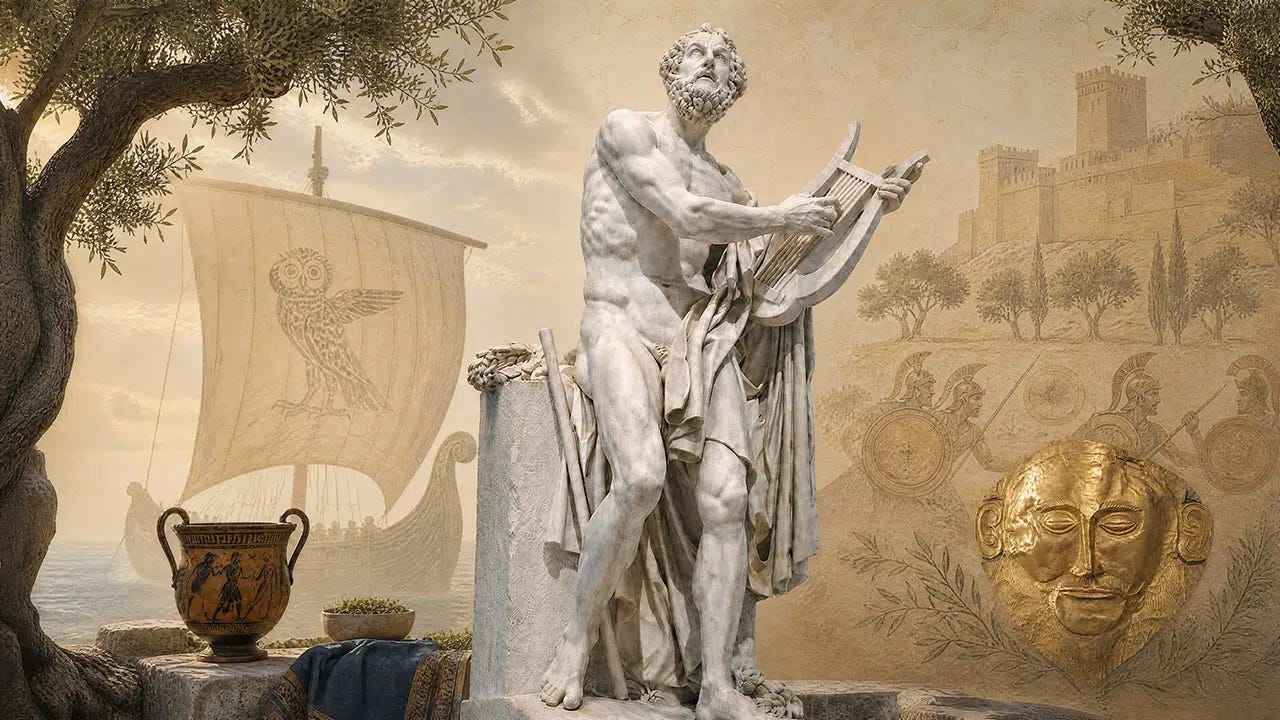
On 15 July, Christopher Nolan’s Odyssey will cast us once again into the sails of Odysseus. If the names of Ithaca, Penelope, Charybdis and Scylla still resound within us, does our age truly know the work of Homer? Marion du Faouët invites us to read and reread this founding text of our civilization, to return to its voice, its rhythm, and to what it says of European man: mortal and faithful, cunning and fragile, rooted in a land, a memory and a lineage. A people that no longer reads its founding texts ends by no longer possessing them, and by wandering, far from itself. It is time for Europeans to take up again the road to Ithaca.
There are works whose very name is enough to give us the illusion of familiarity. They are part of the landscape. We came across them at school; we know a few of their characters, a few episodes, a few images. They are there, somewhere in our memory, like monuments we no longer visit. The Odyssey is one of them.
Odysseus, Penelope, Circe, Calypso, the Cyclops, the Sirens, Ithaca: these names still say something to us. But what do they really say? Are they still living presences, or only floating memories, fragments of general culture, images detached from the poem that gives them their meaning?
To reread The Odyssey is not to pay homage to some venerable antiquity. It is to return to one of the great texts in which Europe learned to think about man: the man who confronts the trial of the world and who suffers, who desires and errs, who schemes, who weeps, who resists, and who wants to return home.
For that is where the heart of the poem lies. Odysseus does not travel for the sake of travelling. He does not seek the elsewhere for its own sake. He does not wish to lose himself in the unknown, nor to undo what he is. He wants to find Ithaca again. This return involves far more than a journey across the sea. Odysseus must become once more king, husband, father, son, master of his own abode. He must take back his place within an order that his absence allowed to come undone. The whole poem strains toward this reconquest. In an age that readily prizes movement, rupture, permanent departure, Homer recalls something simple, almost scandalous today: there is grandeur in return.
Ithaca is nothing like a paradise. It is a harsh island, poor and rocky. Odysseus could choose better. He could remain with Calypso, who offers him immortality. He could surrender himself to pleasure, to forgetfulness, to rest. But he prefers his own land, his mortal wife, his son, his aging father, his threatened house, his destiny as a man. Because a mortal but rooted life is worth more than an eternity far from one’s own.
This is one of the great lessons of The Odyssey. Man is never, in it, an isolated individual floating above the world. He is always caught within bonds: a lineage, a house, a homeland, gods, the dead, duties. His freedom does not consist in ridding himself of these bonds, but in remaining faithful to them through trial.
Odysseus is great because he returns.

The House of Odysseus
We must take Odysseus’s abode seriously. It occupies the center of the poem: the place where everything is lost, and where everything must be restored. During the king’s absence, the suitors occupy the palace. They devour his goods, covet Penelope, humiliate Telemachus, violate the laws of hospitality. In threatening the marriage, they assail an entire order.
The abode, in Homer, bears lineage, authority, transmission, memory. It is first of all a house of stone, with its halls, its threshold, its hearth, its bed rooted in the olive tree. But it is also a house in a deeper sense: a spiritual hearth, a continuity of blood, of name and of destiny. The house of Odysseus thus denotes not merely a building, but a lineage, a sovereignty, a fidelity handed down. It is there that the living and the dead, men and gods, wife and husband, father and son, are held together.
The return of Odysseus thus takes on a political and sacred significance. It restores each thing to its rightful place: to the wife her husband, to the son his father, to the kingdom its king, to the dead their honor, to the gods their justice. Whoever sees in Odysseus only an adventurer misses what is essential. Odysseus is first of all the one who returns to restore his abode.
A World Where the Gods Act
To reread Homer is also to consent to enter a world that is not our own.
We have grown accustomed to explaining myths. We turn the gods into symbols, rites into customs, portents into poetic images. Poseidon becomes the sea, Athena intelligence, Circe seduction, Calypso forgetfulness, the Sirens temptation. Such readings can illuminate certain aspects of the poem. But they become fatal if they make us forget that, in Homer, the gods are not mere metaphors. On the contrary, they are there. They act. Athena protects Odysseus and guides Telemachus. Poseidon pursues the hero with his wrath. Hermes conveys the messages of the gods. Circe transforms men. Calypso holds Odysseus back. Zeus arbitrates.
The whole poem unfolds in a world where the visible and the invisible are not separated as they are for us. The sea is not merely water. The wind is not merely a physical phenomenon. The oath is not merely a spoken word. Hospitality is not merely a courtesy. Sacrifice is not merely an ancient custom. Everything is caught within a vaster order. Odysseus acts, of course. He decides, he calculates, he endures, he lies at times, he hides, he strikes, he entreats. But he is never alone before a mute world. He advances through a universe shot through with signs, powers, limits.
This is where his cunning takes on its full meaning. The mètis of Odysseus denotes more than mere skill. It has nothing of the cynicism of a man who manipulates all that surrounds him. It is an intelligence of the real: knowing when to speak, when to keep silent, when to wait, when to reveal oneself, when to strike, when to entreat.
Homeric man is not great because he believes himself all-powerful. He is great because he knows that he is not.
A Voice Before Being a Book
We often read The Odyssey as a book. That is natural. But we must remember that before being a printed text, before being a schoolroom object, the poem was a voice. It comes from the world of the bards, of recitation, of song, of memory. Homer designates less an author in the modern sense than a poetic tradition, a way of transmitting the heroes, the gods, the transgressions, the sufferings and the glory.
The repetitions, the formulas, the epithets are not archaic encumbrances. They belong to this sung speech. “Odysseus of many wiles,” “grey-eyed Athena,” “rosy-fingered dawn,” “the wine-dark sea”: these expressions do not decorate the narrative. They carry it. They give the world its color, its rhythm, its form. Homer ought to be read aloud more often. To let the names be heard. To feel the return of the formulas. To understand that glory, kléos, is not modern celebrity, but that which abides because a song transmits it.
The bard keeps memory. He gives the living the tale of the dead. He preserves what deserves not to vanish. This is why a civilization that no longer reads its founding texts ends by no longer truly possessing them. It keeps their names, a few scenes, a few images, but it loses the voice that made them live.
Reading in Order to Transmit
It is not enough to preserve the great texts. They must be made desirable once more.
Homer asks for more than a citation or a distant respect. He asks to be frequented. One does not enter The Odyssey as one enters a museum, but as one enters an old house whose rooms are still inhabited. It takes time to recognize its thresholds, its voices, its lights, its shadows. One must consent to let oneself be led.
This is why transmission cannot be reduced to the accumulation of references. It presupposes an art of making others love him. To give a young reader a taste for Odysseus is not to impose a monument upon him; it is to open a road for him. To show him that these songs still speak of what he already knows without always being able to name it: the desire to leave, the fear of losing oneself, the call of return, fidelity, temptation, glory, death, the home.
We must therefore reread Homer simply, seriously, joyfully. Read him aloud at times, to recover the cadence of the poem. Read him with images, with maps, with different translations, with connections to the works he has nourished. Read him above all as a living work, not as a cultural obligation.
A tradition does not survive because one declares it important. It survives when men and women receive it deeply enough to want to transmit it in their turn. And it is with this memory that we must reconnect.
Homer as Beginning
Why begin with Homer? Because he is one of our beginnings. Not the beginning of everything, of course, but the beginning of a certain European way of looking at man: mortal, heroic, cunning, suffering, faithful, tempted, glorious and fragile; capable of grandeur, yet always placed beneath the gaze of the gods; drawn to the open sea, yet called back by the home; desirous of glory, yet shaken by the dead; tempted by immortality, yet choosing in the end the earth, the wife, the son and the father.
Homer gives us no ready-made lessons. He sets us in the presence of a world. He compels us to look higher, further, deeper.
This is why we must stop treating founding works as a decorative heritage. They are not there to embellish our discourse. They are there to form us. Still, they must be opened. Still, they must be read. Still, they must be given to others to read. A civilization may die beneath the blows of its enemies; it will certainly be extinguished if its heirs no longer know how to hear the poems that founded it.
Homer abides. It is for us to take up again the road to Ithaca.
Marion du Faouët — Promotion Dante
OUT NOW - Indo-European Echoes: Our Ancestral Origins and Legacy

Five thousand years ago, communities of herders, warriors, and poets hailing from the Pontic Steppes set in motion one of the most consequential expansions in human history.
Originally published at the Iliade Institute
Translated by Alexander Raynor
That new movie looks stupid, but I hope the publicity and controversy around it encourages more people to read Homer. From looking at what they seem to be emphasizing at the bookstore these days, it seems it already has. That's one literary trend I can definitely get behind.
No mention of Penelope who forever remained faithful.