


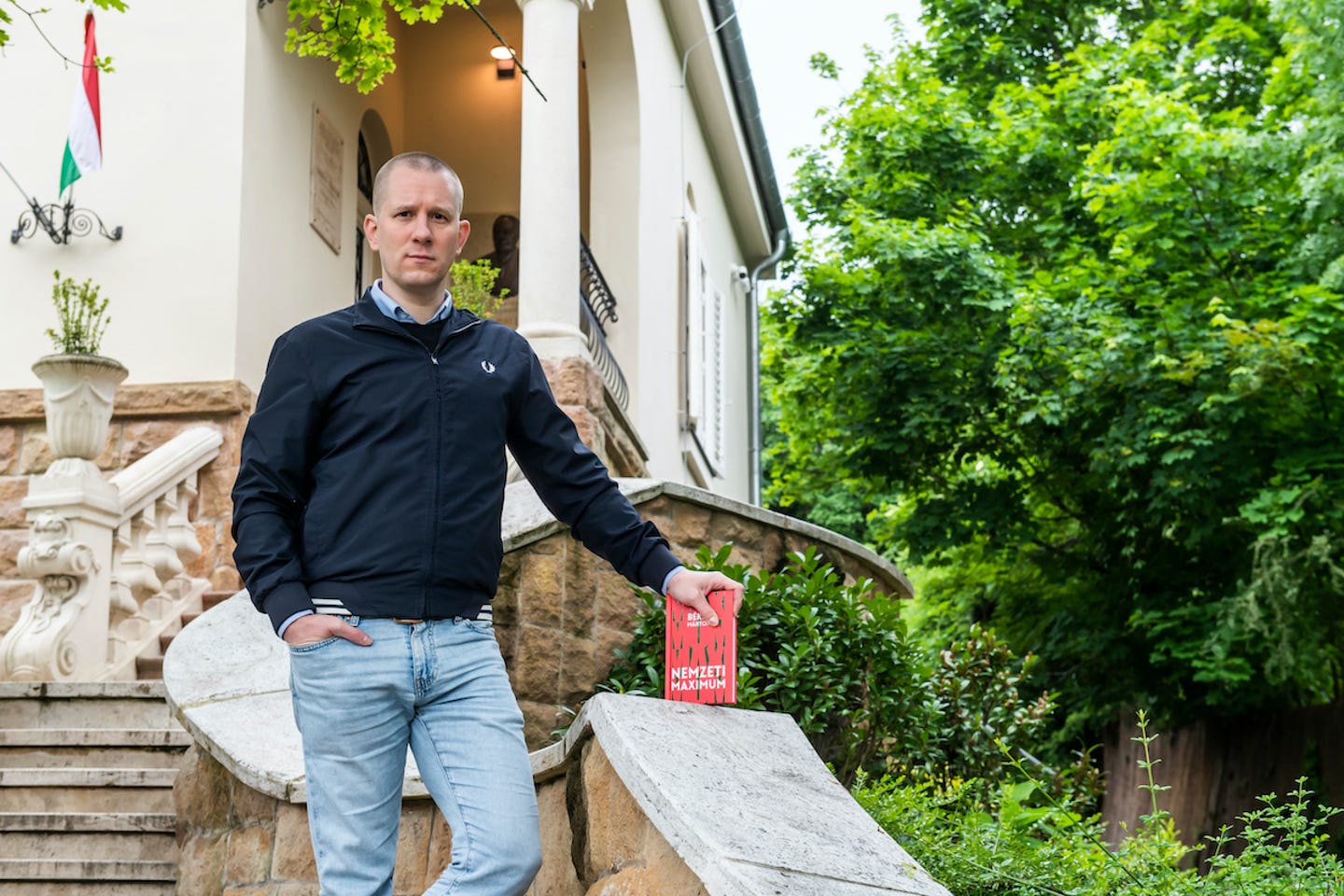
Andrej Sekulović interviews Dr. Márton Békés on the geopolitical challenges facing Europe, the situation in Hungary, the misguided policies of the European Union, and what the future holds for the continent.
Originally published in the Slovenian magazine Demokracjia.
Andrej Sekulović: In the last few years, we have witnessed quite a few events and changes that are reshaping the global geopolitical realm, from the wars in Ukraine and Palestine to Trump’s second victory in the US. Some are saying that the old “unipolar” world order is being replaced by multipolarity. What is your opinion on this, and what does it mean for Europe?
Márton Békés: Back in the summer of 2022, I wrote a long essay about the multipolarization of the world entitled “Világrendszerváltás,” which in Hungarian refers to two world-scale processes simultaneously: on the one hand, a change in the world system; on the other hand, a worldwide political change. Our language offers a good opportunity to create long compound words: in Hungarian, “world” (világ), “system” (rendszer), and “change” (váltás) are written together as világrendszerváltás, also meaning “World Regime Change.” My term was often used by Viktor Orbán in 2024–25 and is now a common phrase in our country to describe the current international geopolitical situation. By this specific term, I mean that the coming multipolar world order is based on different civilizations living on the Earth’s continents, and that they are forming political-economic and military-cultural Großräume (according to Carl Schmitt). I think we are living in the century predicted by Schmitt. In January, my book on this topic will be published in Hungarian. And Europe? It has to play its own game in the current geopolitical world competition, but the leaders of the EU are thoughtless puppets.
Sekulović: While Trump was successful in stopping the war in Gaza, the war in Ukraine is still going on. Hungary has taken a more balanced and neutral approach toward this conflict. What do you think may happen in this war in the near future, and how will it affect Hungary and Central Europe?
Békés: I think that the war between Russia and Ukraine is a brother war between Orthodox Slavic peoples, so it is a tragedy. The main geopolitical question is where Kyiv would orient itself: toward Moscow, which would mean the Eurasian Großraum, or toward Brussels, that is, the Western half of Europe. Unfortunately, after the US-backed “colored revolution” of Maidan, Ukraine was inserted into Western political, financial, military, and cultural structures, and the government in Kyiv pursued chauvinistic policies, violating the rights of indigenous ethnic minorities (mainly Russians, but also Transcarpathian Hungarians). The armed conflict between Russia and the Ukrainian government has been ongoing since 2014; in 2022, a full-scale war began. There has been a war between these states for almost four years, which resembles a World War I-type conflict, but with drones. Whoever has the human and material resources will win: Russia has both, but Ukraine by itself has neither of them. Russia will achieve a limited victory and gain the whole Donbass along with Crimea, areas that once were part of historical Russia and even today are inhabited by Russian-speaking people.
Sekulović: There will be big elections in Hungary in 2026. What do the polls show and who do you think will be victorious?
Békés: As in October 2023 in Poland, the Brussels elite would like to implement a regime change in Hungary next year. In Poland, they now have the Tusk government, which does everything that Brussels wants. This is not a big surprise: Donald Tusk was the leader of the German-backed European People’s Party between 2019 and 2022. In Hungary, we have a strong government, led by Viktor Orbán, which has a national agenda to preserve the sovereignty of the Hungarian state and work for the benefit of the people. If they could enforce a regime change in Budapest, this would solve their “Hungarian problem,” which means eliminating Viktor Orbán’s veto. The leader of the new opposition party in Hungary was the husband of the former minister of justice and has three accusations of corruption and misdemeanors; he is a member of the European Parliament in the faction of the European People’s Party, and he would be a German puppet. The polls show a moderate pro-government advantage. Most voters living in Budapest and in the large cities are against Orbán, but people in the countryside, small towns, and villages support the government. We will win in 2026.
Sekulović: The European Commission has recently announced that they will be including North Africa and Middle East in the Erasmus+ program, which means more non-European students coming to Europe. All the while, Hungarian students – citizens of a member state – are still being blocked by Erasmus+, supposedly because of your government´s decisions that LGBT+ propaganda has no business being taught in your schools. Is this an ideological war of Brussels against Budapest?
Békés: There has been a political conflict between Brussels and Budapest since Orbán has been in power since 2010. This is the same main divide you can see all over the Western world: internationalists against patriots, globalists versus localists, federalists versus sovereignists. The smaller clashes are part of this larger battle, among them the conflict over the LGBT+ lobby versus traditional family life, neoliberal economics versus the welfare state, and the United States of Europe versus a Europe of Nations. We Hungarians are part of the EU, but we have to secure our identity, our security, and our cultural identity against the federal-globalist lobby in Brussels.
Sekulović: In the past, the EU could always rely on its allies in Washington, but since Trump’s victory, this has changed. How do you view US foreign policy toward Europe?
Békés: The honest speech of J. D. Vance delivered at the security conference in Munich last February was a turning point in transatlantic relations. We now see that the Trump administration has its own foreign policy, fulfilling its specific national interests, and does not continue the globalist agenda of the Biden era. There is a disruption in American politics between the thalassocratic internationalism of the coastal regions and the continental isolationism of Middle America. After the Cold War, there was a bipartisan consensus among Democratic and Republican elites to create a unipolar world order — this was the globalist project of Pax Americana, realized by Clinton, the two Bush administrations, Obama, and Biden. Trump’s second term represents a break with the foreign policy of this “Uniparty” and the start of a new American nationalist course. That is why America is abandoning the globalist European Union and trying to make tactical agreements with Russia (the meeting in Alaska in August) and China (the meeting in Busan in October). The EU is a lonely dwarf among rising giants.
Sekulović: The Western part of Europe is being overrun by mass migration, while the people in power keep pushing the most extreme liberal policies – from gender ideology to open borders. Do you think the “true West,” as Viktor Orbán once said, has shifted to Central and even Eastern Europe? Is this an opportunity for our region to become the chief protector and nurturer of authentic European values and virtues?
Békés: The division of Europe was for a long time the same as the division of the whole world: “the West and the rest.” But in the 21st century, the relationship is changing because of trendsetting demographic, economic, technological, and cultural shifts. The “rest” is the majority right now. This shift is unmistakable in international politics, and it is true within Europe itself as well. The Western part of Europe has moved too quickly over the past centuries and has lost its identity because of colonization, consumer hedonism, and migration. Central and Eastern Europe took a different path; some call it “lagging behind Western Europe,” but I think nowadays we will discover the advantage of being behind, because we are not at the dead end of progress.
Sekulović: What is the current situation with alliances such as the Visegrad Group, and how do you view similar initiatives such as the Intermarium Foundation? Will such alliances increase in the future?
Békés: The Visegrad Group is a multilateral forum with a 700-year-old tradition, which has a bright future if the nations of Central Europe (namely Croats, Czechs, Hungarians, Poles, Slovaks, Slovenians, and possibly Serbs and Romanians) recognize their common interests and shared heritage. The Visegrad vision of Central Europe could be a culturally based, ethnopluralist bloc in the multipolar world. On the contrary, I see the Polish-led Intermarium as a purely geopolitical project with some regional hegemonic aspirations.
Sekulović: Finally, could you tell us a bit about your future plans, as well as where you see Hungary and Europe in the coming years?
Békés: I’ve written a manifesto titled “Rejuvenating Europe.” I conclude that we need a great return, a 21st-century ricorso, a new perspective. This new point of view is an archeofuturistic one, and acting according to it results in Europe being – in Hegel’s words – “at once the oldest and the newest.”
Rejuvenating Europe: Genesis, Doom, Futurity

Márton Békés envisions Europe as an open-ended possibility — a project of many peoples whose civilizational heritage centers West and East, North and South — but one whose fate is tragically sealed if it remains trapped in outdated frameworks instead of embracing continental horizons and staking out its own role within the emerging multipolar world orde…
Dr. Márton Békés was born in 1983 in Szombathely, Hungary. He studied political science and history, earning a PhD in history. Since 2019, he has been the director of the Institute of the 21st Century, and since 2018 he has served as editor-in-chief of the journal Kommentár. Over the past decade, he has published ten books, the most recent of which are Nemzeti blokk (2022, National Bloc), Konzervatív forradalom (2023, Conservative Revolution), and Nemzeti maximum (2025, National Maximum).
Now that the New Year has begun, we look ahead while holding on to what matters. Enter the year with serious reading and lasting ideas.
Enjoy 10% off all Arktos titles until January 6.
Visit Arktos.com/shop

this is a super-interesting piece. Both men are full of wonderful ideas. One thing I'd like to get off my chest, though, is that the US , because of its geography, is both a "thalassocratic" and a "continental" power. This is an unparalleled blessing and a dangerous weakness.
"We need a great return"!? 2026 marks the 250th birthday of the Declaration of Independence, formulated in 1776 by the American Founding Fathers; it was an extremely well thought out document by signers who knew what an enormous task and responsibility they were taking on; it represented a new vision and hope for a new nation born from Revolution and a desire for freedom, not only for America but for all the world; its faith in individual and national sovereignty were new concepts for a people who had to fight for the very existence of a new freedom; and that fight continues to this day against all of the globalist forces that would make us "collectivist slaves" as much as the original American colonies were; we need to return to the principles of the Declaration because they have never been fully realized and seen for their words of immortal insight; in one sentence alone we have: " we hold these truths to be self-evident, that all men are created equal, that they are endowed by their Creator with unalienable rights, that among these are the right to life, liberty and the pursuit of happiness." Thank you, America for a dream too often forgotten but will never die!