


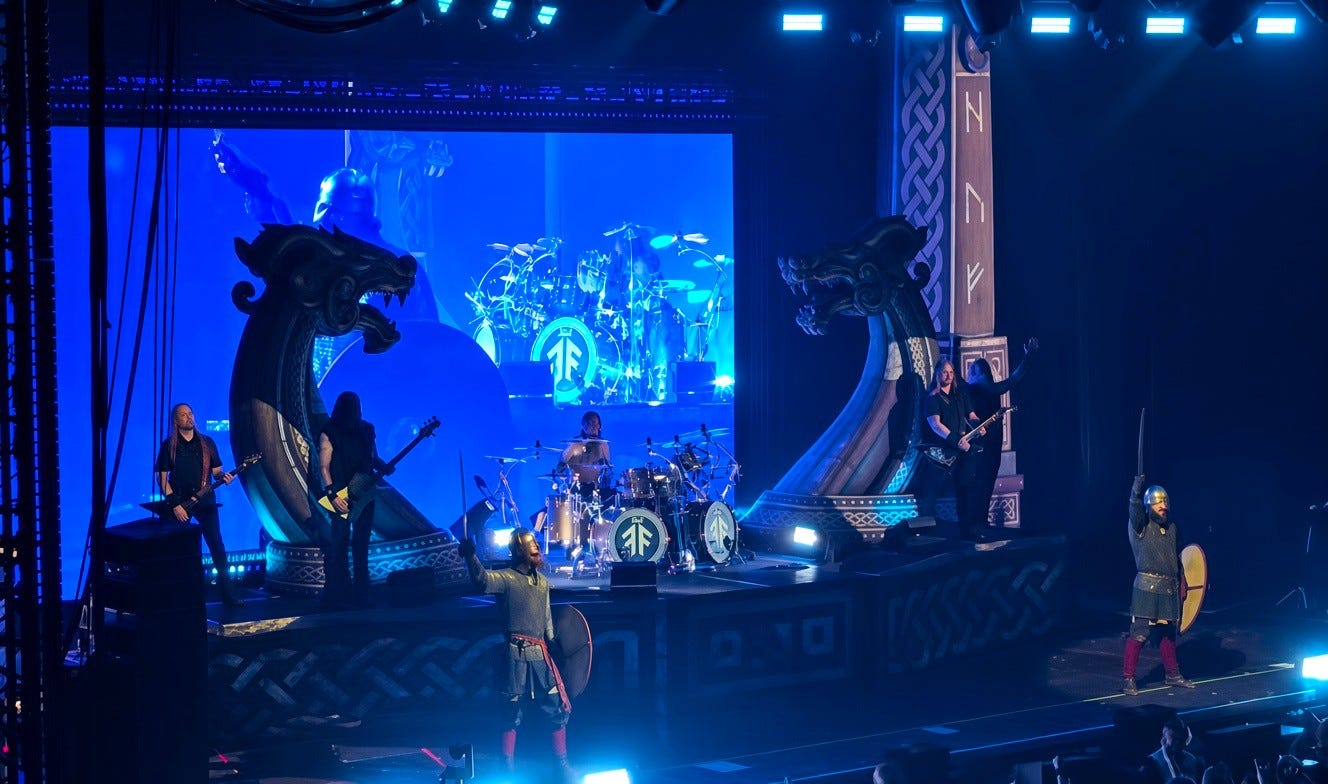
The golden hues of autumn beneath the clouded sky brightened the landscape as once again the wheels turned toward the former imperial capital. I had last been in one of the most magnificent cities of Middle Europe only a good month earlier, to attend a commemoration of the Battle of Vienna on the hill of Kahlenberg, from which the Polish king Jan III Sobieski led the winged hussars to liberate the city from the Turkish siege on the 12th of September, 1683. This time, however, I was attending a rather different event. Instead of listening to inspirational speeches by European patriots, I listened to the hard-hitting tunes of the Swedish bards of melodic death metal. A very different spectacle, yet one which also included European history, albeit in quite a different manner.
Although their name is derived from Tolkien’s mythos, there is not much Tolkienian substance in the music of Amon Amarth, notwithstanding the fact that they drink from some of the same mythological wells as the great English storyteller did. Moreover, the tales of Amon Amarth are more concerned with Midgard than with Middle-earth. Naming themselves after Mount Doom in the fires of which Sauron’s Ring was forged, the band’s initial idea was to arm themselves with the already well-established “devilish” aesthetics, typical for many metal acts. That is, until they found a frontman who was more interested in Norse mythology than in satanic themes.
Today, Amon Amarth is one of the foremost metal acts immersed in Viking aesthetics and themes of Scandinavian and Germanic myths and history. Having stopped in Vienna on their The Allfather Awakens tour after the release of their latest album of the same title, the Swedish metal marauders shook the stage as the powerful drumbeats and fierce riffs reverberated through Viennese concrete. Amidst the flashing flames and images of grim Norsemen and drakkar ships, Amon Amarth delivered a spectacular performance with figures of gods and warriors joining them on stage.
READ MORE in Arktos Journal:

Metal Vikings in Vienna
The evening began with the tale of Odin seeking to drink from Mimir’s well of wisdom, sacrificing his eye to gain knowledge, as retold in one of the band’s new songs, titled “Gjallarhorn”. Then followed the “War of the Gods”, another Eddic-inspired song, focusing on the war between the Aesir and the Vanir, the two tribes of gods that form the Norse pantheon.
The next two pieces, “Death in Fire” and “Free Will Sacrifice”, reflect the grim and heroic ethos of the old North, or what Tolkien articulated as the Theory of Courage in early Germanic literature. “Death in Fire” deals with the cataclysm of Ragnarök, which Tolkien also touches upon when examining the Northern temper and courage in the face of death. The next number, the title track of the band’s ninth album released in 2013, Deceiver of the Gods, naturally deals with the trickster god Loki.
After the vocalist Johan Hegg kicked Loki, who was a bit too Marvel-like for my taste, off the stage, another title anthem thundered throughout the hall, this time from their latest album, The Allfather Awakens. Once again putting the wise, aristocratic Odin at the centre, this very catchy song has a bit of a different flavour, mentioning revolutions and those who bow down to the “gods of ignorance”. Still, the lyrics suggest that the freedom from the shackles of lies, repression, delusions, and “the enslavement of the soul and mind” lies in the awakening of the ancient chief of the gods. Whereas Amon Amarth’s songs are generally topical and express artistic admiration and passion for Norse history and mythology, rather than preaching or dealing with political subjects, their lyrics have a strong touch of rediscovering and respecting one’s heritage, which is especially evident in “The Allfather Awakes”:
A new dawn
We are reborn
With weapons drawn
We are rushing forth
Slay the snakes
Free once more
Cannot break
The spirit of the North
Like many of their compositions, the next song they played, “Hermod’s Ride to Hel - Lokes Treachery, Part 1”, is also drawn from the rich treasury of the Eddas, followed by three tracks concerned with Scandinavian medieval culture. “Put Your Back into the Oar” and “We Rule the Waves” both reflect the restless spirit of the Vikings and their journeying across the harsh waves of the northern seas, while “One Thousand Burning Arrows” is about a king’s Viking funeral.
What followed was a somewhat unusual sight at a death metal concert, as the band sat around the fire and sang a ballad recounting the cosmogonic myth, simply titled “Upphaf”, meaning “beginning” or “origin” in Old Norse. The lyrics are once again inspired by the Poetic Edda, more precisely by the “Völuspá”, the poem about the creation and destruction of the world. Then a few more songs drawing inspiration from the bellicose Germanic ethos and myths shook the stage, including “Shield Wall”, “Guardians of Asgard”, and a few others. The set concluded with “Saxons and Vikings” followed by “Twilight of the Thunder God”, another title track from the band’s 2008 album. While the last song is about the mighty Thor, “Odin’s son, protector of mankind”, and his final battle with the world-serpent Jörmungandr in Ragnarök, “Saxons and Vikings” is a song about the Norsemen’s invasion of the British Isles and quite suitably features guest vocals by Biff Byford from the English outfit Saxon. These veterans of British heavy metal could be compared to Amon Amarth, perhaps not in their style, but in their aesthetic and lyrical focus on the historical legacy of their ethnocultural landscape. Thus, Saxon sing about knights and crusaders just as Amon Amarth growl about berserkers and Vikings. The song also includes a “battle” between Hegg and Byford in the form of an exchange of insults, with the former taking the role of a pagan invader and the latter that of a Christian defender. This addition to the song was most likely inspired by the medieval poetic exchange of insults known as “flyting”, which was practised in different parts of Northern Europe.
From Rejection to Rediscovery
As the band finished their setlist with one of their several hymns to the Thunderer, the stage was set ablaze one last time before the lights went out and the crowd slowly retreated to the gates and onto the streets of Vienna. The event brought together many different people of different shapes and sizes, yet they all shared one thing in common, aside from their love for metal music. Some years back, when I attended an Iron Maiden concert in Zagreb, Bruce Dickinson introduced the song “Blood Brothers” by saying something to the tune of “regardless of religion or race, we are all blood brothers”. At the time, I found the necessity of a such statement before what was probably a hundred percent native European audience a bit ironic. Nevertheless, while Croatia has experienced a demographic change in the form of foreign labour in the last few years, the sight of an all-white audience at heavy metal gigs is quite expected. However, it is perhaps a bit more curious that in a much more multiethnic Vienna one encounters almost the same pattern. Outraged at the anti-white racism of gangster rap, Phil Anselmo from Pantera once proclaimed something along the lines that metal music is perhaps “a white thing”, bringing upon himself the eternal wrath of the dark forces of political correctness.
Be that as it may, my brief account of Amon Amarth’s ascent upon the Austrian capital may serve as a good basis for further contemplation on this particular subculture. Heavy metal and its derivations are founded upon rebellion and rejection of the established social order, but those who are ready to look past the rebellious, often provocative and violent aesthetics, will encounter sentiments which seem more conservative than progressive, as I have argued in my two-part essay in Arktos Journal:
Identitarian Reflections on Heavy Metal (Part 1): Rootedness, Tradition, and Rebellion

In this first part of an original two-part series for Arktos Journal, Andrej Sekulović sees the heavy metal genre as embodying a rebellious yet tradition-rooted revalorization of myth, history, and the ideals of heroism, masculinity, and cultural identity, composing a vibrant alternative to the consumerist and progressive values of the modern music indu…
Identitarian Reflections on Heavy Metal (Part 2): Ethnopluralism, Archeofuturism, and Reactionarism

In this second part of an original series for Arktos Journal, Andrej Sekulović beckons us to listen to how heavy metal blends modern musical expression with ancient myths, cultural traditions, and classical influences, imbuing the genre with an archeofuturistic art form and identitarian thrust that revives heroic and rooted identities in rebellion again…
There are many metal acts and subgenres, and obviously such conclusions do not hold for all of them. Still, the conservative characteristics can be quite strong in the approaches, topics, and imagery of numerous bands and styles from heavy to black metal. Even if many band members hold libertarian and individualist views, their artistic choices and passions are often focused on the world of the past, which was governed by traditions and hierarchies. Amon Amarth may be a good example of this, as their entire aesthetic and content is built around the historical heritage of Scandinavia.
It is not uncommon for metal artists to turn to their own roots when shaping their music and overall image. If one is looking for a basic introductory course in Norse mythology, checking out Amon Amarth’s discography could be a suitable first step. Their lyrics retell the old myths of the Eddas or reflect the harsh environment and the stern mindset of the Northmen, as demonstrated in my short recounting of their performance. The stories they tell are reinforced by sometimes slow, at other times fast, but always powerful and harsh sounds that set the atmosphere and conjure up images of lone outcasts, mysterious wanderers, great battles, and stormy voyages.
The premise of focusing on history, cultural mores, and ancestral beliefs in one’s artistic expressions is in itself quite conservative. Naturally, here we are not talking of conventional conservatism as known in modern party politics, but of a conservative impulse that goes beyond one’s personal politics. It is a very identitarian form of conservatism, where through the medium of art old folktales, beliefs, and ancestral experiences are preserved and passed down to new generations. Without necessarily idealising all the aspects of the past, such conservatism preserves our cultural substance and the awareness of who we are and who our forefathers were. It seems that often metal acts will choose this “conservative” path quite naturally, not because they want to appear patriotic, much less reactionary, but simply because they are genuinely interested in the ways of their ancestors, and fascinated by certain historical periods.
Going Full Circle
Furthermore, as one of the main subcultural currents which developed in the 20th century, heavy metal seems quite interesting when observed through the identitarian prism. Various subcultures gained traction as the established understandings of identity were breaking down due to the atomisation of society and the corrosion of social cohesion. They represented a rebellious alternative to the status quo in a time of civilisational decline. Popular among the youth, some subcultures were often pushed as a means of furthering the leftist social shifts, sever the young from their roots and create generational tensions. Quite naturally, they were exploited by leftist movements as well as the greed of big business. In a world where individual and chosen identities became more important than inherited group identities – in the age of false individuality – subcultures became the main channel of affirming and expressing oneself among the youth. Nevertheless, they still reflect the tribal nature of mankind with the young people choosing their tribe instead of being born into it. In this respect, heavy metal often seems to be a synthesis of both.
In search of authenticity and meaning, heavy metal rebelled against the staleness of the modern world, not by simply looking for utopian visions of the future, but by hearkening back to the more heroic past. Some “sub”- cultures of the metal culture found the right way to express themselves by rediscovering the heritage and identity of their native peoples. The circle was thus complete: from a youthful quest of self-assertion to restored interest in one’s historical and cultural identity. This is especially true of those artists who include traditional instruments in their music or create content focused on paganism, the old cultural practices, local history, etc. Once again, bands focusing on medieval Scandinavian culture and mythology, like Amon Amarth, are a good example of this.
However, with such popularisation of myths and particular historical periods, a question arises whether it can truly contribute to the preservation of this rich heritage or whether it makes a mockery of it, a modern caricature fit to entertain the masses? As I have argued here, whilst it is hostile to tradition, consumerist capitalism has no qualms in exploiting once sacred mores and traditions, if the opportunity for profit presents itself. The same could be said of the entertainment industry.
As for heavy metal, there certainly are bands and fans who treat historical subjects superficially and trivialise great sacrifices of their forefathers as if they were made up in some Hollywood studio. Likewise, myths and traditions are sometimes treated in the same unworthy manner. Yet, this is not the case for many bands who delve deep into mythology and history, offering the listener an authentic “archeofuturistic” experience of familiarising himself with the ancient cultures and mentalities through the modern medium of metal music. Even if many metal fans concentrate only on the music and the aesthetics, not really caring to distinguish between the historical gods and heroes and Marvel characters, there are also those for whom metal can be the starting point for immersion in the rich treasury of European civilisation.
The Western liberal-progressive societies of the present day are increasingly hostile to any semblance of identitarian awareness. Therefore, it appears that alongside epic fantasy literature, “mainstream” metal acts that explore the depths of European mythological and historical legacy represent one of the last safe ways for modern Europeans to engage with and enjoy the fruits and treasures of their multimillennial civilisational inheritance without being immediately labelled as “politically incorrect”. Here, we must, of course, disregard the often horribly inaccurate and diversified “historical” movies and TV shows produced by the mass entertainment industry.
Moreover, the ongoing popularity of such authors as J. R. R. Tolkien or Robert E. Howard, as well as that of heavy metal bands who rather sing of Crusaders and Vikings than endless partying and hedonistic lifestyles, is a very curious phenomenon. In a society dominated by the interests of the multinational corporations and the abstract universalism of liberalism, the thirst for the mystery of myth only increases. Despite being “freed” from the bonds of traditions by materialistic rationalism, people remain fascinated with traditional values and archaic principles that transcend the arrogance of modern cynicism. And that is a very encouraging thought. Even if they do not necessarily abide by them in ordinary life, many people are still drawn to traditional values and the tales of their ancestors, thus embracing epic literature and heavy metal music as they offer them a world that is dangerous and enchanting at once — a world of traditions and values rooted in our past.
Thus, in a time when our identity is under attack, heavy metal can be seen as a welcome medium of preserving certain aspects of native European heritage through its storytelling and aesthetics.
EXPLORE MORE:
From Nihilism to Transcendence: Black Metal as a Spiritual Phenomenon, by Weltanschauung Italia, is available from Arktos and on Amazon:
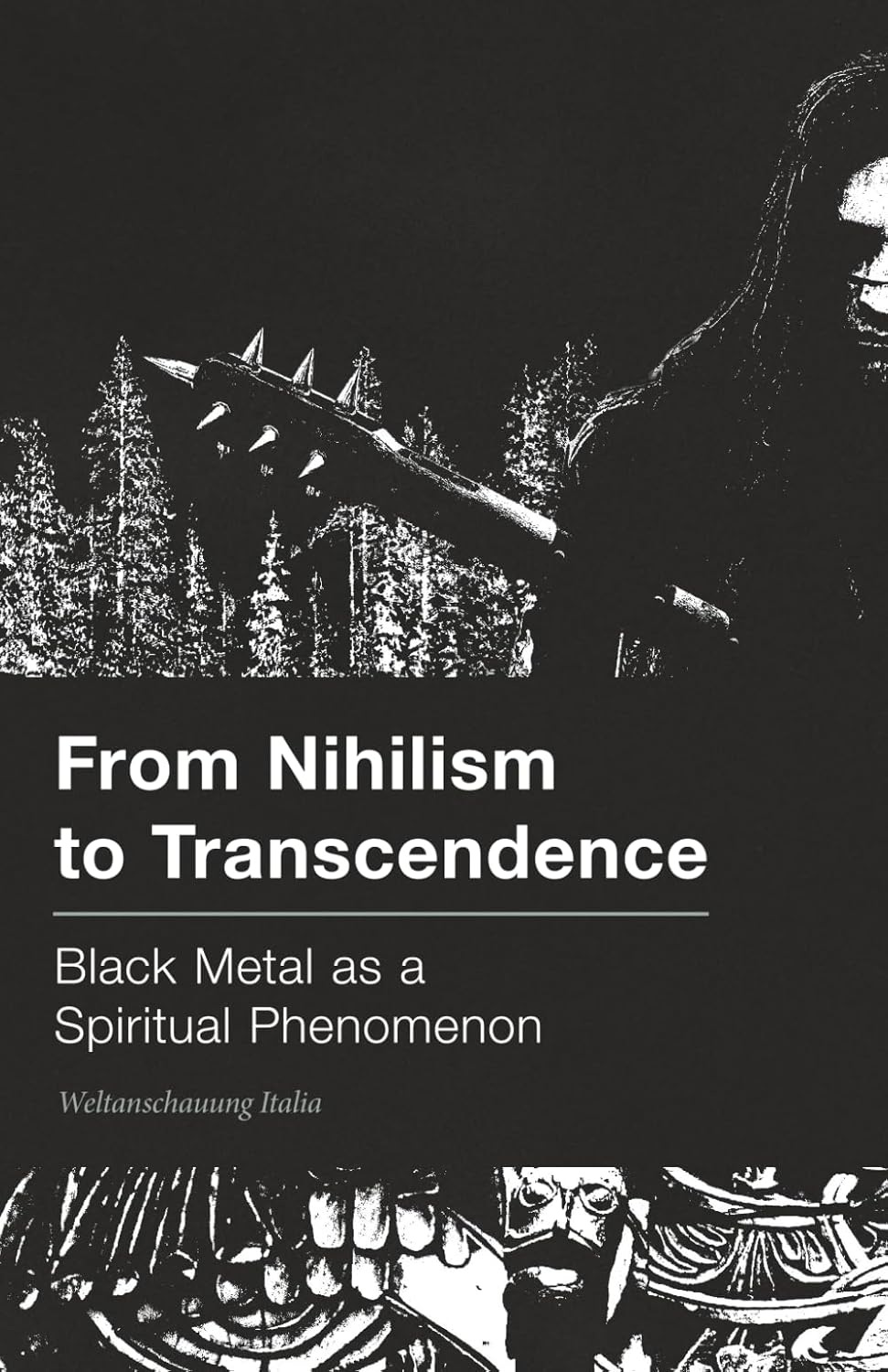
For those who know how to go beyond the surface, beyond the noise and provocation, black metal will remain what it has always been: not a destination, but a powerful and dangerous means of embarking on that inner journey that every human being, sooner or later, is called upon to undertake.
In the panorama of 20th-century music and subcultures, few phenomena have been so misunderstood and embodied such striking contradictions as black metal. From Nihilism to Transcendence: Black Metal as a Spiritual Phenomenon explores how this movement of rebellion, rejection, and darkness came to represent a spiritual and artistic laboratory for generations.
Tracing the genre’s origins, evolution, and main themes through a rich synthesis of musicology, sociology, and philosophy, From Nihilism to Transcendence moves beyond sensationalism and moral panic to uncover black metal’s paradoxical paths to rediscovering the sacred. Black metal’s soundscapes, symbolisms, and controversies are revealed in new light as creatively reflecting the fundamental, existential issues of our disenchanted and superficial age.