


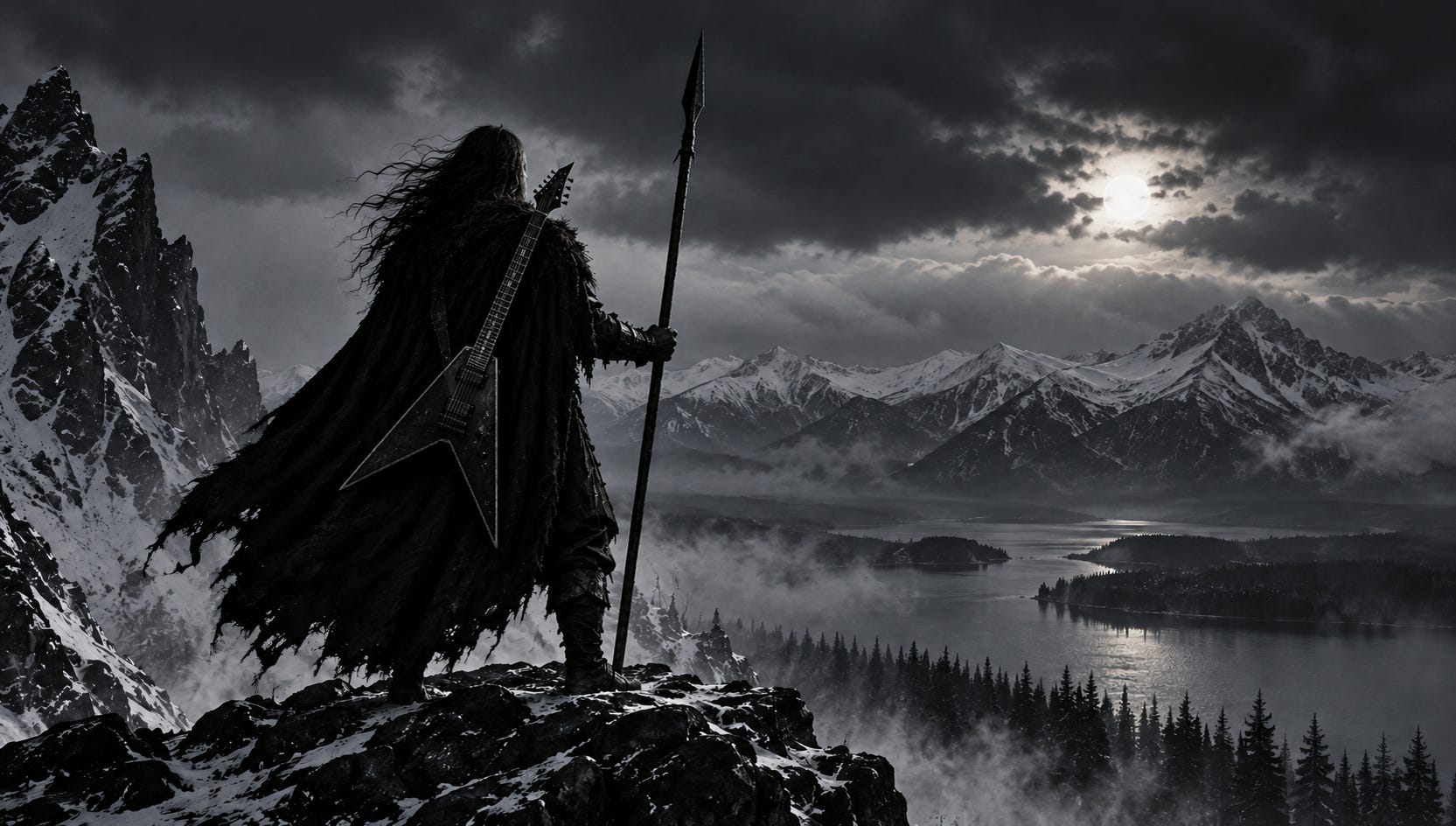
Since its origins, black metal has embraced an aesthetic and rhetoric strongly influenced by war and warrior imagery. Far from being merely stylistic exercise, this trend reflects profound aspects of the ideology and philosophy of this music genre, offering rich ground for cultural and musicological analysis.
Manifestations of the Warrior Aesthetic
The warrior aesthetic in black metal manifests itself in various ways, such as the creation of a coherent and pervasive symbolic ecosystem.
Iconography: the use of weapons (often medieval or ancient), armor, and military symbols is common on album covers, band logos, and musicians’ clothing. Recurring elements include swords, axes, horned helmets, shields with runes, and Celtic or Norse symbols that evoke the imagery of Northern European warriors.
Pseudonyms: Many artists adopt battle names or pseudonyms that evoke historical or mythological warrior figures. From Varg Vikernes (wolf) to Samoth (death), from Fenriz (Fenrir, the giant wolf of Norse mythology) to Ihsahn (son of ice). These names create an artistic identity detached from the civilian persona, transforming the musician into a warrior avatar.
Lyrics: The lyrics often depict battles, both historical and metaphorical, and celebrate warrior virtues such as strength, courage and resilience. The narratives range from Viking sagas and apocalyptic battles to mythological wars and inner conflicts of the soul.
Performances: Black metal concerts are often described as a kind of “sonic assault,” with the musicians adopting aggressive, martial poses on stage and often wielding instruments with aggressive shapes or adorned with war symbols.
The war metaphor in black metal operates on several interconnected levels, creating an intricate semantic architecture.
Spiritual Battle
War is often seen as a metaphor for an inner or spiritual battle, representing an individual’s struggle against the forces of conformity and mediocrity. This dimension has its roots in the medieval tradition of Miles Christi, is presented in the opposite way: the black metal warrior fights against Christianity and the established moral order.
This inner battle is fought on several fronts: the struggle against one’s own weaknesses; the overcoming of human limitations; and the conquest of a form of enlightenment through darkness. Significantly, many lyrics describe this process using the language of war: siege; conquest; victory and defeat becoming metaphors for states of mind and processes of personal transformation.

Cultural Resistance
Imagery of war is used to symbolise resistance against perceived corrupting or alienating cultural influences. Here, the reactionary nature of the movement is evident: war becomes a symbol of resistance against modernity, urbanisation, globalisation and the Americanisation of European culture.
This cultural war is fought through music, which is seen as a means of preserving and transmitting traditional values that are under threat from global standardisation. It is no coincidence that many bands use local languages or archaic dialects in their lyrics, transforming language itself into a weapon of cultural resistance.
Cosmic Conflict
In many cases, war is presented as a manifestation of cosmic forces in conflict, reflecting dualistic views of the universe. This dimension draws on both Norse mythology (Ragnarök) and Gnostic and Manichean traditions, portraying reality as a stage for an eternal battle between opposing forces.
Manifestations of cosmic conflict include the opposition between order and chaos, light and darkness, and creation and destruction.
Purification through Destruction
The idea of war as a means of purification and renewal is a recurring theme, often linked to concepts of apocalypse and rebirth. This conception has its roots in the tradition of furor teutonicus and in Nietzsche’s notion of creative destruction.
War becomes an instrument of collective catharsis, offering the possibility of spiritual and cultural rebirth by destroying the corrupt order. Many bands explore apocalyptic scenarios not as an end in themselves, but as a necessary prelude to a new era. The burning of Norwegian churches in the 1990s can be viewed as such: not as gratuitous vandalism, but as a symbolic act of purification through destruction.
The adoption of this warrior aesthetic has complex roots intertwined with European history, philosophy and anthropology.
READ MORE from Arktos:

Battle, Victory & Death in the World of Tradition
“War is father of all and king of all; some he has revealed as gods, some as men; some he has made slaves, some free.”
This proverb from the ancient Greek philosopher Heraclitus is re-energised for the modern day in Julius Evola’s Metaphysics of War. Revolting against the modern world’s reduction of war to geopolitics, economic interests, and humanitarian ideology, Evola summons ancient and medieval sources from both East and West to reveal how war can be seen as a unique arena of heroism and spiritual transformation at the origins of civilisation.
Written during the explosive years around the Second World War, the essays gathered in this volume explore the existential situation of war and the heights of the warrior ethos. Drawing on Nordic, Roman, Vedic, and other sacred texts and rituals, Evola points to the opportunity for men of the degraded, materialistic, nihilistic modern age to achieve a higher state of consciousness, rediscover the meaning of life and the human condition, and reconnect with metaphysical reality through a bond of mind and action.
Unlike today’s armies, which demand mere soldiers in the mercenary employ of a decadent ruling class, the authentic warrior tradition is a path toward transcendence which extends beyond the battlefield to transform all spheres of life and culture.
This revised and expanded edition of Metaphysics of War features additional essays as well as a new foreword and introduction connecting Evola’s ideas to both his era and our own.
Historical Influences
References to periods such as the Viking Age or the Middle Ages are not accidental: these periods are seen as times when warrior culture was at the heart of social organisation and the collective imagination. Black metal idealises these periods as moments of cultural authenticity, contrasting them with the perceived decadence of modernity.
In particular, the Viking era is seen as a model of a pre-Christian warrior society where values such as courage, honour and strength were paramount.
On the other hand, the Middle Ages offer the model of the inverted Christian warrior: the black knight, the anti-paladin who fights against the Church and the established order. This figure frequently appears in the genre’s iconography, from corpse paint that transforms the face into a death mask to band names that evoke medieval warlords.
Reaction to Modernity
The glorification of warrior virtues represents a reaction to the perception of a “weak” and “feminized” modern society. This criticism is articulated on several levels: the rejection of consumerism, alienating technology, and liberal democracy which is seen as a system that favours the weak at the expense of the strong.
Modernity is perceived as a degenerative process that has led to the loss of fundamental values such as honor, courage, and connection with nature. Thus, the metaphor of war is employed as a means for recovering a heroic dimension of existence, as opposed to the banality of contemporary bourgeois existence.
Extreme Individualism
The image of the lone warrior who is self-sufficient and fighting against the whole world reflects the extreme individualism that characterises much of black metal. Drawing as much on Nietzsche’s Übermensch as on the Norse berserker archetype, this figure combines modern philosophy and ancient mythology in an original synthesis.
The black metal warrior is often presented as a tragic and heroic figure at the same time: condemned to loneliness, he fights a battle that he knows is lost from the outset, but which is necessary to affirm his existential authenticity.
Interdisciplinary Comparisons
The war metaphor in black metal is not used in isolation; it is part of a broader cultural tradition spanning literature, philosophy and other art forms.
Genres such as death metal and thrash metal also use war imagery in extreme metal, but with different nuances. Death metal tends to focus on the brutal and physical aspects of war, whereas thrash metal often uses it as a form of social criticism. Black metal stands out for its emphasis on the spiritual and metaphysical dimensions of conflict.
In literature, parallels can be drawn with authors such as Ernst Jünger (Der Arbeiter, In Stahlgewittern), whose philosophy conceives war as a transformative experience, and with the tradition of dark romanticism that idealises warrior figures of the past.
Philosophical influences range from Nietzsche’s view of war as a means of overcoming to Carl Schmitt’s conception of conflict as a fundamental category of politics and Heidegger’s modern interpretations of technology and authenticity.
Interpretations and Meanings
Many artists view the warrior aesthetic as a metaphor for personal and artistic struggles, and as a battle against mediocrity.
Black metal artists present themselves as warriors engaged in a battle to create authentic and meaningful art against the forces of commercialisation and aesthetic homogenisation. Thus, the war metaphor becomes an expression of the “art for art’s sake” ethos taken to its extreme.
The warrior aesthetic provides a way to express and process aggressive emotions within an artistic context. Music becomes a vehicle for catharsis, allowing the controlled expression of impulses that might otherwise manifest themselves in socially destructive ways.
Evolution and Prospects
In more recent productions, the war metaphor of black metal has shown signs of evolution and sophistication. Bands such as Blut Aus Nord, Deathspell Omega and The Ruins of Beverast have adopted more abstract and philosophically complex approaches, employing war imagery to examine topics like modern alienation and the contradictions of technological progress.
The war metaphor retains its artistic vitality in black metal, adapting to cultural and social changes while maintaining its transgressive power and ability to offer radical criticism of contemporary society.
The warrior aesthetic and war metaphor in black metal represent a complex framework of historical, philosophical, and psychological influences. They reflect the combative and often antagonistic nature of the genre, they provide a means of expressing themes of struggle, resistance, and transformation.
Far from being a mere aesthetic ornament, this metaphor constitutes one of the central semantic nuclei of the genre, allowing for the articulation of a radical critique of modernity through the reactivation of archetypes and symbols from pre-modern European tradition.
However, as with other aspects of the movement, the warrior aesthetic has undergone a process of progressive commercialisation, emptying it of its original symbolic content. What began as an authentic expression of existential and cultural rebellion has, in many cases, become a mere marketing tool.
War iconography has become a replicable formula for gaining underground credibility: T-shirts with runic symbols, graphics that mechanically reproduce Viking or medieval elements, “warrior” poses designed for promotional photos. The metaphor of spiritual battle has been reduced to theatrical costume, losing its transformative dimension to become a mere aesthetic accessory.
Many contemporary artists use these symbols without understanding their cultural or philosophical meaning, reducing millennial archetypes to commercial clichés. The black metal “warrior” has become a character to be played rather than an existential ideal to be embodied.
Despite this commercial drift, the persistence of these elements in the genre’s imagery nevertheless testifies to black metal’s ability to function as a space for the cultural and artistic elaboration of the tensions and contradictions of the contemporary world. Even in its most superficial form, the warrior aesthetic continues to respond to deep needs for identity and belonging, albeit in contradictory ways.
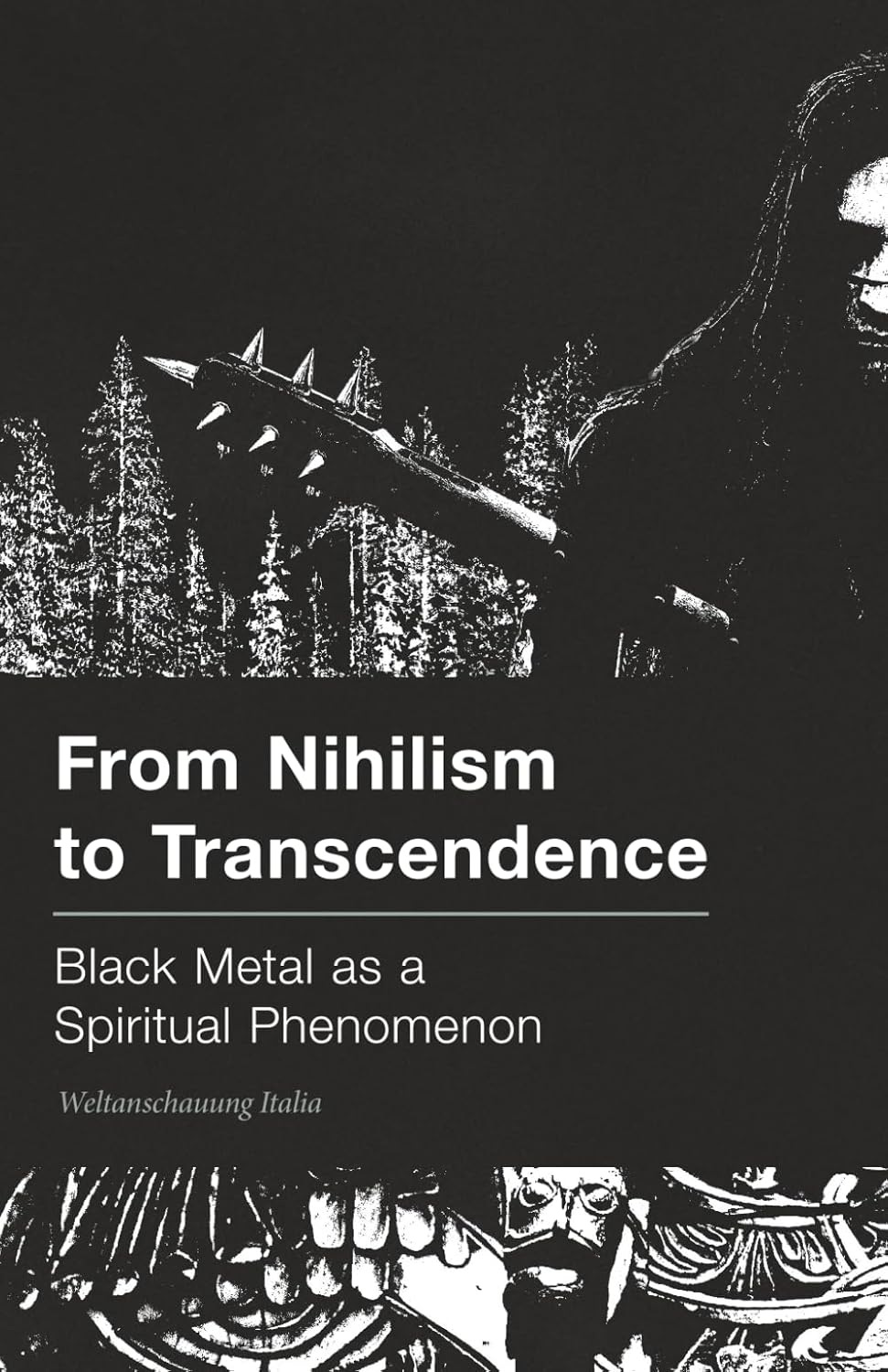
The above is an excerpt from From Nihilism to Transcendence: Black Metal as a Spiritual Phenomenon, brought to you by Arktos and available on Amazon:
For those who know how to go beyond the surface, beyond the noise and provocation, black metal will remain what it has always been: not a destination, but a powerful and dangerous means of embarking on that inner journey that every human being, sooner or later, is called upon to undertake.
In the panorama of 20th-century music and subcultures, few phenomena have been so misunderstood and embodied such striking contradictions as black metal. From Nihilism to Transcendence: Black Metal as a Spiritual Phenomenon explores how this movement of rebellion, rejection, and darkness came to represent a spiritual and artistic laboratory for generations.
Tracing the genre’s origins, evolution, and main themes through a rich synthesis of musicology, sociology, and philosophy, From Nihilism to Transcendence moves beyond sensationalism and moral panic to uncover black metal’s paradoxical paths to rediscovering the sacred. Black metal’s soundscapes, symbolisms, and controversies are revealed in new light as creatively reflecting the fundamental, existential issues of our disenchanted and superficial age.