


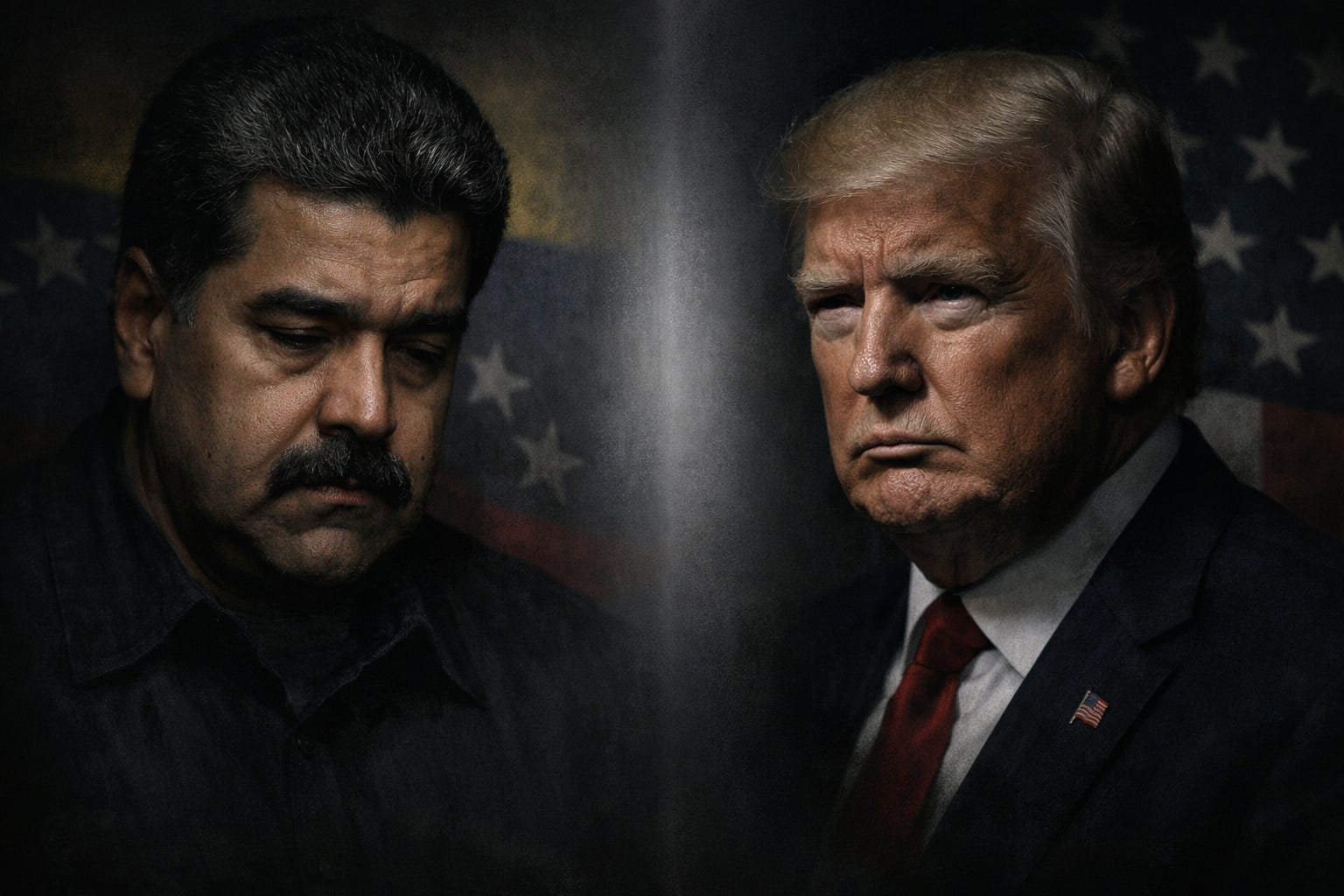
Nicolas Gauthier dissects the muted reactions in France and Europe to the bold US military intervention in Venezuela, questioning whether ideals like international law still hold weight in a world where brute force and strategic interests reign supreme.
“I felt like I was watching a television series,” Donald Trump reportedly said while watching the American mission in Venezuela unfold live. Now that the media frenzy has died down, it is time to take stock of the situation.
The least one can say is that, in France as well as Europe, reactions remain largely perfunctory, with the exception of La France Insoumise, resolutely opposed, and Giorgia Meloni, the Italian President of the Council of Ministers, resolutely in favor. While other authorities—from the Élysée to the Rassemblement National, including Les Républicains and the Socialist Party—do condemn this blatant violation of international law, the least one can say is that their outrage doesn’t go much further than that. And after all, what’s the point? Sure, Dominique de Villepin’s 2003 speech at the UN, which may have salvaged the honor of the Old Continent, didn’t stop the US from going to war with Iraq—with the results we all know. In the end, the power of words only matters when backed by real power—the power of arms. Villepin may have been heard; Trump is listened to. There’s a big difference.
Don’t confuse Maduro with Chávez
Another nuance clearly lost on many of our colleagues: Nicolás Maduro is not Hugo Chávez. The latter was a charismatic, populist, nationalist leader, and also a builder—he was the first Venezuelan head of state to try to pull his country out of the trap of an oil rent monopolized by local oligarchies. He attempted to diversify the economy and worked tirelessly to lift his people out of structural poverty. His struggle echoed that of his compatriot Simón Bolívar, the man who, after breaking with the Spanish crown, also rejected Yankee tutelage over Latin America—a kind of third way, so to speak.
Maduro’s path has been entirely different. From the petty bourgeoisie of Caracas, he joined the Socialist League, a small Marxist group, early on, working as a bodyguard before being sent to Cuba for training in a Communist Party school. In short, an apparatchik without much stature, cut off from the realities of a people he doesn’t really know all that well. Hence the increasingly authoritarian drift that would have repelled his august predecessor. For proof, one need only reread Que la bête meure (Let the Beast Die), one of the best SAS novels on the subject, in which Gérard de Villiers describes how the CIA protected Chávez from assassination plots orchestrated by Venezuela’s upper class—white, of course—who saw him as a half-indigenous communist. Back then, the White House seemed to regard this autocrat as a respectable figure to be dealt with, however begrudgingly. Clearly, those days are long gone.
The persistence of the Monroe Doctrine
And yet, some of our colleagues act surprised by such a show of force. The more well-read among them point to the revival of the Monroe Doctrine, laid out in 1823 by President James Monroe, which claimed that the southern half of the Americas was to be Washington’s exclusive domain. Governments may have changed since, but both Democrats and Republicans have always enforced that doctrine—sometimes with kid gloves, more often without. In 1901, the US occupied Cuba just after it had broken free from Madrid, effectively trading one master for another. No need to revisit the farcical episode of the Bay of Pigs in 1961, when the CIA tried to oust Fidel Castro—who himself had ousted Fulgencio Batista, a White House-installed ruler. Beyond the litany of coups organized in Latin America by American intelligence, two other expeditions foreshadow the one now playing out in Venezuela.
In 1983, during Ronald Reagan’s first term, US special forces parachuted into Grenada, whose government—led by a revolutionary military council—was leaning toward the Castro regime. Though it wasn’t the age of prestige TV yet, the Hollywood flair of the operation inspired Clint Eastwood to direct one of his most brainless films, Heartbreak Ridge (1986). In 1989, George Bush invaded Panama and kidnapped its president, Manuel Noriega—at the time a quasi-official CIA asset, but also an unofficial drug trafficker. In 1992, he was sentenced to 40 years in prison by a Miami court.
In short, as noted earlier, there’s nothing new under the sun. Strong nations impose their will on the weak. What was Françafrique1 if not a series of coups where the Élysée replaced inconvenient strongmen with more manageable ones? Back then, at least, there was some pretense, however hypocritical.
The real change is that Donald Trump has no use for niceties. He says what he’ll do and does what he says. Unlike, say, Woodrow Wilson, who served as US president from 1913 to 1921 and founded the League of Nations, which intended to end all wars, but failed to stop a single one. In 1914, Wilson’s humanitarianism didn’t prevent him from invading Mexico and staying for three years. At the same time, he launched military interventions in Haiti and the Dominican Republic, supposedly to protect American interests. Not bad for a pacifist—though he was also a great admirer of the Ku Klux Klan and the architect of Prohibition. Cheers to you, Woodrow...
France’s diplomatic vanishing act
There are two kinds of autocrats: those who behave like it and own it, and those who do the same while lecturing the world on morality. If forced to choose, one might as well go with the former. Donald Trump fits that bill quite well—just like his Russian and Chinese counterparts, Vladimir Putin and Xi Jinping. Still, one might prefer Bernard Kouchner; bad taste is universal.
Meanwhile, European institutions are clinging to the belief that passing a law against war will somehow outlaw war itself—though war has had its own laws since the dawn of man, with the law of the strongest generally prevailing. The true genius of diplomacy once lay in avoiding war—not in the name of childish moral dualism (defending the “good” against the “evil”), but out of a pragmatic understanding of mutual interests. The war in Ukraine might have been avoided had the Quai d’Orsay become something more than a neocon satellite under American sway. It was, after all, the US that pushed Russia into war—just as they did with Iraq in 1990, forcing Saddam Hussein to invade Kuwait.
In that sense, the American escapade in Venezuela follows a very different logic. Trump, in his trademark bluntness, openly states that US troops are there to profit from local oil. Such honesty is, quite literally, disarming. The same goes for Greenland, which could soon meet the same fate. For all his boorish demeanor, Trump seems to have done some historical homework. In 1867, the US already offered to buy Greenland from Denmark. The offer was renewed in 1946 by President Harry Truman and again in 2019 by—guess who—Donald Trump during his first term. Say what you will, but the man is consistent. What may seem like yet another of his eccentric whims is, in fact, long embedded in White House policy.
Of course, defenders of the international order object that what Trump did in Venezuela somehow excuses what Putin is doing in Ukraine—or what Xi Jinping might one day do in Taiwan. They’re not wrong. But Trump no longer feels the need to justify himself, and Xi likely won’t bother either—since he sees Taiwan as an integral part of China, which, incidentally, aligns with so-called “international law.”
And what about domestic policy?
Donald Trump was re-elected specifically to focus on domestic policy. Hence the anger among parts of his MAGA base, especially its isolationist wing, who fail to see the point of bombing Iran on Israel’s behalf or now invading Venezuela—perhaps soon followed by Cuba or Colombia. Even if this lightning raid was a success—likely aided by high-level internal complicity—what next? It’s not just Arabs who know how to fight guerrilla wars; South Americans are no amateurs either. That could soon become an electoral problem, especially considering that the increasingly crucial Hispanic vote, which helped secure his 2025 win, could just as easily doom him in the upcoming midterms. Play with too much fire, and you might get burned. This is a concern that clearly doesn’t trouble the minds of our Brussels technocrats, who are incapable of grasping that their so-called “new international order”—this organized chaos—was just a hypocritical interlude, and that reality is now reasserting itself. Assuming, of course, that it was ever forgotten. The past, as they say, still has a future.
Translated by Alexander Raynor
Originally published on Éléments on January 6th, 2026
Françafrique (French Africa) refers to the complex, often neocolonial, network of political, economic, and military ties France has maintained with its former colonies in Africa.
Your description of Maduro is unfair. He was a bus driver and head of the bus drivers union as well as becoming a loyal supporter of Chavez and a party minister. He was handpicked by a Chavez as successor when the latter was dying.
I wonder if Trump cackled like Hilary did as she watched humans dying in Iraq and Libya.