


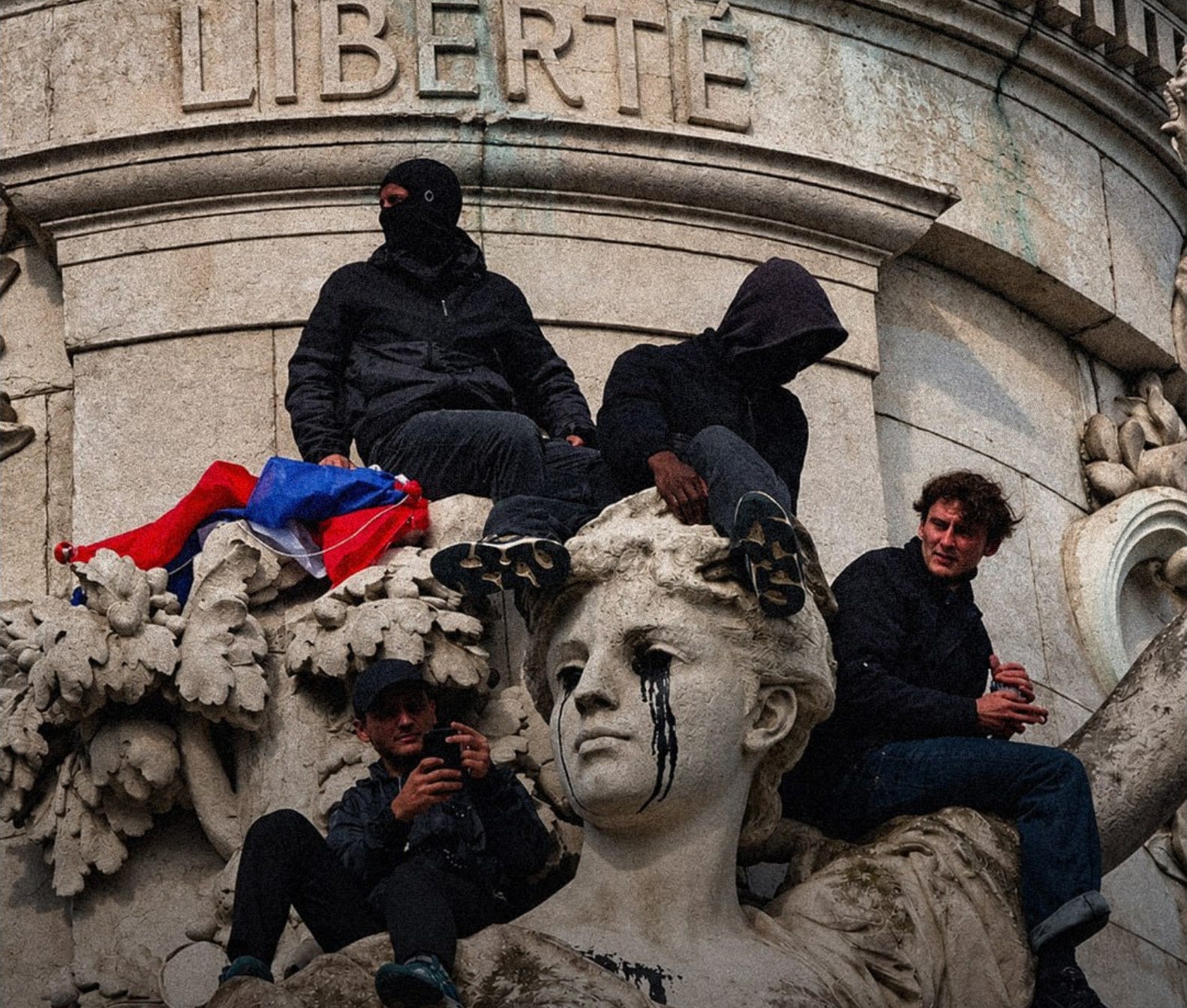
Alain de Benoist sets out three remarks on immigration ahead of France’s next presidential election. He argues that no restriction is possible as long as judges rule in the name of human rights rather than the people, that opponents of immigration must also confront the capitalism that depends on it, and that assimilation cannot work for large, established communities.
Mass immigration and its corollary, lack of public safety, are not the cause of Europe’s decline but a symptom of it. They are, on the other hand, the primary cause of the rise of populisms, and they will be one of the main issues of the next presidential election. Let us contribute to this debate with three simple remarks.
First remark: nothing can be done in the fight against settlement immigration unless we first blow open the lock held by the judges, who have now become the censors of the Republic. Whatever measure a government determined to curb immigration might wish to apply, or even to implement a policy of reversing migratory flows, the judges will oppose it. They have long since ceased to judge in the name of the French people. They judge instead in the name of human rights, that is, in the name of the primacy of the juridical over the political, of the rule of law over democracy, of “non-discrimination” over the common good, and of the sacralization of subjectivities over the will of the people.
Stopping immigration means stripping judges of the power to censor the content of laws for failing to conform to the diktats of a dominant ideology that have been improperly “constitutionalized.” It means dissolving the Constitutional Council and the Council of State and refounding them on new bases, obliging them to keep to their original function. And it means treating as null and void the rulings of the European Court of Human Rights and similar bodies, which have no democratic legitimacy whatsoever.
READ MORE:
Who Will Judge the Judges?

Alain de Benoist examines recent judicial interventions in electoral processes across multiple countries, arguing that such judicial actions represent a fundamental assault on popular sovereignty, where unelected judges effectively decide who citizens can vote for. The problem, de Benoist contends, is the concept of the “rule of law”, a liberal ideologi…

Second remark: fight against immigration or economic growth — one must choose. Drawing on a recent book by Paul Morland and Philip Pilkington, Anthony Marinier recalled in these very pages the “trilemma” arising from the fact that it is impossible to combine falling birth rates, economic growth, and ethnic and cultural continuity all at once. Either falling birth rates are coupled with growth, and recourse to ever more massive immigration becomes inevitable: this is the choice made by the leaders of Western Europe. Or immigration is refused without birth rates being raised: this is the choice made by Japan, which for two decades has posted near-zero growth despite its recourse to robotization. In a period of demographic crisis, fighting mass immigration means ceasing to treat growth as an absolute.
Not a single European country today still prides itself on leaving its borders open; not a single one still sees in the steady rise of immigrant flows an “opportunity” for society. No party openly calls for “more immigrants.” Only big business still does. It was big business that first primed the suction pump of immigration at the end of the 1950s (despite a high birth rate), and it is big business that today stands as its last defender. In January 2026, in Spain, the government of Pedro Sánchez announced the legalization of half a million illegal immigrants “to support growth.” “The economy massively needs immigration,” proclaims Patrick Martin, president of the Medef1, which at least has the merit of clarity.
The capitalist system rests on wage labor and produces not so much goods as things made to be sold, that is, commodities. It has a vital need for an influx of uprooted masses, yesterday through the rural exodus, today through immigration. These masses offer a triple advantage: they have been stripped of the forms of social protection present in their communities of origin; they are scarcely unionized and therefore a priori less inclined to press demands; and they are eminently usable for exerting downward pressure on wages while increasing the number of consumers.
In its essence, mass immigration is indeed the reserve army of capital, a capitalist invention.
Liberalism, for its part, sees in immigrant communities nothing but sums of individuals, without regard for the “externalities,” that is, for the anthropological, cultural, and social consequences of their influx. It has always declared itself in favor of the free movement of people, capital and goods, perceiving every political border as an obstacle to the free market and an instrument of coercion wielded by public authority. For the libertarian Murray Rothbard, “no land area, no square footage in the world shall remain public; every square meter of land must be privatized.” By accelerating the division of labor, migratory flows would supposedly contribute to “progress.” Nomadic humanity and generalized uprootedness versus human biodiversity!
To criticize immigration while remaining silent about capitalism amounts to ignoring capital’s capacity to neutralize whatever resists it. This is an inconsistency of the first magnitude, and it casts a rather strange light on the overtures which anti-immigration parties make to win over big business. In reality, one can only dismiss both sides equally: those who claim to fight capitalism while refusing to oppose immigration, and those who claim to fight immigration while refusing to oppose capitalism.
Third remark: assimilation is an elegant way of describing the abandonment or dispossession of everything that once was more than mere numerical individuality2. Assimilation is possible for individuals or small groups, provided that immigration is limited in time and in volume and that the cultural differences between the society of departure and the society of arrival are not too great. But it is impossible for large populations and established communities.
As early as 1994, Jean Mabire posed this simple question: “How could a country that has not managed, in thirty years, to fully integrate one hundred thousand harkis3 who had fought to remain French be capable of assimilating fifty or a hundred times as many?” Civilizational facts are not an optical illusion. It has not been sufficiently noted that immigration is also proof of the failure of the decolonizations.
Stranger still is the sight, today, of historic adversaries of the Enlightenment calling for an “Islam of the Enlightenment,” and of anti-moderns reproaching Muslims for not being modern enough. These anti-moderns turn against Muslims exactly the same arguments their own adversaries once used against Catholics (”medieval” mores, the subjugation of women, etc.), and in doing so they join their voices to the chorus of those who sing the praises of the “liberated” immigrant, reduced to the state of an individual swallowed up by the model of Homo economicus.
One cannot at once extol the merits of collective memory and enjoin newcomers to renounce or ignore their own. It is the excesses of assimilationist universalism that have produced, by reaction, the racializing identitarianism of the “wokeists.” That universalism was founded on the alliance of morality and economics, and it believed that one need only appeal to the universal to make the common spring forth. Yet living in common is something altogether different from “living together.” Communities can just as well foster integration as feed secession. Today as always, it is the refusal to take differences into account that feeds separatism.
As Marcel Gauchet has observed, Jean-Luc Mélenchon behaves like a perfect liberal when he calls for “the free movement of people, in other words, the right to immigration, perhaps the neoliberal cause par excellence in our historical moment, the proof in action of the universality of individual rights in a world without borders.”
For different reasons, wokeist progressives and the captains of industry alike have every reason to rejoice at the emergence of a “new France” at last “rid of all its previous culture and all its popular traditions” (Jean-Claude Michéa). What they fail to see is that by substituting the “multicultural” for the old cultural identity, one also mechanically creates the conditions for a war of all against all. It bears repeating: the false dilemma of “inclusive society” or “republican universalism” is unacceptable.
Originally published in Éléments no. 222, October-November 2026
Translated by Alexander Raynor
READ MORE by Alain de Benoist, brought to you by Arktos:


TN: Mouvement des entreprises de France, France’s principal employers’ federation.
TN: individualité numérique: the individual reduced to a countable unit; the author’s point is that assimilation strips away every belonging beyond bare individual identity.
TN: Algerian Muslims who served as auxiliaries in the French Army during the Algerian War and were repatriated to France after 1962.