


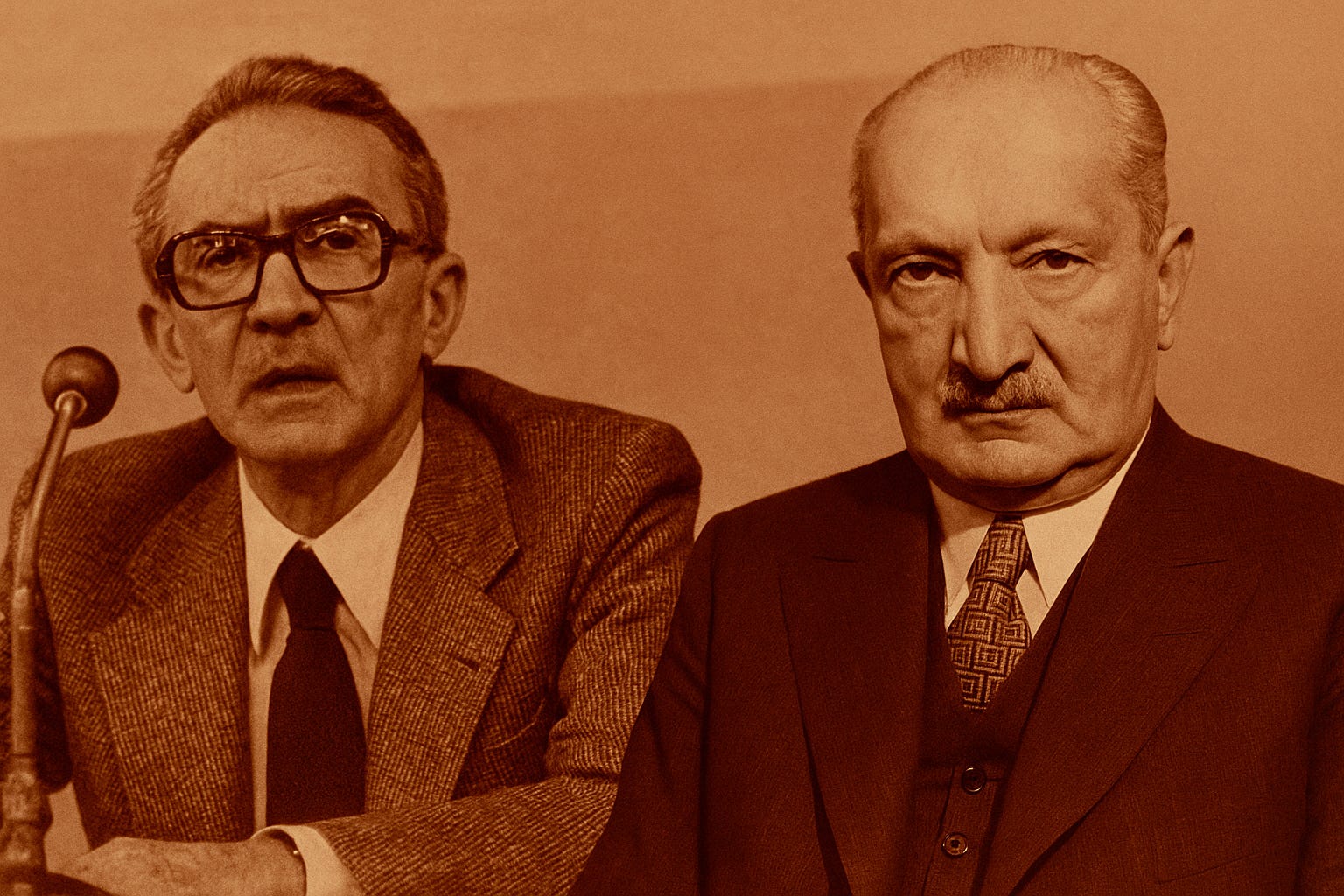
Antoine Dresse (“Ego Non”) explores Italian philosopher Giorgio Locchi’s radical reinterpretation of Martin Heidegger’s work, positioning it as the philosophical culmination of what Locchi calls the “superhumanist myth” that rose with Wagner and Nietzsche and dared to envision a new beginning for European history and thought.
Heidegger is rightly considered one of the most complex thinkers of the German tradition, his hermetic and obscure language enough to frighten any reader not versed in philosophical discipline. In doing so, his work seems reserved for the small academic world and generally only emerges from it during controversies of the lowest journalistic level. Where the general public usually only hears about him regarding his political “compromises,” the academic world, conversely, most often engages in an outrageously intellectualizing and abstruse reading in order to make his thought acceptable or harmless to the dominant ideology.
Quite different is the interpretation undertaken by Giorgio Locchi, author of Wagner, Nietzsche et le mythe surhumaniste (Wagner, Nietzsche and the Superhumanist Myth). After presenting his reflections on the “superhumanist tendency,” the Roman philosopher refined his reflections through a meditation on Heidegger, in whom he recognized the third great load-bearing wall of this historical tendency born with Wagner and Nietzsche.
Far from being a marginal figure of this intellectual current, Locchi even sees in Heidegger’s work the acme of the German Conservative Revolution, the place where one must seek “the most fruitful impulses of a thought aiming to restore vigor to this vision of the world of history which, in the first era of our century, attempted to offer Europe another destiny1.”
Wagner would have represented for the first time in his dramas, in mythical form, a new sense of the time of history, Nietzsche would have then expressed it poetically, and Martin Heidegger would have conceptualized it. Such is, in substance, the Locchian thesis.
A Foundational Reading
What Locchi identifies as the Wagnerian rupture does not reside solely in an aesthetic renewal or an attempt to restore myth as a living form of the sacred. It is primarily a revolution in the gaze cast upon history. The Ring and Parsifal, notably, do not replay ancient legends: they stage, in dramatic form, the end of a world – that of gods, of natural orders – and the emergence of a new humanity, now alone in bearing the burden of meaning. The famous formula from Parsifal, “Redemption for the Redeemer!”, signals this fundamental reversal: salvation no longer comes from above, but is played out here below. It is no longer the divine that saves man, but man who, in his tragic freedom, redeems the lost meaning of the world. He becomes, in time itself, the source of historial meaning.
Nietzsche, heir and critic of Wagner, pursues this revolution by displacing it onto the philosophical plane. His Eternal Return cannot be reduced to a simple cosmic loop. It expresses a spiritual demand: that of being able to will history as it is, in its totality, without repentance or transcendent salvation. History, for Nietzsche, does not have to be redeemed from outside: it must be reaffirmed in its tragic texture, by a will that, instead of fleeing becoming, recaptures and transfigures it.
The Nietzschean superman is one who assumes time without promise of redemption, who accepts that the past is not abolished, but can, in the instant, be taken up anew and reoriented. Becoming thus becomes an act of creation: it is no longer about enduring history, but about engendering it by fully exposing oneself to it.
It is in Heidegger, however, that this new feeling of time reaches its most rigorous formulation, Locchi believes. Where Wagner gives a mythical intuition of it and Nietzsche a poetic intensity, Heidegger reveals its ontological structure. In Sein und Zeit (Being and Time), he does not propose a new philosophy of history, as Hegel would, but thinking of being as temporality.
Man is not a more evolved living being than others, a “rational animal,” but Dasein, that is to say a being for whom to be is to relate to Being – and to do so in time. Heidegger describes this temporality as ecstatic: it is neither linear nor cyclical, but stretched between three irreducible dimensions. Man is thrown into a past he did not choose (Geworfenheit), he projects himself toward a future he must invent (Entwurf), and he stands in a present of decisive instant (Augenblick), where he can either assume or flee from his destiny.
What Time Is
This is indeed a central point in Giorgio Locchi’s thought: temporality is not unique, homogeneous or universal. He affirms, in a Heideggerian perspective, that time takes on a different meaning according to the level of reality in relation to which one situates oneself: microphysical, macrophysical, biological or historical. As his son, Pierluigi Locchi, explains,
“macrophysics has no history, no historical dimension: as we understand it and as we can effectively represent it, it is a configuration that changes in time. Microphysics, the elementary, has its own constitution of being: it is uniquely, in one way or another, discontinuous. Life also is not historical: in its effort of ‘reproduction of the identical,’ it is subject to evolution; and if it is effectively ‘evolutive,’ it is in its essence ‘remaining-identical-to-itself’2.”
Man alone, Dasein, is open to historical or historial (geschichtlich) time, that is to say the only level where temporality becomes consciousness, responsibility, and the creation of meaning.
Historial time thus thought is no longer a framework in which events are inscribed, nor a river that one goes up or down. It is the very structure of human existence as openness to the world. Man becomes time: not in the sense that he would be delivered to an inevitable flow, but because time is the very space of his engagement, his freedom, his power of foundation.
What Heidegger discovers, and what Locchi forcefully emphasizes, is that history is not a chain of causes and effects, nor a linear progress, nor an eternal repetition. It is the field of projected freedom, of assumed or refused signification. The historial man is he who, by tearing himself away from simple biological life, by distinguishing himself from animality and modern massification, rises up in time to found a world.
Toward a New Beginning
Giorgio Locchi sees in this filiation – Wagner, Nietzsche, Heidegger – the thread of a new myth: the superhumanist myth, which frontally opposes the dominant myth of egalitarianism. While the latter promises universal reconciliation in a beyond of the tragic, superhumanism affirms that man only accomplishes himself by assuming the irreducibility of his destiny, by projecting himself toward a singular, non-reproducible historical work.
This mutation of the feeling of time is therefore not just a philosophical question: it engages a new vision of man, of culture, of politics and of the world. It perhaps announces, for those who perceive its possibility, the beginning of another history:
“Giving meaning to the past again is part of the ‘possibility’ of the Dasein who decides himself historically: for the Dasein can, with us, from his ‘projected’ future into the past, choose his own having-been [Gewesenheit] (against other possibles). The ‘new’ man faithfully returns to tradition, but what his tradition must be, he freely determines himself3.”
Further reading:
Giorgio Locchi, Wagner, Nietzsche et le mythe surhumaniste [Wagner, Nietzsche and the Superhumanist Myth], La Nouvelle Librairie, coll. “Agora” de l’Institut Iliade, 2022.
Giorgio Locchi and Guillaume Faye, Sur Heidegger et le mythe surhumaniste [On Heidegger and the Superhumanist Myth], La Nouvelle Librairie, coll. “Agora” de l’Institut Iliade, 2025.
Michael Millerman, Beginning with Heidegger: Strauss, Rorty, Derrida, Dugin & the Philosophical Constitution of the Political, Arktos, 2021.

Originally published in Éléments no. 214, June-July 2025
Translated by Alexander Raynor
Buy Antoine Dresse’s book: Political Realism

Giorgio Locchi, Sur Heidegger et le mythe surhumaniste (On Heidegger and the Superhumanist Myth).
Ibid., p. X.
Ibid., p. 12.