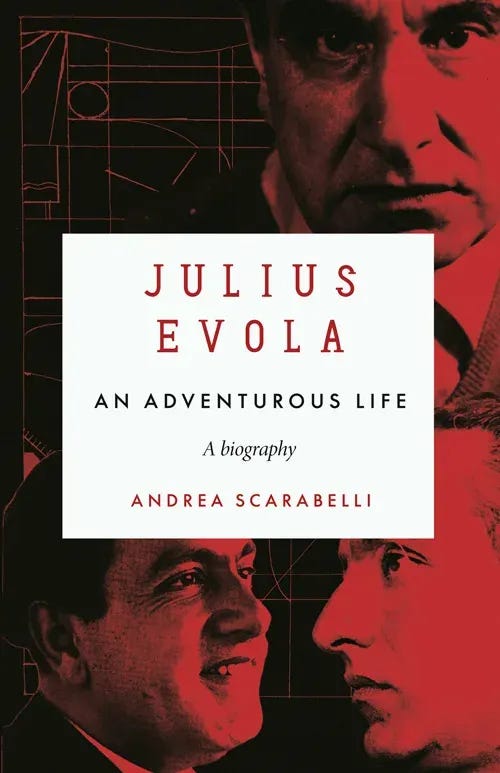
Excerpt from Chapter 8 of Andrea Scarabelli’s Julius Evola: An Adventurous Life, now available from Arktos and PRAV Publishing.
‘I am back in Rome, with the intention of remaining here from now on, if the necessary conditions can be arranged’, Evola wrote to Aniceto Del Massa on 23 May 1951, five days after his return. This stability proved fleeting: the next day, at ten o’clock in the morning, agents of the Political Police — led by Umberto Federico D’Amato, the future head of the Reserved Affairs Office — burst into Corso Vittorio. Due to Evola’s health condition, they placed him under house arrest, and he ended up in prison a few hours later as the alleged ideologue of the Fasci d’Azione Rivoluzionaria (Fasces of Revolutionary Action). This was the first application of Law No. 1546 of 3 December 1947 — aimed at ‘repressing Fascist activity and activity directed at the restoration of the monarchical institution.’
The philosopher would call this ‘a farcical affair’ — a little show set up by the police with various extras, the FAR being ‘a small group of young people who called themselves the ‘Black Legion’,’ the Imperium group, and some paper bombs detonated ‘pretty much in a tumultuously goliardic spirit.’ However, the deus ex machina was missing: ‘As many of the young men treated me as their ‘master’, as I was the author of Orientations, as I had handed a couple of articles of mine — and purely cultural articles at that — to the editors of Imperium by way of encouragement, I was soon accused by the police with such a fabricated role and arrested.’
The trajectory of the Fasci d’Azione Rivoluzionaria can be divided into two phases. The first runs from 1945 to 1947, while the second begins in the second half of 1950, when the acronym was resurrected by a new group that included, among others, Rauti, Graziani, Gianfranceschi, Erra, Franco Petronio, Cesare Pozzo, Mario Gionfrida, Nino Capotondi, Franco Dragoni, and Alberto Ribacchi. The FAR carried out acts of a purely demonstrative nature, without any deaths or injuries: on 27 October, a paper bomb exploded in the Galleria Colonna (a shopping mall), spreading a series of leaflets signed Legione Nera (Black Legion), followed by two more devices set off in the offices of the Republican Party and the Socialist Party on 16 November. On the same day, Erra and Rauti were arrested, while Cesare Pozzo was indicted in Padua. Informed of the facts, Evola wrote to Gianfranceschi: ‘Unfortunately, I already knew of Erra’s arrest as well. It is the height of absurd idiocy. I thus hope that, as is most likely, the trial will end in a soap bubble.’ Things would not turn out that simple.
On 13 March 1951, while Evola was still living in Bologna, two bombs exploded in Rome — in front of the Foreign Ministry — and in Milan, near the US embassy. Others followed in Arezzo, Brescia, and Bari. At that point, the police arrived at Imperium: an expert’s report revealed that the latest issue had been printed with the same typeface as the FAR leaflets (whose statutes were found at the home of MSI member Luciano De Perini). Interrogations, searches, and arrests ensued: weapons and attacks aside, the charge was of attempting to reconstitute the PNF. It was the first ‘trial of ideas’ of the new Republic.
On 18 May, the day of his return to the capital, Evola received an unusual letter from Angelo Berenzi, containing a warning:
According to rumours in Rome, our ‘diligent’ police […] are in an ever-increasing and almost pathological state of alarm due to a terrible organisation whose ranks are being laboriously unravelled, namely the FAR. […] The problem is that, again according to Roman rumours, the leader or one of the leaders of this organisation is one J . Evola!!!…
Five days later — on his return from Sweden — Gianfranceschi was arrested. They ordered him to speak: if he remained silent, they would arrest Evola. He only gave in when they extended the threat to his wife, who was pregnant at the time. Shortly afterwards, it was the turn of Graziani, Sterpa, and Petronio, among others.
Given his health condition, the alleged ‘Master of the FAR’ did not end up with the other prisoners, but was taken by ambulance to the Regina Coeli infirmary — where he would spend six months. After so many years, the newspapers returned to cover him. Here is a small press overview:
‘The former Fascist leader, who arrived in Rome only 13 days ago from Bologna — where he had been hospitalised in the Putti clinic for some time — is said to have planned the various attacks and indicated the people who were to carry them out. He is said to have made several trips to Milan, where one of his brothers, also a former Fascist leader, resides’ (Corriere dell’Informazione, 30–31 May).
‘A former Fascist journalist and race theorist’ (Corriere della Sera, 3 June), a ‘‘historian’ and ‘philosopher’ of neofascism […] his statement — full of quotations, mottos, and the most arbitrary and bizarre historical references imaginable — was listened to with religious attention by the defendants’ (L’Unità, 13 October).
‘He is the author of a peculiar philosophical system, which went by the name of ‘philosophy of the I’’ (Corriere della Sera, 31 May).
‘He is content to be considered a guru by two dozen fanatical kids’ — carrying forward ‘the confused idea of a medieval Fascism, mixed with cabalistic magic’ (L’Europeo, June 1951).
The prize, however, goes to the 5 June issue of L’Unità, which ran the headline:
‘Low-level mysticism and TNT bombs. The Black Legion bombers: Buddhists and devotees of magical rites. The ignorance, racial intolerance, and fanaticism of the young Nazi-Fascists. Julius Evola’s teachings. The sentences foreseen for the main perpetrators.’
Curiously, the ‘philosopher’s third name’, Andrea, appears again on the arrest report, while an article in the French press, published in Tunisie-France, reports another, even more peculiar name. Here are a few excerpts from the piece, satirically titled The ‘Sun Men’ Have Failed in the Tough Job of the Dynamiter:
‘The grand master of the group is Julius von Evola. This Germanised name will say absolutely nothing to readers, because the ‘master’, Julius von Evola, is as German as you and I: his real name is Cesarino — as Italian as you can get.’
Very Italian indeed — but certainly not belonging to the protagonist of this story, who, moreover, would also be called this name on another occasion, two years after his death, by Pier Giuseppe Murgia, who spoke of ‘Cesarino Evola, a baron philosopher and lover of magical practices.’
On the subject of ‘magic’, Tunisie-France’s article closed with the words: ‘While waiting for the day when their prestige will shine in all its splendour […] our ‘sun-men’ are content to draw hooked crosses in their cells.’ This little mystery is also linked to another document, namely an inventory of materials seized by the police and contained in the court documents. The list speaks of a letter (unaccounted for in the files) ‘addressed to the editorial board of Imperium, at Gianfranceschi’s house, from a certain Gianmaria (surname unreadable), whose sender begs Rauti to remind him of what was discussed with the Baron (Evola), in order to get him to admit that it was ‘a mistaken magic operation.’’’ Might this be a reference to the Viennese incident? This ‘Gianmaria’ (perhaps the Genoese Giammaria Gonella, a pupil of the Kremmerzian Marco Daffi) ‘adds a few lines for Rauti, in which he suggests adopting magical practices to find relief (these are references to Evola’s work in the field of Oriental esoteric disciplines) and advises him to draw some signs at the four cardinal points of the cell, including strange swastikas, reproduced in the letter.’
READ MORE about the ‘Vienna incident’:
The Bombs, Body, and Books of Julius Evola

Excerpt from Chapter 7 of Andrea Scarabelli, Julius Evola: An Adventurous Life
If the tones used by the press are very vague, the summary drawn up by the prosecution is no less so: Evola is said to have maintained ‘that the amorphous mass of the majority, constituted by the plebs, was destined to be dominated by the bearers of the symbol of Imperium — that is, by a minority constituted by the elect’, those who ‘prefer the uncomfortable life’. ‘The defeat of Italy, Germany and Japan, ‘who had elevated Imperium to their symbol’, would have been due to ‘the sole reason of having had men who were not up to the situation and not heroic and decisive enough, whose struggle had to be resumed in order to arrive at the creation of the new world on the ruins of modern civilisation, on which the few new men of the future would be erected.’
On Wednesday, 30 May, at half past five, Giulio Cesare Evola (this time, there is no third name) was subjected to a first interrogation:
‘Since the years of my early youth,’ he declared, ‘I have dealt with philosophical and historical problems, defending a vision of life, of an aristocratic and hierarchical nature, from which I have drawn political consequences.’
His collaboration with the journals considered close to the FAR was ‘prompted by a Roman friend, whose name I refuse to mention.’ This was obviously Scaligero: ‘He told me that there was a group of young people in Rome who were very interested in my ideas and therefore wanted me to lend them my services.’ Finally, Evola returned to the Roman meeting of a year earlier — and the Bologna Congress he had attended in silence.
Less than a week later, on 4 June, he underwent a new interrogation. He con-firmed the previous deposition, dwelling on the relations between Imperium and the MSI. The ‘spiritualists’, who had invited him to write through the Anthroposophist, deprecated certain materialist tendencies in the movement, opting for ‘criteria of authority, order, justice, and hierarchy. Since I too have always advocated such principles on a purely ideological level, I did not withhold my collaboration.’ As for the charge, he states that he was not aware of either FAR or any ‘activist’ programme: ‘I did not intend said journalistic collaboration to incite or in any way collaborate in the reconstitution of the Fascist Party, of which I have never been a member.’
It is enough to read Evola’s articles, along with Orientations, to come across the call for a primarily interior reconstruction: ‘Nothing has been learnt from the lessons of the past by those who delude themselves, today, about the possibilities of a purely political struggle.’ As we have already seen, Evola was interested in constituting an elite — not squads of thugs or bombers — and hoped for the presence of men capable of keeping themselves intact in the general decay, ‘to serve as exemplars; not by pandering to demagogy and the materialism of the masses, but in such a way as to reawaken different forms of sensibility and interest.’ In 1959, he would write: ‘It is certainly not my fault if some have made arbitrary, confused, and petty use of some of the ideas in my books, mistaking very different plans’ — by translating, that is, theoretical principles into practical claims.
The police in Rome apparently did not share the same view, and on 12 June thundered: ‘Julius Evola — who was ‘once devoted to pretentious esoteric studies (i.e., the science of the few) and magical disciplines of Oriental origin’ — ‘had become the master and spiritual father of this clique of fanatics’. But this was not enough: they pulled out of their hat his lectures of 1941–1942, aimed at ‘destroying the ‘myth’ of Mediterranean Latinity in order to exalt the concept of Nordic-Aryan racial superiority.’ The report recalls the measures taken against Evola by the consulates, creating a little coup de théâtre: used in the 1940s to prove his anti-Fascism, they were now invoked to prove the opposite! On the other hand, in November the same judgement would candidly recall how the police (of the ‘new’ Italy) had been ‘misled by malicious rumours circulating in Fascist circles at the time’ (!).
In order to discredit Evola, the police unearthed OVRA files that spoke of ‘magical practices’ and ‘certain attitudes in his personal life, on which it is not deemed appropriate to dwell.’ They then moved on to Orientations, which they saw as having been put together in no time at all for contingent reasons: they defined it as ‘a genuine and shameless mystification, capable of taking a hold on the souls of those fanatical and crazy young people, with the most dangerous and senseless consequences. […] An absurd jumble of theories, apparently consequent and coherent, but actually held together by the same logical thread that characterises the monstrous lucidity of insania mentis.’ This was the real charge. Deputy Commissioner D’Agostino memorised whole paragraphs of it, chanting them in the corridors of the court. He wanted to make a good impression by reciting them in court — but an attack of amnesia frustrated his purpose and the policeman had to resort to his notes: partly owing to his terrible handwriting, he cut a poor figure.
But this was not the only oddity in the trial. During one of the hearings, Commissioner Salvatore Immè let slip that ‘it was a national leader of the MSI — ’whose name he refused to give’ — who denounced the Imperium current to the police as a more or less legal expression of the FAR’. This is peculiar, but only up to a point, considering the relationship between the ‘Sons of the Sun’ and Imperium. A grotesque picture emerges: on the one hand, the police of republican Italy nonchalantly drew on OVRA materials to set up its trials; on the other, it was rumoured that the first anti-Fascist tribunal after the Second World War was established with the generous contribution of a… MSI report.
Meanwhile, Evola was stuck in the Regina Coeli infirmary. That summer he sent a letter to the magazine Meridiano d’Italia, specifying: ‘Naturally I knew absolutely nothing about the ‘activist’ and organisational initiatives of those young people. […] Besides, I had asked for a meeting just in case.’ Evola was referring to the exchange that was seen to constitute the corpus delicti of a purely ideological trial, which had led to the arrest of
the wrong man — that is, someone who has never been a card-carrying member, who has never belonged to any party, whose ideas were the same before, during, and after Fascism, and who, if he defended ‘Fascist’ ideas, did not defend them insofar as they were ‘Fascist’, but insofar as they accorded with the great European political tradition, with the very ideas of people like Frederick the Great, Metternich, Donoso Cortés, and other… Fascists.
Postponed due to various complications, the trial opened on 10 October in a packed Court of Assizes. Two days later, Evola entered the courtroom, carried by officers. With difficulty, he hoisted himself onto the chair, fitted the monocle to his left eye, and looked around — somewhere between curious and amused. When some of the boys approached him shyly, expecting an earful, he remained aloof, convinced that it was all a farce — he had been in far worse situations in previous years. Also in court that day was his future publisher Giovanni Volpe, who would recall Evola’s ‘Socratic serenity’ in the general tension of that courtroom, while Enzo Erra would recount:
When the trial began and we saw him lying on the sheet, carried by some policemen, it struck us. […] Rauti and I stared at each other […]. We expected a stern reprimand from him; instead he did not utter a single word of reproach . Even on that unpleasant occasion, the man’s height was confirmed . When we were released from prison, we went back to visit him at home. We told him: ‘Professor, we are mortified’. He replied: ‘For goodness sake, don’t even say it.’
The same attitude emerges in a letter that Evola sent to Walter Heinrich after the trial had ended:
‘For me, the whole matter naturally meant nothing; it was merely an opportunity for a spiritual retreat, since, on a material level, it was certainly far easier and more comfortable than the situation at Schönbauer’s in Vienna or at Dussik’s in Ischl, with those terrible ‘nuns’.
On 12 October, in the courtroom, Evola answered the charge of ‘apologetics for Fascism’. ‘I reject any party formation in principle’, read the document he prepared for the hearing. Regarding the FAR (those of 1946–47), he claimed that he had only become aware of their existence through Mario Tedeschi’s recently published book, Fascisti dopo Mussolini from L’Arnia. Evola disapproved of terrorism, regarding it as a useful means of supporting the faltering established order. From a metapolitical point of view, however, the tightening of anti-Fascist measures could provide an opportunity to develop a new ideological framework and overcome the fetishism of the Fascist period prevalent in many circles. These were the theses that he had previously expressed in the article Trarre vantaggio dall’ostacolo (“Turning the Obstacle to One’s Advantage”), published in Il Nazionale on 26 November 1950. He preferred ‘a formative and ideal education’ to party structures and attacks. The reference to the ‘legionary’ posture that so scandalised the prosecution alludes to this:
‘Aptitude for choosing the hardest path, a non-activistic ethical and heroic attitude. Silent revolution proceeding in depth to gradually supplant the decaying world, going against the demagogy and materialism of the masses.’
Regarding the defamatory remarks about his activities, Evola noted that the police had achieved the arduous feat of reaching ‘degrees of sheer libel.’ Far from being a third-rate magician, he had delivered lectures at university and published studies with major Italian publishing houses, such as Hoepli and Laterza. These studies had even been translated abroad. At that point, a voice interrupted him, saying, ‘You don’t publish anything by Laterza that is not to Croce’s liking!’ This was Evola’s lawyer, Francesco Carnelutti, who was defending him free of charge. Evola then continued:
‘The incompetent police call my works demagogic, but they are actually about metaphysics, asceticism, and Orientalism.’
In response, the Public Prosecutor stated that the accusations of ‘apology for fascism’ should be understood in the sense that Evola’s writings support Mussolini’s ideas, such as ‘hierarchism, aristocracy, and monocracy.’ The defence remained silent, while the defendant took the floor. He stated that those ideas were much older and that he had drawn on them in the still ‘traditional’ Mitteleuropa, adding:
‘I am a defender of a conservative revolution that finds authoritative supporters in Germany’.
He also quoted Armin Mohler, who in Die Konservative Revolution in Deutschland 1918–1932. Ein Handbuch (1950) — a reworking of his doctoral thesis defended with Karl Jaspers — counted him, alongside Vilfredo Pareto, among its Italian exponents. The book had been sent to him by the publisher Vorwerk, an old friend of his.
On 23 November, after the trial had finished, Evola wrote the following lines to Mohler, which Emanuele La Rosa discovered during his research at the Deutsches Literaturarchiv in Marbach:
During the trial, for which the most prominent figures in the Italian legal profession were enlisted, your book was also discussed. The intention was to demonstrate that neither I nor this newly formed movement had any intention of rebuilding the ‘Fascist party’, but rather that the entire endeavour, like my previous activities in Italy and Germany, was to be categorised as part of a ‘conservative revolution’.
This was a movement based on ‘aspirations that are not to be identified with National Socialism, and which are once again relevant due to the resurgence of circumstances similar to those of the years after 1918’. Four days later, Mohler replied:
‘The fact that my book was used as evidence in your favour during the trial is one of the most gratifying successes I have experienced so far.’
In that courtroom, the Roman philosopher reiterated his stance:
‘I advocate for a monarchical system that is independent of any dynasty’. He added: ‘I am against the totalitarianism that characterises Fascism’.
In the name of the organic state, he had always spoken out against the populist worship of a strongman (ducismo), both during and after the Fascist regime. ‘I have also always opposed tyranny and self-proclaimed tribunes of the people, considering them to be based on the irrational ignorance of the masses.’ Evola also took a stand against the Social Republic. What remained of the accusations?
The notes taken at Regina Coeli were reworked into the famous Autodifesa (“Self-Defence”), which was published at the end of the year in L’Eloquenza and articulates Evola’s worldview even more broadly. It reiterates many themes discussed in the courtroom, returning to the existential and non-militant dimension of Orientations. In an utterly broken world, in the absence of a ‘spiritual’ right wing (the only one worthy of the name), Evola pointed to an inner option:
‘Despite all this world of ruins, I incite you to maintain such a high level of ethical tension, and yet I am accused of being […] an ‘evil and gloomy character’, a rouser of fanatical youth!’
He invoked the formation of a spiritual elite — an idea with deep roots, as we know — in the form of an Order rather than a party.
‘It must have nothing in common with demagogues and electoral agitators; it must know the ways of a more essential and real penetration than that which gathers the masses, who are ready to change allegiance as soon as the wind changes.’
These lines, which have a bitter autobiographical flavour, are drawn from Meridiano d’Italia. Another article entitled Gli uomini e le rovine (“Men among the Ruins”) appeared in this publication, which was even more eloquent:
‘A nation does not rise again except when it awakens to the superior aware-ness and power of a group of men. More than a party, this group must be an Order. These men must embody the national quality and combine it with an inner stature on an ethical and spiritual level.’
These were the same ideas he had held before 1945.
The real problem was that the trial was being conducted by people who were completely unfamiliar with these ideas:
‘Laying claim to the competence, authority, and function of judging matters of high culture, philosophy, and the doctrine of the race’, and presenting themselves as self-styled scholars of Darwinism, existentialism, and psychoanalysis, they — Evola writes — tried to ‘denigrate me as a writer, presenting me as an amateur known only to esotericist circles. The funny thing is that the report shows that its compiler does not know what ‘esotericism’ means!’
This was the same kind of ignorance that had driven Italian consuls to ostracise Evola across half of Europe during the war. After recounting his meeting with the Duce (‘This recognition given spontaneously by Mussolini to a non-Fascist — that is, someone without party membership — is one of the most flattering memories of my life’), he spoke of the informants who had spied on him for his ‘magical activities’: all of them had been PNF members — unlike himself.
‘As the champion of independent ideas, […] in Fascism I have had both devoted friends and deadly enemies’. Since the police loved to play the role of archivists, why not recall La Torre, which had been closed down due to attacks on ‘some rascals who, with the excuse of Fascism and squadrismo, al-lowed themselves all sorts of things’?
These circumstances were little known at the time, but well alive in Evola’s memory.
‘I do not intend to present myself in any way either as an anti-Fascist or as a victim of Fascism’, he wrote, ‘but certain things should not be forgotten’. With regard to ‘monarchy’, ‘hierarchy’, and ‘aristocracy’, ‘if such ideas can be accused of being ‘Fascist’, then I would have the honour of seeing people such as Aristotle, Plato, the Dante of De Monarchia, and so on, up to Metternich and Bismarck, sitting at the same bench as myself.’
Evola quotes these words in Self-Defence, but when he uttered them in the courtroom Carnelutti interrupted with the hilarious remark: ‘The police has also gone in search of these people’. That the police do not excel in wit is not exactly news, but this exaggerated display of their lack of it is also recalled by Amalia Baccelli: ‘A diligent cop carefully recorded the names uttered by the Master during his self-defence. […] The poor fellow believed that he was noting down the names of dangerous neo-Fascists to be promptly put in handcuffs, when he was in fact jotting down the names of people from ancient Greece and classical Rome!’
So, were these the ‘Fascist ideas’ that the philosopher advocated? Even if the police were unaware of this, ‘they belong to the heritage of the hierarchical, aristocratic, and traditional conception of the State, a conception that has a universal character and was upheld in Europe until the French Revolution — the source of the modern catastrophe.’
‘Some like to portray Fascism as ‘grim tyranny’. During the period of such ‘tyranny’, I never had to endure a situation like the present one.’
These are the same words that appeared in a second letter sent to Meridiano d’Italia on 21 October. The philosopher provided his readers with an update on the situation and shared some details of the trial, since the press had started discussing it again in a rather inappropriate manner (to put it mildly). He reaffirmed his independence, but went further, stating:
‘In order to discredit me, the political branch of the police did not hesitate to exhume rumours spread against me by certain adversaries in bad faith during the Fascist period. According to these rumours, I was under surveillance (something I never realised and which never prevented Mussolini from awarding me a high honour).’
Perhaps fearing that he would appear too ‘anti-Fascist’ to his readers, Evola chose to hide something: as we have seen, he had been fully aware of this surveillance at the time.
Meanwhile, the trial continued. On 6 November, Carnelutti discussed the charges in a harangue that took the form of a real lecture. He talked about Orientations, in which the police saw Fascism everywhere — a remark that triggered laughter in the courtroom. ‘And now we come to the facts. […] The fact, then, is a man. There he is. Evola — who is he?’ By defining him as a rouser of fanatics, a bizarre philosopher, and an obscure devotee of esotericism and Oriental doctrines, the police were ‘ill-informed; but this should not happen […] when it is a question of imprisoning a man — indeed, a war invalid — for nothing other than his ideas.’ The point was that the man in the dock was a powerful thinker, not a political agitator. By emphasising this, the lawyer shifted the debate back to the realm of ideas.
The harangue continued with quotations from Heidegger interspersed with snippets of the doctrine of the State. Evola’s aristocracy was to be understood in the etymological sense as ‘government of the best.’ ‘Tell the truth, Public Prosecutor’, he said, ‘are you not also in favour of such an aristocracy?’ Evola emphasised ‘freedom’, which was essential to his definition of ‘individual.’ The philosopher preached ‘the legionary spirit’ and here lay the greatest blunder made by the police: for they had forgotten that this spirit was to be cultivated within oneself and not by setting off bombs. For saying these things to Italian youth, Evola had been labelled a lunatic by the police, treated like a delinquent, arrested, searched, denounced, and imprisoned for six months!
The judgement was read in the Court of Assizes on 20 November, after a ten-hour meeting in chambers and over a month of trial — also due to the number of defendants. Of the 36 of whom Evola was alleged to have been the ‘master’ (when in reality he had been in frequent contact with only five or six of them), 23 were fully acquitted — some for not having committed the crime and others for insufficient evidence — while 13 were sentenced. And what about the philosopher, for whom the prosecutor asked for eight months’ imprisonment? Here are a few excerpts from the judgement concerning him:
‘Evola, whether as a private individual, for the purported magical arts practised by him, or as a scholar of political, historical, and social sciences, is a not very recommendable character, as he was presented by the judicial police.’
Since the incriminated doctrines were contingent formulations of metapolitical ideas rather than recipes worked out ad hoc to fuel violence in the streets, ‘a sentence of acquittal must be pronounced against him for not having committed the crime.’
Here is the conclusion:
‘One may not agree with Evola’s highly utopian political conceptions, but, apart from the fact that they cannot be incriminated, since they constitute a product of thought, they prove to be very different from the ideology of the dissolved Fascist party.’
Was this a full acquittal, as Evola claimed on several occasions? Not really, according to the verdict of the Court of Appeal of 6 July 1954, three years after the end of the trial. On 22 November 1951, the prosecutor Pietro Manca appealed, and Orientations was re-examined in July two years later. Here is the outcome: Evola, Erra, and Fernando De Biasi ‘should be sentenced for the crime of apology for Fascism ascribed to them if the crimes were not covered by the amnesty’. Evola — represented in court by lawyer Mario Martignetti — had had his intellectual personality assessed in the previous trial, but this had nothing to do with his involvement in FAR: it was not a question of examining him as a philosopher, but ‘of judging whether with the incriminated writing he had fallen foul of the penal law’. All distinctions aside, Orientations was described as ‘a hymn to the ideas embraced by Fascism’. Its criticism of the Fascist regime was seen as rather mild — or at any rate not expressed as vehemently as other criticism. In any case, it was the amnesty that sealed the deal.
Although in the early 1950s Evola minimised his involvement in the trial, it cast long shadows over his future. ‘In the context of newly ‘liberated’ Italy, the farcical episode of my legal prosecution somewhat contributed to blacken my reputation’, he would write a decade later in The Path of Cinnabar.
‘Those who bought current rumours […] continued to regard me as the ‘Fascist’ writer who had been in touch with terrorists. With equal ignorance and closed-mindedness, such people continued to label me a ‘racist’, a former friend of the Nazis, and an enemy of Catholicism. This proved more than enough for the Italian press to relegate my works to perpetual silence.’
However, as he now had a personal, fairly loyal ‘readership’, and given ‘the nature of the Italian intelligentsia, I could well do without its attention and approval.’
In the same book, moreover, he glossed over the amnesty:
‘Naturally, nothing came of the whole affair: the trial merely served to hold the zealots of the political police of the new Republic up to ridicule.’
What is there to say? Autobiographies — ‘spiritual’ or otherwise — are often not the best sources for understanding authors’ lives.
‘I was to be blamed for a movement I knew almost nothing about, and accused of allegedly defending ‘Fascist’ ideas (‘apology for Fascism’). […] The only consequences were free publicity in my favour and a poor figure for the impotent, hypermetropic police state.’
Evola wrote this to Carl Schmitt on 15 December 1951, more than a decade after their meeting in Berlin…
READ MORE of Andrea Scarabelli’s Julius Evola: An Adventurous Life, the first definitive biography of the Italian Traditionalist, brought to you by Arktos and PRAV Publishing.