


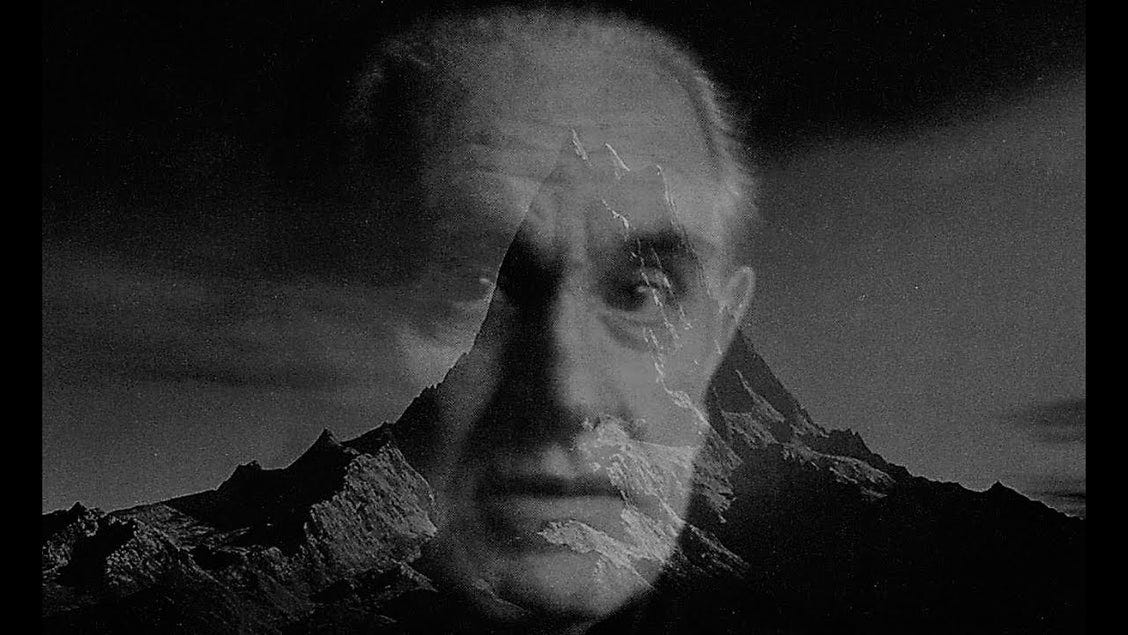
Excerpt from Chapter 7 of
Julius Evola: An Adventurous Life
by Andrea Scarabelli
COMING SOON — April 2026 — from Arktos and PRAV Publishing
‘Towards the end of the last world war, apocalyptic bombings had turned Vienna into a kind of hell, where the marriage of iron with fire seemed to suspend time, abolishing all the limits of reality. The old imperial capital of Habsburg Europe went up in flames.’
These words were written by the Romanian Traditionalist Jean Parvulesco to introduce the last act of the philosopher’s vita activa – Evola’s final secret mission. Like any proper mission, this one came with a codename: as yet unknown, it is unlikely to have been ‘Carlo de Bracorens’, the name he adopted while in hospital and only dropped after returning to his home country. Remaining incognito, as far as we know, he did not send even a single letter to Italy – which is why it is not easy to reconstruct the circumstances of his journey.
One thing is certain: in the 1920s, Vienna had served as the barometer of the end of a world – the traditional world of the Central Empires, disintegrated by the Great War. It served the same function now, in even more dramatic circumstances. Massacred by joint Soviet and American bombing, the former symbol of Austria Felix was but a memory. It was during these dress rehearsals for the Apocalypse that Evola reached it, to carry out the research commissioned to him in Verona. Before discussing this, however, it is worth saying a few words about the commissioners.
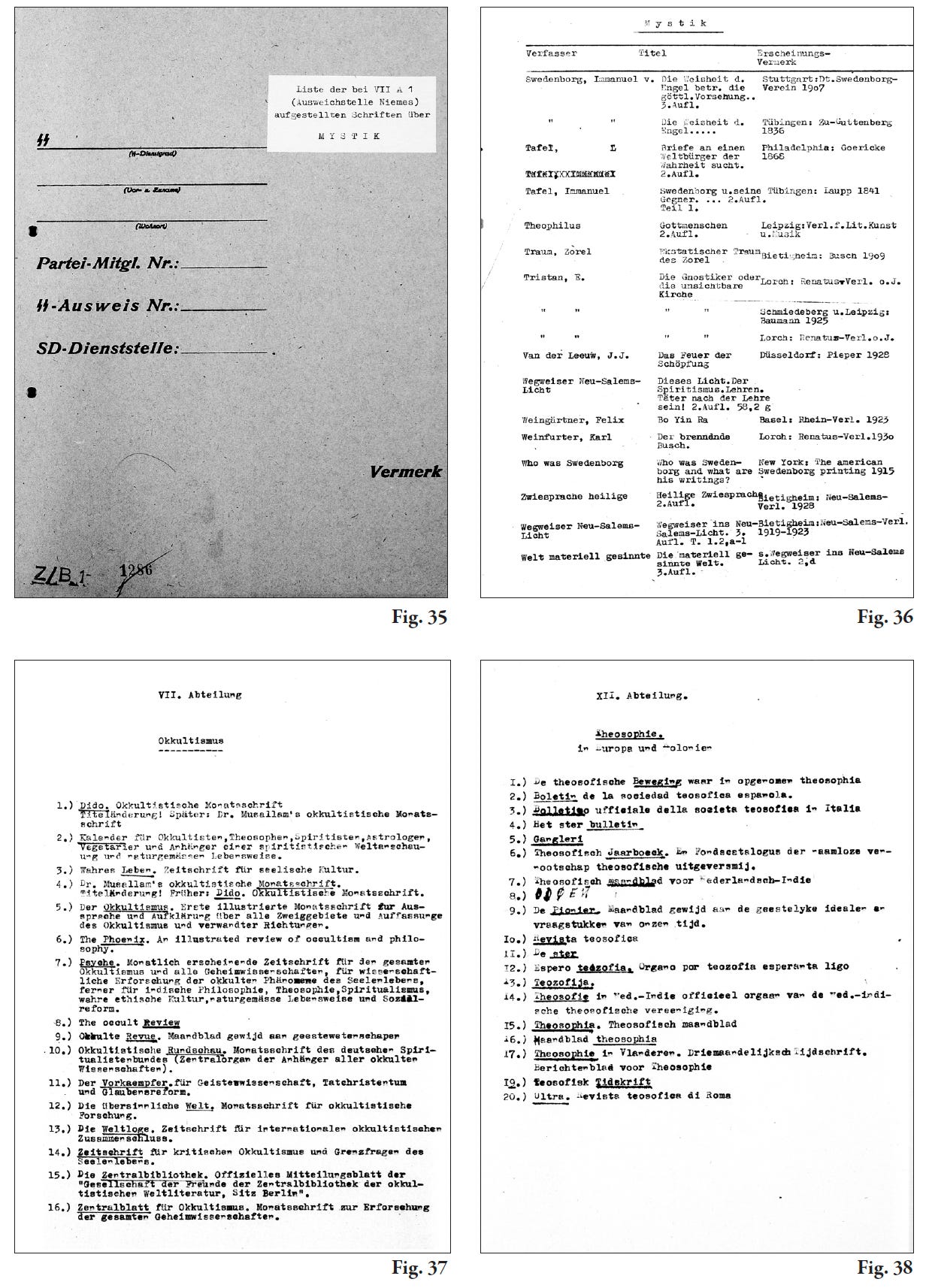
‘It is the most mysterious of the departments of the RSHA [Reichssicherheitshauptamt, the Reich Security Main Office], and almost certainly the smallest’, states a booklet from the Counter Intelligence War Room in London about Amt VII. It had about 50 staff members, whose work was more historical and cultural than strictly political; many were not even members of the SS, nor were they party members, and the results of their research were not kept secret — as is the case in other offices — but were disseminated in publications and at annual conferences. This is also why the organisation would gradually lose its importance — and resources — during the war, as wartime urgencies imposed a strict Realpolitik. While bombs were falling, its members were discussing the authenticity of the Protocols of the Elders of Zion and the origins of Freemasonry (Evola’s longstanding interests), effectively condemning themselves to marginalisation behind the front lines.
In short, it was a cultural institution that frequently touched on ‘frontier’ topics. There were sub-departments dedicated to Freemasonry (VII B1), ecclesiastical politics (VII B2), and churches (VII B3). Also related to Freemasonry are the archive (VII C1) and the museum (VII C2), which Evola may have visited in the late 1930s. Department VII C3, directed by Rudolf Levin, was dedicated to witchcraft, magic, and popular superstitions, linked to Sonderauftrag H (Hexen, ‘witches’). Twenty specialists studied the records of ‘witch trials’ in Germany and Austria, along with documents from private libraries and archives (17th-18th centuries), often working in collaboration with the Ahnenerbe, with the aim of compiling a monumental Bibliography of Witchcraft, a project which remained only at the embryonic stage.
According to the Counter Intelligence War Room, Amt VI and Amt VII often worked in tandem on the occupied territories between 1943 and 1944, which might explain how, in Verona, the philosopher was able to ‘pass’ from one to the other without too much difficulty. The same booklet speaks of ‘political whispering campaigns’ initiated by Amt VII as a cover for the activities of Amt VI, involving ‘some of the most cultured, respectable and less prominent men of Amt VII.’ This sounds like Evola – although, let us reiterate, he never became an agent, but was hired for different reasons.
In his memoirs, Evola is quite succinct in recalling those months: ‘thanks to an extraordinary set of circumstances, while living in Vienna, I came across some precious and rare material on the basis of which I intended to write a book entitled The Secret History of Secret Societies (Storia segreta delle società segrete).’ This is the same text he had come up with in 1939, when he asked to see the archives of Amt VII. Having arrived in northern Italy in 1943, he met the men of the ‘occult department’, who knew very well who he was, were familiar with his interests and, needing to carry out Masonic research, entrusted it to him. […]
In those turbulent months, as Europe headed towards catastrophe, Evola constantly asked himself the age-old question ‘what next?’ He did so in Rome, with the Movimento per la Rinascita dell’Italia (Movement for the Rebirth of Italy), and he did so in Vienna, drawing on the many connections he had made in the 1930s. ‘I moved […] to Vienna’, he wrote, ‘where I had already been summoned. In that city, in a different circle, we tried to work in a similar way to how we had in Rome.’
These sparse lines, written 15 years after the events they describe, have nothing to do with Sonderauftrag C, but they do conceal a maze of names and a powerful metapolitical action carried out with the collaboration of various milieux: the conservative-revolutionary circle, but also Walter Heinrich, Rafael, and Othmar Spann.
In 1946, he wrote to Scaligero: ‘A certain work along our lines in Vienna, which had attracted me and to which I had devoted myself, has been suspended for contingent reasons.’ While the philosopher remains vague, reducing the defeat in the war to ‘contingent reasons’ (!), the declassified OSS reports trace a dense network of people connected to him. It cannot be ruled out that it was precisely these people who were responsible for Evola’s ‘summoning’, mentioned en passant in The Path of Cinnabar, a summoning that preceded his arrival in Verona and was therefore unrelated to Amt VII. Let us try to clarify matters.
In November 1941, a Free Austrian Movement was formed to protect Austrian exiles – particularly those who had fled to Great Britain – and two years later it intensified its activities. Although monopolised by communists – which led to endless divisions and splits – it welcomed all those who opposed National Socialism and its hegemonic ambitions. Its members included military personnel and members of the SD and RSHA. In addition to Spann and Heinrich, who were close to the movement but never joined it, one of its members was Werner Göttsch, Evola’s likely ‘employer’ who, according to OSS sources, had a house in Vomperberg in the Inn Valley, where he could hide resistance fighters.
Taking advantage of Berlin’s lack of control over the occupied territories, Grimsted writes, ‘Göttsch claimed to have formed an independent group of influential members of the RSHA who wanted to liberate Austria from Nazi rule’, establishing ‘relations with non-Nazi and anti-Nazi groups in Austria, which would send peace messages to the Allies.’ It seems that news of the plan reached Kaltenbrunner in December 1944. Refusing to join, he let it go, having become disillusioned with the outcome of the war. In contact with Masonic lodges in many countries, Göttsch frequented a certain ‘Dr. Doppler’ in Vienna, who was close to Heinrich and the Spanns, involving Freemasonry and Western churches in the anti-Nazi struggle, with their approval.
The coincidences multiply: Göttsch worked with the conservative-revolutionaries frequented by Evola, as well as with SS-Sturmbannführer Wilhelm Höttl, a former Viennese professor of modern history, member of Amt VI and... of the Italian Invasion Network, now acting as head of a circuit that coordinated various resistance groups, infiltrating agents into the German Armed Forces, establishing foreign radio contacts, sending men undercover to the Adriatic area and organising propaganda. The aim was to negotiate a separate peace with the enemy for anti-Soviet purposes – attempts that were rejected by the Allies as contrary to their post-war hegemonic ambitions.
Without ever receiving a reply, throughout 1944 the conservative-revolutionaries tried to communicate with the British through Major Christie, a member of the London Traveller’s Club linked to Heinrich since the time of the Sudeten Question, when the Spann-Kreis mobilised the Sudetendeutsche opposed to National Socialism – an operation that may have involved Evola himself, encouraging his ‘European explorations.’ In a completely changed context, the philosopher’s collaborators sent dozens of letters signed with the code name Vater der Schloss Kinder, using the mediation of a certain Krausburger, a native of the Sudetenland and friend of the ‘Kronid’ Rafael.
That the conservative-revolutionary esotericist was involved in the delicate operation emerges from another OSS document, dating back to the summer of 1944, a few weeks after the attack carried out in Rastenburg by Colonel Stauffenberg and the arrival of the Roman philosopher in Austria. The report reads:
Some time after 20 July 1944, Göttsch discussed with Franz Popek and [Rafael] Spann the possibility of assassinating Hitler. Everyone agreed that the Wehrmacht’s support was necessary and that the operation would only succeed with the backing of Western forces. Spann was also planning an uprising in Vienna, but took no action as there was no support from the West.
Many American reports list Rafael and Heinrich (‘Nazis in 1934, but later arrested for anti-Nazi activities’) among the members of another group, together with other personalities... linked to Evola. For example, the Christian socialist Friedrich Schreyvoegl, one of the leading figures of conservative Vienna and author of Diorama Filosofico, or the conservative Theodor Blahut, who invited Carl Schmitt to give various lectures in Rome in the 1930s, where Evola met him on several occasions at the German embassy, often mentioning him in Bibliografia fascista. After the Night of the Long Knives, Blahut distanced himself from National Socialism and took refuge in Rome, where he encountered a whole series of Austrian dissidents, aristocratic opponents of Hitlerism, and proponents of the Corporative State, which had been dismantled after the Anschluss. His encounter with Evola dates back to that period and was so influential that it led him to study Hinduism. But the two remained in contact even after the Second World War: not only did Blahut visit the philosopher in Rome, but, together with other intellectuals, he secretly held ‘Evolian seminars’ in Soviet-occupied Vienna.
For the record, during those months in Vienna, the philosopher frequented diplomats and politicians, including Alfons Knaffl-Lenz (1878–1957), Austrian ambassador to various Latin American countries, and Countess Elsa von Thurn (1886–1974), who would visit him in Rome after the Second World War.
Even though – once again – there is no trace of Evola’s presence in the archives mentioned, nor of a ‘code name’ attributable to him, it is nevertheless difficult to believe that he was unaware of these activities.
Close to the ‘internal faction’, he worked for Amt VII, classifying and cataloguing dozens of periodicals and volumes until the tragic accident we will mention shortly. He changed residence several times, always remaining in the Innere Stadt, the ‘inner citadel’ surrounded by the Ringstrasse; shielded by the Sicherheitsdienst and his code name, he carried out his duties – but not as a mere ‘outside observer.’
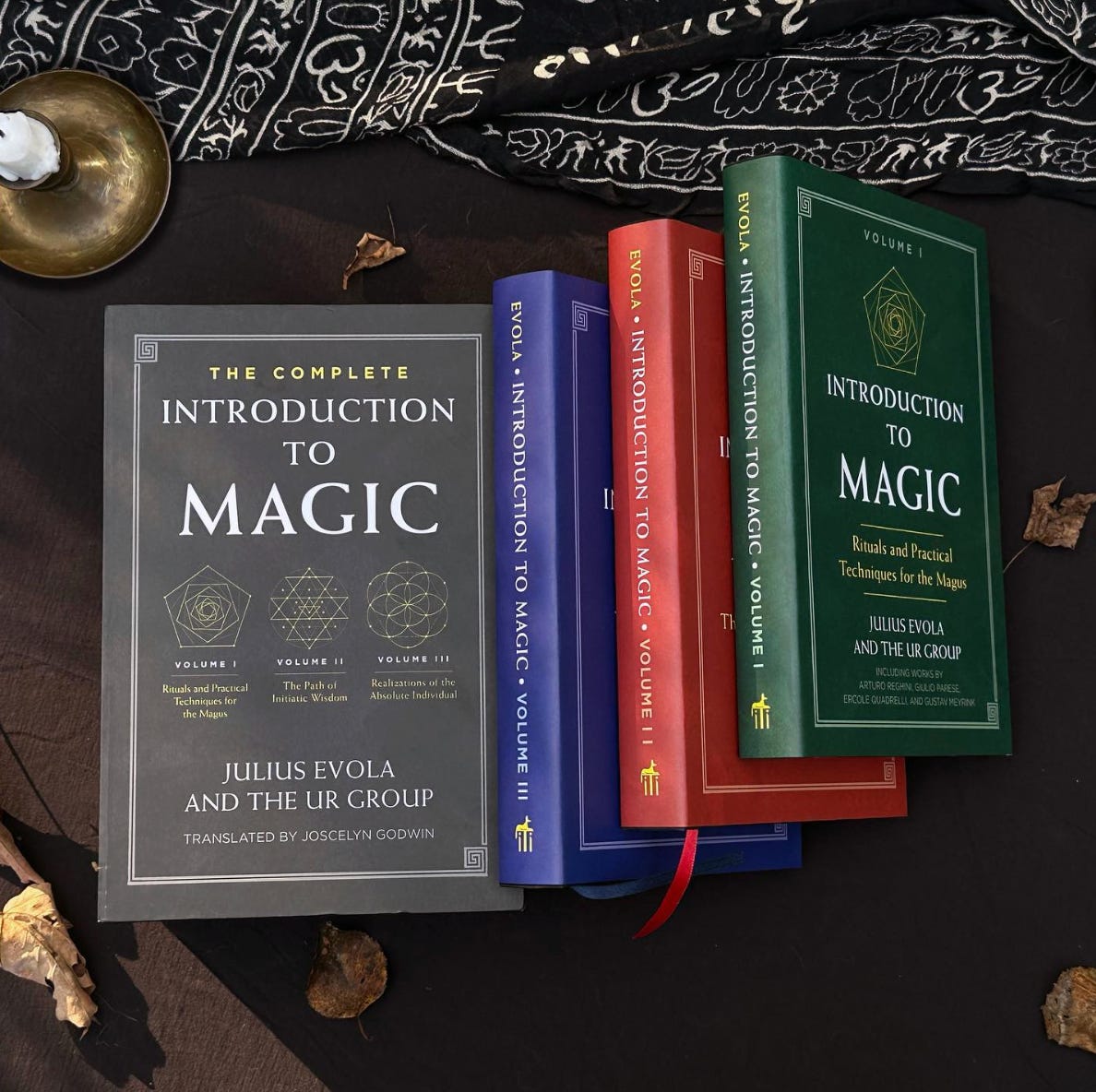
After the Second World War, during a French journalistic controversy, he said that he had gone to Vienna having been ‘commissioned to study Masonic rituals […] and to supervise the translation of certain esoteric texts.’ Which translationwas he referring to? The answer is contained in a letter addressed to Massimo Scaligero: it was the Ur Group’s writings. Speaking of the material intended for Introduction to Magic, in 1947 Evola wrote to the Anthroposophist: ‘It had already been largely translated into German, but the translation was lost in the events of the war, which at the same time caused the dissipation of an interesting and vast combination to which this translation also belonged, and in which you too could have been profitably involved.’
It is evident that the Ur Group’s ‘operational documents’ have little to do with the political activities of 1944, the attempt to establish an alternative Europe to Hitler’s. If anything, they may fall within the framework of the ‘Hermetic politics’ of Sonderauftrag C ‘Project Leo.’ Could they be linked to the mysterious ‘call’ that preceded his arrival in Verona? We know nothing about it, but we can make some guesses.
From OSS documents, we know that the esoteric manoeuvres carried out by the SD began in 1943, in the same weeksduring which the philosopher – whose financial situation was not the best – suddenly bought back all the files of Ur and Krur and began to revise them (‘Having had a lot of free time’, he wrote to Bocca, as we have already seen, remaining vague). On the run – called – to the north, he put them in his cardboard suitcase, along with a few clothes and basic necessities. Did he take the rare esoteric files with him not to pass the time, but because he knew he would need them once he crossed the Alps?
A sea of enigmas to which future research may offer convincing answers – capable of shedding light on Evola’s delicate situation, who, while a world was about to end, was approaching the most radical turning point of his life.
Under the American and Russian bombs that contended for the shreds of disfigured Vienna, as the Axis powers suffered a long series of defeats and Europe was on the verge of collapse, Evola’s typewriter rattled on unceasingly: between the whistle of sirens and the crack of anti-aircraft fire, he revised Ur, ordered and systematised dozens of Masonic files... The circles he frequented were a constantly boiling cauldron, but no concrete results were visible at the time. Conspiracies upon conspiracies, secret plots, communications with the Allies, double and triple agents… but nothing came of it. He continued to work. In all likelihood, he attended the traditional New Year’s Eve concert on 2 January: that year, at the Musikverein, the conductor Clemens Krauss performed a series of waltzes by Johann Strauss’ son, including the famous On the Beautiful Blue Danube.
Evola’s activism, however, was incapable of exorcising the general uncertainty. Beyond the various initiatives he followed – tireless as ever – a turning point was urgently needed. But what kind?
21 January 1945 was a Sunday. When yet another firestorm raged over Vienna – orchestrated by 170 American B-17 bombers stationed in Foggia – Evola asked himself a question. It was the darkest moment of his entire ‘adventurous life.’ He would spend the next few years trying to remember it, in vain. The Russians were approaching, Germany and Italy were about to collapse, but he had only that question in mind, and tried to answer it by questioning fate – certainly not for the first time. He did not rely on the safety of air-raid shelters, but... left the place where he was staying, a guest of two spouses located in the Third District, and went for a walk. As Gianfranco de Turris has written, rather than relying on complicated lucubrations, Evola wanted to ascertain experimentally what the future held in store for him: ‘To survive, yet how and for what reason? To be swallowed up in the furnace of fire like so many Viennese, physically disintegrated, transforming into ashes and to vanish into the ultimate Nothing without leaving a trace of oneself other than one’s own writings?’
Immediately after lunch, he left his house – which would be razed to the ground – and, after wandering a bit through the bombed-out streets, reached the very central Schwarzenbergplatz, named after Austrian Marshal Karl Philipp, who had distinguished himself in the Napoleonic Wars (today it houses a Monument to the Heroes of the Red Army, dedicated to the ‘liberators of Vienna’). He lingered for a while: between the whistling of the sirens and the general stampede, his whole being was focused on that question. Then something happened that was destined to mark his life forever – a watershed between before and after.
A bomb fell next to him, hurling him against the wooden structure protecting the Schwarzenberg statue – it was perhaps this that saved him.
He lost consciousness for some time and, waking up in the square, realised two things: he had an intense burning in his chest, and he could no longer feel his legs. He had the sensation of a ‘free fall’ – the kind one experiences during intercourse (more on this later) – while he told Scaliger that he distinctly saw his own soul hovering above his body, taking the form of a shining jewel at the centre of a white sheet. After that, he descended again into the most sidereal silence.
All in all, one thing is certain: perhaps the question had not been properly formulated. A ‘subtle’ trace of it remained in what Evola asked as soon as he woke up, after eight hours of unconsciousness. His face and limbs were cyanotic; he was wheezing; and he had a persistent burning sensation extending from the pit of his stomach to his chest, which would last three days.
‘Where is my monocle?’
The question resounded in a room at the Schönbauer Clinic, where he was immediately taken. If, in the months before, he had lived in the capital incognito, he now found himself facing the authorities. When they asked him for his personal details, he replied, without much thought: ‘Karl von Bracorens.’ It was the name of a count who had fought alongside Victor Emmanuel II.
‘Date of birth?’
‘27 October 1899’, he whispered, making himself a year younger.
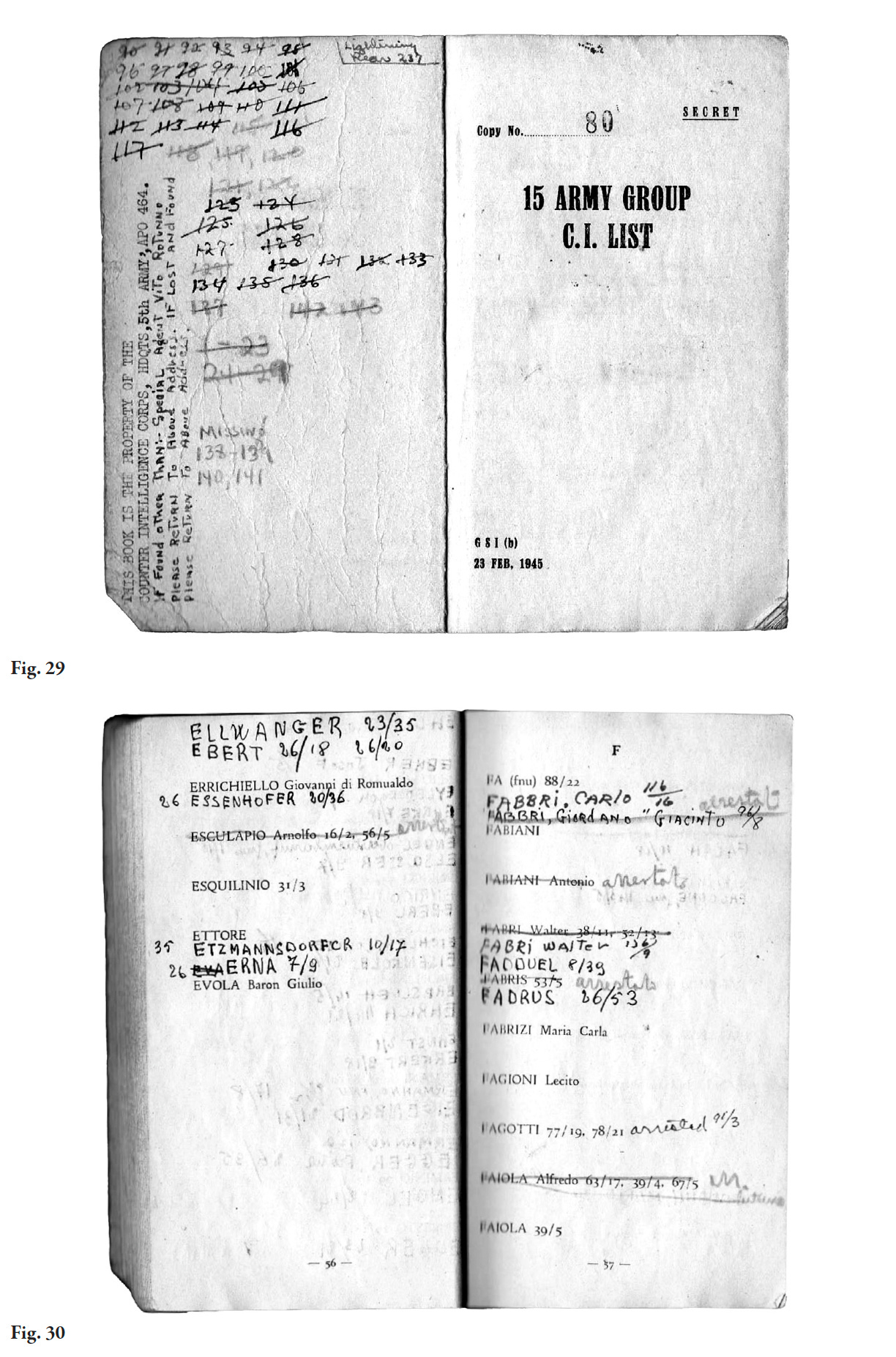
Instinctively, he realised that it was better to conceal his identity. The Soviets were at the gates – you never knew...
‘To tell the truth’, he wrote, ‘the fact was not without relation to the norm, which I had already followed for some time, of not dodging, but rather of seeking out dangers, in the sense of a tacit questioning of fate. […] Even more so had I adhered to the rule then, close to the collapse of an entire world.’ This has given rise to a vast amount of literature: according to some, Evola went off to fight against the Russians, being wounded in the third chakra; according to others, he enlisted in the Waffen-SS, or was maimed in a magical or tantric operation... ‘This, of course, is sheer fantasy’, he would write, ‘not least because, at the time of the accident, I had long interrupted any work in the realm of the supernatural.’
Guénon shared a memorable interpretation with Evola on 28 February 1948, stating it could not be ruled out ‘that ‘something’ has taken advantage of the opportunity provided by this injury to act against you.’ Figuratively speaking? Not at all:
‘There are things in what you tell me that remind me of what happened to me in 1939, […] when I lay in bed for six months without being able to turn around or make any movement. We all thought it was a rheumatic crisis, but in reality it was something quite different, and we knew very well who unwittingly served as the vehicle of this evil influence; […] measures were taken to make the person leave and never return to Egypt, and nothing like that has happened since.’
We do not have the response, which Evola summarised as follows:
‘I told Guenon that a similar attack would be an unlikely cause in my case, not least because an extraordinarily powerful spell would have been necessary to cause such damage: for the spell would have had to determine a whole series of objective events, including the occurrence of the bombing raid, and the time and place in which the bombs were dropped.’
When they found Evola lying on the ground in the square, he had no serious external injuries or broken bones. On 26 February, they took a marrow sample from his spine, while four days later they performed an X-ray, which did not reveal any pathological changes, although he had great difficulty moving. One thing was unequivocal, however, as his medical papers revealed: after the accident, he could still walk.
As already mentioned, Evola provided no ‘magic’ explanation. As for the ‘meaning’ he attributed to that 21st day of January, matters are more complex. To Girolamo Comi, for example, he wrote that he had put himself to the test, asking, through ‘a methodical exposure to danger, to what extent ‘one’ wished that I remain in a meaningless world and continue a life already lived in all its essential possibilities, and to what extent, instead, ‘one’ wished me to go ‘beyond.’’ Destiny’s answer, however, was not as clear: ‘Neither one thing nor the other happened, but rather something that I would call a bad joke, if I were not prevented from doing so by my faith in the profound meaning that is hidden in every event – a meaning that cannot always be deciphered down here.’
What we are dealing with here is Evola’s practical metaphysics – based on the Guénonian ‘continuity of states of being’ – according to which life has a much broader dimension than the so-called ‘material’ one, and our anagrammatic birth is the result of a pre-birth decision. ‘Nothing comes from nothing’, Evola wrote in Diorama Filosofico on 24 January 1937, and accepting one’s destiny does not mean assuming an attitude of passivity, but achieving the ‘fulfilment of a profound harmony between ourselves and something transcendental and superterrestrial.’ This ancestral heritage guides our existence at the level of family, lineage, caste, and so on. Whether one is born a man or a woman, whether one belongs to a certain people or environment, is not the result of chance, but is ‘due to the fact that one already was or wanted to be a man or a woman, of one race or another, etc., […] in the sense of a transcendental inclination or deliberation that we, for lack of adequate concepts, can only understand through its consequences.’ All consequences, none excluded.
This ‘decision’ never manifests itself in pure form; rather, we must discern it in everything that happens to us — however traumatic it may be. Evola condensed this wisdom when speaking of the ‘differentiated man’ in Ride the Tiger, whose purpose is to remind himself why, while hating the modern world, he freely chose to be born into it. There is much of Julius Evola’s adventurous life in the final pages of Ride the Tiger, which represent his metaphysical apex — the summit of that vertigo. And it is no coincidence that the author viewed this book as an encapsulation of his own life.
Let us return to the Diorama article. Recourse to pre-existence excludes the idea of freedom as the mere absence of limits, but neither does it imply absolute determinism. Rather, it imposes the exercise of a kind of memory that transcends life and death – that of the myth of Er (Republic, X) and of the Delphic ‘know thyself’ – based on the remembrance of having wanted to be what one is. Life thus acquires meaning as a ‘mission’ (the ‘occult mission’ of which Parvulesco would speak). This is not a matter of theoretical disquisitions, but of an awareness destined to shake one’s being to its very foundations: ‘The free breath of the heights and the open sea is reawakened, the sensation of having come here from afar, from other shores, from other seas, so much so that everything that may appear tragic, anguishing, and definitive here is played down.’ Once we remember that we have chosen ourselves, the most distressing features of life turn into trials we have deliberately chosen. What appears empty or meaningless becomes the foundation of the ‘mission’ of being who we are. To exemplify this, Evola quotes a Far Eastern saying we have already encountered: ‘Life is a journey in the hours of night.’
It was in the light of such a worldview – formulated before and reiterated after 21 January 1945 – that Evola framed his own Viennese misadventure. ‘To remember why I had wanted it, and yet to grasp its deeper meaning for the whole of my existence: this would have been the only important thing, much more than ‘getting well.’ This awareness alone could form the basis for a hypothetical ‘recovery’: if ‘such a ‘memory’ had surfaced — or were to surface — there would certainly also be the possibility of removing the physical fact itself, if one so wished.’ But in the 1960s and 1970s, Evola saw no trace of such an awareness: ‘the fog which clouds my memory has yet to lift. For the time being, I have come to adapt myself to the circumstances. Occasionally, I am humorously led to believe that it is gods who might be responsible for the situation, having used a little too much force when playing with me.’
It is rare to encounter such a close melee between Evola’s worldview and his concrete life. And the fact that these are not ex post facto reconstructions is borne out by two documents, in addition to those already mentioned.
The first is a letter to Scaligero dated 3 January 1949:
‘Regarding my affair, it should be framed in a slightly different way. When I faced dangers, I did so not in a spirit of defiance or arrogance, but in a spirit of ‘offering’ (almost in a religious sense). In both the secular and domestic spheres, I considered meaningless an existence that would continue after the war.’
The point is that he put his own existence on the line, with a result that is difficult to decipher:
‘As far as vital and natural force is concerned, I am ready to step forward as soon as a foothold emerges, but as far as ‘fire’ is concerned, I feel absolutely none […]. I remain in a state of active indifference, which has affected the various peripheral domains, including the field of certain subtle instruments, which have curiously proven to be paralysed, unlike the ordinary intellectual faculties.’
The second document dates from the same period. Once back in Italy, Evola resumed contact with Goffredo Pistoni, who asked Father Clemente Rebora to visit the philosopher and offer him ‘spiritual assistance.’ This is precisely what he wrote to the priest, who replied in the affirmative on 2 May (on the same day, he asked his superiors for permission to bring his ‘aid’). The two finally met on the 10th, and two days later, back in Rovereto, Rebora wrote to Pistoni: ‘He told me of an interior event that occurred to him during the bombing of Vienna, and he added that it still remains mysterious to him, with this trial of his in progress.’ In the letter, he adds that he had also suggested that Evola go to Lourdes, to ask for a grace and thus be cured of his infirmity.
We discover the outcome from the letter sent by Evola to Rebora on 14 May 1949:
‘I would have to go to Lourdes to ask – on the level of grace – that the physical impediment be removed. Now, I have already told you how little this means to me, and even if the illness were far more serious, it is not for such things that a man worthy of the name should turn to the supernatural. […] If I were to ask for a grace, it would rather be that of understanding the meaning – on the spiritual level – of what has happened.’
The accident ‘was like an enigmatic answer to my question, posed by exposing myself to danger, as to whether there might be an end to my earthly life.’ Evola then abruptly concludes: ‘Nothing would have changed in me if I had been ‘healed’: the real problem, namely the growth of the inner light, would not have been resolved.’
In short, the philosopher put forth a far more radical anamnesis than a priest could offer — one based on the Platonic and Orphic idea which founded a European vision of metempsychosis. […]
Perhaps in an effort to find a way out of his condition, that summer Evola travelled the 500 kilometres between Bad Ischl and Budapest. Bizzarri assumed that Evola had gone to the Hungarian capital to receive András Pető’s avant-garde treatments, which aimed to rehabilitate patients through ‘breathing exercises, education, motor therapy, and special gymnastics.’ These treatments were rather famous in the West from 1945 onwards and rumour had it that they worked miracles, but this was not the case for Evola, who returned to Austria in mid-August. Interestingly, this brief visit is not referenced in any of the aforementioned medical documents.
From Evola’s correspondence, however, we know that he spent a couple of months in Budapest: he resided at Vàczi-utca 23, the most important street in Pest. It was a private house, possibly owned by Countess Zichy, who had previously hosted him. He always used a false name, as Hungary was now under Soviet occupation – a fief of Moscow. While there, on 15 June 1947, he resumed contact with Carlo Torreano di Bocca in an attempt to piece his publishing business back together. He was concerned about the fate of his books and wanted to ‘put them in a safe place’, rescuing them from oblivion by ‘placing’ them in a publisher’s catalogue. A year and a half later, he wrote to Torreano: ‘Given my uncertain future, due to my physical state, you will understand my ‘fatherly’ concern to ensure the future of my ‘creatures.’’
A letter dated 15 June discusses some of these books: The Yoga of Power, Meyrink’s The Angel at the West Window, and The Mask and Face of Contemporary Spiritualism. Evola also mentions Introduction to Magic, stating his willingness to give it to the publisher for free and warning him that ‘if he showed up, he would have to deal with a minor collaborator of the group whom I had expelled at the time.’ It is unclear whether this was Reghini, who died two weeks later in Budrio, or Parise. Evola indicated Countess Fernanda Crotti, with whom he remained in contact until the end of his life, as the intermediary for handling the correspondence and concluded: ‘I intend to move to Austria, hoping that the specialists will understand more about my handicap.’ This is an unusual conclusion, given that it was from Austria that Evola had arrived in Budapest.
On 17 July, Torreano replied, offering a deal for all these works. The Yoga of Power and The Angel at the West Window would be published in 1949, while Laterza would print Mask and Face that same year.
Regarding Introduction, he wrote: ‘I hope in the coming winter to begin the typesetting. As you know I do not have the original’ – i.e., the glossed and hand-corrected Ur and Krur files, which Evola had travelled halfway across Italy with four years earlier and had been working on before the bombing, in the context of the aforementioned ‘Hermetic-political’ operation.
Another letter, dated late 1947 and again addressed to Torreano, contains further details about the manuscript of Introduction, which ‘miraculously escaped destruction in the battle of Vienna.’ It was not at Evola’s home, unlike perhaps the ‘German translation that was being made’ for the League of Kronids, which ‘was lost.’ Regarding the fee, Evola only requested compensation for the substantial revision work he had carried out. ‘Several less important articles in the new text have been replaced with translations of essays by R. Guénon, the greatest living authority on the subject.’ The vast majority of the excised essays were signed ‘Ea’, i.e., Evola. These were articles written in a lively style and devoted to magic; the remaining articles revised and, so to speak, ‘anaesthetised.’ In addition to many Glosse varie (Miscellaneous glosses), he also did away with parts included in The Hermetic Tradition, along with the essay L’albero, la serpe e i titani(“The Tree, the Serpent, and the Titans”), which was also merged into the same book.
However, Evola wrote other essays, using the pseudonyms ‘Ea’ and ‘Arvo.’ They covered topics ranging from Guénon’s teachings and counter-initiation to the Grail, Roman sacredness, Christian esotericism, and the Hyperborean tradition. In Vivificazione dei «segni» e delle «prese» (“Vivification of Signs and Grips”), he shared the results of his mysterious research on Freemasonry in Vienna. Many additions in italics and anonymous pieces are also attributable to him, as well as the decision to include analyses of Meyrink and excerpts from Crowley’s works. Notably, Evola included excerpts from the Liber Aleph, which was not officially published until 1961. It is hard to say who might have given him a copy of the manuscript, as well as to clarify the origin of the numerous discrepancies between the text in Introduction to Magicand that printed in the 1960s. Did Evola make these changes himself? Or did he receive a different version?
Let us return to the curious fate of the files. Evola wrote to Torreano to inform him that he had come into possession of the material. However, this was not the case, as in April–May 1949, he had instructed Heinrich to retrieve it, adding a few details:
‘To aid the search: these are not three volumes, but rather three bundles of loose files. There are 12 files in each bundle and 53 in total. They are printed in Italian and contain handwritten notes and additions, as well as typescripts. The title is Ur. Introduzione alla Magia, Quale Scienza Dell’Io (“Ur. Introduction to Magic as a Science of the ‘I’”). The format is 8vo, the paper is yellowish, and the whole work is, I think, unmistakable, not least since it is unlikely that other Italian manuscripts of this sort would be found in the flat. [Rapha]El [Spann] at the time reassured me that all the files were there.’
What flat was this? Perhaps the headquarters of the League of Kronids, to which Spann obviously had access? It certainly wasn’t Evola’s own apartment, which had been reduced to rubble shortly after he took his enigmatic stroll under the bombs, seeking answers from fate.
Grappling with a body that no longer obeyed him, and a stranger in a foreign land, ‘Carlo de Bracorens’ resumed his former activities – within the limits imposed by his new situation. He began, first of all, to translate again. His new project was Nietzsche e il senso della vita (“Nietzsche and the Meaning of Life”), a book devoted to the author of Thus Spoke Zarathustra, whom he reinterpreted in a manner strikingly similar to his own. His analysis of the text seems to foreshadow the pages of Ride the Tiger, evoking a man left to his own devices who, unable to find salvation outside himself, seeks it within. The problem of the self-determination of values – the cornerstone of all ethics in a secularised world – emerged clearly in the book he was translating. ‘It is mainly philosophical in nature, but accessible’, he wrote to Laterza, proposing its publication – in vain – ‘and touches on vital issues, especially in these times, when there is little meaning to be found in existence.’
He managed to contact the publisher, Braumüller, and secured the rights for 1,000 schillings (less than 15,000 lire) – most likely through the author himself, Robert Reininger, a university professor in Vienna and a member of Othmar Spann’s circle. A scholar of Western philosophy, Reininger also had a strong interest in mysticism and Hinduism – he gave several lectures on Vedanta in Vienna in the 1930s, much to the indignation of his colleagues. It is not out of the question that he followed the translation personally, perhaps even visiting Evola in the hospital.
It was difficult for the translator not to identify with passages such as this:
‘To love life because it is painful and because we hate it – this is either an unparalleled perversity or the dictate of another duty: to overcome even that which revolts us most, in the awareness of a higher inner necessity.’
These were more than mere words for someone who was translating the text into Italian under desperate conditions – struggling to balance body and mind, using a copying pencil and a wooden reading rest, surrounded by the moans of the sick and tormented by an indecipherable affliction. Only in Italy did he transform the manuscript into a typescript, sending it to Laterza, who ultimately rejected it – at a time when the philosopher of Zarathustra did not enjoy a strong reputation in Italian cultural salons.
While still confined to his hospital bed, Evola prepared the German edition of Mask and Face, which had never been published. He had even secured a publisher – An den Kompass Verlag, where Ludwig Ferdinand Clauss worked – who re-established contact with him in early 1949.
He also took on some more ‘frivolous’ translations to pass the time – one such example is Heinrich Spoerl’s Die Maulkorb (The Muzzle), published in 1936 and set in a small Rhineland town during the imperial era. It is a humorous novel with a simple yet ingenious plot: the ruler of the country is said to have delivered a speech – one that no one actually heard – in which he fiercely criticised his subjects. Rumours about this supposed oration spread, stirring widespread indignation, until one morning it is discovered that someone has muzzled the ruler’s monument in the town square. The perpetrator turns out to be the very public prosecutor assigned to the case. The twist: he committed the act while drunk, after an evening spent in a tavern railing against the mysterious speech – and he remembers nothing of it! Still unpublished in Italian, the novel was quite popular at the time, thanks in part to a 1938 film adaptation. After completing the translation, Evola contacted Neff Verlag in Vienna to request the rights, attempting to initiate a collaboration that ultimately never materialised.
During his Austrian seclusion, he also began revising his books, which he had been told were sold out and in demand in Italy. As a result, in 1948, the second edition of The Hermetic Tradition was published, followed the next year by Mask and Face and The Yoga of Power. That same year, he undertook one of his most challenging revisions: in March, his brother sent him a copy of Revolt Against the Modern World – specifically, Massimo Scaligero’s copy. Since Hoepli was in financial trouble, the new contract was signed with Bocca on 9 December, and the book went to press on 15 April 1951.
Evola reread, rewrote, simplified, and corrected his texts. Fifteen years separated him from the first edition – an abyss not only political but existential. He had to make choices. What to do with the hundreds of notes? Back in 1934, they contained the most up-to-date texts on the subject. Add new ones? Impossible, under those conditions. Besides, that would have meant writing a different book altogether. After all, Revolt is a closed universe – ‘it is what it is’, as they say. Moreover, the later German edition contained many more sections than the one he was working on. After some Viennese friends brought him a copy, he translated the additions, inserted them into the text, and standardised everything. He eliminated references to issues that had been topical in 1934, thus completing the metamorphosis – finally realised in 1969 – of a bellicose manifesto into the hieratic monument of a worldview. The judgments became less categorical; the tone, more impersonal.
He once again asked Guénon to review the drafts – something Guénon was not particularly enthusiastic about: ‘He asks me to reread this book to indicate the points that I would think need editing’, he wrote to De Giorgio on 19 June 1949. Around the same time, the two also resumed discussions about Introduction to Magic, in which Evola hoped to include some of the Frenchman’s essays. In the end, only one was published, under the pseudonym ‘Agnostus.’ The issue was that many of the texts requested by the Italian had already been used in other works intended for translation, such as the seminal The Reign of Quantity and the Signs of the Times.
Not only did the philosopher go to great lengths to find a copy – which was not easy in Austria – but after reading it, he wrote to Torreano, calling it ‘a remarkable book, if a little heavy-handed, of which it seems you yourself intend to publish an Italian translation, which could serve as a sort of complement to Revolt.’ And indeed it is. Compared to The Crisis of the Modern World, it goes further, anticipating what we now commonly refer to as postmodernity: the dissolution of materialism, social fluidity, the inversion of symbols...
In the meantime, he worked on the language of Revolt, and indo-ariano became indo-ario; the idea of ‘passing on tradition’ becomes the need to ‘keep standing’ in a world quite different from that of the 1930s. He also changed the titles of some chapters: La divinità regale (Royal Divinity) became La regalità divina (Divine Kingship). The appendix on the Grail was omitted, as it had already been developed in the 1937 book.
He decided to retain the chapter “The Sceptre and the Key,” dedicated to Janus, although it would instead disappear in the third edition. Interestingly, most of the time the word tradizione (tradition) was given with a lower-case ‘t.’ It was not until the 1960s that Evola began to refer systematically to Tradizione.
This revision speaks volumes about Evola’s intellectual evolution. The same holds true for The Yoga of Power, a new version of his 1920s book on Tantrism. Atanòr, newly re-established, was about to reprint it as it was, but Evola intervened at the last moment, resulting in a thoroughly revised edition – drier, more ‘academic’, with less Nietzsche and ‘Absolute Individual.’ Alongside its emphasis on power, the new version introduced a different question: in the name of what can one wield this power without being consumed by it? What kind of man is capable of this?
However, the horizon remains the same, as is evident in an essay from that period, Il significato del tantrismo per la moderna civiltà occidentale (“The Meaning of Tantrism for Modern Western Civilisation”), which stresses the centrality of Tantric practice in the Kali-Yuga. As the teachings valid in other ages – ‘snakes deprived of their venom’ – wane, the powerful Left-Hand Path gains ground. It achieves transcendence not through devotion but through the voluntary breaking of order. In the geography of modernity – which sees the collectivisation and mobilisation of the masses, the spread of acephalous and obscure irrationalism, and the elemental forces unleashed by technology – Tantrism is proposed as the path for ‘a Western elite that does not want to become the victim of those experiences, while civilisation as a whole is on the verge of being submerged.’
These are the theses of The Yoga of Power. In the nocturnal heart of the Kali-Yuga, only Tantra and the Āgama can lead man beyond himself, ‘transforming poison into medicine.’ The pitfalls are not to be denied but used for a liberating purpose, following a path ‘as difficult as walking on a razor’s edge or as riding a wild tiger.’ The reference to the book published in 1961 is hardly coincidental, given that Evola was completing it in those very months. This theme also appears in another article from the summer of 1950, where, once again discussing Tantrism, the Oriental principle of ‘riding the tiger’ is evoked – an approach that enables the overcoming of the human condition and a form of liberation not rooted in renunciation, but in ‘possession and enjoyment – through inner detachment, an inner sovereignty – of everything the world offers.’
Julius Evola: An Adventurous Life by Andrea Scarabelli — the first definitive biography of the legendary Italian Traditionalist — is forthcoming in April 2026 from Arktos and PRAV Publishing.


READ MORE by Julius Evola:

Sounds like an interesting read
Cavalcare la tigre è un libro fondamentale per poter vivere nel mondo attuale dove il cinismo, la mancanza della Tradizione sono diventati una quotidianità.