


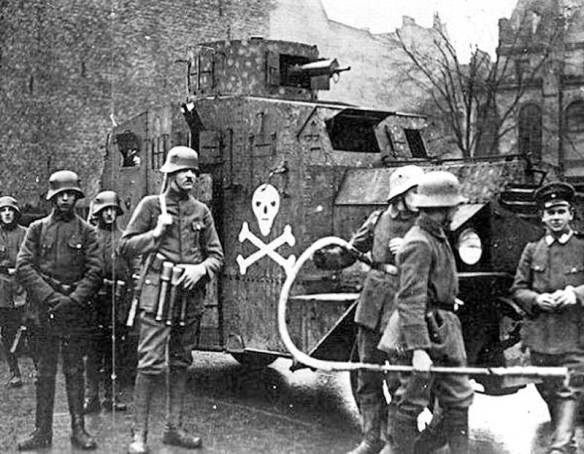
Ernst Jünger argues for a militant, uncompromising nationalist revolution to overthrow the existing liberal order and establish a new Germany driven by nationalist ideals.
This article was originally published in the journal Standarte on 20 May 1926.
By the honorary title of nationalists, we want to turn away sharply not only from those for whom this word means the epitome of evil but also from the peaceful citizen in general. A movement that wants to defend the values of life by warlike means and that does not care a bit whether these means are approved by a generalized morality or not depends on warriors, on real, full-blooded men who are in it with lust and love. These are not the shopkeepers and marzipan manufacturers with whom an era of universal conscription has diluted the armies, but men who are dangerous because they take pleasure in being dangerous.
These are not the complacent souls who consider the state saved if a general’s uniform or a black-white-red flag can be carried across the street and for whom the collapse of the thrones seemed to mean that world history had lost its meaning. Yes, if these representatives of peace, order, and persistence — whom liberalism should pay pensions for supplying its inexhaustible material for activity — if they were to act as fighters for nationalism, then indeed the existence of the November Republic1 would be guaranteed. No protective law would be necessary, and the mutual indignation between conservative and democratic liberalism would have to suffice to satisfy the need for movement, if it could not occasionally hope for some bloody supply from communism.
But such complacency cannot be relied upon in the long run. With surprising clarity, the possibility of a national revolution emerges from this time, and thus liberalism faces the danger of being deprived in one fell swoop of the great and seemingly final prey of 1918 through an act of refreshing lawlessness. Nationalism itself is astonished by this possibility, which would be unthinkable without all the preceding events, without the war, the upheaval, and the relationship of forces that emerged from it. Its carriers, the nationalists, were so accustomed to binding their will to a great, traditional apparatus that with the disappearance of this apparatus, their willpower also seemed to have been lost. For nationalism did not shed all this like a worn coat, but it took a long time to overcome internally the complexity of forms of an old state, long after they no longer belonged to the real world. In its first, still unclear uprising in Munich2, nationalism was in the midst of this process. But as it progressed, completely new feelings awakened. The will to power saw itself no longer bound, no longer obligated, but completely liberated, as liberated as the German will has perhaps never been before.
On the nationalist barricades, they will achieve greater things than Marxism has in fifty years.
Thus, a very clear situation arises for nationalism. The formal existence of the past is concluded; its preservation can be left to the petty bourgeoisie on the one hand and to the publications of the Weltbühne3 on the other. The first self-evident duty of nationalism is to turn its back on this subordinate battleground without any resentment. Its task is rather to prepare the fight against the current state of affairs by all means, which is absolutely the state of 1919, with some beautifications of the facade calculated for the petty bourgeoisie. Here, we must leave no stone standing.
To have made nationalism capable of this task is the true meaning of the revolution of 19184. Through it, not only was the German’s fear of revolutions in general broken, but it also removed all essential obstacles that could have posed internal hindrances to an unrestrained nationalist will. Making this path entirely revolutionary is indispensable, not only to deliver a death blow to liberalism by bypassing all legal tricks but also to strengthen the nationalist will itself. The nationalist must not even consider any other possibility. He has the sacred duty to give Germany the first real revolution driven by ruthlessly pioneering ideas.
Revolution, revolution! This is what must be preached incessantly, spitefully, systematically, relentlessly, even if this preaching should last ten years. Few have yet recognized this demand in all its sharpness; the sentimental chatter about brotherhood and unity through all possible and impossible kinds of spirit is still in full bloom. To hell with it, or send it to the parliaments where it may belong. In the finite world, there is no brotherhood of opposites; there is nothing but struggle. The nationalist revolution needs no preachers of peace and order; it needs proclaimers of the phrase: “The Lord will come upon you with the sharpness of the sword!” It should free the name of revolution from the ridicule with which it has been afflicted in Germany for almost a hundred years. In the great war, a new, dangerous type of man has developed; let us bring this type into action!
So, to work, comrades! Let us seek to strengthen our influence in the combat leagues5, for their revolutionization is the first necessity. Less comfort, fewer members, more activity! Central preparation! Engage with the working class! Away with all the rotten enchantments of economic peacefulness! We are not puppeteers of the employer class. The nationalist combat unions must be expanded and centralized; their leadership belongs to workers of a nationalist type. On the nationalist barricades, they will achieve greater things than Marxism has in fifty years. How do things stand at the universities, in the youth movement, and in those other places that concern us? What is a cell nucleus? How does one affirm a state? Through cooperation and opposition. How does one negate it? By detaching from it, starving it out, and creating a state within a state that is independent in every way, from ideology to power. How does one affirm the German nation? By recognizing it fully, which means embracing nationalism.
Being a nationalist in the war meant wanting to die for Germany; today it means raising the flag of revolution for a more beautiful and greater Germany. This is a goal worthy of the best and most passionate youth of this country.
(translated and annotated by Constantin von Hoffmeister)
The November Republic refers to the Weimar Republic, the democratic government established in Germany after the abdication of Kaiser Wilhelm II in November 1918, following World War One.
The uprising in Munich refers to the Beer Hall Putsch, a failed coup attempt by Adolf Hitler and the Nazi Party in November 1923 to overthrow the Weimar Republic government.
The Weltbühne (World Stage) was a German weekly magazine known for its critical and intellectual commentary on politics, culture, and society, particularly during the Weimar Republic era.
The revolution of 1918 refers to the German Revolution of 1918-1919, which led to the abdication of Kaiser Wilhelm II, the end of the German Empire, and the establishment of the Weimar Republic. This revolution marked a significant political and social upheaval in Germany following World War One.
The “combat leagues” (Kampfbünde) in this text refer to paramilitary organizations in post-World War One Germany, composed of nationalist and right-wing groups, which were involved in violent street fights and aimed to overthrow the Weimar Republic.
You can be sure I’m going to skip any other extracts from Ernst Jünger.
This may be suitable for Germany in the 1930s, but it doesn’t suit today’s world.