


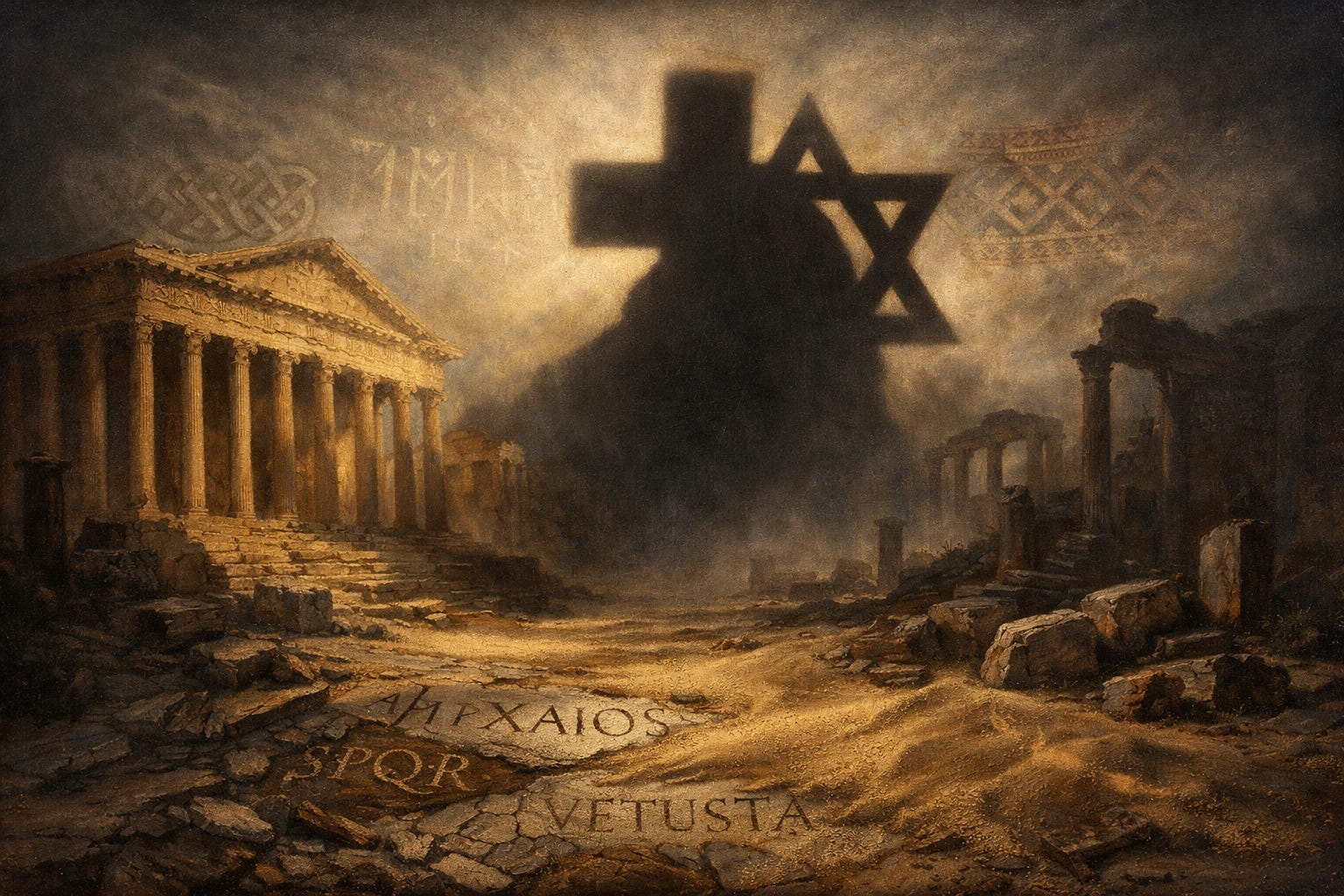
Alain de Benoist argues that the widely invoked notion of a "Judeo-Christian civilization" is a recent ideological fabrication with no historical basis, designed primarily to construct a religious front against Islam while erasing Europe's Greco-Latin heritage.
From the editors of Éléments:
For some twenty years now, an expression has imposed itself on public debate: that of “Judeo-Christian civilization.” Invoked like an identity talisman, it claims to redefine the long history of Europe. Author of L’homme qui n’avait pas de père. Le dossier Jésus (“The Man Who Had No Father: The Jesus File”) (Krisis, 2021), Alain de Benoist here dismantles this syntagm turned into a watchword. Behind this semantic fiction looms an ideological strategy: erasing the Greco-Latin heritage, smoothing over theological antagonisms, and fabricating an imaginary religious front. Here goes a look back at a rigged genealogy.
Until quite recently, it was understood in all educational institutions that European civilization had its roots in Greco-Latin antiquity. This no doubt made light of Celtic, Germanic, and Balto-Slavic cultures, but it was not entirely devoid of meaning.
But this discourse has changed. Initially, Europe was attributed “Christian roots,” allowing two or three millennia of pagan culture to be conveniently forgotten, after which, from the 2000s onward, a bizarre idea began to spread according to which European (or Western) civilization was in fact a “Judeo-Christian civilization.”
Politicians of all stripes are now the first to lay claim to a “Judeo-Christian Europe,” a “Judeo-Christian tradition,” a Europe born of “Judeo-Christian civilization.” Donald Trump and Éric Ciotti, Nicolas Sarkozy and Emmanuel Macron invoke the “Judeo-Christian roots of Europe,” the “Judeo-Christian foundations of our culture”; others call for a “civilizational front” demanding a “Judeo-Christian revival,” and so on. We are thus witnessing a new great replacement: that of Hellenism and Latindom by the “Judeo-Christian,” without this sleight of hand provoking any particular commentary—which is rather astonishing. To make the Judeo-Christian pairing an exclusively Western cultural fact is in effect to ignore the theological differences between Christianity and Judaism, and to presuppose a cultural homogeneity that one would be hard-pressed to find. We are dealing here with a fantasy — or a magical incantation.
The Rise of Christian Identitarianism
When one looks more closely at this semantic and ideological invention in order to explain its current vogue, one realizes that this theme emerged in circles which believe that to effectively oppose immigration, one must engage in a war of religions, mobilize two monotheisms to combat a third (the excluded third of the Abrahamic revelation), and declare war on 1.6 billion Muslims.
The argument, which constitutes something like an inverted mirror image of jihadist discourse (according to which Islam is at war “against Jews and Christian crusaders”), is quite obviously more politico-cultural than properly religious. It is situated within a context of enunciation in which the Christian referent is essentially taken as an identity marker. The rise of Christian identitarianism paradoxically goes hand in hand with the collapse of faith (this collapse itself being a factor of radicalization). One is obviously free to adopt this position, but certainly not to legitimize this strategy by alleging a “Judeo-Christian civilization” — whose drawback is that it has never existed.
The term “Judeo-Christian” is, of course, not devoid of meaning. But strictly speaking, its use is only legitimate in two very specific cases. First, to designate the “early Christians,” gathered around James, the brother of Jesus, in the very first community of Jerusalem. It is in this sense that the expression “Judeo-Christianity” was used for the first time by the liberal Protestant exegete Ferdinand Christian Baur, founder of the Tübingen School, in an article published in 1831, and it is also in this sense that it is accepted today by all specialists.
The historian of religions Simon Claude Mimouni offers the following definition: “Judeo-Christianity is a recent formulation designating Jews (or Judeans), along with their pagan (or Greco-Roman) sympathizers, who recognized the messiahship of Jesus, who recognized or did not recognize the divinity of Christ, but who all continued to observe the Torah in whole or in part.”
But it is here that the ambiguities must be dispelled. Better placed than anyone to know what the intentions and doctrine of Jesus (Yeshouah) were, being his most direct continuators, the Judeo-Christians are Jews who rallied to the movement of Jesus without in any way breaking with Judaism. They are nothing more than messianists who see in Jesus the Messiah announced by the Scriptures and who endeavor to convince other Jews of this with arguments that can be found in the Epistle of James, the Epistle to the Hebrews, or the Gospel according to Matthew. (Paul of Tarsus himself preached only in synagogues.)
To make the Judeo-Christian pairing an exclusively Western cultural fact is to ignore the theological differences between Christianity and Judaism. We are dealing here with a fantasy — or a magical incantation.
They are therefore in no way dissidents from Judaism: they have all the less intention of creating a new religion since Jesus told them he had come only for the “lost sheep of the house of Israel” (Mt 10:26; 15:24). One might add that, historically speaking, the Judeo-Christians precede all forms of “pagano-Christianity,” which means that in the immediate aftermath of Jesus’s death, the only “Christians” who exist are “Jewish Christians,” in the same way that there exist Jewish Essenes, Jewish Pharisees, Jewish Sadducees, Jewish Baptists, Jewish “Hellenists,” and so on. This is why, rather than “Judeo-Christians” (or, more ambiguously still, “early Christians”), it would be better to speak of “Jewish (or Judean) Christians.”
Rediscover ancient European origins with Alain de Benoist on the pages of an Arktos classic: The Indo-Europeans: In Search of the Homeland

The Disappearance of the Judeo-Christians
The name “Christians” itself originally had no other meaning than “messianists”: the christianoi were nothing more than “partisans of the Anointed One,” Jews who saw in Jesus first a prophet, then a Messiah. This name of “Christians,” which seems to have been given to them for the first time in Antioch (Acts 11:26), is not, moreover, a self-designation. The Acts say only that this is what they were called, in an intention that was not necessarily laudatory. They themselves preferred to call themselves Nazoreans (notsrim), from netzer, “descendant,” the central idea being that Jesus was descended through his father from the stock of David.
During the first two centuries, the Judeo-Christians comprised three main groups: those who adhered fully to the Jewish tradition, including circumcision; those who adhered to it but no longer required circumcision; and those who continued to observe the general principles of the Torah and the major Jewish festivals but required neither circumcision nor observance of dietary laws. The Catholic theologian Raymond E. Brown believes that James and Peter belonged to the second group, but that James was closer to the first group, while Peter was closer to the third.
The influence of the Jewish Christians began to wane following the Roman conquest of Jerusalem and the destruction of the Temple in 70 CE. The event brought about the refounding of Judaism on the basis of rabbinic authority (under the direction of Rabbi Yohanan ben Zakkai) and, consequently, the progressive separation of the Jewish faith and the Jesus movement.
The tension between the two currents gradually transformed into a certain hostility, which only intensified over time. With the members of the Jerusalem community finding themselves scattered, the center of gravity of nascent Christianity shifted toward Antioch, Alexandria, and Rome. The Pauline current henceforth had a free hand, and the Judaizing current (Judeo-Christian in the proper sense) survived only within groups such as the Ebionites or the Elkasaites, who were for the most part eventually cast into heresy, by other Jews and by the Church of Rome alike.
The separation of the Church and the Synagogue was gradual, less rapid than was once believed. One cannot really speak of Christianity until the 2nd century, and it would take two more centuries before the rupture became definitive. The Nazoreans disappeared in the 5th century, the Ebionites around the 7th or 8th, the Elkasaites around the 10th—not without having probably exerted a decisive influence on the birth of Islam (which professes a rigorous conception of the oneness of God and venerates Jesus as a prophet without recognizing him as God, which corresponds to the position of the Ebionites). With this paradoxical consequence: if one situates oneself within the perspective of an alliance of Jews and Christians directed against Islam, it would be to the Muslim religion that the Judeo-Christians would have most left their mark.
All of this, in any case, obviously unfolded entirely on the margins of European history. For Ernest Renan, who adopted Baur’s theses, the expression “Judeo-Christian” has a purely historical meaning, never a civilizational one. He does not celebrate the “unity” of Jews and Christians, but, on the contrary, underscores their cultural and spiritual opposition, which for him reflected the difference between what was called in his time the “Semitic spirit” and the “Aryan spirit.” As with other historians of religion, the idea of a “Judeo-Christian civilization” corresponds, in his work, strictly to nothing.
A People of “Deicide”
There have been Jewish communities in Europe since the 1st century of our era. Throughout this period of exile (galout), relations between Jews and Christians were detestable and gave rise to anti-Jewish persecutions which, though of a distinct nature, created the conditions for the acceptability of modern antisemitism. As Sophie Bessis writes, “the first otherness against which Christian Europe was built was Jewish otherness.”1
The Church, for nearly two millennia, was in fact hostile to both Jews and Muslims, assigning to both the same status of cultural otherness, politically constructed or observed. With, however, this particularity: the Church, on the one hand, reproached the Jews for not having recognized the divinity of Jesus and accused them of “deicide” (sic), but moreover set itself the goal of making Judaism disappear, not only by requiring its followers to convert, but by positing itself as the verus Israel.
This is the foundation of what has been called the “theology of substitution” (which one might also call replacism or supersessionism, since it involves a desire to suppress Judaism while taking its place), the doctrine according to which Christianity would have replaced Judaism in God’s plan, rendering the latter null and void in the process. One of the consequences was that, until the 18th century, Jews and Christians never attributed to themselves a shared history, beyond their common origins.
Over the centuries, Christianity and Judaism took, on the contrary, divergent paths. Judaism is above all the religion of a people and an orthopraxy ordered by the Law (one can perfectly well be Jewish without being a believer); Christianity is a dogmatic orthodoxy, a religion of faith and salvation, of grace and forgiveness. Judaism has always been shaped by a dialectic between a particularist pole and a universalist pole; Christianity affirms above all the spiritual and moral unity of humankind. Judaism advocates Mosaism for Jewish communities and respect for the Noahide laws for the rest of humanity.2
The second legitimate use of the expression “Judeo-Christian” makes of it an adjective capable of qualifying, in a specific way, themes common to Jews and Christians, perceived as forming a cultural ensemble that can be contrasted with, for example, Hellenism or paganism. For example: the linear and teleological conception of historical temporality, as opposed to the cyclical conception of the Ancients. Jewish messianism, as Gershom Scholem has amply demonstrated, is nevertheless distinguished from Christian millenarianism by the fact that it is not realized in the hereafter but unfolds on the concrete stage of history.
A Common Foundation?
It was in the 19th century that the expression “Judeo-Christianity” began to designate, in a generally approximate and therefore not very rigorous manner, a body of beliefs and, above all, moral principles drawn from the Bible that were supposedly shared by Christians and Jews alike. The nascent Third Republic saw in it the possible foundation for the “secular” and liberal morality it was then trying to theorize in order to remedy the prevailing crisis. This “common foundation” then became the subject of various speculations, in which Christians were far more present than Jews, while Maurras, in 1899, did not hesitate to contrast ancient wisdom with “Judeo-Christian barbarism” in L’Action française.
The notion of “Judeo-Christian morality,” which appeared around 1880, is particularly ambiguous. In a famous book that has been reprinted many times, Morale juive et morale chrétienne (“Jewish Morality and Christian Morality”, 1867), the rabbi and philosopher Elie Benamozegh (1822–1900) — who exerted a decisive influence on the psychoanalyst Jacques Lacan — specifies for his part that the principles and values upon which the two religions rest are not the same. His thesis is that Judaism, like Islam, is a dual system: it is at once a civil code and a morality, a politics and a religion; Christianity abolished the code in order to retain only the morality.
In the 20th century, and more specifically from the Second World War onward, the Church of Rome began to change its attitude toward Jews and asked forgiveness for its historical anti-Judaism (but the Jewish religion is not a religion of forgiveness). It recognizes the Jewish origins of the Jesus movement, places itself within this lineage, and even proposes to rename the Jewish Bible the “First Testament.” In March 1937, Pope Pius [sic!] IX already declared: “As Catholics, we are spiritually Semites.” Formerly attributed to Paul on the basis of an interpretation of the Epistle to the Galatians (3:15–16 and 6:15–16), then developed by Tertullian and Augustine, the theology of substitution was officially abandoned on October 15, 1965, with the adoption by the Second Vatican Council of the famous declaration Nostra Ætate.
Hot off the press from Arktos:
The Papal Curse: The Medieval Origin of the European Syndrome, by Laurent Guyénot, featuring a foreword by Alain de Benoist:

Nostra Ætate was in fact aimed at conducting an “appeased dialogue” with Judaism and Islam in order to foster “mutual understanding.” It is also on the basis of dialogue, understanding, mutual respect, and good intentions—and not of a shared history—that various initiatives were born, most of them marked by repentance, which allowed Jews and Christians to come together for exchange, such as the Amitié judéo-chrétienne de France (Judeo-Christian Friendship of France), founded in 1948, whose first presidents were Henri-Irénée Marrou and Jacques Madaule. Concretely, this “Judeo-Christian dialogue” never led to anything. Orthodox Judaism, which has some historical reasons for being wary, never wished to participate.
In general terms, the very expression “Judeo-Christianity” is practically never used in Jewish thought. For many Jews, it evokes not so much respect for Judaism as an attempt at erasure designed to absorb Judaism into Christianity. Especially since the Catholic Church does not seem to have entirely divested itself of the claim—unbearable for Orthodox Judaism—to embody the verus Israel.
For John Paul II, for example, “the Church, People of God founded on the New Covenant, is the new Israel, and it presents itself with a character of universality: every nation has within it an equal right of citizenship.”3 Rémi Brague, for his part, specifies that for Christians, the covenant of Abraham was “raised to incandescence in the person of Jesus Christ.” “The emergence of the Judeo-Christian subject as a collective subject conjures away the Jew,” comments Sophie Bessis.
Among the Jewish thinkers who very early regarded the notion of “Judeo-Christian morality” as an absurdity is the Israeli philosopher Yeshayahu Leibowitz, who liked to point out, in the face of a Christianity which today claims to be the heir of Judaism, that one cannot inherit from someone who is not dead.4
Rome, Jerusalem, and Washington
In this brief overview, we do not forget, of course, the return to the Bible advocated by the Protestant world, nor the contribution of so many eminent Jewish thinkers to the advent of modernity, nor the founding across the Atlantic of an American state that has always conceived of itself as a “New Promised Land.” But, once again, none of this allows one to make Western civilization into a “Judeo-Christian civilization.”
To conclude, let us say that one also cannot consider as “Judeo-Christian” such religious movements as Zionist evangelicalism (or Christian Zionism), which has flourished in the United States for over a century through movements like Christians United for Israel, Always Israel, Jerusalem Connection, and so on (eleven million members, no less).
Indifferent to the fate of Arab and Palestinian Christians (the “Eastern Christians”)—who quite obviously do not feel particularly Judeo-Christian—these baroque-style evangelical Zionists offer the Jewish state unconditional support that is all the more ambiguous given that, according to the literal and eschatological reading they make of the Bible, the extermination of all enemies of Israel will coincide with the Second Coming of Christ and the end of times, when Jews who have not converted to Christianity will be destroyed!
Sophie Bessis, whose book does not deserve only praise, is not wrong to argue that this discourse, in which she sees a “sham,” has as its consequence, if not its aim, the forgetting of the two-millennia-old antagonism between Jews and Christians, and the removal of Judaism from the status of otherness that was its own for over fifteen centuries, in order to transform it into a subject of exclusively European history, then into an outpost of Western civilization—while conjuring away both the Greco-Latin heritage and Jewish singularity, henceforth “Westernized.” The debate on “Judeo-Christianity” remains open.
Translated by Alexander Raynor
Originally published on Éléments on no. 218, February-March 2026
READ MORE about Alain de Benoist, the religious question, and the New Right, in Pawel Bielawski’s European Apostasy: The Role of Religion in the European New Right, brought to you by Arktos.
“Pawel Bielawski is both a specialist in the history of religion and a highly knowledgeable authority on the so-called ‘New Right’. In his book, he addresses a little-known subject with method and precision. His work undoubtedly provides an excellent foundation for a substantive discussion of the topic.”
— Alain de Benoist

Sophie Bessis, La civilisation judéo-chrétienne. Anatomie d’une imposture, Les Liens qui libèrent, Paris 2025, p. 24.
“The universal religion does not consist in a pure and simple conversion of the Gentiles to Mosaism,” writes Elie Benamozegh in Israël et l’humanité (1914), “but in the recognition that humanity must make of the truth of the doctrine of Israel.”
John Paul II, Mémoire et identité (Memory and Identity), Flammarion, Paris 2005.
“Sur le prétendu ‘héritage judéo-chrétien commun’” (”On the So-Called ‘Common Judeo-Christian Heritage’”) [1968], in Cités, 2008, 2, pp. 16–25.
Yes! The power of terminology to manipulate thinking is terrifying. The Old Testament of the Christian Bible isn't about the religion of "Judaism" - it's about the Promise of the Coming Christ & the history of the Israelites.
"Judaism" is an apostate religion which arose long after Abraham's Time. Jesus constantly railed against that false religion - so much so that some Jews demand that publishers of Bibles be forced to put "anti-Semitism" disclosures in the Bibles they publish. Judaism & Christianity are opposites and enemies of each other!
Yet the term, "Judeo-Christian", falsely manipulates People into believing that Christianity arose out of Judaism and that the two are related & compatible.
But that accursed term, "Judeo-Christian", has been in use much longer than 20 years. I heard it used during the early 1950s, and it infected MY thinking until I actually read the Bible with an open mind. Then I saw that the two religions are in enmity with each other.
They don't teach Logic in American public schools and Americans are unable to think. In the public schools, we were programmed to uncritically accept whatever our teachers told us and to repeat it on tests. The term, "Jew", is ambiguous: It can mean a descendant of Judah (as Jesus was); it can mean a resident of the Province of Judea; or it can mean an adherent of the apostate religion known as "Judaism". Zionists get these different meanings all mixed up - they trumpet, "JESUS WAS A JEW!" They just don't know - Martin Luther was right when he warned that public schools could open up the Gates of Hell to a Country. Hell is what one sees in America of today.
At every possible opportunity, we must object to the lying term, "Judeo-Christian" and explain why it's a lie.
Our Congress is controlled by "Israel", and Trump and many of those on his Cabinet are totally controlled by "Israel". They have been well paid for their support - look at the charts showing the amount of money various American politicians have received from AIPAC ! And they can feel good about themselves when they take the bribes because "Jesus was a Jew" and "Jews" are God's "chosen people". And God will bless them if they bless the modern day apostate nation state which falsely claims to be the "Israel" of the Old Testament.
Damn "hiring preachers" such as John Hagee & Paula White who teach false theology and get rich doing so.
Thank you for your Article.
Judeo-Christian is an American term to foster a political coalition between certain Jews and Christians.
It is merely the long shadow of America’s influence that the term gets picked up by leaders across the world.
One could imagine a parallel world with a different demography where the term Indo-European holds similar salience.