


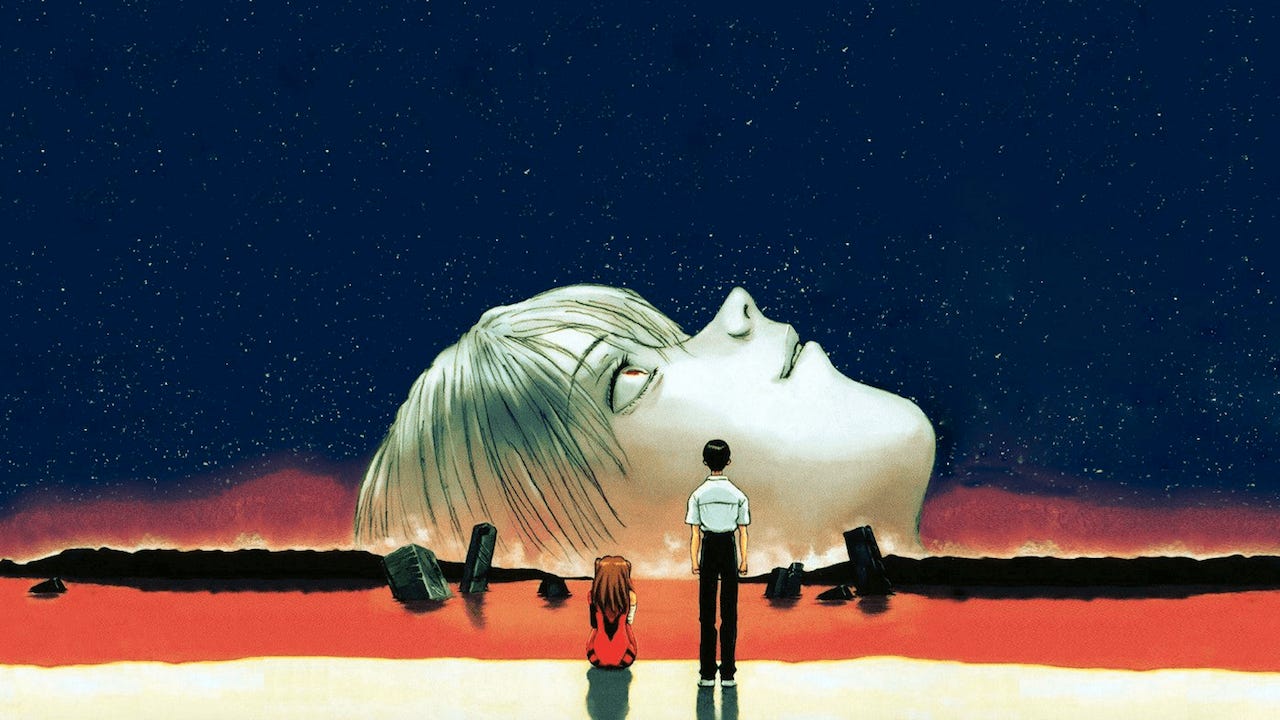
Alexander Raynor explores Hideaki Anno's The End of Evangelion (1997), which stages its apocalypse as a philosophical argument: the Human Instrumentality Project, the dissolution of all individual souls into a single, frictionless consciousness. This is not a villain's scheme but the fulfillment of liberalism's deepest aspiration, the abolition of suffering through the abolition of difference.
Neon Genesis Evangelion (1995-96), directed by Hideaki Anno, is a Japanese animated television series about a boy, Shinji Ikari, who pilots a giant robot and suffers from a great deal of mental health issues. At first glance, it appears as nothing more than your typical Japanese kaiju, where kids piloting giant robots battle giant monsters every episode. There is far more to the series than that, though. The series builds its symbolic vocabulary from Kabbalistic mysticism, Shinto cosmology, Midrashic tradition, Arthur Schopenhauer, and the psychoanalytic frameworks of Freud and Jung; it is among the more sustained explorations of psychological fragility in postwar popular fiction. The television broadcast ended in March 1996 with two strange, inward episodes that resolved the series’ psychological themes while leaving its external plot entirely unresolved. The End of Evangelion (1997), directed by Anno, was produced as an alternate theatrical conclusion: it stages, on an apocalyptic scale, what the television ending had rendered as an inner monologue.
The Problem in the Machine
The End of Evangelion (1997) stages an apocalypse you are meant to find appealing. The armed forces of SEELE liquidate the staff of NERV. Giant bio-mechanical units are crucified against a darkening sky. The angel Lilith, wearing the face of Rei Ayanami, dissolves every human being on Earth into an ocean of amber fluid. These images register as catastrophe, instill dread, signal horror in the way horror is supposed to signal it. This is the apocalypse, the end of all things; this is “The Human Instrumentality Project.”
The Human Instrumentality Project, the event toward which the entire Neon Genesis Evangelion narrative has been building, presents itself as the fulfillment of a wish: that suffering could be ended by ending the separateness between selves. All loneliness, all conflict, all the mechanisms by which one person is irreducibly foreign to another. Dissolved. What remains is a totality without friction, a humanity finally coincident with the abstract ideal of humanity. Alain de Benoist has a phrase for this horizon: the “ideology of the Unique,” which “cannot bear otherness and aims to reduce everything to a state of unity: one God, one civilization, and one line of thought.”1
‘The Ideology of Sameness’: A Critique of Egalitarianism

Alexander Raynor reviews Alain de Benoist’s recent work, The Ideology of Sameness (Arktos, 2022).
Shinji Ikari’s refusal of the Human Instrumentality Project is the film’s central act. He is not someone for whom refusal comes naturally. Trembling, self-loathing, nearly incapacitated by interpersonal dread. His refusal isn’t a gesture of strength. It is a recognition, arrived at through suffering, that the pain of existing as a particular, bounded, mortal self is not a problem awaiting a solution. The film is about this.
Anno had no involvement with GRECE or the Nouvelle Droite. The convergence traced here is independent, arising from a different tradition, a different intellectual context, a different order of despair. What the two bodies of thought share is a structural argument: that the aspiration to end suffering by ending difference is, at its limit, an aspiration toward something that cannot be distinguished from death.
SEELE and the Ideology of Sameness
SEELE (German for “soul”) is the film’s closest approximation to a liberal political body. Its members are aged, seated in a semicircle, identified by numbered monoliths rather than by faces or names. They speak in the language of humanitarian necessity and completion. The Human Instrumentality Project will end human suffering by ending the separateness of human beings.
De Benoist traces this structure to a specific theological origin. In The Ideology of Sameness, he argues that “the ideology of Sameness was initially formulated on a theological level, surfacing in the West through the Christian notion that all men, regardless of their personal characteristics and of the specific context of their actual existence, are endowed with a soul as part of an equal relationship with God.”2 From this premise the full liberal program unfolds: the secular universalism of the philosophes, the revolutionary abolition of intermediary bodies, the humanitarian creed of human rights, and at its terminus the fantasy of a single global humanity. Citing Arendt, de Benoist identifies the terminal form of this logic: “the multiplicity of men is melted into one single human individual known as humanity.”3
In Evangelion, the Third Impact performs this melting literally. The AT Field,4 the psycho-spiritual boundary that both separates and constitutes individual selves, is what the liberal program has always sought to dissolve under other names: the national border, the ethnic distinction, the cultural particularity, the organic community. In SEELE’s cosmology the AT Field is the mechanism of suffering and must be abolished. De Benoist calls this identification of difference as pathology the “ideology of Sameness” in its purest form: “allergic to anything that specifies, interpreting any distinction as potentially devaluing and consider[ing] all differences to be incidental, transitory, inessential or secondary.”5
What makes SEELE’s project specifically liberal is its self-presentation as benevolent. The Instrumentality Project is framed as fulfillment, the technical resolution to the problem of human loneliness. De Benoist has identified this technicization of the social as itself a product of the liberal program: the main modern ideologies have “alternatively fantasized about the unification of the world by means of the market, about a ‘homogeneous’ society purged of all ‘foreign’ social negativity, and about a humanity that is at peace with itself, having at long last rediscovered all that defines its essence.”6 SEELE’s redemptive vocabulary, saturated with Kabbalistic reference and Catholic iconography, makes the theological genealogy explicit. This is Christian universalism’s eschatological ambition, technically realized.
The film’s most disturbing structural choice is to present this consummation as invited. SEELE doesn’t simply execute the Third Impact; it creates the conditions under which Shinji will ask for it. De Benoist’s observation applies: “The universalist ambition, which tends towards unity, always correlates with individualism, which, in turn, leads to separation and dissociation.”7 The more thoroughly the liberal program dismantles organic bonds between individuals, producing the atomized, rootless, suffering private self, the more attractive the promise of total merger becomes. SEELE did not manufacture Shinji’s loneliness. Liberal modernity did. SEELE merely appears, at the limit of that loneliness, to offer its dissolution.
Zero and the Primordial: Rei, Lilith, and the Symbolism of Return
The film’s two central female figures carry the philosophical weight. Rei Ayanami and Lilith, the crucified angel whose merger with Rei triggers the Third Impact, constitute a layered symbolic system through which the film works out what lies at the origin of the universalist project, and what its promise of dissolution actually offers.
Rei, at her most fundamental, is a personification of the liberal ideal of abstract humanity. Her name means zero or null, a designation that is precise rather than ironic. She is a clone: a manufactured copy of Shinji’s deceased mother Yui Ikari, fused with genetic material from Lilith. She exists as a series of interchangeable instances, Rei I, Rei II, Rei III, each deployed after the previous one’s death, each without persistent memory across iterations. She is, in the strictest sense, man in general: a human being reproduced without the generative friction of sexual difference, without a unique biological lineage, without the accumulated personal history that makes any individual irreplaceable.
De Benoist puts the liberal anthropology plainly: universal humanity can only be conceived “by envisioning it as a composite of individual atoms, all of which are viewed as abstractly as possible, that is to say, completely out of context (’soil-less’) and beyond all mediation, thus ultimately defined as both substitutable and interchangeable.”8 The Rei clones embody this with uncomfortable literalness. There is a de Maistre line de Benoist cites: “I have seen men of all kinds, but never in my life have I encountered man himself.”9 Rei is man himself. The abstract type, the null individual, the instance without essence. Character designer Yoshiyuki Sadamoto conceived her explicitly as a “motherhood symbol,” a figure of unconditional absorption rather than particular selfhood. Critics compared her to the Virgin Mary. Both comparisons are accurate.
Anno described Rei as “the unconscious Shinji.” She is, among other things, a figure of what Shinji most deeply wants: merger, return, the dissolution of painful separateness into something warm, total, and accepting. The seduction of Instrumentality takes the face of the series’ least particular being because only such a face can make dissolution feel like love. What de Benoist calls the ideology of sameness does not present itself as cold. It presents itself as maternal.
The mythological Lilith adds a dimension worth sitting with. In the Jewish folkloric tradition most extensively developed in medieval sources, Lilith appears as Adam’s first wife: created simultaneously with him from the same earth, not derived from his rib as Eve would be. She is the figure of primordial equality, the being who preceded the differentiated creation in which hierarchy and asymmetry would enter the world. She fled Eden precisely because she refused submission to Adam; she was made from the same material and saw no basis for his authority over her. The spirit that insists on its own distinct selfhood even at the price of exile.
The mythological Lilith fled the Garden to preserve her irreducible selfhood; the film’s Lilith is the primordial matrix into which all selves are dissolved, the originating undifferentiated substance to which Instrumentality proposes a literal homecoming. What the mythology presented as the spirit of self-assertion becomes, in Evangelion‘s cosmology, the spirit of absorption.
The inversion follows a trajectory de Benoist traces for liberal egalitarianism. Lilith’s mythological insistence on equal origin, “we were made from the same clay,” is the egalitarian principle in its purest statement. But the principle is unstable: equal origin can ground either a demand to be recognized as equal—the mythological Lilith’s self-assertion—or a demand to become the same, in which all distinction is surrendered. Pushed to its logical conclusion, it terminates in the latter, and dissolution follows. As de Benoist argues, abstract equality “bears within itself a principle of non-differentiation. When applied to human beings, it signifies that there is no difference between them that could be perceived as one to relativize the aspects through which they do not differ.”10 The demand to be recognized as the same has become the demand to become the same. The film’s Lilith embodies this exactly: the originating equality has become an originating dissolution.
When Rei achieves her planetary form, she wears a beatific expression, the only moment in the series when her face registers something unambiguously warm. Anno’s face for the promise of total merger: the open smile of the mother who loves all her children equally and without condition. The seduction of Instrumentality is inseparable from its tenderness.
Komm, süsser Tod: The Dictatorship of Well-Being
The film’s most formally audacious sequence accompanies the onset of Instrumentality: the upbeat song “Komm, süsser Tod” (”Come, Sweet Death”) (named after the song of the same title by Johann Sebastian Bach) plays over images of mass annihilation, Anno’s own lyrics earnest in their expression of the desire to dissolve, to stop being a self that causes suffering by being separate. The irony is not cheap. It is philosophical.
Shinji Ikari is not forced into Instrumentality against his will. At the moment of maximum despair, after watching the mutilated body of Unit-02 dragged across the sky, after his father’s betrayal, after the deaths of everyone who might have cared for him, Shinji concludes that everyone should die, himself included. Lilith does not impose the Third Impact. Shinji invites it. The LCL sea is what he, at that moment, most sincerely desires.
Writing in Éléments no. 28-29 (1979), Faye opens “The Dictatorship of Well-Being” with Huxley’s late recognition that Brave New World was no longer fiction: that “a society without suffering and unmet needs was on the verge of becoming the sad reality of our time, and that, as in his Brave New World, any free individual or anyone showing original thought was already seen as harmful by masses conditioned by... the dictatorship of well-being.”11 SEELE’s Instrumentality is this. The warm bath, not the jackboot. The promise that suffering, understood as the condition of finitude, can be technically resolved.

Faye identifies a libidinal trap specific to the well-being project. The system “blunts” desire by satisfying it without friction: “Blunted by habit, pleasure then demands a constant escalation, leading to perversion. Modern consumers impatiently want everything, right away, but this hypersensitivity to deprivation makes them, in reality, incapable of savoring the joys of acquisition.”12 The distinction Faye borrows from Lorenz deserves to be isolated: pleasure is merely the act of consumption; joy is the pleasure of the creative act. Shinji cannot receive love; he can only dread its absence. He has been so thoroughly conditioned by the promise of frictionless well-being that the actual, friction-laden presence of another person registers as threat. This is the ground from which his invitation to Instrumentality grows.
In The Ethnocide System, Faye named the terminal product of this process homo universalis: the System has “no sovereign other than an abstract individual — homo universalis — in pursuit of homogeneous and planetary needs: well-being, consumption, security.”13 The political relationship between a people and legitimate authority is replaced by what Faye called “blackmail through well-being”: surrender your particularity, your conflict, your historical existence, and receive in exchange the guarantee of material comfort and freedom from pain.14 SEELE’s offer to Shinji is structurally identical. Surrender your AT Field, surrender your separateness, and the pain stops. The film reads this as the deepest form of political coercion, precisely because it addresses the longing to escape the burden of selfhood, not the body’s capacity for physical resistance.
Ethnocide: The System for Killing Peoples

IdeoChoc takes a deep-dive into Guillaume Faye’s The Ethnocide System, fresh off the press from Arktos:
Faye cites a passage from Drieu La Rochelle’s Le Jeune Européen (1927) worth quoting in full: “The stifling of desire through the satisfaction of needs — this is the sordid economy... that will destroy our races. The abundance of groceries kills passion. Stuffed with canned goods, there occurs in man’s mouth a bad chemistry that corrupts language. No more religions, no more arts, no more languages. Numbed, man no longer expresses anything.”15 The LCL sea is this condition rendered literal: a humanity in which well-being is total, suffering is zero, and the corruption of language is complete, because language, like all meaning, requires the friction of difference to exist.
Rooted Being and the Refusal of Universal Man
Rei-as-Lilith, in the liminal space of Instrumentality, asks Shinji whether he wants this world to continue. Two anthropologies face each other: abstract humanity, which Lilith embodies in her Rei-form, and particular existence, which Shinji arrives at through suffering.
His conclusion, that “life is about experiencing pain as well as joy” and that he therefore rejects the single consciousness, sounds thin if taken as personal preference. It isn’t. De Benoist insists that “a person’s belonging to humanity is never immediate, but on the contrary, always mediate: one is only human to the extent that one belongs to one of humanity’s constituent cultures or communities.”16 The corollary is stark: “Liberalism regards men as being interchangeable because it only perceives them in an abstractly generic way, as soilless beings disconnected from any sort of community and devoid of any belonging, with such severance viewed as the primary condition for their ‘emancipation.’”17 What Instrumentality achieves is this severing taken to its terminus: the liberal subject dissolved entirely, emancipation from particularity completed.
The official figurine game of the series describes Shinji’s final act plainly: “Shinji renounced the world where all hearts had melted into one and accepted each other unconditionally. His desire to live with ‘others’ — other hearts that would sometimes reject him, even deny him. That is why the first thing he did after coming to his senses was to place his hands around Asuka’s neck. To feel the existence of an ‘other.’” The strangulation is not violence. It is epistemology: the act of verifying, through resistance and friction, that Asuka is genuinely Other, genuinely irreducible to Shinji’s consciousness, genuinely there.
De Benoist: “Every exchange presupposes otherness. An exchange only makes sense to the extent that it contributes to something in the presence of another. Exchanging the Same for the Same can only occur in monologues.”18 The AT Field is the condition of encounter, not its obstacle. Shinji strangles Asuka to reestablish the AT Field between them, to verify that she is sufficiently other to make genuine encounter possible. He chooses to live in a world where she can say “kimochi warui,” “how disgusting,” rather than a world in which no such rejection is possible.
De Benoist, on equality and meaning: “Any form of equality receives its significance and sense from the corresponding possibility of inequality. A form of equality without the possibility of an inequality... is without value and significance.”19 The red LCL sea, in which all distinction has been dissolved, is a state in which equality has achieved its absolute form and precisely therefore become meaningless. The Schmittian implication follows: a politics that abolishes the friend/enemy distinction doesn’t achieve peace; it achieves entropy. The terminus where the political has ceased to exist, because the structure of difference from which it draws its energy has been liquidated.
The mythological dimension clarifies what is being refused. The mythological Lilith insisted on her own irreducible particularity, equal in origin and therefore refusing submission, and fled to preserve herself. Shinji’s refusal of Rei-Lilith recovers something of this original meaning: the insistence that selfhood is worth preserving even at the cost of exile and pain. Unlike the mythological Lilith, Shinji does not flee the structure of differentiated creation. He reaffirms his commitment to it.
The Shoreline and the Persistence of Difference
The film ends with Shinji and Asuka on a ruined beach, beneath a sky still stained orange with LCL. Asuka’s “kimochi warui” is typically read as nihilistic, as though the refusal of Instrumentality has accomplished nothing: the same broken, hostile, irresolvable relationship persists unchanged. This reading mistakes the film’s point. The persistence of that hostility is precisely what was at stake.
One could read the two figures as the Adam and Eve of a new humanity. Apt, with one qualification: they are not the seed of a perfected species. They are two particular, embodied, wounded, mutually opaque beings who exist in a specific place at a specific time, constituted by their history, incapable of fully knowing each other, and for precisely that reason capable of encountering each other. Yui Ikari’s final message to Shinji, that “anyone can return to their physical body if they have the will,” is not consolation. It is an invitation to finitude: to re-enter the condition of being a mortal, particular, irreplaceable self among other mortal, particular, irreplaceable selves. Perhaps it is a new humanity grounded in genuine otherness rather than absorption, with the two figures positioned as a new Adam and Eve whose relationship begins not in union but in an irresolvable difference.
That Asuka returns and Rei does not. The distinction matters. Rei, the null, the clone, the eternal mother-figure, disappeared when Lilith was destroyed; the abstract universal cannot persist once Instrumentality is refused. What remains is Asuka: loud, abrasive, constitutionally incapable of the unconditional acceptance that Rei-Lilith offered. She is difference itself, unreduced, unreconciled. Her final words are not “I accept you” but “How disgusting.” The new world begins with revulsion, and revulsion is, in the film’s logic, the minimal condition of the real.
De Benoist articulates the alternative: “It is, in fact, the principle of diversity that one should contrast with the ideology of Sameness... differences are more important — firstly, because they are the ones that specify, define an identity, and make each person or people irreplaceable.”20 He adds that “a society only comprised of men ‘like any others’ would inevitably be one where individuals have become interchangeable to such a point that the disappearance or elimination of any one of them would, from a broad societal perspective, only take on a relative sort of importance.”21 Asuka’s survival and her disgust are proof that this society has been refused. She is irreplaceable. Her reaction is hers alone.
The Thanatos of Total Well-Being
The film’s real target is the libidinal structure of liberal aspiration. Not its procedural or institutional forms. The fantasy that suffering can be ended by ending the conditions that make suffering possible. Faye saw this clearly in 1979: the well-being project “inevitably generates disappointed hopes and a climate of collective dissatisfaction,” because what it produces is not the satisfaction of desire but the blunting of desire’s capacity to be genuinely satisfied. The LCL sea is not happiness. It is Faye’s homo universalis in its final form: a subject with no more needs, no more passions, no more enemies, and therefore no more life.


The film distributes this desire across three figures. SEELE provides the bureaucratic-political form. Rei provides the human face: null, accepting, depersonalized, a being for whom dissolution into the undifferentiated is what she was made for. Lilith provides the mythological depth: the figure of originating equality rewritten as originating dissolution, whose promise is the return to the undifferentiated substance from which all particular, suffering selves emerged. The liberal project, in this reading, is cosmological as much as political. The dream of returning creation to its source, of healing the wound of differentiation, of making the cosmos safe for those who find the burden of existence, in its ineliminable particularity, too painful to bear.
Anno wrote the film during his own clinical depression and period of suicidal ideation. He is not diagnosing a political program. He is diagnosing a wish. But the film refuses to honor that wish. Shinji’s refusal of Instrumentality is a philosophical act because it is a refusal made in full knowledge of what is being given up: the pain will return, the loneliness will return, Asuka will be disgusted by him. He chooses this anyway. His choice is, in de Benoist’s terms, an affirmation that “all belonging is most certainly a limitation, but a limitation that delivers us from others. Dreaming of the unconditional is, after all, still dreaming.”22
The critique of the ideology of Sameness, its reduction of the irreducibly qualitative, particular, rooted, and suffering human being to an abstract unit of universal humanity, finds in The End of Evangelion an image that no political essay could produce: a teenage boy, shaking and weeping on a ruined beach, choosing to strangle the girl who disgusts him rather than live in a world where no one could. It is a terrible image. It is also, in the terms this film sets, an image of life.
Alain de Benoist, The Ideology of Sameness, trans. Roger Adwan (London: Arktos, 2022), 10.
Ibid., 12.
Ibid., 12, citing Hannah Arendt, Qu’est-ce que la politique? (Paris: Seuil, 1995), 42.
An A.T. Field (Absolute Terror Field) is a nearly impenetrable force field generated by Angels and Evangelions in the anime Neon Genesis Evangelion. It acts as a physical shield, but metaphorically represents the emotional barriers and fears of isolation that define individual human identities.
Ibid., 10.
Ibid., 13-14.
De Benoist, The Ideology of Sameness, 14.
Ibid., 14.
Ibid., 21, citing Joseph de Maistre.
Ibid., 3.
Guillaume Faye, “The Dictatorship of Well-Being,” trans. Alexander Raynor, European New Right Revue (Substack), May 2025; original publication: Éléments no. 28-29 (March 1979).
Ibid.
Guillaume Faye, The Ethnocide System, trans. Alexander Raynor (London: Arktos, 2026), 7.
Ibid., 55-56.
Faye, “Dictatorship of Well-Being,” citing Pierre Drieu La Rochelle, Le Jeune Européen (1927).
De Benoist, The Ideology of Sameness, 21.
Ibid., 34.
Ibid., 22-23.
Ibid., 6, citing Carl Schmitt, Constitutional Theory.
Ibid., 20-21.
Ibid., 23.
Ibid., 21.
"When Rei achieves her planetary form, she wears a beatific expression, the only moment in the series when her face registers something unambiguously warm."
Incorrect. In fact, her planetary form is depicted as quite creepy - the devouring mother. The only "warm" smile we ever see is when Rei II is rescued by Shinji and sees the love on his tear-streaked face (which reminds her of the only shred of love she ever received from her father figure, Gendo).
Ah, so eoe is literally the future liberals want