



IdeoChoc takes a deep-dive into Guillaume Faye’s The Ethnocide System, fresh off the press from Arktos:

Guillaume Faye was a French essayist and political theorist, born in 1949 and deceased in 2019. He was one of the principal figures of the Nouvelle Droite (New Right) and took part in the development of the so-called identitaire (identitarian) current. Known for his iconoclastic style and his capacity to forge innovative new concepts, he is responsible for such expressions as ethnomasochisme (ethnomasochism), convergence des catastrophes (convergence of catastrophes), and archéofuturisme (archeofuturism).
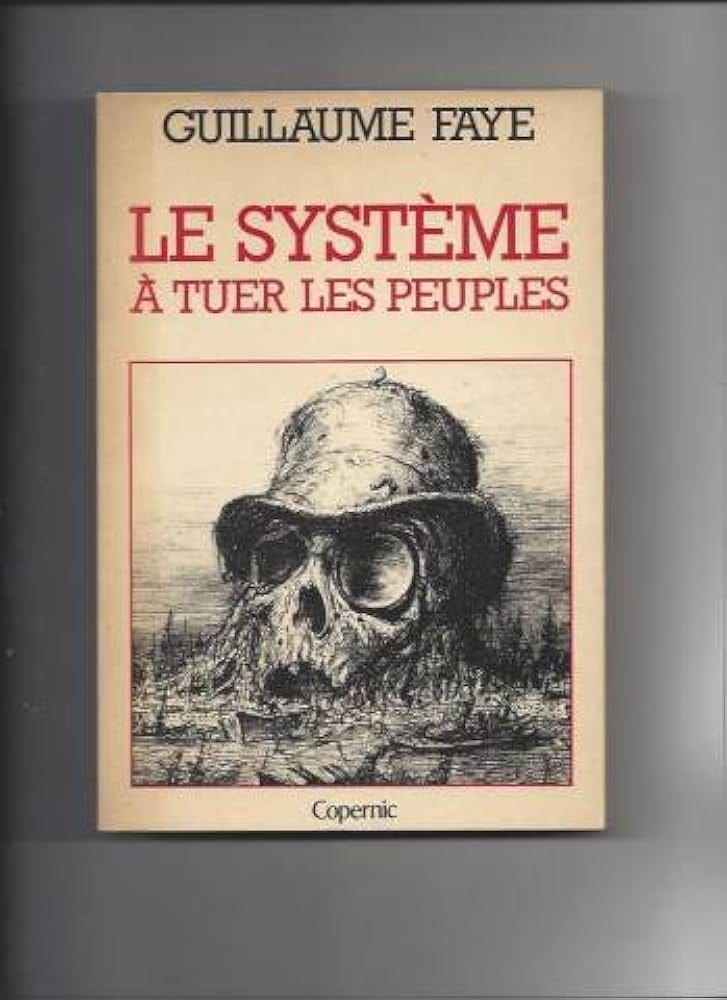
In the 1970s and 1980s, alongside Alain de Benoist, he was one of the principal pens of GRECE (Groupement de Recherche et d’Études pour la Civilisation Européenne — Research and Study Group for European Civilization), and in 1981 he published his first book: Le système à tuer les peuples [The Ethnocide System], a forceful work that returns in depth to the homogenization of the world. As a champion of “ethno-differentialism,” Faye denounces the decomposition of every particular identity.
From Civilization to System
First, an observation: humanity seems to be heading more and more toward one and the same mode of organization. People readily speak of a “global village” or a “world civilization.” But are these terms accurate? Are they not a way of reassuring ourselves by reaching for words that point to a known reality, when fundamentally we are entering the unknown, the never-before-seen?
What is being born under our eyes, says Faye, has nothing left of the village or the civilization about it. The reality of our time, “is one of ethno-cultural and national entities threatened with disappearance, peoples gradually emptied of their substance by a supracontinental macro-structure.” Now, this macro-structure has nothing of a civilization; rather, it presents the characteristics of a system. For a civilization, even a worldwide one, is always grounded in a cultural past and aims to perpetuate itself into the future. A system, by contrast, has something mechanical and timeless about it, even when it is alive. “A machine, a bacterium, a cancer cell — these are systems in their various ways. They lack what Ludwig Klages called a soul.” Our social environment appears more and more anorganic — that is, dead, without inner life, closer to machinery than to a growing organism.
The world System breaks with all earlier forms of human collective life, which were grounded in a history and in a territory. Until now, every human community has gathered around the representation of a common origin and of a space in which one “dwells,” in the poetic sense Heidegger gave to this word. The System, by contrast, brackets the historico-national principle and the politico-territorial principle. The criteria of belonging to the System are economic and technical. To be “Western,” in this globalized sense, is to belong to a certain mode of life, a type of consumption, a rhythm of existence — not to a nationality, an ethnicity, or a particular past. “A bank executive from Singapore will be more ‘Western’ than a Breton peasant who still speaks his language and follows his ancestral culture. The one will form part of the System; the other will not.”
Our planet is thus less and less experienced as a space and more and more as an ensemble of zones — a development that produces an inner uprooting of populations and a loss of will, on the part of governments (especially European ones), to protect their territory. To dwell is an existential and ethological function, as Heidegger and Konrad Lorenz each described in their own way. Yet the System turns us into residents and no longer into inhabitants. The planet is now experienced only instrumentally, as the juxtaposition of specialized zones: the sun-and-vacation zone, the oil zone, the Western-Europe zone, etc., toward which it would be unjust to restrict the immigration of anyone whatsoever.
Unlike civilizations, the System also does not situate itself within history; its consciousness belongs rather to practical immediacy. Civilizations know that they are mortal — which is why they leave monuments, testimonies of their existence, so that their grandeur might be remembered. The System, by contrast, does not regard itself as provisional and mortal but as definitive and eternal. Why then would it bother to secure itself historically or to “leave its traces”? Inspired by humanist rationalism and progressivism, it believes itself installed once and for all upon the earth and does not entertain the possibility that history might “change direction” against it.
The factors of world homogenization today are technological, but also ideological and economic. Let us look at some of those that Faye foregrounded in his book.
The Total Economy
Homogenization spreads according to the logic of an economic-cultural complex. In industrial societies, in fact, cultural behaviors (reading, eating, dressing, going to a show, etc.) correspond to purchases, to economic preferences. The System therefore imposes its culture by way of its economic grip.
Films, automobiles, clothing, electronic gadgets of every kind — these objects, far from being neutral, carry values and act on the psyche of those who consume and use them. This is easily noticed: the West fascinates the countries still on the System’s margins through its objects of cultural consumption (rock, jeans, cars, etc.). This is the “advertising” phase of the System’s tactics. Then, once mercantile habits have taken root, cultural impregnation is reinforced through television and the media, but also through music, films, and the rest, which penetrate further into the mental universe of peoples, progressively destroying their specific mores.
Once the “advertising” phase is over, once the country’s elites — fascinated by the West — have made their traditional culture appear “backward,” the second phase of “normalization” begins. Economic habits and consumption practices become institutionalized, things one can no longer, morally, do without. The point is to “satisfy needs” or to undertake “humanitarian actions” in countries still little “developed.” And the third phase is that of “consolidation,” intended to forestall revolts or possible revivals of specific cultures. Fashion is thus the tactical instrument of this consolidation: the dominant culture is wholly incorporated into the economy. “The economy is cultural and culture is a planet of the economic system.” But this does not mean that we are witnessing the birth of a new culture in the traditional sense of the word. There is now nothing but a gigantic cultural product, a global subculture to be consumed.
This subculture appears at first sight as Anglo-Saxon, and more precisely as American. “From the lyrics of songs to the user manuals of electronic devices, Anglo-Saxon and American language and mental structures dominate.” In a certain way, one can say that the System carries a kind of American culture for external use, simplified by comparison with its model. This is why, says Faye, the System can be likened to “the Americanosphere,” as the extension of American society — at least in its “globalizable” principles.
For all that, one should not simplify the situation by making the System into a project politically piloted by the United States, as if it were merely their empire. In truth, says Faye, the Americans in no way “direct” the System. Führung — “guidance”1 — which Max Weber made one of the essential criteria of politics, is totally absent from it. There is, to be sure, an American political hegemony within the Western System, but the United States long ago gave its “style” to all the latter’s mechanisms, which now duplicate it ad infinitum, whether in Europe or in Japan. The hypermarché (hypermarket), for example, is the paroxysm of the American mode of consumption — and yet, Faye reminds us, it is a French invention. This is why he urges us not to mistake which battle to fight: to combat the System is not to denounce the political hegemony of the United States in the world. As he wrote: “We ourselves are already the purveyors of the System’s mental and economic structures. Less and less will we be able to make the United States our scapegoat.”
Indeed, by the very fact that it is economic and technical in essence, the world System no longer has need of leaders. It needs only regulators: “The political decisions of states are replaced by decentered strategic choices made within networks of power that transcend national frameworks: networks of corporate management, international banking networks, networks of public and private speculators, networks of international legal obligations, etc.” In other words: “No conductor governs us. No consciously programmed will animates the whole through long-term decisions.”
The System now functions through incentive-based self-regulation; power no longer has a place or a face. Yet, contrary to the Marxist schemas, this self-regulation is not exercised by the owners of the means of production but by a planetary technocratic class of administrators, of managers. The System’s capitalism is a capitalism of functionaries, not of owners — which is all the more troubling. Property, after all, encourages caution and a regard for the long term. Here, it is not even “the interest of profit” that motivates them, but the internal logic of their own organizations. This technocracy is not authoritarian for all that. Founded on liberal ideology, it claims above all to be rational. “Self-regulation claims, in fact, to replace the political with rational, quantified, mathematized decisions. Questions of economic technique are systematically presented as the most important.”
The technocratic System then presents itself as without alternative and makes peoples live to the rhythm of its short-term self-regulations.
OUT NOW: The Ethnocide System

In the new global era, the peoples of the Earth find themselves under the monstrous tentacles of a techno-economic system which sees only numbers. Spawned by the American mercantile order but now supplanting it, this system uproots, domesticates, and homogenizes national identities, replacing them with an anonymous global society under “scientific” mana…
The Global Ideology
But how does this headless body not collapse, one might ask? Because, from one end of the world to the other, a common and implicit ideology holds the System together. The conflicts between the liberal right and the left should not make us lose sight of their shared ideological ground.
It is back to the founding fathers of liberalism and democratic thought, Faye says, that one must go to find the premises of a globalist order. “Hell is paved with good intentions, and the totalitarianism of the System is paved with humanitarian concepts.” Now, as Carl Schmitt showed, liberal concepts tend to annihilate the political and to transform the State into society — society being understood as a universe without history or root, a universe in which contractual and economic relations dominate. Whether in Adam Smith, Voltaire, Benjamin Constant, or Thomas Paine, one finds the same idea: that whatever is historical, political, rooted, popular is dangerous and risks leading to war. Now it is commerce and contractual relations that are to pacify the world: “We have arrived at the age of commerce, an age which must necessarily replace that of war,” wrote Constant.
Yet Marxism rejoins liberalism in this desire to construct a pacified, denationalized, depoliticized universe without historical peoples. It is simply, paradoxically, less effective than liberalism. “The proletarian international fails: it ends up in nationalisms and is caught in the trap of its ‘means’ [...] The international of refrigerators, by contrast, succeeds.”
The foundation of the global ideology, Faye continues, is at bottom what he calls “the religion of human rights.” We find it first in 1776, in the American Declaration of Independence, which insists less on the political rights of the citizen than on man’s pursuit of happiness and on the right of the individual to resist any sovereignty that might obstruct his pleasure. According to that Declaration, the end of politics is to guarantee the happiness and well-being of individuals. This sacralization of individual happiness rests on a rationalist and technical discourse. Technology in fact leads to the domestication of peoples, but also to the belief that, thanks to it, all the world’s problems will be smoothed away. Pollution, world hunger, social violence — all of this is now nothing more than a technical problem. Yet paradoxically, Faye remarks, this world innervated by technology has no technological project:
“No grand design animates the technicization of the Earth. Only programs, governed by profitability, that pile up upon one another in disorder. The technicist ideology leaves it to science fiction to dream about technology. Technology itself is envisaged only in the prosaic form of an instrument for the planned regulation of existence and of the world, for the elimination of the unforeseen, of adventure, of the political — and this is so on the left as much as among the liberals.”
The consequence is a more and more static world. This is paradoxical, since the ideology of progress also undergirds the world System. Here liberalism diverges somewhat from Marxism. Although the two share the same goals and believe in the idea of universal progress, their conceptions of progress differ. For Marxists and socialists, even if progress will end up bringing history to its term, it is achieved through history, by way of political conflicts and class struggle. Progress lies at the end of revolution, in the radical transformation of present social reality.
The Western System has another idea of progress. Progress does not revolutionize; it reinforces and consolidates what already exists. Its leitmotiv is purely quantitative: “more of.” This is observable in electoral discourse. Politicians do not promise to change the order, the structure of things; they promise to increase what exists: comfort, highways, leisure time, security, etc.
One should not, however, believe that the ideology of the world System makes a clean sweep of the past. Here too it differs somewhat from communist revolutionary ideology. Culture, as we have said, becomes a consumer product like any other. Now, the past undergoes the same kind of recuperation. The past is no longer interiorized but “stored,” arranged like a backdrop — nostalgic, aesthetic — alongside the present. Réenracinement (re-rooting), conceived in decorative mode, can give birth to no myth capable of bearing action.
“Each person has his epoch-fads, his fake-origins, materialized in badges, ‘authentic’ everyday objects, etc. The past becomes a hobby, one of the elements of the system of leisure pursuits; it enters a sphere of rational activity and thereby loses, for the System, all subversive danger, all historical value capable of awakening the memory of peoples.”
Thus, paradoxically, it is by this insistence on history-as-leisure that the System de-historicizes peoples. “Hyper-pragmatic forms of life require, by way of compensation but also to reinforce their own immediacy, a passéiste backdrop that gives them a clean conscience.” A real people integrates its past to the point of being able to forget it; it does not “play” it. The passéisme proper to our era thus coexists with mercantile forms of life. To visit the Musée des Arts et Traditions Populaires (Museum of Popular Arts and Traditions), notes Faye with regret, in no way prevents the cultural uprooting of the daily life of modern urban men. “The visitor leaves full of good conscience, believing that traditions are conserved. Precisely, alas, they are; that is why they no longer exist.”
“We see that the stabilization of the System rests, rather paradoxically, on two mythemes that balance each other and that refer the one to the past, the other to the future: the false “museum-like” sacralization of tradition, and the reassuring idea of progress. There is here a deft recuperation, but also a neutralization of the themes of tradition and of destiny, which in another context would have been dynamic and bearers of history. Here, on the contrary, pseudo-tradition and the idea of progress absorb past and future and ‘pin’ the present down in immobility.”
The Cause of Peoples
The struggle against the System must transcend the old cleavages, Faye notes in his final chapter: left/right, socialism/liberalism, belief/atheism, materialism/idealism, etc. New political regroupings must be born along this new caesura between the System and what is not the System. Hence this book, which presents itself as an attempted call to consciousness directed at those Europeans who still confuse the Western System with the values and destiny of their own civilization.
The System undertakes a gigantic domestication of peoples, whose societies become nothing more than “biological machines,” whose sole function is to satisfy artificially stimulated, homogeneous needs of consumption and security. The demographic decline of the peoples that form part of this System proves that, preoccupied only with the present, with the current moment, homo occidentalis will probably have no biological descendants. For “the Western System does not kill peoples by inflicting on them insurmountable trials — wars, famines, or epidemics — but by gnawing away from within their vouloir-vivre (will-to-live), by uprooting them from the organic soil of their traditions, by discouraging them from willing themselves a future.”
At the moment Faye wrote his book, no precise ideology yet united the System’s adversaries — but they existed potentially, he believed. Against the System will rise all those who do not want the Earth to become a Monde-Un (One-World), all those who reject cosmopolitanism, mercantile society, the bourgeois spirit, and the New York model of subculture. In Europe as in the Third World, a push in this direction is again manifesting itself.
The task, then, is to nourish a true revolutionary spirit. But the struggle against the System must not be blind. The fact that it is fundamentally technicist must not, for example, lead us to defend neo-Luddite or reactionary positions. What must be held against the System is not that it rests on technology but that it ignores technology’s poetic, creative dimension, conceiving it solely as the banal instrument of happiness. As Armin Mohler said, technology must be a bearer of meaning and must reintegrate culture.
“From art to space conquest, there is matter for technology to become irrational again. Let us not forget that its destiny is not comfort and idleness, but the bringing-to-light of the myths inscribed since the dream of Icarus in the subconscious of European peoples. It is by way of a new futurism, eminently pagan and Faustian, drawing inspiration from our most ancient traditions, that we will succeed in liberating ourselves from the System — from its presentism, its refusal of the future and of history.”
The System holds back history the way a kettle holds back steam. But there comes a moment when the kettle bursts. Some twenty years before writing his book on the “convergence of catastrophes,” Guillaume Faye was already predicting that the System would, in time, face a series of geopolitical, economic, cultural, demographic, and military factors that would converge upon a breaking point. But this convergence of catastrophes is not, in his eyes, to be feared: it is from this convergence that the liberation from the system-that-kills-peoples will begin.
Clear ideas and ideo-shocks; words that strike home and shatter mental sclerosis the way a hammer does. A firm will to learn, to discover, to create. Swift, fleeting flashes of lightning by which to rise. A high-altitude cure for the mind, a blitzkrieg for the intellect. IdeoChoc has presented to you Le système à tuer les peuples [The Ethnocide System] by Guillaume Faye.
Guillaume Faye’s The Ethnocide System is now available from Arktos:

Translated by Alexander Raynor
IdeoChoc is a French-language platform that condenses the essence of important books into twenty-five-minute audio capsules, each accompanied by a reading sheet. Every week, a new idéo-choc delivers the substance of a major work — political, philosophical, historical, economic — without flattening its argument or its voice. The library ranges from Augustine and Epictetus to Max Weber, Carl Schmitt, and Guillaume Faye.
Faye retains the German term Max Weber uses in his political sociology (variously rendered as “leadership,” “direction,” “guidance” in English Weber translations). The doubled French gloss « guidage » is preserved in English as “’guidance,’” italics on the German term retained per source.
More and more, I feel that the forces exerting themselves on humanity have little to do with humanity. Great article. Thanks