What if our nihilistic, decadent modern era was of our own making, somehow rooted in our very own (dis-)connection to our ancient, mythical origins? What if European man — from the Stone Age hunter and the ancient Germanic tribesman to the modern philosophical visionaries like Nietzsche and Sorel — has been destined to decide on the end of the tale?
In this lively, haunting, enchanting essay below, Michael Gazda invites us to stare into the abyss and see ourselves staring back.
If the midnight of our civilization is inevitably approaching, all the better.
Our mythical and mythologized past is an instruction on how we must approach the present. Myths were a language of belonging, emanating from a common experience of shared culture. Georges Sorel articulated how myths are created in our epoch of nihilism; in a time when such belonging and shared culture have been long severed from living memory. The transition in form from ancestral to modern myths is the story of our decline and a vision of overcoming this decline.
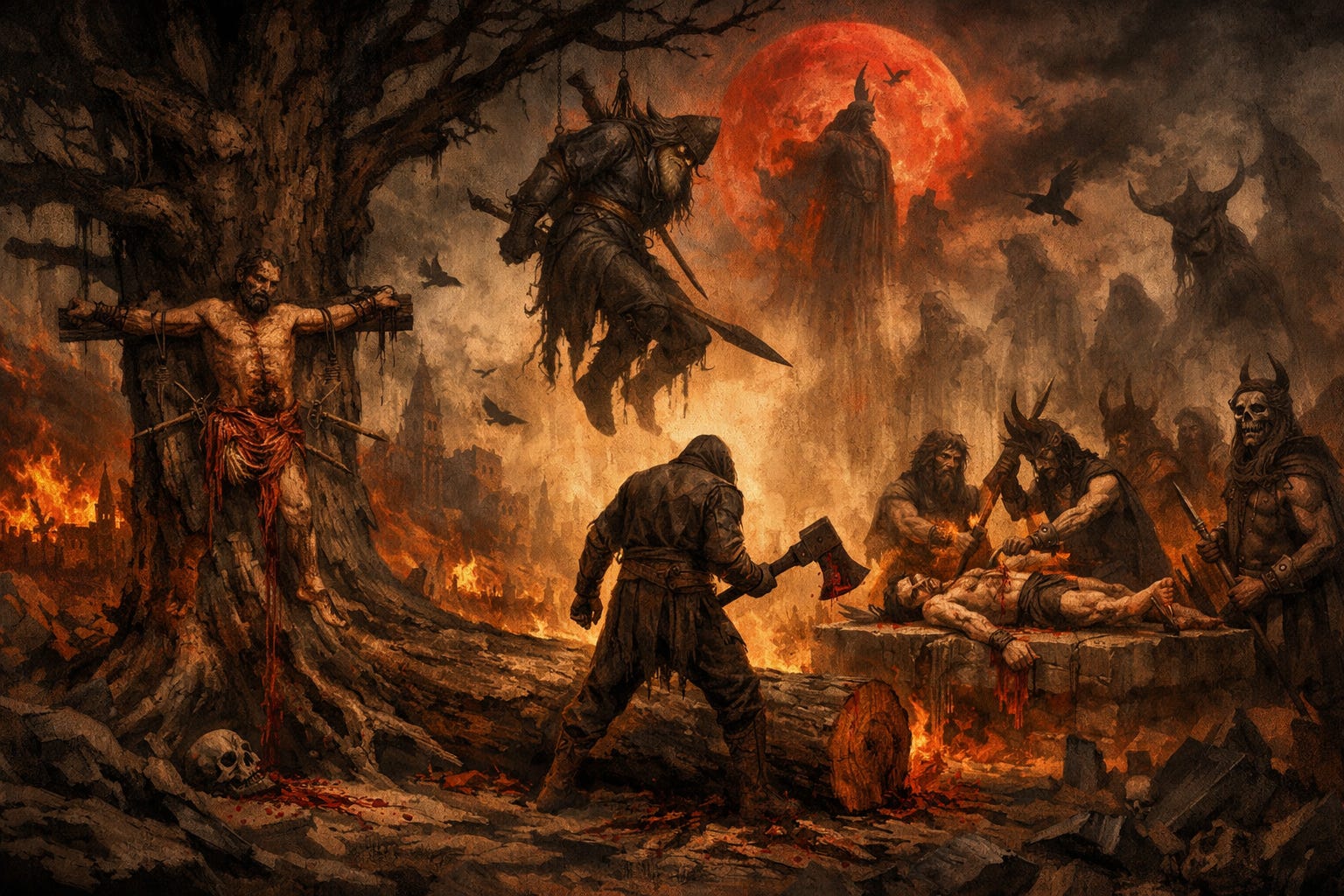
Siberian oral histories spoke of a Great Tree that once connected the material earth to the terrains of the gods and spirits. It was a conduit through which humanity was conversant with the plants and animals. They tell of a man from the steppe who swore that he would cut it down. He took an axe and felled it, just as he had promised—rendering the spirits invisible, the plants and animals mute, and the gods exiled forever in silence.
For tearing the bark from sacred trees in the primeval forests, Germanic tribes proscribed a penalty of disembowelment for the captured offender, whose entrails would be nailed to the wounded flesh of the oak and they would be forced to walk around the tree until they perished.
At one time and in one place, the best among us were the final arbiters of whether anyone would hear the gods ever again. At another time, and in another place, the best among us were the agents of order, substituting the flesh of a man for the flesh of an oak. The power to liquidate a decadent society and the power to construct a new order were ours only because we made it so.
These qualities of the uniquely Western spirit were once deified, as we read in the Edda1:
I know that I hung on a windswept tree
Nine long nights,
Wounded by spear, dedicated to Odin,
Myself to myself,
On that tree of which no man knows
From where its roots run.
With no bread did they refresh me nor a drink from a horn,
Downwards I peered;
I took up the runes, screaming I took them,
Then I fell back from there...Hávamál, 138-139
Odin displayed the range of those characteristics of the Western spirit—solitary attunement, dissatisfaction with what is, love of danger, self-sacrifice in service to the will, oriented toward the infinite, accomplishing the impossible through action. He was not the first or the last god, but he served his tenure as the highest god.
READ MORE:
How can we find stability in the Night of the World? How can we anchor ourselves in the void of existence, the great nothingness of the endless dark plain ahead of us? The new voices of the old Gods can be heard from afar, beckoning us back into the fold of the folk. Where will we wander? Into oblivion or the primeval forest, from whence we came and to which we have always belonged and thus must return? The meanings of words spell out the destinies of men. Acknowledging the roots of language leads us to an understanding of where we now stand and where we must go if we do not want to perish. The Gods without must once again become the Gods within, so we can hear for the last time the faint whispers of our ancestors guiding us into a better tomorrow.
The inevitability of Western civilization’s terminal decline is an obstacle equal to the Western spirit. Spengler characterized the overcoming of resistances as the typical impulse of the Western soul.2Bäumler wrote that such resistance is actively sought out because “the will to power is the will to overcome fate.”3 What could be a greater source of resistance than inevitability? What could be a greater act of will than to overcome fate?
The onset of Western nihilism must be understood as an inevitable historical eventwhichinitiated the epoch of the irresistible decline of Western civilization.4 Vegetating in our own decadence has never been in our nature. We are mere centuries into the epoch of nihilism and have been gnashing our teeth the whole time.
Nietzsche identified this onset of nihilism with the devaluation of the highest values: the intolerable consequences of which are with us and continue to rapidly develop according to their own evolutionary laws. Reason is the cruelest weapon perfected by Western man. From Aristotle’s logic to Hegel’s dialectic, reason has been the instrument of our decline —
Hate the Greek philosophers for having been philosophers!
Hail the 30 Commissioners and their 300 lash-bearers who flagellated Athens!
Celebrate the punishment of Socrates!
All Power to the Krypteia!
— what other force could make war on the Western spirit but Western reason?
The origin of our nihilism was then within us; we did it to ourselves. And it is wholly ours. That other peoples and civilizations are collateral damage and subject to our decline is simply due to our historical success in forming the world; it was ours to ruin.5 It is fitting then that Nietzsche’s work announced the onset of nihilism, documented the contours of its development, and articulated the conditions of ending it — all within the forms of the Western philosophical tradition. A distillation of this work can be identified in the unity of the will to power, eternal recurrence of the same and revaluation of all values. He identified the characteristics of the men who will emerge to overcome nihilism:
“What would men have to be like whose valuations are the opposite? Men who have all the traits of the modern soul but are strong enough to transform them into so much health—their means for their task.”6
“Principle: There is an element of decay in everything that characterizes modern man: but close beside this sickness stands signs of an untested force and powerfulness of the soul. The same reasons that produce the increasing smallness of man drive the stronger and rarer individuals up to greatness...”7
What is 21st-century man but sickened in the most literal sense? By toxic foods, chemical dependencies, physical and mental lethargy, dysfunctional families, economic insecurity, social rootlessness and godlessness. And yet, these are the conditions which become his health: because the aspirations from his blood whisper to him to resist, to overcome; and some will listen to this whispering. The greater the resistance, the greater his will to overcome.
Nietzsche completed Western philosophy8 by closing the routes through which our reason may continue despiriting us and perpetuating our decline. Power beyond reason (logic, truth) for the sake of more power is the force of life — life itself. This being of Being recurs eternally because life as power for the sake of more power can reach no end, but must exist within the limits of the world. Recognizing this requires the revaluation of all values and the formulation of new values, as this recognition liquidates the basis for our devalued values in the epoch of nihilism.
“Overall view of the future European: the most intelligent slave animals, very industrious, fundamentally very modest, inquisitive to excess, multifarious, pampered, weak of will—a cosmopolitan chaos of affects and intelligence. How could a stronger species raise itself out of him? … To fight upward out of that chaos to this form—requires compulsion: one must be faced with the choice of perishing or prevailing.”9
Ah, the choice of perishing or prevailing…
Think of the last days of the Neanderthals; of places like the Moula-Guercy and El Sidrón caves, where their frenzied genocide by sex and murder became fossilized. They were probably the most creative and sensitive branch of the homo genus. Oh yes, and their men had their skulls split open with rocks and their women were turned into cave whores by the earliest homo sapiens. Many were just killed to be eaten. History is the story of victors and vanquished. It’s better to be the former than the latter if you can help it.
Wounds develop in the body of our decadence from time to time, some larger or deeper than others, in which the intolerability of decline ignites the spirit of greater or lesser numbers of people in action. Most often these expressions of spirit that manifest in such moments are deformed by confusion, momentary concerns, and ideology.
Twenty years after Nietzsche’s incapacitation, Sorel’s conception of myth elaborated a practical organizing principle of resistance and overcoming under the conditions of nihilism. For Sorel, a myth is a symbol upon which the intuition of greater or lesser numbers of people attach their aspirations, derived from their direct personal experiences. Unlike an ideology, a myth lives through the impressions of those who act upon it rather than through an external mediator.
“Myth lives through the impressions of those who act upon it”…
Indeed… and perhaps no other author published by Arktos is as renowned and as “controversial” (all the better!) for “acting upon myth” than Julius Evola, the legendary Italian Traditionalist who famously took up the question of the “myth of race” in The Myth of the Blood: The Genesis of Racialism, a must-read brought to you in English by Arktos:
In his own time, Sorel attached this concept to the myth of the “general strike” in which the industrial workers of modernity would collectively lay down their tools and go on strike against capitalism itself. He cared little about the practical details of such an apocalyptic act—or even whether it would ever happen. Its function was to solidify a principle of endurance and desire for action in a self-selected community.
He compared the myth of the general strike of the 20th century with the myth of the return of Jesus among the first Christians, who endured persecution and continued to proselytize with the faith that the Second Coming was imminent and would remake the world. Sorel’s myth thus fulfilled its function by separating many industrial workers from the middle-class socialists, welding them into a community of spirit. The myths of world revolution and the nation would supplant that of the general strike in subsequent political movements that took state power in Russia and Italy.
In our own time, the myth of the “globalist elite” is operative, harnessed by political parties and various actors, but owned by none. While not as dramatic as the storming of the Winter Palace or the march on Rome, the recent mass spontaneous resistance to the lockdowns and vaccination mandates were operating according to the same dynamics: the welding of a community of spirit under the conditions of nihilism, deformed by the contingencies of temporal events and particularities, but animated by a will to resist and overcome the symptoms of decline.
Faustian man isn’t in his midnight—he has yet to reveal himself. His life will be unburdened of Being, unpolluted by reason, and dangerous. Decadence in the epoch of nihilism has decoupled him from the grounding and attachment of his traditions. Its forms have poisoned his body and mind, but he was selected as perfectly constituted for his mission of world-formation through his endurance. He is the maker and subject of myth. The words of Goethe’s Mephistopheleswill be the birth-cry that announces his emergence:
Like the man from the steppe, in a moment of decision, he will liquidate his own civilization to escape the fetters of nihilism. It has been done before, and he is uniquely disposed to do it again. Rather than the savior of Western civilization, he is the abyss that will emerge from its midnight, signalling its final disintegration—and, like the Germanic tribesmen, he will construct a new order to take its place.
***
This daring meditation on the fate of European man from the heights of mythic prehistory to the depths of the nihilistic era has been brought to you by Arktos Journal.
Arktos publishes works rooted in timeless values, civilizational memory, and long-form thought — we’ve been doing so since 2009, and we aspire to continue to do so for generations to come.
If this essay and other Arktos Journal publications have inspired you to think differently about the past, present, and future of the West, consider a paid subscription to help keep our efforts sustainable, independent, and handled by those who truly care about the essential ties that matter:
This is the first appearance of Alfred Baeumler’s writing in English. One wonders why… Unlike so many in postwar Germany, Baeumler did not die in an internment camp; yet he was meant to experience a different kind of death. The professorship and authority Baeumler enjoyed in the prewar world was never returned to him after his time in postwar detention. He was meant to die in obscurity, along with all his ideas. Presented for the first time in English and republished for the first time in the postwar world is Alfred Baeumler’s Nietzsche: Philosopher and Politician (1931). Herein are ideas the postwar world meant to kill—because they are deemed disagreeable, dangerous. Dangerous to what? Dangerous to ideologies that intern and censor to death. This book, more than anything, is a mirror.
“The overcoming of resistances may far more justly be called the typical impulse of the Western soul.” Oswald Spengler, The Decline of the West, Volume I: Form and Actuality (Rogue Scholar, 2020), p. 315.
“One of the essential formulations that designate the event of nihilism says, ‘God is dead’. The phrase ‘God is dead’ is not an atheistic proclamation: it is a formula for the fundamental experience of an event in Occidental history… By nihilism Nietzsche means the historical development, i.e. event, that the uppermost values devalue themselves, that all goals are annihilated, and that all estimates of value collide against one another…” Martin Heidegger, Nietzsche: Volumes One and Two (HarperCollins, 1991), pp. 156-157.
“Will-to-power even in ethics, the passionate striving to set up a proper morale as a universal truth, and to enforce it upon humanity, to reinterpret or overcome or destroy everything otherwise constituted — nothing is more characteristically our own than this is.” Oswald Spengler, The Decline of the West, Volume I: Form and Actuality (Rogue Scholar, 2020), p. 344.
See this concise statement from Heidegger on the will to power and eternal recurrence as the overcoming of metaphysics:
“Will to power says what the being ‘is’. The being is that which (as power) empowers. Eternal recurrence of the same designates the how in which the being that possesses such a ‘what’ character is. It designates its ‘factualness’ as a whole, its ‘that it is’. Because Being as eternal recurrence of the same constitutes the permanentizing of presence, it is most permanent; it is the unconditioned that. We must at the same time recall something else: the fulfillment of metaphysics tries on the very basis of that metaphysics to overcome the distinction between the ‘true’ and the ‘merely apparent’ worlds. At first it tries to do this simply by inverting those two worlds. Of course, the inversion is not merely a mechanical overturning, whereby the lower, the sensuous realm, assumes the place of the higher, the suprasensuous—an overturning in which these two realms and their locales would remain unchanged. The inversion transforms the lower, the sensuous realm, into ‘life’ in the sense of will to power. In the essential articulation of will to power the suprasensuous is transformed into a securing of permanence. In accordance with this overcoming of metaphysics, that is, this transformation of metaphysics into its final possible configuration…”
— Martin Heidegger, Nietzsche: Volumes Three and Four (HarperCollins, 1991), p. 170.





Civilization is a death trap! Chaos has momentum. Time to return to Forest! The road to glory, the road to the stars begins in Forest!