


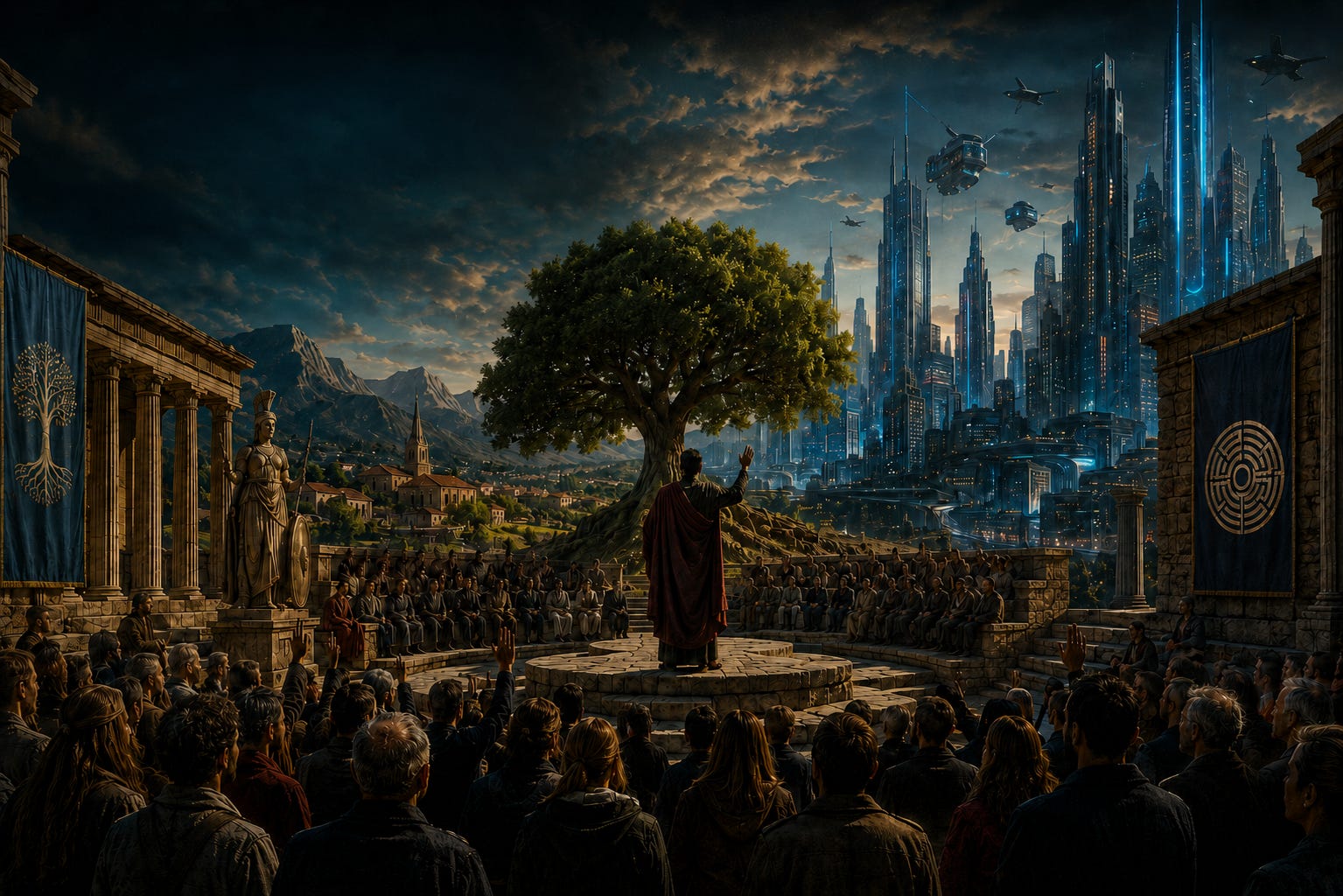
One of the main political developments of the past decade has been the rise of populism, even if its roots can be traced further back, perhaps to the 1990s and the rise of the Freedom Party of Austria under Jörg Haider. The larger breakthroughs, however, came in the 2010s and beyond. By 2026, populist parties are polling at or near the top in countries such as France, Germany, and Austria, while governing, or helping to govern, in Italy and Slovakia. In Britain, Nigel Farage is ahead in the polls, while the emergence of a second populist force around Rupert Lowe may point toward a future trend.
However, despite this success, populist movements are still usually described negatively, even if the negativity is strongly biased — anti-elite, anti-globalist, anti-technocratic, anti-immigration. And while populist movements often are all these things, being anti-something still denotes that one remains in the protest phase. It suggests that populism is not mature enough to develop its own worldview, nor become capable of deeply articulating not only what it opposes, but also what it stands for.
This weakness becomes clearer when one looks at populism’s opponents, who possess developed worldviews and theories of politics. They answer the basic questions of political life: what is man, what is society, and what is political authority for? Liberalism sees man as an autonomous individual, society as a voluntary association, and political authority as a protector of rights, liberty, and private property. Socialism and communism see man as a social being, society as interdependent, and political authority as a means of distributing resources fairly.
Populism, however, is still based more on instinct than on a theory of similar calibre and depth. One of its usual answers is patriotism or nationalism, and the nation-state — imperfect though it is — as the only currently viable framework for democratic politics. But the problem with nationalism is that it cannot, in and of itself, provide a coherent political theory.
Nationalism or localism, while essential to most populist movements, does not by itself constitute a worldview. Its versatility lies in how easily it enters very different political theories. Ho Chi Minh’s Vietnam and Enver Hoxha’s Albania both combined communism with nationalism. Liberal nationalism often expresses itself through civic conceptions of the nation. National Socialism combined socialism with an extreme form of racial ethnonationalism. Thus, nationalism is better understood as a political vector within a worldview, rather than a worldview in itself. It tells us on behalf of whom politics is conducted — the nation — but not what kind of society that nation should embody or build. This does not mean populism lacks the ingredients for a political theory of its own. One of them is its claim to speak on behalf of the people it represents.
But if populism claims to speak on behalf of the people, it must also explain how the people are to rule. According to Alain de Benoist, liberal representative democracy is flawed because it tends to become procedural, managerial, and deprived of real political substance. It therefore attracts the politician suited to such a system: the technocrat, the manager, and the career operator.

De Benoist sees liberal democracy as tending toward oligarchy, not by abolishing democracy, but by emptying it from within: power shifts from the demos toward a narrow political class chosen to represent them. The system remains democratic on the surface, with elections, parties, and institutions, but citizens vote occasionally without meaningfully shaping decisions. Over time, this fuels career politicians and shared interests among cross-party elites, while major parties begin to resemble one another. At the same time, power increasingly migrates toward bureaucracies, courts, central banks, and supranational bodies that are not directly accountable to voters, yet still shape the future of countries and their communities. The result is a political order in which institutions become entrenched, economic actors learn to benefit from them, and citizens supposedly sovereign are reduced to spectators rather than participants.
De Benoist’s alternative points toward frequent referenda, local decision-making, and forms of direct democracy. This resembles populism’s claim to speak for the people, but also challenges it to make that claim real: to turn anti-elitist rhetoric into a concrete practice of popular sovereignty. New technologies, including blockchain voting and decentralised autonomous organisations, may make direct participation easier in principle. This raises the deeper question: under what criteria, and with what weight, should people vote in referenda?
This question leads directly to another area where populism must develop a deeper theory: human rights. When populism criticises human rights and globalism, it often does so because abstract rights discourse can restrict political communities from defending their borders, preserving cohesion, or deporting those with no legitimate right to remain. But here again, populism often remains at the level of opposition; criticising human rights is not about rejecting human dignity. Rather, the critique should be directed at the abstraction, rootlessness, and universalism of contemporary human rights discourse, which is often detached from specific peoples, histories, and communities. It does not sufficiently take culture and inheritance into account, whether of the migrant’s original community or the native community into which he arrives.

From a populist perspective, human rights can become a tool against native peoples, borders, communities, and inherited ways of life. A mature populism should therefore defend dignity, but in rooted and identity-based terms. People belong to families, broader communities, peoples, and traditions, which must be respected, cultivated, and passed on because they give life much of its deepest meaning. Universal and abstract rights, when detached from these concrete realities, risk erasing precisely what makes life meaningful: local relationships, identity, customs, roots, stories, literature, dances, and songs. These are the things that root life in place and time, connecting ancestors with descendants through a living chain of inheritance.
This leads naturally to the deeper anthropological question: populism needs its own definition of the human person. It should not merely remain on the same terrain as other ideologies, which answer the question of what man is through their own anthropology: the human being as primarily an individual, consumer, economic unit, or rights-bearing subject. These views are not necessarily wrong, but they are horizontal views of man, produced by mass society, economism, and materialism.
Populism, on the other hand, must examine what the human being stands for and define him through what a Traditionalist would call a vertical anthropology. One attempt would be to define man as a historical, cultural, inherited, and rooted being, shaped by family, memory, myth, nation, tradition, and civilisation. The nation helps form man, but so does the civilisation from which he comes. In the European case, this means the Graeco-Roman and Christian inheritance, as well as the more immediate inheritance of nation, region, city, town, village, and family. Man is also oriented toward higher purpose, eternal principles, and transcendence, building and creating something that outlasts him, whether materially or spiritually.
Another part of this anthropology is ecology: the relationship between man and nature. The dominant vision of ecology today is material, managerial, rootless, technocratic, and above all horizontal. It sees nature as something to be managed, measured, optimised, and often turned into corporate or bureaucratic frameworks such as ESG, carbon accounting, and sustainability metrics. Ludwig Klages claimed that modern man first destroys nature inwardly, by reducing it in his mind to quantities and resources.

A populist ecology could understand nature differently: not horizontally, but vertically. A country’s nature is part of one’s inherited home, received through time and left to those who come after. From a Traditionalist metaphysical perspective, nature can also be seen symbolically, and through stories passed down across generations, it becomes sacred. Brocéliande in France is bound to the myths of King Arthur, Pelion in Greece to the Centaurs, and across European tradition lakes, rivers, and forests often had their nymphs, spirits, or Ladies of the Lake. Suddenly, the lake or forest is not merely trees, water, or a carbon sink, but a vessel of memory and meaning. Preserving it becomes not only ecological, but cultural and spiritual.
This is Roger Scruton’s oikophilia, the love of home. People care more deeply about landscapes, rivers, forests, and villages when they inherit them materially and, from a Traditionalist perspective, metaphysically, through stories received from their ancestors. Thus, a populist ecology would not concern itself merely with optimisation and bureaucratic measurement. It would instead fight uprooting, architectural uglification, abstraction, and placelessness. It would seek to restore beautiful, local, traditional architecture rooted in time and place, as our ancestors often did without degrees or sustainability credentials, yet in harmony with local materials, climate, landscape, and inherited identity. Thus, a populist ecology would restore harmony between people, land, beauty, and inheritance across generations.
But rootedness must not become nostalgia. Ludwig Klages and certain Traditionalist currents often display a deep suspicion of modern technology, something populism would have to balance with what Guillaume Faye called archeofuturism: the fusion of ancient values with modern technology, giving those values new forms. Populism cannot return Europe to the 1980s or 1990s. Some reversal, especially on immigration, may be possible or necessary, but the world of 2026 is shaped by digital technology, cryptocurrencies, AI, and technological acceleration. Europe’s partial decoupling from the United States and the rise of a multipolar world could create space for European technology companies rivaling American big tech, but shaped by archeofuturism: technology fused with genuine historical European values rather than managerial-progressive ones.

Finally, once populism develops its own political theory, it should remain more flexible than its ideological opponents. Other worldviews often suffer from such ideological rigidity that they struggle to see their own faults or pivot without losing coherence; populism, therefore, should not become frozen or hardened into dogma, but should continue deepening itself. When someone absorbs a worldview entirely, he often inherits its blind spots and becomes less able to overcome them.
Liberalism, for example, still clings to global free-market assumptions, at least in theory, even as multipolarity rises. The Greens cling to abstract global environmentalism even when it harms Europe’s social and economic cohesion. Socialists cling to welfare-state structures even as changing geopolitical realities and weakening American security guarantees force Europe to prioritise defence. A mature populism should be principled and rooted, but not rigid; adaptive enough to self-correct without losing itself.
To conclude, populism today has momentum and force, but those alone are not enough for the long term. If populism is to mature beyond being against something, it must develop a coherent theory of what it stands for. If it is serious about speaking on behalf of the people, it must become more democratic than the current establishment: rooted, ecological, civilisational, adaptive, and future-facing. It must create a worldview that combines the memory of the past with the challenges and technologies of the future.
About the author: Alexandros Dolgov is a Web3 developer, author, and essayist interested in political thought, European myth, Traditionalism, and archeofuturism - the idea of combining ancient values with modern and future technologies. He is the author of Beginning Solidity: Learn to Program Smart Contracts with Solidity, published by Wiley, and has written for The European Conservative on ecology, artificial intelligence, cultural inheritance, and the crisis of liberal modernity.

What’s interesting here is that the piece correctly identifies a real weakness in contemporary populism: many populist movements are united more by opposition to liberal managerial politics than by a fully coherent alternative vision of society. The discussion of de Benoist, rootedness, and the limits of abstract liberal universalism is probably the strongest part of the article.
At the same time, I think the essay occasionally blurs together very different strands of populism - democratic dissatisfaction, nationalism, Traditionalism, and civilisational politics - as though they naturally converge into a single worldview. This, however, is minor. I'd also like to add Tony Blair to your list of populists - I think too often we reach for the extremes when discussing populism.
I also think the critique of liberal technocracy is more convincing than the proposed alternative anthropology. Once concepts like rootedness, civilisation, and inherited identity become politically central, there’s an unresolved question about who defines them, how flexible they are, and what happens to people who do not neatly fit the inherited cultural model being defended.
Nevertheless, the broader point is important: contemporary politics increasingly feels ideologically exhausted, and many movements labelled “populist” are attempting - however unevenly - to reconstruct meaning, sovereignty, and collective identity in response to that vacuum. I've actually explored this topic recently in my article 'Why Populist Leaders Love Nostalgia' - I'd really appreciate an expert's feedback if you get some time to read it!
This essay's eloquent when describing how our current situation has become overly procedural, managerial, oligarchic, and increasingly detached. But when it asks “how the people are to rule” it oddly treats this as if it were an unsolved historical mystery rather than something large parts of the Western world, especially the United States, actually possessed for a comparatively long time. America once had genuinely democratic governance structures, however imperfect and limited, fundamentally built around decentralized and publicly accessible mass-member parties operating inside a politically, economically, financially, scientifically, and governmentally pluralized system with strong local/state authority, legal and regulatory variability, municipal developmental agency, local fiscal dominance, geographically distributed banking and industry, and broad public access points into decision-making. Those structures did not disappear because “democracy failed,” they had actually held through the 1930s and were getting re-invigorated, the beginning of the process that greatly degraded them was contingent on the US WW2. And then they were gradually centralized, standardized, professionalized, and transformed after WW2 and especially after the 1970s into the much more managerial-technocratic topology the essay now criticizes.
And it lasted a comparatively long time and it didnt go away over night and we still retain real pieces of it. At one point the essay seems its at risk of capture, well, more so than others? Monarchies arent? Communism isnt? If the the standard is no risk of capture then nothing meets the standard. If every system is vulnerable to capture, then monarchy, technocracy, communism, managerial nationalism, and "archeofuturist vanguardism" -- :-) -- are no less vulnerable than democratic systems; the real question is which institutional architectures diffuse power broadly enough to make capture more difficult, reversible, and publicly contestable.
There is also seems to be a contradiction in the essay’s proposed direction. It critiques centralized technocracy, procedural oligarchy, and detached elite management, yet much of its own “rooted” alternative still gravitates toward mythicized civilizational narratives, vertical anthropology, "archeofuturist" managerial direction, and identity-heavy frameworks that seem to just arbitrarily place immense power and decision making into a relatively small socio-professional network(s) instead of any discussion of any actual institutional mechanics