


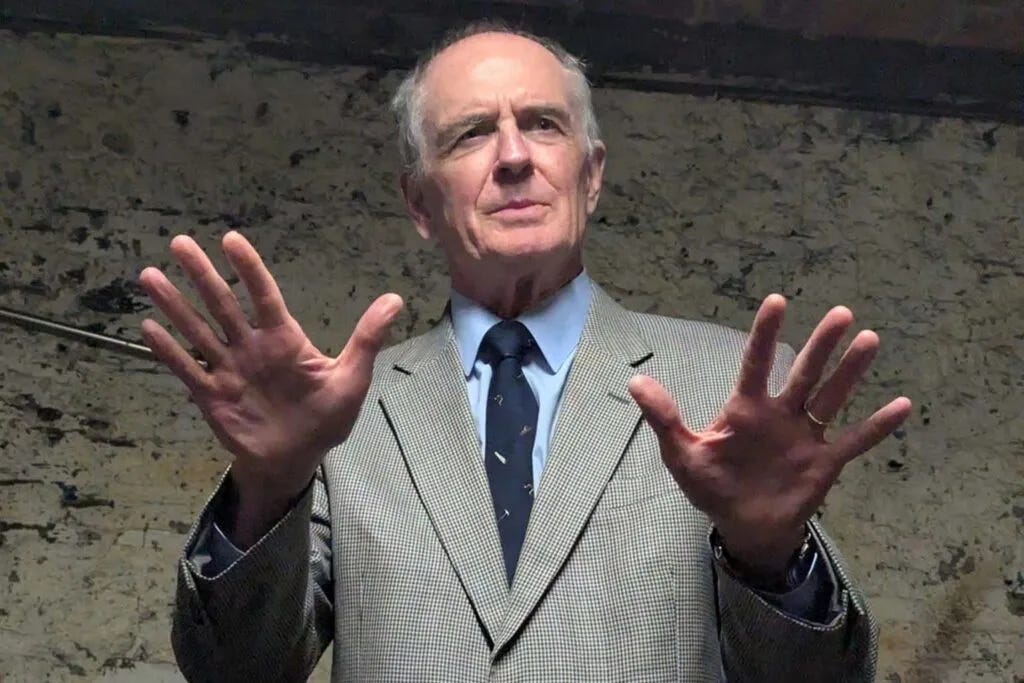
In this compelling interview, American identitarian thinker Jared Taylor discusses his advocacy for white interests and offers a sharp critique of multiculturalism and diversity ideology. He explores the biological realities of race, the shared civilizational heritage between Europe and the United States, and the urgent need to preserve European-descended peoples and cultures in the face of demographic replacement.
An essential figure in the American identitarian movement, Jared Taylor has for several decades developed a radical critique of multiculturalism and the ideology of diversity. His visit to France gave us the opportunity to meet him and discuss with him topics as burning and controversial as the one whose presence obsesses public debate, perhaps because it is forbidden to mention it. Whether one agrees with him or not, it is important that such speech not be prohibited by the new thought police who hunt “thoughtcrimes” with a zeal that makes George Orwell’s universe less a dystopia than a report on our world.
ÉLÉMENTS: You define yourself as a “white advocate.” What difference do you make with white supremacism?
JARED TAYLOR: That’s the question journalists always ask! There were white supremacists in the past. They believed that whites should rule over non-whites. How? By establishing colonies or slavery, as during the period of segregation in the American South. In that multiracial society, whites had a formal position of superiority and could direct the others. I don’t know anyone today who seeks to reestablish such a society. France’s civilizing mission during the colonial era was also a form of white supremacy. What I seek is anything but that type of multiracial society. I want us to be able to be at peace in our own home. That has nothing to do with white supremacy. Similarly, if one defines white supremacy as the fact that whites are superior to others, I disagree: Asians have a higher average IQ than ours. Our group is our family. As for what I think of whites? Well, I love my children more than my friends’ children, because my children are mine. I consider whites as my extended great family. The continuation of our cultural adventure is impossible if we are replaced. There is nothing supremacist in that.
ÉLÉMENTS: What does the anti-Americanism that exists within the New Right inspire in you? Is it justified?
JARED TAYLOR: Oh yes, there are perfectly legitimate criticisms: there is a cultural invasion of the United States in Europe. American films are often detestable, hamburgers too. But one criticizes the United States as if European societies were not also consumer societies. Consumption in the United States has taken precedence over many other considerations, the desire to cultivate oneself, to understand History, to be interested in politics. The “American dream” is an exclusively material dream. It is almost shameful. The dream is to consume more, that’s all! Not to become a better person. Moreover, since the 1960s, the United States has exported poisonous ideas, among others the idea that diversity and mixed societies can be a great strength. But I believe that European identitarians are too little interested in their American counterparts. Yet there exists in the United States an identitarian current deeply attached to Europe, the source of all our values.
ÉLÉMENTS: Are American identitarians in love with European civilization and talk about something other than being white?
JARED TAYLOR: I believe that the largest delegation at the remigration summit in Portugal on May 30 last was the Americans, with three speakers. I make an effort to value the expression “worldwide fraternity of Europeans.” We are Europeans. The people who come to American Renaissance conferences have great respect for European identitarians.
OUT NOW - Remigration

What if the issue of our century isn’t managing migration, but reversing it altogether? What if we could replace the Great Replacement with a Great Remigration?
ÉLÉMENTS: For you, is there a European civilization distinct from American civilization?
JARED TAYLOR: I think it is a mistake to differentiate the two, because there are many different civilizations in Europe. I believe that the difference between the United States and Italy is greater than between Italians and French, but perhaps not so much if one compares Italy and Norway. One can consider that the United States is a branch of Europe that established itself overseas and that our country is the result of mixtures of many European immigrants. Our personality is more “self-sufficient” (“rugged individualism”): I mean by that that one depends on oneself. That said, I think we are part of the great European family. Is Russian civilization less different from French civilization than American civilization? We have many points in common with English-speakers, Australians. Perhaps some Europeans think that Americans do not have the right to call themselves Europeans, but I think they do.
ÉLÉMENTS: Why do you speak of “race realism”?
JARED TAYLOR: For decades, we have been trying to convince ourselves that race has nothing biological about it. But who could look at a native of Greenland and a Sub-Saharan and consider that the differences are not biological? It is pure madness. This dogmatic grid has been used against identitarians to say that if we are replaced by Pakistanis or Guatemalans, we are ultimately only replaced by ourselves! Race has produced physical differences that one sees immediately, but also of personality, intelligence, sensitivity, as well as conceptions of morality, even if I cannot prove it. Intelligence is the most studied aspect via average IQ tests. Do you know the marshmallow test? You take a child and give him a marshmallow. If you offer to give him a second one provided the child waits ten minutes before eating it, differences appear: Asians succeed best at this test (this is the concept of “time preference”), then whites and blacks. Now, there is no civilization if there is no “time preference” that measures a momentary sacrifice for a greater success in the long term. There is also the experiment conducted by Thomas J. Bouchard on twins adopted by different parents: two genetically identical people but raised in different environments. Well, the tests showed that they were so similar that one would have said one and the same person. Just as one speaks of average IQ of races, there is an average personality of races.
ÉLÉMENTS: Why does one not approach without terror the biological differences between human groups?
JARED TAYLOR: There are many reasons for this, starting with the two world wars. How can one have a first butchery as useless as it was colossal and twenty years later start again? This engendered growing hostility toward nationalism and any awareness of differences. There was also the persecution of the Jews, from which one drew the conclusion that any awareness of differences carried the seeds of Auschwitz.
What founds the singularity of Western civilization? One submits to the law. Respect for the vote, for the word of others, that is very Western. Attitudes toward women are also revealing. European civilization has valued them in a unique way. Respect for women is very European. The environmental movement is also very Western. I am convinced that Angela Merkel let Syrians in to show compassion and kindness. There is even a feeling of superiority among right-wing people: they say they are virtuous. I am not entirely convinced that Christianity is so responsible for this state of mind, because my Confederate ancestors, good Christians though they were, were perfectly aware of racial differences.
ÉLÉMENTS: Did you grow up in a Southern context?
JARED TAYLOR: My parents were very proud to be Southerners. My mother was a woman of the left, but General Lee was for her the human being closest to God who ever existed. It wasn’t so strange at the time. When she was a kid, everyone was proud to be Southern. It’s a mentality that no longer exists. My father was Southern, but not so much. He even became more and more left-wing with age. Both my parents were leftists, voted Democrat, my mother was a feminist. But everyone was Southern. Their ancestors had fought for their native country, they were heroes. My WhatsApp profile picture is Confederate General Nathan Bedford Forrest, a Southern genius superior to all. He was never a commander, but his exploits were so remarkable that Erwin Rommel studied him. He received no military school training, but his instinct was sure and his leadership abilities extraordinary. He was a horseman. His equestrian statue, located in a park in Memphis, Tennessee, was destroyed. The city sold the park to a group of blacks for the derisory sum of 3,000 dollars and they destroyed the statue and exhumed his remains. The family protested without success.
ÉLÉMENTS: Where is American identitarian thought at?
JARED TAYLOR: It is not guaranteed that there are enough identitarians, but their number is growing at a dizzying speed. There is a great awakening among the young that we are on the wrong road. It is my generation that denies these obvious facts: the future belongs to the young and a few old people like me. We have drawn lessons from the past on racial questions; we are in the process of relearning them. There are thousands of Americans who understand this. It is a force that cannot be stifled.
ÉLÉMENTS: Can American identitarians forget their link to Europe?
JARED TAYLOR: No, for us, it is the same struggle. Our future is closely linked to yours. We are the same people with all sorts of variations. There is a tendency among European identitarians to believe that Eastern Europe is paradise, whereas there too it is a race against time. Look at Poland with the Indians. Identitarians in the United States are enormously interested in Europe, except for marginals like the KKK who are in no way intellectual and exercise no influence today. We are white and European.
Take the example of “renaissance fairs” [literally “Renaissance festivals,” medieval fairs and festivals], they are very popular in the United States. They are gatherings of whites, my daughter goes there, one eats medieval food there, there are medieval martial arts competitions, there are shows, jugglers, one shoots with a bow, especially on the East Coast. It is a bit the equivalent of rodeos in the center of the United States.
ÉLÉMENTS: What is your view on the MAGA movement?
JARED TAYLOR: In 2016, there was a big Trump rally in Virginia. I wanted to attend, but there were few seats left, with a long line. Unable to get in, I questioned the people who were lining up. No identitarian response. Everyone was talking about reindustrialization, bringing back offshored jobs, strengthening the army, perhaps a bit about controlling immigration, but it was obviously not the essential. I asked if the United States should not remain majority white and the answers were negative. Yet these people had nothing to hide. The MAGA movement remains always “conservative” and “Republican.” It is only the young who are identitarian. My wife, a Republican Party activist in Maryland, sometimes takes me to meetings. No one seems to know me, except among the young. A small Republican group invited me to give a speech at a university in Maryland. Furious, the Maryland Republican Party found this abominable. Its members tried to punish the organization. That says something about the future of the party. The Maryland Republican Party was terrified at the idea of losing its only representative in Congress while whites are a minority in Maryland because of African Americans from Baltimore and the suburbs of Washington DC.
Interview conducted by Gabriel Piniés

Originally published on Éléments on June 16th, 2026
Translated by Alexander Raynor
