


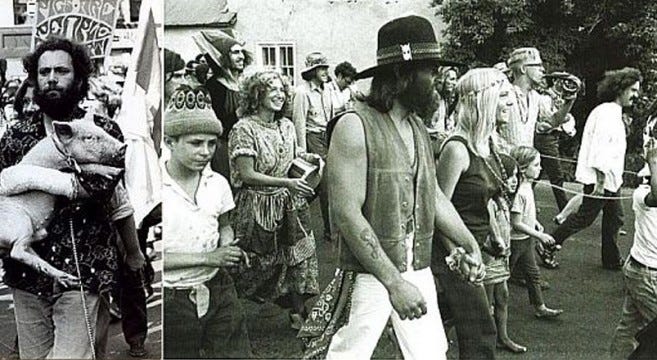
Joakim Andersen reviews John R. Searle’s interpretation of the 1960s student revolts as a quasi-religious movement rooted in affluence, moral absolutism, and rebellion against impersonal authority, arguing that the student radicals ultimately shaped today’s ideological landscape, especially “woke” politics, by embedding anti-intellectualism, guilt-driven ethnomasochism, and hostility toward Western institutions within the cultural elite.
The 1960s were intimately bound up with a wave of student revolts. Whether one approaches them from ideas, classes, or generations, this was a critical phase in the modern history of the West (Aftonland1) whose aftereffects we are experiencing to this day.
For the boomer generation, it was a decisive experience; the generation of “prophets” then sketched out the ideas under whose banners they would proceed to shape society in the coming decades. At least this was true for the minority who were directly involved, a minority that also came to form an important part of the managerial elite. In hindsight it appears as a perfect storm, with catastrophic consequences for Aftonland at large.
The significance of the student revolts for the hegemonic ideology and the elites tied to it is at the same time so central that they are normally not portrayed critically in popular culture; instead, we encounter the infantile, romanticized self-image of a number of idealistic rebels who supposedly knew better than a surrounding world driven by irrational sentiment, prejudice, and ignorance.
An interesting book about the period is John R. Searle’s The Campus War from 1971. Searle (1932–2025) was himself an academic, focused among other things on the philosophy of language. He had also been active for “Students against Joseph McCarthy.” But the student radicals of the 1960s were something different from the student activists he had been one of. At the same time, he could see how difficult it was for university leadership to handle them, and how difficult it was even to explain the phenomenon.
Campus War was an attempt at explanation, and it is valuable both as a contemporary document and for understanding similar tendencies in our own time. The sentiment, dramaturgy, and ideas of the student revolts of the 1960s have been carried forward to our time, often surprisingly unchanged, and today are known under names such as “woke” and “critical whiteness studies.”
Searle’s central insight was that the student revolts were fundamentally a religious phenomenon. By this he did not mean that they originated from a church or belief in the supernatural, but that they were built on what in the psychology of religion is called ‘the sacred.’ For the student radicals this sacred was race and Vietnam (Searle wryly added that “it is perhaps depressing that civil liberties and academic freedom are not Sacred Topics”). For readers familiar with Guillaume Faye’s ethnomasochism concept and D. H. Lawrence, it can be noted that the sacred for the radicals was ethnoracial outgroups, in itself an interesting psychological phenomenon.
In any case, Searle also described the more structural factors that made the student revolts possible. There was, of course, affluence; one can compare Strauss and Howe’s description of the boomer generation’s secure upbringing with Searle’s:
“the present generation of white middle-class students is the product of a period of affluence unparalleled in the history of this or the other Western democracies. They have grown to adulthood without any recollection of economic insecurity, with no experience of the Depression, and with no genuine understanding of the work and sacrifices that earlier generations have made to produce our present level of prosperity. They have never gone hungry, and they cannot remember a time when dad was out of work. In a very real sense, they take prosperity for granted.”
At the same time, they had been raised in warm and permissive forms:
“it is a warm, loving, permissive, forgiving, ‘child-centered’ style of home life, but it is interestingly inconsistent with the prevailing adult style of life for which the child is ostensibly being prepared. The characteristic social organization of our society is not the cozy suburban household, it is the large bureaucracy.”
The contradiction between a warm childhood and impersonal adult life was one of the factors behind the radicals’ dissatisfaction. Searle also pointed out that the institutions were fairly outdated, noted the general tendency toward crisis for established authority figures, and saw that many students in fact had to be at universities if they wanted to avoid the Vietnam War and the dull adult world. In addition, there was the sheer number of students:
“in the early 1950s there were about a million and a quarter college students in the United States. In the fall of 1969 we enrolled over seven million; in the fall of 1970 the figure was even higher.”
Most important was imitation:
“a glamorous, rewarding, and exciting role for students to play has been created, and as long as it continues to be rewarded — by prestige, absence of penalties, media, especially TV, glamorization, and inner meaningfulness and significance — it will continue to flourish. At present there is no more rewarding role for students than that of the rebel.”
The radicals appeared glamorous and/or sexy in the media, their lives meaningful and exciting. The society of petty-bourgeois “squares” had little to offer in comparison.

Searle also developed a three-stage model for following the development of the student revolts. It began with a question, often a local one, with demands that the university administration could not meet without losing authority and prestige. These questions were normally tied to the “sacred topics” (blacks and/or Vietnam). Then followed the next phase, the creation of a rhetorical climate in which the administration gradually came to be portrayed as a direct enemy of these sacred questions. The foundation was then laid for the final phase: the collapse of authority. When the administration eventually called in the police, this was seen as unforgivable and the university exploded. Interestingly, leadership could short-circuit the process by calling in the police before the rhetorical climate had been created, but seldom did. Searle also described the euphoria that the student rebels experienced during the third phase, a sense of deep meaningfulness.
University leadership had difficulty handling the student revolts, not least because they were the wrong kind of people for conflicts and lacked a natural and loyal base. Searle noted that
“the upper middle level of college administrations, deans and vice-presidents, are apt to be populated by middle-aged men who have been moderately successful in their disciplines but have come to feel that they may not make any more important contributions to their field of specialization”.
They had not sought their positions expecting to be met with threats and violence. Students in general were often pleasant to deal with, but not so the student radicals. Searle states that
“many of them are in a frenzy of hatred, and normally the college authorities are the targets of the hatred. A sizable percentage of the revolutionary extremists I have dealt with have been clinically ill.”
Added to this was that the faculty was mainly composed of liberals, and liberals were not loyal. On the contrary, they often sympathized with the students; Searle writes:
“by instinct they would prefer to be on the side of ‘the students’ and not of the administration. The dramatic category of idealistic young people struggling against corrupt authority to build a better world is one they cherish.”
They were harsh in their assessment of leadership’s actions but were happy to look the other way regarding both violence and fanaticism from “the youth.” Searle described the three ways of handling such violence:
“first, it didn’t really happen (‘It has never been proved that the auditorium was destroyed by arson’); second, it did happen but it doesn’t count (‘Professor So-and-So’s class was disrupted, but he is a special case’); third, it did happen and it does count, but the people who did it don’t count (‘The peace movement has attracted a few hooligans’).”
One concrete example was Professor Bunzel, a liberal political scientist who was harassed by black militants with everything from slashed tires to bombs outside his office. Interest from his colleagues was limited; they had dramatic categories for “blacks attacked by whites” but lacked a category for what befell Bunzel. Over time, however, the behavior of the student radicals often drove parts of the liberal faculty away from them, causing a bitter conflict among the liberals.
Searle’s book is interesting in several ways. He addresses the university’s various subcultures, including the previously dominant fraternity culture which during this period saw its position taken over by the student radicals. The relatively apolitical hippies are also discussed, as well as a radical subculture: “the two most salient traits of the radical movement are its anti‑intellectualism and its hostility to the university as an institution.” It was neither particularly centralized nor theoretically advanced, but it made up for this with fanaticism and strong emotions. A contributing factor behind the radicalization was also the presence of black militants. Searle wrote of these that
“in these years colleges increased their ‘minority group’ enrollments by an enormous factor — that is, they increased the enrollment from almost nothing to at least something — thus bringing on the campus enough black students to create a small but often cohesive black subculture.”
It was a subculture dominated by its more radical elements, with a strong influence on the white radicals. Hence:
“because many middle‑class white students felt so guilty about the racial injustice in the United States, they found it psychologically impossible to criticize, much less actively oppose, the views and strategies of the black militants, no matter how evil or irrational those views and actions may sometimes have seemed.”
Taken together, it is a highly readable book that undermines the official historiography around the student revolts. They had more in common with religious fanatics, they were enemies of academic freedom and their own society, and they behaved generally badly. That their legacy causes harm should therefore not be surprising. Searle was also an incisive writer, with quotable passages such as:
“this liberal mistrust of authority produces a certain feebleness in the defense of other liberal values when they are challenged by anti‑authority groups.”
The difficulties for the liberal establishment in handling radicals both in 1968 and today are clear in his account, as is the psychology behind ethnomasochism. Today, his book should be combined with, among others, Peter Turchin’s research on the overproduction of elites and Curtis Yarvin’s reasoning about the Cathedral (where student radicals appear as a driving and ideology‑producing avant‑garde), as well as Piccone and Althusser, not least since the lunatics Searle had to deal with have now made the long march through institutions.
At the same time, one can note that their grip on these institutions is weakened not least because the secular religion that drove them is reality‑averse and unpopular. Their mythology is also built on lies, whether it concerns school integration or the student revolts.
(Translated from the original Swedish article)
Read Joakim Andersen’s Rising from the Ruins: The Right of the 21st Century, brought to you by Arktos:

Editor’s note: The term “Aftonland” (literally “Evening Land”) is a poetic and symbolic expression in Swedish (as well as German: Abendland) evoking the idea of the West as a civilization in decline or nearing its twilight.