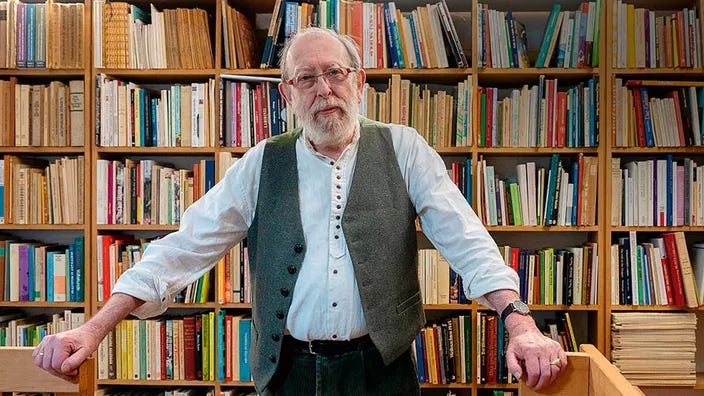
Following the 13th Colloquium of the Institut Iliade, Arktos had the honor of visiting one of the founding fathers and the leading philosopher of the European New Right, Alain de Benoist, for a day full of reflections on the past, discussions on the present, and visions for the future.
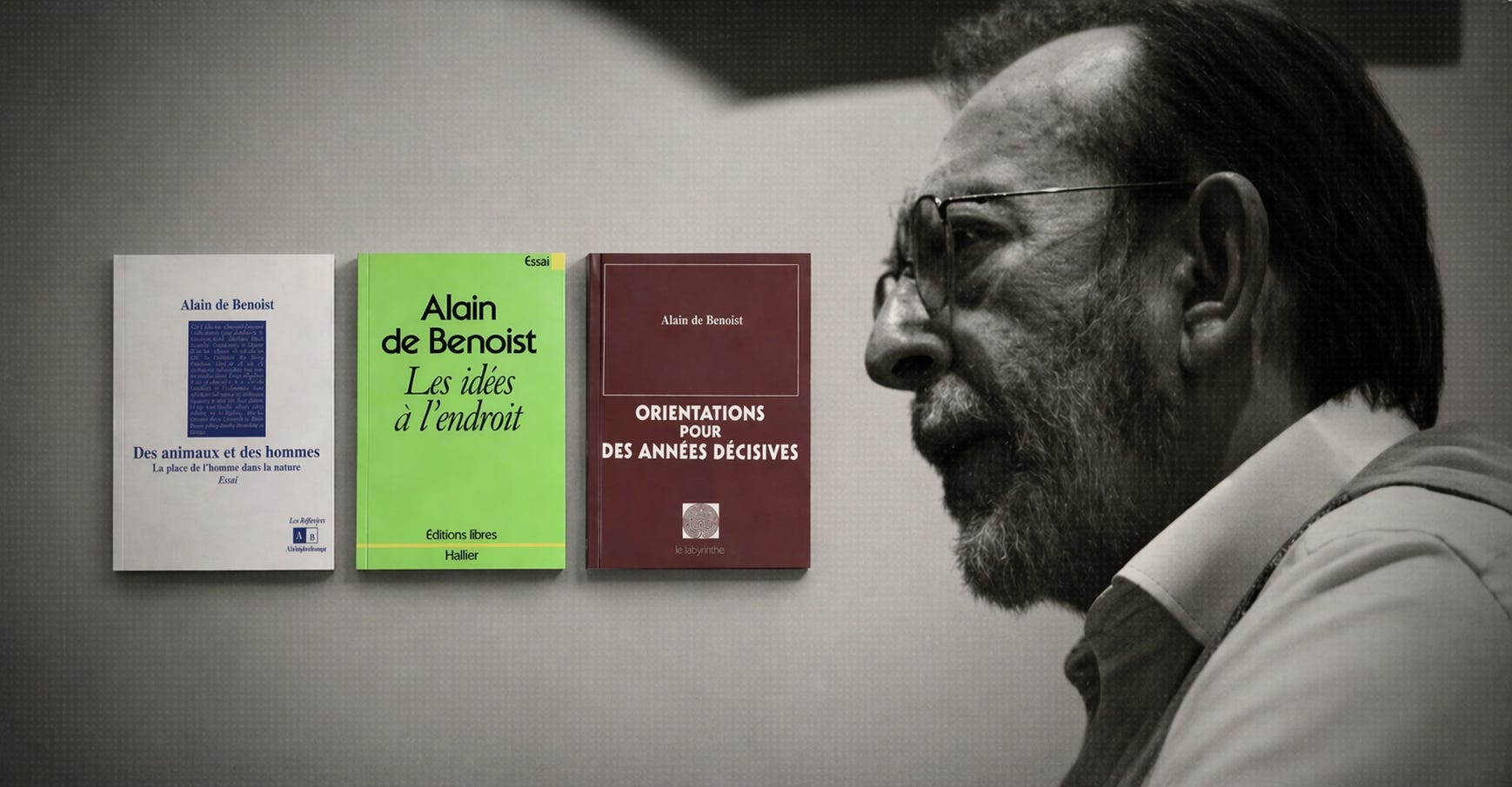
Continuing our long-standing and ongoing legacy as the English-language publishers of de Benoist, Arktos is glad to announce that we will be releasing a number of de Benoist’s key works this summer, including Ideas in the Right Place, Guidelines for Decisive Years, and Animals and Men, to be followed by many more.
On this occasion, Arktos presents the following exclusive interview, conducted by our very own Occidental Liaison and French translator, Alexander Raynor, in which we have the special opportunity to hear Alain de Benoist touch on vital questions facing Europeans today and reflect on more than half a century of metapolitical thought and struggle for a European Renaissance.
Alexander Raynor, Arktos: The 13th Iliade Institute colloquium, held this year at the Maison de la Chimie before an audience of over 1,500 people drawn from France and across Europe, took as its theme Libertés: Pensée – Parole – Action (Freedoms: Thought — Speech — Action). The conference addressed the erosion of fundamental liberties, of movement, of expression, of assembly, in contemporary European societies, and the speakers themselves, several of whom have faced deplatforming, bank account closures, or professional dismissal for their ideas, embodied the theme in particularly concrete ways.
What is striking about this framing is that the Nouvelle Droite has historically been one of the most incisive critics of liberal freedom: the atomized, deracinated individual standing apart from all community and inheritance, bearing rights that are ultimately instruments of dissolution. Yet the movement now finds itself, in a certain sense, on the front lines of defending freedom of thought and assembly against a new form of ideological enforcement from the opposite direction.
The conference’s central argument appeared to be that genuine liberty cannot be reduced to the mere accumulation of individual rights, nor to libertarianism, but is only fully realized within a free community; individual and collective liberties are inextricably linked, and authentic freedom requires reconnecting with the European tradition of responsibility and enracinement (“rootedness”).
Do you see this as a coherent position, or does it risk a certain ambiguity, defending liberty against its enemies while remaining committed to a critique of the liberal framework that has historically been its primary institutional guarantor? Is there a specifically European concept of freedom that your work has been working toward, and if so, how would you distinguish it from both liberal individualism and the authoritarian traditions that have also claimed the European heritage?
Alain de Benoist: I find your question rather strange. If I understand you correctly, it would be contradictory to criticize the liberal conception of freedom while at the same time claiming for ourselves those “fundamental liberties” of which, historically, liberalism has always claimed to be the “institutional guarantor.” This implies, first, that liberalism is indeed a defender of liberties, and second, that a coherent anti-liberalism ought rather to push us to refuse these liberties in favor of a more or less authoritarian (if not dictatorial?) model.
I disagree completely with both implications. Liberalism is for me an ideology that, under the cover of defending freedom, in fact defends only a false idea of it, and whose advocacy of “emancipation” and “individual autonomy” in practice ends up subjecting persons and peoples to new forms of alienation.
The question, obviously, is not one of knowing what “quantity” of liberty or liberties should be allotted to one or another party. It is rather a question of knowing which anthropology, which conception of man, one is referring to. Liberal freedom rests on a specific anthropology, in which the individual is conceived as prior and superior to his social belongings. In John Rawls’ theory of justice, for example, individuals are envisaged as rational subjects capable of choosing their principles of justice independently of their particular conceptions of the good. Such a construction supposes that the identity of individuals is independent of inheritances, filiations, and specific social, cultural, or political contexts, and consequently that the identity of individuals is constructed only on their own initiative, downstream of themselves (this is the ideal of the self-made man, supposedly building himself up from nothing).
Yet this idea of an abstract individual, detached from his constitutive belongings, is a pure fiction incapable of accounting for the identity of persons who are always situated within specific traditions, practices, and social relationships. This means that individuals do not define themselves independently of the frameworks of meaning that surround them, and that freedom cannot be understood as the mere capacity to choose; it can be understood only in relation to the cultural and moral horizons, bearing their landmarks of orientation, that render choices intelligible.
Non-liberal anthropology treats man as a situated being, always inserted into networks of dependence (family, community, mores, traditions) that are indispensable to his psychological and moral development. Dependence is not an anomaly, but is a constitutive dimension of the human condition. The ‘I’ can develop only if there is also — and already — a we.
Freedom presupposes relationships of reciprocity, shared practices, and institutions capable of forming individuals to discover for themselves the meaning of things, and indeed the reasons for their presence in the world. To put it in other terms, freedom is in no way an abstract attribute of the subject. Nor is it a matter of (subjective) rights. Bound up with concrete social institutions, it is defined as active participation in a common life oriented toward shared ends.
The freedom of liberals is thought of essentially (1) as the absence of external impediments to individual action: ‘I am free if nothing constrains me’; and (2) as the inalienable right to do what one wants so long as one respects the freedom of others to do likewise. These two statements are in reality empty of meaning: who can boast of being constrained by nothing? Who can claim that their freedom is never liable to hinder that of others? The liberal conception rests on abstract principles that do not correspond to reality.
Mere common sense already leads one to recognize that there is no such thing as absolute freedom: real freedom varies according to circumstances; it depends on what is possible. Here one rediscovers the “liberty of the Ancients,” as opposed to that of the Moderns, theorized by Benjamin Constant, and the old idea of Aristotelian, republican, or personalist thought, which holds that man is a naturally social and political being.
The opposition between liberal freedom and non-liberal freedom (which one might equally well call “illiberal,” communitarian, or “post-liberal”) does not come down to mere differences of definition. It reflects competing anthropologies and opposing visions of the political. Where liberalism privileges individual rights and the neutrality of institutions, non-liberal freedom insists on the relational, moral, and historical dimension of freedom, which must at once be protected from the arbitrary and rooted in shared forms of life. Far from being confused with authoritarianism or despotism, post-liberalism is rather founded on such notions as the common good, civic virtues, rootedness, solidarity, the reciprocity of duties, the legitimacy of limits, the usefulness of intermediary bodies, and a sense of responsibility.
Allow me to add, as a postscript, that I am well aware of the difficulties involved in discussing “liberal freedom” with English speakers, for two reasons. The first is that in continental Europe, liberalism is identified above all by its unconditional defense of the right of property and of the freedom of the market, whereas in the United States liberals are progressive social-democrats who are not hostile to redistribution as a means of ensuring equality of opportunity. In France, it is the great merit of Jean-Claude Michéa to have shown that “progressive” cultural liberalism always requires the endorsement of the market (in this sense capitalism is fundamentally “progressive”), and conversely, that the defense of the market necessarily finds its support in the continuous extension of rights that is the hallmark of contemporary individualism.
The second difficulty lies in the fact that English, unlike most other European languages, has two different words for speaking of “freedom”: freedom and liberty. Liberty (from the Latin libertas) refers to a juridical or political status; it is an abstract and formal notion. Freedom (from the Germanic frēo, “free, not enslaved”) designates rather a concretely lived condition, the fact of being a free man. This ambivalence can be a source of misunderstandings.
Alexander Raynor, Arktos: One of the consistent refrains of your critics, from Taguieff to Bar-On, has been that the Nouvelle Droite‘s metapolitical strategy amounted to a sophisticated evasion of political responsibility: that it criticized liberalism with extraordinary analytical precision while systematically refusing to specify what a post-liberal order would actually look like institutionally. Now, in 2026, when post-liberal ideas are actually being implemented, however clumsily, by governments in Hungary, Italy, and arguably the United States, do you find those implementations vindicating, disappointing, or simply irrelevant to what you were arguing?
In an interview given to the magazine of the Friends of Jean Mabire, Alain de Benoist discusses the often misunderstood concept of ‘metapolitics’, central to the New Right’s activities and his intellectual journey.
Alain de Benoist: Between those who believe that engaging in metapolitics implies contempt (or refusal) for political action, and those who imagine that metapolitics is “another way of doing politics,” metapolitics has never been very well understood. This is no doubt one of the reasons behind the reproach you mention. I confess that this reproach seems to me entirely unjustified. It is a little as though one were reproaching a mechanic for not being a florist or a computer scientist! From a poet we expect that he write beautiful poems, from a philosopher that he enunciate sound philosophical principles, from a politician that he know how to make the right decisions. In life, we are all more or less specialized in one task rather than another. What sense is there in demanding that some also do what others do?
Between metapolitics and politics, between cultural power and power tout court, there is of course a relation. It is often, though not always, a chronological relation: the philosophy of the Enlightenment comes before the Revolution, not after. Lenin (a good practitioner, but a poor theorist) comes after Marx, not the reverse. But, above all, it is not the same people who take on all the roles. Competence, or even excellence, in one domain has never implied that one is equally competent in others. To believe that one can wear all the hats, successively or simultaneously, is rather puerile.
Personally, I have always refused to be an actor in political life (I am nevertheless an observer and an analyst of it), not out of a refusal of politics, but because I think it does not correspond to my competencies or to my temperament. That does not mean I condemn those who have made a different choice! Moreover, it is not for theorists to put forward institutional proposals that, in the current state of things, could only amount to wishful thinking. I would add that one must also take circumstances into account: there are times when political action allows a great deal, and others when it allows very little.
You ask me what I think of the way in which certain post-liberal ideas are being implemented today in countries like Hungary and Italy (I set aside the particular case of the United States). To answer, one would obviously need to examine them case by case. Overall, I view these experiments as characteristic of a transitional period (what I have called the “populist moment”); they are symptoms of a development whose major cause is the generalized crisis of liberal democracies. They remain largely unfulfilled (Giorgia Meloni is increasingly contested by her own electorate, Viktor Orbán lost the last elections), since up to now they have translated mainly into the coming to power of fairly reformist liberal-conservative movements. This fact alone suggests that it is not really “post-liberal ideas” that animate these movements. None, to my knowledge, has ever sought to limit the deleterious effects of the capitalist system, to disentangle itself from the grip of the financial markets, and so on. In foreign policy as in economics, these regimes do not call the dominant ideology into question. To do so, they would first need to possess a conception of the world, a coherent and articulated Weltanschauung, that could be a source of inspiration capable of structuring minds and inspiring a genuine strategy of rupture. For now, we are still quite far from that.
Alexander Raynor, Arktos: The concept of remigration has moved, in a remarkably short time, from a provocation at the margins of identitarian politics to something approaching a mainstream program of the European right. Jean-Yves Le Gallou, whose long trajectory intersects at certain points with the intellectual world of GRECE, has recently articulated, in Remigration: For a Europe for Our Children, what he calls a “Copernican reversal” of the migration question: a reorientation of the entire debate from the perspective of the immigrant (how they are to be received, housed, and integrated) to the perspective of the native population and what mass immigration has concretely cost them in terms of security, educational quality, social cohesion, and cultural continuity.
Le Gallou frames remigration as simultaneously a “mobilizing myth,” a clarifying vision capable of restructuring collective imagination, and a staged political program with specific juridical mechanisms. Central to his argument is what he calls the JUGEXIT: the diagnosis that the primary obstacle to any realistic immigration policy is not the legislature, but a transnational judicial caste that has progressively expanded asylum protections far beyond the intentions of the 1951 Geneva Convention, effectively substituting judicial will for democratic deliberation.
Your own work on identity, the droit des peuples (the right of peoples), and the critique of liberal universalism shares certain philosophical premises with this argument — the rejection of a humanity abstractly conceived at the expense of concrete peoples, the insistence on the irreducible value of cultural and civilizational continuity. But your ethnopluralism has also been elaborated as a principled commitment to the preservation of all distinct peoples and cultures, not a hierarchy of European precedence over others.
Where do you situate yourself in relation to remigration as a political concept? Is it a legitimate application of the principles of ethnopluralism and collective self-determination, or does it introduce a demographic and biological register that your own framework was specifically designed to avoid? And to Le Gallou’s institutional argument that the true enemy of any restoration of European sovereignty is not the immigrant but the judicial-administrative apparatus that imposes immigration against popular will, do you find that compelling as a theory of power?
Alain de Benoist: This question gives me the occasion to set the record straight. For more than half a century the Nouvelle Droite has opposed what Guillaume Faye in his day called the “system for killing peoples” (système à tuer les peuples) [just released by Arktos as The Ethnocide System].
Ethnopluralism (a term I rarely use) does indeed hold that all peoples are equally entitled to defend their identity — and that, moreover, a principle is only valid by virtue of its generality, without which one falls into the very subjectivism that drove Trotsky, in Leur morale et la nôtre (Their Morals and Ours), to reduce morality to “what is good for us.”
But these considerations of principle obviously do not prevent us from acknowledging that every identitarian affirmation can give rise to situations of tension or conflict. The “right of peoples to self-determination” does not entail the right to self-determine against us! I defend the principle of the plurality of peoples and cultures, but if one of these peoples designates me as its enemy, I react as a good disciple of Carl Schmitt and treat it, too, as an enemy.
Politics is above all a matter of realism. That does not mean I believe my country or my culture enjoys a timeless precedence over others, but that I defend my own as a priority because this is an existential imperative: I can only oppose anything that endangers our specific existence. I see no contradiction in this: I do not believe in a hierarchy of peoples or cultures; I respect them all a priori; but if circumstances are such that certain of these peoples attack mine, then the logic of the friend-enemy relation reasserts itself, for as long as the causes of the conflict have not disappeared. By contrast, just like Carl Schmitt, I do not believe in the absolute enemy, who would be the same for all time. History is neither linear nor cyclical; it is circumstantial, contextual, and configurational.
The relatively new idea of “remigration” emerged in the context of the (heated) debates over immigration de peuplement1 whose consequences in terms of social pathologies and cultural colonization are now evident to a growing number of European autochthones. Jean-Yves Le Gallou presents it as a “mobilizing myth,” comparable to that other mobilizing myth which, for Georges Sorel, was the general strike. The expression seems to me quite apt, but the problem then arises of knowing how one passes from myth to reality.
In other words, the question is not whether remigration is necessary, or whether it conforms to this or that principle, but whether it is possible. For my part, I am rather skeptical. Part of the program is certainly feasible — but it is also the easier part (the more “soft“). I fear that the same will not hold for the “hard“ part, whose implementation might well imply the creation of an ethnostate, which, in present circumstances and for the foreseeable future, seems to me nothing but a completely impolitic dream (the only ethnostate in existence today is Israel).
On the other hand, I am in full agreement with Le Gallou when he holds that no effective means of fighting immigration can be implemented so long as the “power of judges” (the Conseil d’État, the Conseil constitutionnel, the European Court of Human Rights, and so on) stands in opposition. Exposing the judicial authority as having gone over to the principles of the dominant ideology, which demands the free movement of persons, capital, and goods, is assuredly a priority.
Alain de Benoist examines recent judicial interventions in electoral processes across multiple countries, arguing that such judicial actions represent a fundamental assault on popular sovereignty, where unelected judges effectively decide who citizens can vote for. The problem, de Benoist contends, is the concept of the “rule of law”, a liberal ideologi…
Alexander Raynor, Arktos: Arktos is bringing Les idées à l’endroit (Ideas in the Right Place) to English-language readers for the first time, more than 45 years after its original publication by Éditions Libres-Hallier in 1979. The book appeared in the immediate aftermath of the Figaro Magazine controversy, as a kind of intellectual counter-offensive, and it remains one of the most concentrated statements of the philosophical positions you were developing at that moment: the critique of egalitarianism, the attack on both liberalism and Marxism as products of the same Enlightenment matrix, the defense of différentialisme. Looking back at the text now, what do you consider its most durable arguments, and what, if anything, would you substantially revise or retract?
Alain de Benoist: You are right to recall the circumstances of this publication. We were then in the aftermath of the great press campaign of the summer of 1979, which both saw the expression “Nouvelle Droite” appear in the media and made this same Nouvelle Droite known throughout the world. Éditions Libres-Hallier, a subsidiary of the major publisher Albin Michel, had then asked me to assemble in haste several texts representative of the ideas of our current of thought, in order to satisfy a broad public that had been hearing about it for months without yet knowing very well what it was about. I recounted all this in detail in my memoirs, Mémoire vive (Living Memory), which appeared in 2012 in the form of a book-length interview with François Bousquet. So this is a work now more than 40 years old, a work of youth, and at the same time a kind of assessment of the first decade of the Nouvelle Droite‘s activity.
If I had to rewrite it today, I would certainly introduce certain nuances or make a few corrections of form and style, but as for the fundamental ideas, I see nothing to change. With one exception: today, I would not use the word “nominalism” to define my worldview. I had done so in the 1970s under the influence of my friend Armin Mohler, the historian of the German Konservative Revolution, who retained from the history of nominalism only its resolute opposition to “universals.” It was only afterwards that I realized that medieval nominalism had also been one of the intellectual roots of liberal individualism, as specialists in the history of ideas know well. So when I speak of nominalism today, it is always in a critical vein. But this is only a change of vocabulary: the content of an idea is always more important than the label used to designate it!
Alexander Raynor, Arktos: Orientations pour des années décisives (Guidelines for Decisive Years) was written in immediate response to a specific conjunctural event, the victory of the French left in May 1981, yet its diagnosis reaches well beyond the occasion. The text’s central structural argument is that the right lost not because of any failure of policy or economic management, but because it had abdicated the terrain of cultural power, accepting the left’s value framework while merely promising to administer it more competently.
The Gramscian lesson you drew from this reads in 2026 less like a polemical intervention and more like a settled empirical observation: that political power is always downstream of cultural power, that a parliamentary majority unsupported by an ideological majority is inherently provisional. And yet the text’s other great argument, the designation of liberal “Occidentalism” as the ennemi principal (principal enemy) rather than Soviet communism, was deliberately counter-intuitive in 1982 and remains charged today. Your reasoning was that liberalism was not the antidote to communism but its productive cause, that it prepared the egalitarian, individualist, deracinating ground on which socialism grows most naturally, and that the greatest long-term danger was not an explosion of historical violence but an implosion: the soft, painless dissolution of peoples and collective memory through the globalization of a consumer society in which, as you put it, nothing is worse than death, and therefore nothing is worth dying for.
Arktos will be bringing this text to English-language readers for the first time alongside Les idées à l’endroit (Ideas in the Right Place), meaning these arguments will reach an Anglophone audience with no prior access to them, and in a political moment that in some respects rhymes remarkably with the one that prompted their composition. Now that Soviet communism has collapsed, that liberalism itself appears to be fracturing from within, and that hard geopolitical conflict has returned to European soil in ways that complicate any simple “implosion” narrative, how do you read the text’s central arguments from the vantage point of 40 years? Which diagnosis proved most durable? And was the implosion you feared already well underway before anyone recognized it, or has something interrupted it?
Alain de Benoist: In that little book, which appeared two years after Les idées à l’endroit (Ideas in the Right Place), I did indeed designate “the West” — a portmanteau term whose meaning has varied greatly over the course of history — as the “principal enemy.” You say that this was “counter-intuitive”; allow me to say, in all modesty, that it was also a shrewd observation!
I observed that the divergence of interests between Europe and the United States was destined to widen, and that the result would be a strategic decoupling of the first magnitude — which has indeed come to pass. I sensed that the Soviet system was going to collapse before long, and that the principal effect of this would be to reunify the western, central, and eastern parts of Europe. As for the communist parties, which I had always regarded in the past as competitors more than as enemies, I foresaw that they would lose all revolutionary ardor and would end by transforming themselves into social democrats or liberals of the left. And above all, I saw that we were already in the process of changing worlds, that the world we had known, and sometimes loved, was in the process of disappearing, and that the great cycle of modernity was drawing to a close. We were preparing to enter the great postmodern transition.
Soviet communism did not die of an explosion, but of an implosion. It had suppressed liberties and bruised bodies. But the Western system had done far worse: it had destroyed souls by subjecting the symbolic imaginary to the new alienation produced by the religion of the market and of consumption. In the Western countries, men were little by little losing — in comfort, and often with their own consent — that which made them specifically human.
This process has only accelerated since: the planetary grip of a wholly deterritorialized capitalism has brought about, as Marx had already seen, a radical transformation of social relations, in which men gradually become things. This is what Heidegger calls the Ge-stell (the “Enframing”), the total generalization of Machenschaft (“machination”), in which the whole world is enframed by the axiom of interest, the obsession with performance, the acceleration of existence, the rise of a “liquid society” (Zygmunt Bauman), and so on. One sees it clearly today: when it comes to egalitarianism, materialism, or cosmopolitanism, no one has ever outdone the West!
When the Soviet Union collapsed, Francis Fukuyama was able to announce the “end of history,” “happy globalization”2, and the radiant future of a liberal democracy founded on parliamentarism, human rights, contractual procedures, and commercial exchange.
The opposite has occurred. History has reclaimed its rights, and with it politics and the tragic, while liberal democracy is in terminal crisis. Carl Schmitt had already said it: the more liberal a democracy is, the less democratic it is. It is all this that I foresaw, with more or less precision, in my Orientations pour des années décisives (Guidelines for Decisive Years) (the title obviously borrowed from Spengler and his Jahre der Entscheidung [The Hour of Decision]).
Alexander Raynor, Arktos: You have been working, writing, and thinking for more than 60 years, across GRECE, Nouvelle École, Éléments, Krisis, and dozens of books that have reached readers in languages and countries far beyond what anyone in 1969 could reasonably have anticipated. The Iliade Institute, drawing 1,500 people to a single afternoon in Paris and extending its networks across the whole of Europe, embodies a kind of vitality and seriousness of purpose that speaks for itself.
Translations of your work are appearing in English, German, Italian, and beyond; a younger generation across Europe is clearly hungry for exactly the kind of intellectual depth and civilizational engagement that your work has always demanded.
Looking at this landscape, not backward at what was lost or diluted, but forward: what gives you the greatest cause for confidence? Is there something in the current moment, in the energy of the Iliade Institute or in the broader cultural and intellectual ferment of the European right, that strikes you as new, as alive, and genuinely capable of carrying this work into the decades ahead?
Alain de Benoist: "Reasons to hope"? I could cite for you Gramsci's watchword: "Pessimism of the intellect, optimism of the will." Or the maxim of Charles the Bold, which William of Orange took up as his own: "It is not necessary to hope in order to undertake, nor to succeed in order to persevere." In other words: to speculate on "reasons" is to waste one's time — let us content ourselves with doing our duty. But that would be somewhat too brief a reply. Reasons to hope — there are always some, even in times of low water, even in the blackest night, for the simple reason that history is always open — and that it is by assuming one's historiality, one's Geschichtlichkeit, that man can answer its call.
History is always open because, by definition, it is unpredictable, and can therefore always open onto the better or the worse. From this perspective, the small groups that try to understand the meaning of the historical moment we are living through, who contribute to forming minds and to giving reasons to act, must know that what they do is not in vain. The sparks they kindle can multiply to the point of "setting the plain ablaze," as Chairman Mao Zedong said. The only obligation to which they must submit themselves is to understand that we have already entered another world, in which old nostalgias and old concepts alike have become obsolete. In the age of artificial intelligence, of the rebirth of "civilizational states," and of the establishment of a new "Nomos of the Earth," the future belongs to those who will have known how to analyze what is coming, in order to set their mark upon it.
Interview conducted and translated by Alexander Raynor
Read more from Alain de Benoist: buy his books here.
Alain de Benoist’s hitherto untranslated classics, Ideas in the Right Place, Guidelines for Decisive Years, and Animals and Men — and much more — are forthcoming from Arktos.
Translator’s Note: “settlement immigration” — immigration understood not as the temporary movement of labor but as the permanent settlement of foreign populations, a term of art in contemporary French political discourse.
TN: mondialisation heureuse — “happy globalization”- an allusion to Alain Minc’s La mondialisation heureuse (1997), shorthand for triumphalist 1990s liberal globalism.
Great stuff. I wonder though whether it's right to twit liberalism as abstract, to me it seems more like a "mxing of the planes of discourse." It's quite concrete from a God's-eye perspective in which individual differences, etc. recede to insignificance (freedom pairs with equality here).
IOW it's really a religious framing, a hangover from Christianity, which is why it still has some of the cachet of a kind of quasi-religious fervour.







Excellent interview. Good wishes for the Philosophe.
Great stuff. I wonder though whether it's right to twit liberalism as abstract, to me it seems more like a "mxing of the planes of discourse." It's quite concrete from a God's-eye perspective in which individual differences, etc. recede to insignificance (freedom pairs with equality here).
IOW it's really a religious framing, a hangover from Christianity, which is why it still has some of the cachet of a kind of quasi-religious fervour.