



What the Hell is That?
You don’t quite believe your eyes or ears: on a large stage, late at night, a rock band is playing in the bright glow of torches and spotlights. The long-haired musicians are dressed in black, adorned with silver-shining studs, metal spikes, and ammunition belts, giving them a menacing appearance.
Their faces are decorated with a kind of white war paint, at first glance a mixture of Hollywood Vikings and clowns, making the overall image even more striking.
Large white animal skulls are mounted on wooden stakes. In a semicircle around the rear of the stage, several living young women hang from crosses, completely naked. The band plays a brutal, heavy sound, but the singer doesn’t sing at all; no, he screams in a rasping voice, making it impossible to understand anything.
A large crowd of exclusively white spectators presses forward in front of the stage, all of them dressed in black as well. Many raise their hands in the air, forming a sign by extending their index and little fingers while keeping the remaining fingers together, creating a kind of animal’s head.
This, or something similar, is how many “black metallers” present themselves at their concerts. This naturally raises a legitimate question for the uninitiated: What kind of bizarre spectacle is this?
Is it for the Right, too?
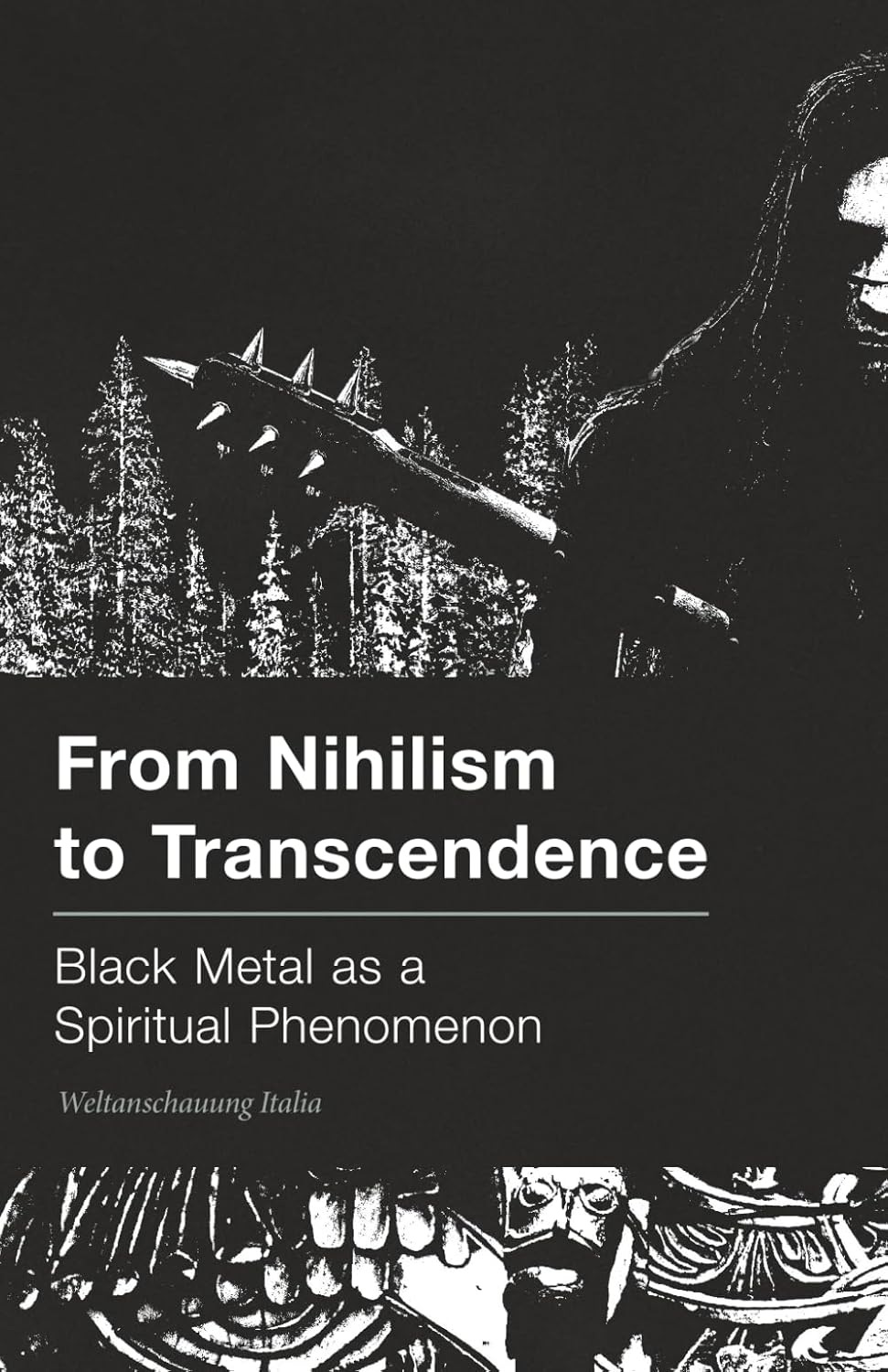
The English-language book From Nihilism to Transcendence, by Weltanschauung Italia, a metapolitical project of the Italian Right, provides a brief but comprehensive background report on the subject. It is an informative publication, which aims to shed light on “Black Metal” (BM) as a phenomenon that originally emerged from a subculture but has, within just a few decades, become an established part of rock music worldwide, with many thousands of bands. Hardly anyone can make sense of the sheer volume of songs, concerts, bands, and styles anymore. Even experts struggle to keep up.
However, the focus of this book is not on the genre’s commercial bands, which have by now been absorbed into the musical mainstream, but on genuine artists with depth who, consciously or unconsciously, have affinities with the political Right. The authors analyze in an informed manner whether and how Black Metal can be reconciled with Right-wing cultural ideas. Their work identifies what is interesting in musical, lyrical, and aesthetic terms. They, who seem generally sympathetic toward BM, succeed in presenting their positive assessment in a highly convincing and understandable way. In principle, BM is something for the political Right, but not for everyone: one must have an affinity for many elements that take some getting used to in order to be moved by them on an emotional level.
Where Did This Musical Genre Come From, and How Did it Develop?
The authors sensibly trace the origins of BM back to 1984. They explain how rock music continued to fragment and evolve. The genre’s heyday in the 1990s is outlined, followed by the development of post-Black Metal between 1996 and 2000. Finally, the book surveys the latest developments over approximately the past 20 years.
Against Commercialism
Alongside commercial BM bands, the “true” scene is anti-commercial. Its members are often connected through relatively loose groups that are self-sufficient and content to exist on their own terms. Making concessions to anyone or anything is frowned upon. Some go so far as to cover their faces completely during concerts, making themselves unrecognizable so that the audience has to concentrate entirely on the music.
The authors describe the standards of quality that prevail within the scene, how its members communicate, what they want, and what they reject. It is a remarkably creative laboratory in which lifestyle, politics, art, and much more intermingle. Meanwhile, artistic elements of Black Metal—from aesthetics to music—have increasingly seeped into various areas of the mainstream, albeit somewhat beneath the surface. The film industry is one example.
A Broad Spectrum
Naturally, the various subgenres and offshoots of BM are also covered. The main varieties discussed in the book range from “atmospheric” Black Metal without vocals to “pagan” and “suicidal” BM, all the way to the highly political “National Socialist Black Metal” (NSBM), which takes National Socialism as its ideological point of reference. The spectrum addressed extends from the depressive, introspective brooder to the political activist. By the authors’ own assessment, however, the vast majority of bands are not political. Nevertheless, from a Right-wing perspective, one can identify a consistently positive metapolitical significance in almost all of them.
The authors explain the aversion to Christianity found in most bands. They explore why this fierce reaction against Christianity occurs and what the opposing worldview looks like. The authors also explain the sense of elitism openly displayed by many, along with their anti-humanism and anti-egalitarianism.
One of the most disturbing aspects of BM is its overt Satanism. The book explains this phenomenon just as convincingly as it explains the beliefs of BM’s neo-pagan adherents, including the relationship between these two currents.
It should be expected that a musical genre involving tens of thousands of musicians and a relatively large following will exert an influence beyond its own community, despite certain tendencies toward isolation. That community must also draw on intellectual and musical sources that nourish and inspire it. Indeed, a genuine exchange with a variety of cultural elements does take place. The authors illustrate this through Tolkien’s influence on BM, which in turn has affected how the film industry receives and interprets the genre.
READ AN EXCERPT:

Further Distinctive Features, Contradictions, and Opposing Views
There is no need here to address every aspect of Black Metal mentioned in the book. The wide range of topics, even if some are treated very briefly, covers the main issues relevant to the subject. Readers can use this as a solid overview and then conduct their own further research.
The broad BM scene is heterogeneous in every respect. There are differing opinions on virtually everything. At the same time, homogeneous fan communities have formed around particular bands, styles, and subject matter. It is in the nature of the scene that men are overwhelmingly dominant within BM. The authors have, of course, not overlooked this fact.
“Truth” and “purity” have led to disputes within the BM scene, as has the emergence of explicitly “Christian” or “National Socialist” BM groups. The division between Left and Right that is unavoidable in society is also reflected in the BM scene. This is particularly significant where commercialization corrupts bands and where individuals and media outlets attempt to make money from the subject.
Despite the book’s sympathy for the genre, it is not an excessively one-sided defense of BM. Many issues are questioned and examined critically as well.
What is Not Explored in Detail
Naturally, this Italian book does not examine German BM bands, their history, or their musical output in any particular depth. It also leaves aside the state repression of bands, as well as efforts by the music, media, and live-event industries to politically censor BM.
The book does not specifically address why BM is an exclusively white cultural form—although, according to the reviewer, this supposedly requires little explanation: the answer supposedly follows from BM’s content, musical style, and aspirations.
Negative activities by BM musicians and their followers, such as murders and church arson attacks, are also mentioned only in passing. Thankfully, the book likewise does not dwell on how the scene treats a gay singer or on the disputes among its members over content and music.
Thus, alongside an overall survey, the book focuses on the ideological and musical core of the part of BM that the reviewer considers positive, and on the successful attempt to establish a connection with the cultural world of the political Right. The decision to leave certain subjects unexplored has proved worthwhile, since many of them have already been extensively covered by alternative media and even by media loyal to the established system.
Ultimately, the question must remain open as to the extent to which simply consuming radical music keeps young people in particular away from active politics, encourages destructive subcultures, or even leads to depoliticization through immersion in dream worlds. At least, the authors have identified those positive aspects of BM that may help prevent precisely these outcomes.
Alex Kurtagic as a Further Recommendation
For readers who would like to gain an overview in an even shorter format alongside reading the book, and discover additional perspectives, this reviewer recommends the article “Black Metal — Die Konservative Revolution in der Populärkultur,” included in Alex Kurtagic’s book Ja, Afrika muß zur Hölle gehen [“Yes, Africa Must Go to Hell”, a German language collection of Alex Kurtagic’s writings —Ed]. A similar version, in English, of the article is also freely available online as a PDF through The Occidental Quarterly.
Conclusion
At 112 pages of text, the book is not particularly long, but it covers the subjects discussed in such a way that readers, whether specialists or newcomers, gain a good overview and insight into the topic. The book is recommended without reservation and is an absolute must-read for Black Metal fans. The political Right should certainly pay more attention to this field of cultural politics as well. With this book, the first step has been taken.
The above is a review, originally published in German by Thymos Kvltvrmagazin, of From Nihilism to Transcendence: Black Metal as a Spiritual Phenomenon, brought to you by Arktos and available on Amazon:
For those who know how to go beyond the surface, beyond the noise and provocation, black metal will remain what it has always been: not a destination, but a powerful and dangerous means of embarking on that inner journey that every human being, sooner or later, is called upon to undertake.
In the panorama of 20th-century music and subcultures, few phenomena have been so misunderstood and embodied such striking contradictions as black metal. From Nihilism to Transcendence: Black Metal as a Spiritual Phenomenon explores how this movement of rebellion, rejection, and darkness came to represent a spiritual and artistic laboratory for generations.
Tracing the genre’s origins, evolution, and main themes through a rich synthesis of musicology, sociology, and philosophy, From Nihilism to Transcendence moves beyond sensationalism and moral panic to uncover black metal’s paradoxical paths to rediscovering the sacred. Black metal’s soundscapes, symbolisms, and controversies are revealed in new light as creatively reflecting the fundamental, existential issues of our disenchanted and superficial age.
READ MORE from Arktos Journal:
Identitarian Reflections on Heavy Metal (Part 1): Rootedness, Tradition, and Rebellion

In this first part of an original two-part series for Arktos Journal, Andrej Sekulović sees the heavy metal genre as embodying a rebellious yet tradition-rooted revalorization of myth, history, and the ideals of heroism, masculinity, and cultural identity, composing a vibrant alternative to the consumerist and progressive values of the modern music indu…