


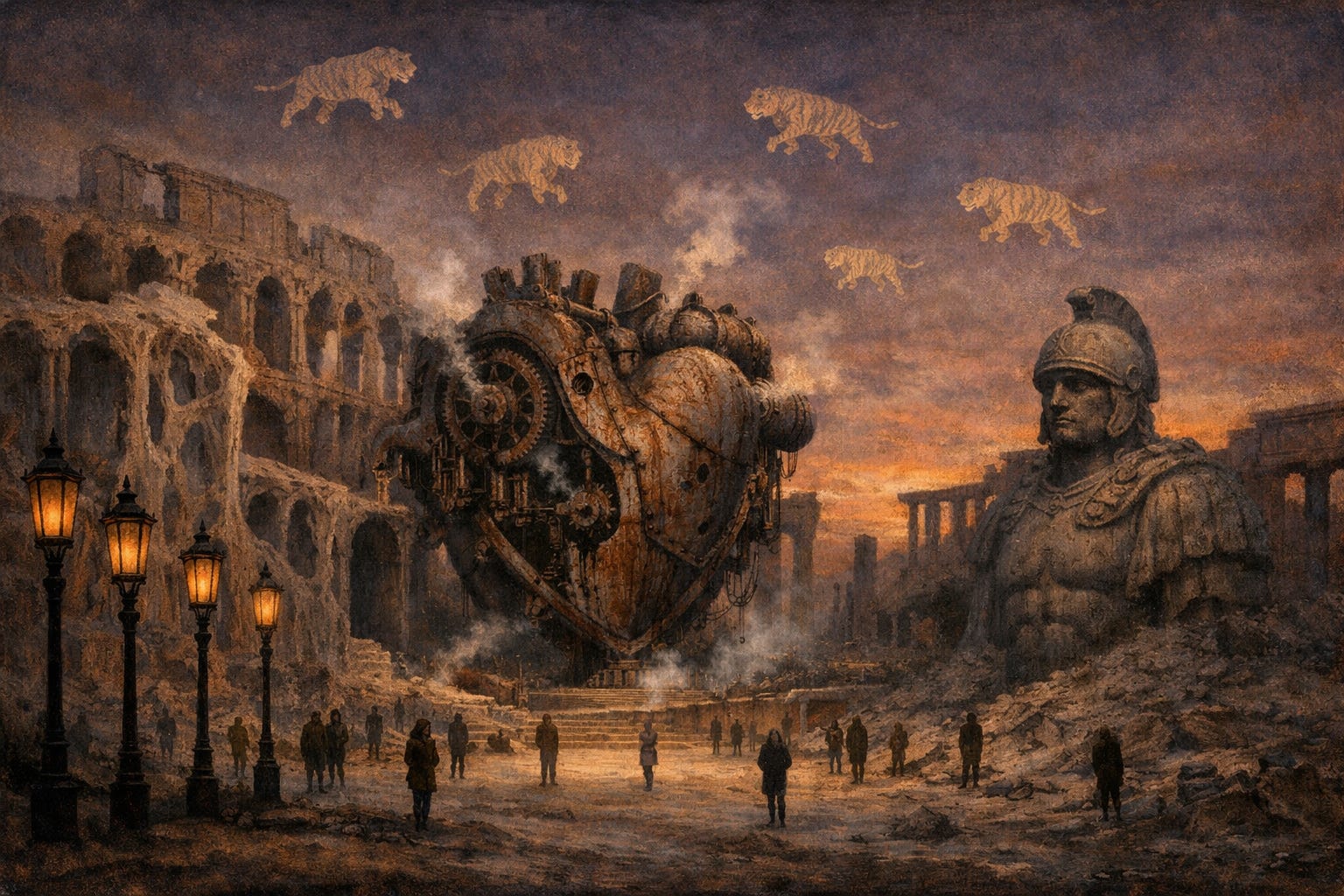
The text you’ll find below is a speech by Alain de Benoist from the 8th Conference of GRECE (“Research and Study Group for European Civilization”) held on October 22nd, 1972.
At the time of this conference, the Nouvelle Droite (“New Right”) was beginning to emerge as a serious school of political thought. In 1972, GRECE began to receive limited press coverage. At this time, GRECE was well-established, and a second Nouvelle Droite journal, Eléments (pour la civilisation européenne), would begin its circulation to the larger public the following year, with its first issue being published in September 1973. While Nouvelle École, which began circulation in 1968, was distributed in France and abroad (including Europe, South America, and South Africa), Eléments would largely circulate in France.
Many of the thinkers cited by Alain de Benoist in this speech were gradually rehabilitated within intellectual debate and went on to serve as key sources of inspiration for the distinct school of political thought that would come to be known as the European New Right.
In this essay, de Benoist meditates on civilizational decline, exploring parallels to Rome, cyclical history, the Great War as a wound, and the nature of decline.
Decadence and the Fall of Civilizations
by Alain de Benoist
In 1938, Henry de Montherlant, reporting the words of an Englishman of the time, exclaimed:
“The French are not people with whom one can go tiger hunting!” In 1972, one can read in Le petit livre rouge des écoliers et lycéens (The Little Red Book for Schoolchildren and High Schoolers): “Adults are paper tigers.”
The young protesters of today thus seem to have finally decided to go tiger hunting. But they are hunting paper tigers.
In one of his last works, Montherlant summarized in a striking way the evolution that our civilization has undergone over the course of several centuries. There was a time, he says, when drunken helots were shown as a spectacle to the children of men of virtue, so that these children would know what they ought not to be. Then, we arrived at the moment when, to these same children, drunken helots were still shown, but this time to give them an example of what they should be. We are now at the era when helots show their children the last men of virtue, telling them that this is what they must not be.
This is what a society in decline looks like.
Decadence! An ancient subject. “The fall of civilizations is the most striking and at the same time the most obscure of all the phenomena of history. In terrifying the mind, this calamity holds something so mysterious and so grandiose that the thinker never tires of considering it, of studying it, of circling around its secret.” Thus begins Gobineau’s famous Essai.1
It is indeed a reality, a fact that strikes the mind, that wounds our sensibility, against which we would like to protest and which, nevertheless, imposes itself upon us—it is a fact that civilizations are mortal. That there comes a moment when, for reasons often difficult to understand well, and even more to analyze, the great cultures gradually cease to grow and develop, and seem on the contrary so exhausted as to never find a second wind, age, falter, and die.
But the death of civilizations is like other deaths: there are several kinds. Some die of extinction, others of exhaustion, some perhaps of boredom. Only few die a violent death. It is not an exaggeration to say that some commit suicide (sometimes on command, when they have been subtly convinced to do so). None, in any case, disappears in that ideal manner evoked by Montherlant:
“Happy are those who die without prattle and without weeping, in the holy solitude where beasts die, and soldiers at the bottom of a distant shell crater.”
The causes of this are therefore diverse. It can be conquest, fatigue, laxity, dissolution, admixture. The Greco-Roman world had established the doctrine that States, peoples, and civilizations perish essentially through luxury, softness, poor administration, corruption of morals, and fanaticism. But these are only secondary symptoms, which appear only when the malady is already present. For a society that sinks into luxury, a citizen who declares himself unfit to bear arms, an administrator who hesitates to do his duty, or who no longer does it at all, morals that dissolve, fanaticisms and irrationalities that spread—all these phenomena are consequences, neither more nor less.
It is difficult to isolate a single cause and make it a global explanatory factor. And it even happens that what is a cause of decline in some cases can be, elsewhere, on another scale of values, a cause of success.
Don’t miss the Arktos Spring Sale!

In one of the chapters of his Essai, Gobineau speaks in these terms of corruption:
“Did the Phoenicians owe their ruin to the corruption that gnawed at them and that they went about sowing everywhere? No; quite the contrary, it was this corruption that was the principal instrument of their power and their glory; from the day when, on the shores of the Greek islands, they went about as dishonest traders, villainous hosts, seducing women to make merchandise of them, and stealing here and there the goods they ran off to sell, their reputation was, to be sure, well and justly tarnished; they grew nonetheless and held in the annals of the world a rank from which their rapacity and bad faith in no way contributed to their descent!”
And then, one must take into account the exhaustion of blood. Perhaps never more than now have we been able to observe the terrible effects of that dreadful European civil war that was the Great War of 1914–18.
France, and not only France, but all the countries involved, were, during those four tragic years, truly bled dry. The imprint that this conflict left on the d’Annunzios, the Jüngers, and the Montherlants is in itself most revealing.
We realize only now that the France of the early century was still a Gaulish France, a France where round-headed, blond-haired peasants with thick mustaches were still the majority, where they constituted a sort of biological reserve, thus guaranteeing a possibility of renewal that was the most important of promises made to our country. Now, this promise was not kept, because the best, whatever banner they fought under, were mowed down by great strokes of nothingness. Frankish France had begun to die between 1789 and 1793. Gaulish France, for its part, must have begun to disappear between 1914 and 1918. And these voids that have never been filled weigh cruelly upon us.
The Great War, as we all know, was the end of an era. It was the last time that men professing the same virtues and displaying the same type of energy found themselves face to face in the trenches.
Here, for example, is Wilhelm Weidemann. He is a student of philology. In 1916, he is twenty years old. From the Flanders front, where he is stationed, he writes to his family to report the death of a friend.
“No, we will not continue alone on our path,” he says in this letter. “We cannot forget him, we can speak of him... He remains ours, such as he was, proud and faithful. Henceforth, we can think without dread that after him, we too must pass through the dark gate that none pass through again, that keeps its secret, and that, yet, does not separate us from the dead. Death is not a friend, but I know her now so well that I can see her come tranquilly... She has brushed against me often, I have often dealt her without flinching, I pass daily under the thunder of cannons and the whistling of bullets, and I go straight ahead. The war has taken from me all that it could take; what remains to me and what I fight for, no one can take away.”
On February 13, 1916, he is killed.
On the other side, here now is Marc Boasson. A corporal of infantry, also twenty years old. Like Weidemann, like all soldiers, he sends letters to his loved ones. He writes:
“The most horrible thought that imposes itself is that of the very vanity of a victory. Incapable, however brilliant one might like to suppose it, of henceforth compensating for the depopulation of a country bled white, France and Germany will emerge from the struggle exhausted for a long time. France, perhaps, for longer still. Finally, let us try to die well. Pyre of Hercules, conflagration of the Nibelungs, a vast heroic redness will remain in the sky of History, sublime and atrocious like the dazzle sometimes, in the shadow of twilight, of flaming liquids that set the horizon ablaze.”
On April 29, 1919, six months before the armistice, he too is killed.
I do not claim, of course, that such characters have all disappeared, nor that more recent events have not had occasion to reveal admirable ones, but still, at fifty years’ distance, one realizes that the spirit of the century has changed.
There was a time when war prolonged the old tradition of honor, and all the duels accumulated since antiquity. The Great War was at once the last of the classical wars and the first of the total wars. Far off now is the time when Achilles killed Lycaon saying Alla philos (Die, friend!). The time when one could fight without necessarily feeling anger or hatred for the adversary, but on the contrary, sometimes, a certain esteem that came precisely from the fact that one was fighting against him and that he breathed at the same level as you.
All these causes of decline that I have just enumerated are therefore also effects. They react upon one another, in the same way that today drugs are at once the cause of a certain state of mind, and the consequence of an era that produces drugs, and multiplies addicts...
One has the impression, more simply, that there comes a moment when the motor that drives the axis of civilization, when this motor is broken. Or rather when no fuel comes to feed it any longer. Then the motor continues to turn. But it turns now in a void, in a deafening clamor, and it is from this noise that the illusion is born that it is running at full speed.
Things, in general, go slowly. It would be futile to date at ten, or twenty, or thirty years, according to convenience or passion, the sources of a state of mind that has subtly introduced itself into the dwelling. The institution of a veritable Marxist mandarinate in the University, to cite only one example, is the culmination of a slow labor, undertaken notably by those good schoolteachers of the Third Republic, devoted servants of their country, great admirers of the Empire, faithful in combat against clerical pretensions, but who were also the spiritual sons of Rousseau, that is to say the children of dream and illusion.
Likewise, that a body like the Church, which was, even in its excesses, for centuries the example of firmness, certitude, and continuity, should today be shaken by internal convulsions and ravaged by doubt, this should only half surprise us. For one must know the patient infiltration that has operated within this body now sick, and which, progressively—it is the right word—has worked its way up the current of the hierarchy.
Decadence, in truth, has distant origins. So distant that one would waste time trying to situate them at a precise point in History, so true is it that in the final account, because such is life, all power begins to be lost from the day it is conquered.
But, if it is impossible to say when the decline began, at least one can signal in passing some of the symptoms that are its principal manifestations.
For M. Jean Cau, one of the characteristics of decadent eras is that everything there is codified. Even and especially what should not be. Because the natural sources, those that should flow of themselves, are dried up. “In the anthill,” he writes, “no one has honor. There are only rules of functioning. Laws. The less morality is each person’s affair, the more laws multiply. I would even say that the number of laws is inversely proportional to the sense of honor of those who are subject to them.”
And then, there is mediocrity and baseness. Not good or evil, both of which can be exercised in a powerful way. But abasement.
The Roman world, says Montherlant,
“knew how to recognize greatness, which the modern world does not see, mocks when it does see it, and places and exalts where it is not. When a people has hatred for all greatness, let their leader take good care not to pronounce the word! Had he done nothing for greatness, this word would still be too much! The people would make a stone of it, the day they wish to stone him” (Le treizième César (The Thirteenth Caesar)).
Montherlant had moreover remarked that in today’s France, at the cinema, at the theater, in all the public places where spectacles are given, it is generally enough for a character to pronounce a somewhat grand, somewhat strong reply, for him to say something noble or powerfully moving, for someone or some few in the audience to burst out laughing. And to burst out laughing without realizing that in mocking himself, a people removes forever its right to speak.
And Montherlant adds: The attitude of the French toward war and liberty
“can be summarized thus: it is all the same to them if they are gassed tomorrow, or if they are serfs, if they are given a 10% raise today (or if they are given holidays they don’t know what to do with, eagerly yearning for the resumption of work). In other words, stuck to their little pleasures, and drunk on them, until the precise instant when the first bomb falls, like flies on excrement, where one can seize them between two fingers. An attitude I would place under an epigraph drawn from the second discourse of the Corinthians to Lacedaemon, in Thucydides: ‘He who does not wish to prepare, because it would interrupt his pleasure, will soon see taken from him that very pleasure on account of which he did not wish to prepare...’”
Societies in decline correspond to those anthills to which Jean Cau alluded. They correspond to the materializing, petrifying, and solidifying apogee of the final state of the egalitarian illusion.
These societies no longer have leaders. They no longer want them. They pretend to believe that everyone can now claim the title of leader. In other words, everyone wants to lead. But no one wants to obey.
Jean Cau, in Le temps des esclaves (The Time of the Slaves), then says:
“When there are no more true masters, all of society is made of slaves. But of sad and empty slaves. And the bourgeois there is but the promoted and ashamed slave.”
Decadence, if you will, is fleas bustling about wondering what lions could possibly be good for.
But the domain in which exhaustion manifests itself most clearly is perhaps that of artistic creation and cultural manifestations.
When one can no longer create, one contents oneself with “adding” to the inside of or in relation to what others have already created. One refines, one distorts, one overcomplicates, one pretends to consider classical rules as outdated, then one rediscovers the value and interest of what one had declared outdated. One burns what one had adored, one adores what one had burned. One makes puns and plays on words. One buys shares on the Stock Exchange. One puts at the top what should be at the bottom, and at the bottom what should be at the top.
This yields, in the best of cases, the Hellenistic style compared to the Greek style. In the modern era, the noodle style, the “Jugend Stil” and kitsch. In antiquity, the time of the sileni, of the Bacchanalia and the Graeculi. The Tanagra statuettes. Later, the end of flamboyant Gothic, etc. All of this is still beautiful. But, already, the sources of renewal are exhausted. The power has departed.
In the preface to the work entitled Imperium, the American philosopher Francis Parker Yockey writes: “Originality at all costs is an effect of decadence, and decadence is pregnant with barbarism.”
One finds the same observations in Der Untergang des Abendlandes (The Decline of the West). Oswald Spengler writes therein as follows:
“What marks the decline of creative force is the absence of form and of measure, necessary for the artist to produce a work that still has roundness and wholeness... (One can) no longer suffer the supra-personal rule, the absolute mathematics of form, the destiny of the formal language of art matured gradually... The ancient artists feel themselves masters of the great form, the late artists its slaves... The mark of all living art, perfect harmony between willing, obligation, and ability, evidence of the goal and unconsciousness of the means of realization, unity of art and culture: all this is past... Liberty and necessity were formerly identical. Now, one calls liberty a lack of discipline... The destiny of living form lived in the race and in the school, not in the private tendencies of individuals. Under the impulsion of a great tradition, the small artist too arrives at perfection, because living art guides him, and his task together with him. Today, these artists are obliged to want what they can no longer do, to work, to calculate, to combine with the intellect, where disciplined instinct is dead.”

Further on, Spengler says again:
“What is fabricated today in the name of art is impotence and falsehood (...). One may traverse all the exhibitions, all the concerts, all the theaters, one will encounter only art industrialists and noisy idlers who take pleasure in bringing to market something of whose uselessness they have long felt inwardly. In the general assembly of a joint-stock company or of the engineers of any factory, you will notice more intelligence, more taste, more character and ability than in all the painting and music of present-day Europe. For a single great artist, there have always existed a hundred useless art-makers. But as long as there was a great convention, therefore an authentic art, these bunglers themselves produced something good. One could forgive the existence of these hundred useless ones, because in the ensemble of tradition, they were the soil where that unique artist would bear fruit. But today, there remain only these 10,000 workers ‘for a living,’ whose necessity one cannot see, and it is certain that one could close all the art studios without art even being touched. We have (moreover) only to transport ourselves to Alexandria, in the year 200 BC, to know the artistic din with which a cosmopolitan civilization can delude itself about the death of its art. There, as in the great cities of present-day Europe, it is the quest for illusions of continuity in art, of personal originality, of ‘new style,’ of ‘unsuspected possibilities’; it is theoretical chatter, the magistral posturing by those who set the tone, like acrobats in the ring handling weights of 50 kilos in cardboard; it is the literary man substituted for the poet, the shameless farce of expressionism, considered as a fragment of art history and organized by art industrialists; it is the industrialization of thought, of feeling, of plasticity. Alexandria also had its philosopher-dramatists and its artist-directors, whom they preferred to Sophocles, and painters who discovered new orientations to astonish the public. What do we possess today under the name of art? A mendacious music, all of artificial noises of massed instruments; a mendacious painting which, on the formal foundation of past millennia, ‘founds’ every ten years a new style from which each is free to make what he will; a mendacious sculpture (finally), living by thefts from Assyria, from Egypt, from Mexico. And this alone, yet, this taste of profane people, is considered the expression and sign of the times” (Der Untergang des Abendlandes (The Decline of the West), Vol. 1).
This citation is rather long. But if one reflects on the fact that these lines were written in 1917, one will admit that they have a value and a scope that render them singularly urgent today.
The theses of Spengler that I have just cited are known. The fact that great cultures, in the image of the individual organisms they contain, and which are themselves so many small universes inserted into the macrocosm, grow, mature, reach their apogee, age, and die, obviously does not mean that the idea of universal history cannot be taken into consideration. Spengler, who gave Der Untergang des Abendlandes (The Decline of the West) the subtitle Umrisse einer Morphologie der Weltgeschichte (Outline of a Morphology of World History), moreover subsequently developed very original views in this direction, particularly in his last essays, which unfortunately have never been translated into French.
But to speak of universal history, even of the history of humanity, simply amounts to signaling that cultures do not develop in an isolated fashion. That there are, that there have always been among them, contacts and relations, and that these have exercised their influence on the development of each of these civilizations. This does not mean, of course, that history unfolds in all places at the same rhythm, nor above all in the same direction.
The very fact that civilizations are born and decline, that there are, if I may say so, highs and lows in History, shows how much the linear conception of History, that conception that theologians, Marxist theoreticians, Freudian psychoanalysts, and the scholiasts of Lévi-Straussian structuralism all agree to develop, how profoundly erroneous this conception is.
At the base of theories of unilinear History, I recall this only for the record, one always finds cultural egocentrism and irrationality. It is always a matter of an illuminated one (or a group of illuminated ones), who considers his own history as the beginning and culmination of the universe, intends to reduce the one to the other by enslaving minds, and claims in a sense to assimilate the Return to the Promised Land to immersion in the species, the entry into Paradise, the Golden Age, the classless society, and the Last Judgment.
To this conception of History, we oppose another, itself perfectly in accord with the complexity and the multiple perspectives of historical becoming. It will be a cyclical conception of History, or better said, a discontinuous one, where processes will come to replace events, and where the notion of destiny will take the place of simple causality.
It takes, in truth, a certain naivety, or a certain bad faith, to see in the Rome of Hildebrand, of Charles V, or of Alexander VI, the “logical” sequel to the Rome of Caesar, of Flaminius, and of Sulla.
I cite the Roman example deliberately. For it is an example that obsesses us and has never ceased to obsess historians of all times. The parallel has often been drawn between the Late Empire of yesterday and that of today. And it is significant that when Montherlant wished to tell his contemporaries what he thought of our era, it was toward Rome that he turned, to write a book entitled Le treizième César (The Thirteenth Caesar).
Everything begins again indeed. And if not in the same manner, at least in an analogous manner.
One encounters today in the street, in Paris as in Hamburg or San Francisco, groups of young people disoriented, disconcerted, and haggard. Some, having lost even the slightest consciousness of themselves, a tuft of hair on their shaved skulls, chant to the tune of “Hare Krishna,” dressed in saffron robes, shaking their crotales. The spectacle is not surprising to those familiar with the res romana, who know that nineteen centuries ago, the castrated priests of Cybele stirred about similarly, with their robes and their instruments, on the slopes of the Aventine Hill. That is why one should not be astonished that the partisans of Krishna, drowned in their pious imagery, instinctively find again, to curse today’s world and incense their idols, the tone of the early Church Fathers who glorified eunuchs for the greater glory of the kingdom of heaven.
Pierre Vial earlier spoke to us of those protesters of yesterday, of that miserable plebs of charlatans, of so-called saviors, of falsifiers, of soothsayers, of prophets, of parvenus, and of false masters, who flourished in the time of declining Rome, and of whom the filmmaker Fellini has restored to us the oppressive and motley image in the admirable film he adapted from the Satyricon.
It is good to return to this aspect of things.
In his essay, now a classic, on Le christianisme antique (Ancient Christianity) (Flammarion, 1928), Charles Guignebert makes the following observation:
“The Christians of the first ages believed the end of the world imminent and they desired it; quite naturally, they detached themselves from the cares and duties of earthly life, and, in their hearts, love of the heavenly Jerusalem did great harm to that of the Roman fatherland.”
Christian protesters, for example, declared themselves conscientious objectors. That was their way of opposing war to love (of neighbor), and, in a more general way, of dissociating themselves from Roman imperialism. “The same life cannot be owed to God and to Caesar,” wrote Tertullian. “And we cannot admit as licit the state of soldier, since the Lord has not permitted that one use the sword even once.”
The Church, subsequently, had no fewer occasions to resort to the sword. But let us wager that at that period of the Roman Empire, there must have been, alongside conscientious objections, a good number of cases of “leaks,” even publications of “top secret” military reports and some thefts of ministerial documents...
Christians, as we know, also refused to obey the leaders of the State. “Can we swear an oath to men,” Tertullian again asked, “we who have sworn an oath to God?”
Just as today one challenges the “bourgeois courts,” Saint Paul, in the first Epistle to the Corinthians, challenges the courts of Rome. “When you have disputes,” he exclaims, “you go to take as judges people whom the Church despises! What a shame, in truth.”
Tertullian, ever him, is the first to use an argument that will be, after him, abundantly repeated, when he declares: “One is not bound to respect an unjust law!” The word, which today seems to have passed into custom, is worth pausing over. If only to oppose to it this maxim of the samurai, often cited by Montherlant: “One is bound to keep all the promises one has made, even when one has made them to a dog.”
In the eyes of the protesters of ancient Rome, all of society is corrupt. Money is evil. The time devoted to leisure is too long. What the Romans considered virtues becomes, in the eyes of their critics, so many inexpiable faults. And the evangelists hurl anathema upon this pagan universe that will not fail to succumb to its “internal contradictions.” In that “Apocalypse” that one should perhaps reread more often, John denounces in clear terms the City of Rome: “And I saw a woman sitting on a scarlet beast, covered with blasphemous titles and bearing seven heads and ten horns (...) The seven heads are the seven hills on which the woman sits... And this woman, she is the Great City, the one that reigns over the kings of the earth... In the measure of her pomp and her luxury, let her be given torment and misery.”
Torments and miseries, an overflowing imagination sets itself to draw up the complete catalog. One does not find there yet forced reeducation, nor camps in Siberia, but Tertullian evokes with no less jubilation that day of the Last Judgment, when, he says, the great, the rich, the strong, and the powerful will be judged.
“What an object of joy and pleasure it will be,” he writes, “to see so many celebrated monarchs, whom they said reigned in heaven, uttering dreadful groans in the midst of the profound darkness of hell with their god Jupiter and with the crowd of their favorites! What a sudden transport upon seeing so many governors, so many magistrates... burning in unbearable flames hotter than those where they once threw the martyrs, while the latter in turn insult them in this eternal and rigorous torture.”
The idyllic character of such a tableau left the Old Romans perplexed, despite its great evocative power, for the Romans, even those of the Late Empire, had great difficulty understanding that their absolute happiness, that of all humanity, could pass through the destruction of the good and the beautiful, and of all the things they loved.
Marcus Aurelius, skeptical, said: “What is not good for the swarm is not good for the bee.” In other words: a morality that leads to the destruction of a balanced society cannot be the one suited to each man taken individually.
“The State,” concludes Charles Guignebert, “hardly noticed until the course of the second century the social peril that Christianity seemed to harbor; but it then began to consider it as a sort of anarchism. It was the best princes, the most attached to the duties of their dignity and, as we would say (today), the most patriotic, who showed themselves the most bitter enemies of the Christian churches.”
Without bearing alone, of course, the responsibility for the fall of Rome, nascent Christianity found itself rather well served by it, used its vicissitudes to its profit, and, as the case might be, accelerated the process.
READ MORE:

At the end of the fourth century and the beginning of the fifth, a group of Roman aristocrats and literati, gathered around the senator Symmachus, did not hesitate moreover to take up again the accusations of pagan authors. They thus attributed responsibility for the misfortunes of Rome to the innovations introduced by Constantine and his successors, in contempt of the laws of ancient Roman tradition. For them, it was, without any doubt, the abandonment of the cult of the gods of origin that had condemned the Empire to perish.
Let us note in passing that a similar idea would resurface during the Renaissance. Then Montesquieu, in his Considérations sur les causes de la grandeur des Romains et de leur décadence (Considerations on the Causes of the Greatness of the Romans and Their Decline), in 1734, would spread the idea of a decadence due to moral causes. Voltaire himself would multiply his sarcasms against the era of the Late Empire and the Byzantine period. Finally, the English historian Edward Gibbon, in his monumental History of the Decline and Fall of the Roman Empire, published from 1776, would write: “I have described (finally) the triumph of barbarism and of religion.”
The heavenly Jerusalem of today’s protesters, the one they call for in the catacombs and the sewers, the opium dens and the sex shops, is the society without constraints, the city of immoderate pleasure, the city where all the streets will be downhill, where disorder will triumph over that supreme “injustice” that is the ordering of a normal society, where the struggle against scarcity will be nothing but a matter of “social organization,” and where the creation of economic utilities will be done automatically by the care of social Providence, chance and necessity, or their holy trinity.
For it is quite certain that at an era when courage is measured above all by the number of manifestos one has been able to sign, while virility is expressed preferably in horsepower, one can consider, with Jean Cau, that socialism is the “worldly religion of today’s slaves.”
In Le temps des esclaves (The Time of the Slaves), the work already cited, Jean Cau says again:
“If you want to be revolutionaries, be worthless. In a class, it is not the good students who want things to change.”
What is striking indeed is the poverty of current protest. Its creations are poor. Its imagination, supposed to take power, is poor. Its proposals are poor. Its conformism, on the other hand, is great. Protesters, in all the fashions of the moment, feel at home. Safe. They drown themselves in the voluptuous absurdity of their own jargons.
Goethe said he had the “mania for reality.” It is obviously a mania that is much lost today. Protesters, one could say, see the world only in the way they represent it to themselves, and above all in the way they represent themselves. For they see only their world, and not the universe that surrounds this world and, to a certain extent, explains and contains it.
They imagine that by acting as they think, they will act justly. And that is why their revolts end in intense disappointments.
They care, in truth, rather little about tomorrow. They ignore, as Jean Claude Valla has recalled, the laws of economics. They care also very little about those of politics. For them, the society that delimits their horizon is bad in its totality. Science is bad. Technology is bad. Natural laws are bad. Order is bad. As for knowing what can come after, it matters little. One must first destroy, they say. Thus they await the end of the world and the Last Judgment.
All this is doubled by a strange masochism, and a negation of the Self.
One of the reasons that incite intellectuals to sympathize with Marxist theories is, as we know, the antibourgeois theme. Yet, most of these intellectuals are themselves bourgeois and sons of bourgeois.
They are always ready, moreover, to praise a new Master, provided he is strong. Aragon sang of the GPU with poetic accents that Tertullian himself had not imagined.2 He also sang of Stalin, as his disciples sing the merits of China or Cuba. In a very general way, the more protest declares itself anti-authoritarian, the more it thrills with enthusiasm before the military parades of the Third World, Cuban Stakhanovism, and the militias of Peking.
“The intellectual,” wrote Jean Cau, “is a prostitute: The more one strikes him, the more he adores. The less one subjugates him, the more he cries oppression.”
This does not mean, of course, that the current society is perfect, nor that it responds to all our wishes. But still one must know where to situate a just protest. What is remarkable indeed in current protest is that it makes no effort to get out of the system it claims to criticize. It even provides it, by its critique, with an escape and an alternative. The protester opposes the “bourgeois” as the son opposes the father: it is a conflict of generations. Both are situated in the same perspective, in the same mental universe, in the same egalitarian dialectic. They separate only on the manner of realizing, more or less honestly, with more or less hypocrisy, with more or less concern for their personal interests, the same morality and the same values of decline.
One can be “anti-bourgeois.” But one must agree on the words. When we speak, to make a critique of it, of the “bourgeois” world, we do not mean to allude to the liberal, capitalist, and consumerist society to which the Western and developed civilization in which we live is reduced. More exactly, we do not refer to the bourgeoisie as an economic class, but indeed to its counterpart from the point of view of values.
“There exists,” writes Julius Evola, “an intellectual world, an art, a way of being, a general conception of existence that has taken form starting from the eighteenth century in parallel with the revolution of the Third Estate, and which appears today as something insipid, empty, and outdated.”
But there are two ways of taking a position, and of surpassing mercantile and bourgeois values. One can surpass them from below, and one can surpass them from above.
Surpassing from below amounts quite simply to a new regression. It is the surpassing to which current protest invites us, and that is why, vis-à-vis it, we do not hesitate to say that the state of things in place is still better.
“There exists however,” adds Evola, “another possibility, oriented this time toward the heights... This second possibility is tied to a resumption of heroic and aristocratic values, assumed in a natural and clear way, without rhetoric or grandiloquence. In the past, the Roman and Romano-Germanic world have already furnished typical examples of this. One can keep one’s distance from all that is merely human and above all subjective, one can despise bourgeois conformism, its petty egoism and its petty moralism, one can espouse a style of active impersonality, love what is essential and real in the superior sense, freed from the mists of sentimentality and intellectualist structures, one can dedicate oneself to a radical demystification, all this while standing upright, while feeling the evidence of that which, in life, goes beyond life, and drawing from it precise rules for action and behavior” (Gli uomini e le rovine (Men Among the Ruins). Sept-couleurs. 1972).

It is a matter of proceeding, as Nietzsche asked of us, to a true “transvaluation of values.” It is a matter of crystallizing a human type and, in accord with this type, of conferring a specific tone upon a given society.
When Jean Cau says that “the bourgeois is the anti-hero who has used cunning, trade, money, schemes, and who has debased himself as a man to become bourgeois,” and when he criticizes at the same time a certain protest, he is not positing his discourse as contradictory. He is, on the contrary, in his own logic.
One could, on this subject, multiply observations. But this has been done in the course of previous Colloquia, and time is counted for us.
Francis Parker Yockey, in Imperium, had enunciated a law that he called the “law of constancy of power.” He estimated that within a social ensemble, a nation, a civilization, the quantity of Power, of potency and energy, remained in the final account practically constant for a given population. That is to say that any quantity of energy would automatically find itself credited to another individual or another group of individuals.
This law seems more or less verified, in its broad outlines at least. What makes the weakness of some makes the strength of others. Victories nourish themselves on defeats. And the decline of aging cultures only accelerates the rise of those that are growing.
The question that arises today is situated very exactly in this perspective. It is a matter, even if we consider things in the long term, of knowing whether cities such as New York, Berlin, Rome, and Paris will one day be “cities of ancient culture,” cities of ancient glory, as are today Luxor, Thebes, Babylon, Texcoco, and Pataliputra.
Spengler drew from his works conclusions of a pessimistic nature. At least that is what has been said of them, the spirit of the times always labeling realism and lucidity as pessimism. Gobineau, whom it is obviously not a matter of taking at the letter, but who had the merit of interesting himself among the first in this question of decline, was no less reserved. His Essai ends on the most desperate of interrogations.
“Religion itself,” Spengler writes, “has not promised us eternity. Science, in showing us that we have begun, seems always to assure us that we must end. There is thus neither reason to be astonished nor to be moved in finding one more confirmation of a fact that could not pass for doubtful. The saddening foresight is not death, it is the certainty of arriving there only degraded; and perhaps even this shame reserved for our descendants could leave us insensitive, if we did not feel, by a secret horror, that the rapacious hands of destiny are already laid upon us.”
Oswald Spengler, in profound accord with himself, proposes hardly more than images, mute heroic examples. It is the Roman soldier dead at Pompeii whose example he gives, this soldier who was found buried under the ashes, standing and in arms, and who remained there simply because they had forgotten to come relieve him. But others have gone further in refusal.
On November 25, 1970, the writer Mishima, former lieutenant of the Imperial Japanese Army, committed suicide in Tokyo to bear witness. He reproved the spirit of his time.
On September 21, 1972—it was exactly one month ago yesterday, on the day of the equinox—the writer Henry de Montherlant, former volunteer in the Great War, took his own life in an exemplary manner. Thus placing the final mark on a body of work destined to dominate the minds of the best. He too, he repeated it a hundred times, reproved the spirit of his time.
One can ask the question: what is this society where men of virtue, those who are great, but who do not have the taste for action, can express their reprobation in a manner suited to their measure only by taking their own lives in this way?
In ancient China, it happened that the steward of a king, or the tutor of a prince, in disagreement with such or such a decision of his sovereign, would address reproaches to him, then commit suicide in order to give these reproaches a bit more weight. That is, doubtless, a fine lesson in conduct. But a lesson that requires a certain responsiveness. For, in ancient times, the sovereign took heed of the warning: he was inclined to think that an opinion to which its author joined his death by way of calling card, deserved some attention.
Who would pay attention today to an opinion expressed in this manner? Very few people, we can guess.
Very few people, and all the less because the “total” war I evoked at the beginning of this exposition has today become much more total still. It has truly invaded everything.
Henry de Montherlant writes:
“The worldwide domination of imposture and the facility with which it is imposed, thanks to snobbery born of the lowering of intelligence (without speaking of lack of character), are novelties as important in the history of humanity as atomic inventions. Snobbery is social, political, religious, cultural, medical, economic. It insinuates itself into everything, leads to everything, and leads everything.” (Le treizième César (The Thirteenth Caesar)).
This is to say that if one wants to detect in the already advanced process of the decline that threatens, a flaw sufficient to block the mechanism; if one wants to effectively measure and weigh the probably small chances that may be parsimoniously dispensed to us, it is important to be at once well conscious of the importance of the stakes, of the extent of the terrain where these stakes must be disputed, and, on the other hand, firmly decided to utilize all the possibilities susceptible of effectively passing within our reach.
When it is a matter of History, the direction of the hands on the essential clock does not change, as anyone can guess, with good feelings and pious wishes. It requires an authority. “Cyrus, Theseus, and Romulus,” it has been written, “would not have been able to make their constitutions observed for long if they had been unarmed.”
Nietzsche said: “What does not kill me makes me stronger.”
In these times, these are words to meditate upon.
One must not forget, indeed, that there exists in History a sort of pendulum, to whose play the dominant influences and currents have always alternated. The more the balance leans one way today, the more it will lean the other way tomorrow.
Montherlant, who, decidedly, will have been of precious help to us throughout this day, the Montherlant whose shadow has not finished enveloping us in the years to come, wrote:
“It happens (quite fortunately) that lions devour the one who released them. Which can also be said: whoever opened the sewer shall perish by the sewer.”
And finally, this last word, from Montherlant still, but which is already older:
“The more honesty is threatened, the more it commands us; the more vileness there is around it, the more it shines, like those evening lights in cities, lit when it is still day, but which illuminate only when night has fallen.”
What, then, are today the lights of the city? What are the lights lit in broad daylight, and which, for this reason, no one yet sees shining, but which, in the evening, once night has fallen, will illuminate the space around them? What are these lights that must not cease to shine in the dark, until morning comes?
It is not for me to answer this enigma of the historical sphinx. It is up to you.

An Essay on the Inequality of the Human Races (originally: Essai sur l’inégalité des races humaines), published between 1853 and 1855, is a racialist work of French diplomat and writer Arthur de Gobineau.
The reference is to Louis Aragon (1897–1982), the French poet who began as a Surrealist but converted to hardline Communism in the early 1930s. The “GPU” (rendered in French as “Guépéou”) was the Soviet secret police—the State Political Directorate (Gosudarstvennoye Politicheskoye Upravlenie)—successor to the Cheka and precursor to the NKVD.
De Benoist is alluding to Aragon’s notorious 1931 poem “Front rouge” (Red Front), which contained the lines:
Vive le Guépéou véritable image de la grandeur matérialiste
(”Long live the GPU / true image of materialist greatness”)
The poem also called for violence against “social-democratic leaders” and French police, leading to Aragon’s prosecution for incitement to murder. It became a scandal that eventually contributed to his break with the Surrealist movement.
De Benoist’s rhetorical point is caustic: he draws a parallel between Tertullian’s ecstatic visions of pagans burning in hellfire and Aragon’s poetic raptures over the Soviet secret police. Both represent a certain type of intellectual who delights in imagining the destruction of their ideological enemies—the early Christian dreaming of Roman magistrates in eternal torment, the Communist intellectual singing hymns to the apparatus of state terror. It’s an indictment of how self-declared “anti-authoritarian” intellectuals so often genuflect before brutal power, provided it wears the right ideological costume.
What a load of hot air. You must be French to be able to conjure up so many words and little observations whilst still producing no meaningful output.
Perhaps you’re unwittingly exemplifying the ‘fall of civilizations’ in the manner of your exposition; impressive edifice but lacking structural integrity?
In this otherwise very interesting and remarkable text, one can see the three most serious mistakes made by Western European thinkers such as de Benoist, Spengler, Sorel, and of course Gibbon and Voltaire.
Especially regarding the third point, almost all representatives of the so-called Conservative Revolution of the Eurogenic (incorrectly also called Western) World and Civilization engage in it with a characteristic inclination.
a. Preference for Classical Greek Antiquity over the Hellenistic Era.
b. Disparagement of Byzantium as a supposedly decadent era. And
c. Total rejection of Christianity as supposedly being the cause of the decline of Late Antiquity.
. Concerning the so-called Classical Years of Greek Antiquity, the overestimation that this period enjoys in our time is the result of projecting Modernity onto Antiquity. "The era (country, city, civilization, etc.) that gave birth to Democracy"...
When in reality it is an era during which, yes, many of those cultural characteristics that later came to define Greco-Roman and European Civilization began, but these were rather the result of a previous period and not of the Classical one. On the contrary, Classical Greek Antiquity was responsible for the moral decline of the Peloponnesian War, the, analogous to WWI, Great Greek Civil War.
In contrast, the Hellenistic, Alexandrian Years, the period that could also be called the Macedonian era, was a time characterized by an attempt to once again place Hellenism (and by extension, the future Europe) on its pedestal. A Struggle not only for Empire but also for a "Nietzschean" Revaluation of All Values, even for the Birth of New Gods! Saviour Gods! (And so it came to be...) In contrast to the Classical Years where Democracy killed Philosophers because they introduced New Daemons (Gods) ...
. The disparagement of the so-called "Byzantium". Of New or Eastern Rome. Consequently of Romanìa and by extension Romiosyne (Eastern Romanity). Typical Western European shortsighted and shallow thinking. If Byzantium was truly so decadent, then how did it last a thousand years longer than the Western part of the Empire?
The fact that Voltaire, especially him, and Gibbon showed such biased animosity against Byzantium should be enough for a thinker of the caliber of a de Benoist, an advocate of Empire and of a Europe that is unified but beyond the Nation-State, as a Civilizational State, as an Empire, to be skeptical towards them and not to assent to them.
Was it Byzantium that was responsible for the changes of the "interregnum" between Late Antiquity and the Middle Ages, or was it Byzantium that embraced them, adapting, in order to transcend them, just as Nietzsche embraced Nihilism for the exact same reason?
. The total rejection of Christianity and the false manichaean dichotomy of Christianity vs Paganism. The attribution of all responsibility for the decline of Late Antiquity to Christianity. Was it Christianity that was responsible for this decline, or was it Christianity that tried – and succeeded up to a fairly advanced point in time – to halt it?
Did Julian fail because he ultimately could not organize ancient religiosity (and not religion), so-called Paganism, in accordance with the standards of the Christian Church, as he intended? If Julian had ultimately succeeded, would the civilizational outcome of his effort have differed significantly from what we today call Byzantium and which the devotees and admirers of Julian – and there is no reproach here – love to hate?
As if Christianity were not the last great creation of "Pagan" Hellas / Rome / Europe! As if Paganism by itself is uniform and neutral and is not divided into Olympian and Kronian/ Saturnian "Paganism". Into Gods and Titans. As if the Titanomachy is not the "Ragnarok", the "Armageddon", of Hellenic-Roman "Paganism".
If it is Kronian/ Saturnian Paganism, then how does it differ from the worship of the God of the Sabbath? Of Black Magic, Usury, Moloch, infanticidal human sacrifices, cannibalism and all other titanic practices?
If it is Olympian Paganism, then Who else is Dionysus if not Zeus Christ?
It is evident that what lies deep at the root of this misunderstanding is the misinterpretation between a Cyclical or Linear Worldview. But this is yet another false manichaean dichotomy, like Creation or Evolution. Neither the one nor the other. Neither a god creator of the World nor an evolutionary theory that supposedly contradicts Creation. Emanation! The World emanates from God. God does not create the World ex nihilo.
In this case, of Emanation, the dividing line shifts from Paganism vs Monotheism to Platonism vs Abrahamism. These become the essential denominators of religions, and any nominalist differences between them lack essential metaphysical meaning, beyond purely Ethno-Cultural Idiosyncracies.
If History is cyclical, then there is no Free Will and everything is permitted and justified. From absolute brutality to absolute willing servitude. "It is not me, it is Fate". If History is linear and eschatological, then it has absolutely no meaning. Especially the Beyond. Who other than our own "All-Good" and "All-Powerful" God could prevail? And if the Beyond has no meaning, then neither does the T/Here! And when the T/Here has no meaning either, then everything is permitted and justified...
Neither the one nor the other, then. Neither an absolute deterministic Cycle, nor a monotonous and monotheistic Abrahamic straight line. The world around is the Circle. History moves on the Horizontal Axis and the Soul on the Vertical, the Axis Mundi, the Tree of Life. Their meeting point we call hic et nunc, T/Here, Dasein. Together they form the Symbol of the Cross. The Cross in the Circle.
Summarizing:
. Modernism and Classical Antiquity: Nation-State and City-State and all against all.
. Hellenistic Era and Byzantium: Struggle for Empire and Salvation, vindication and consolidation of this Struggle.
. Abrahamism, linear path from nothing to nothing. Kronian/ Saturnian Paganism, cyclical futility without Free Will. Vain Eschatology.
. (Neo)Platonism whether as Paganism or as Christian or Islam. Eternal Return of the Soul to the One, the All, the Good, the True. Open History as a result of Free Will of Man and not only. True Metaphysical Struggle.
I am absolutely convinced that if a true Revaluation of all Values does not take place and these modernist complexes are not overcome, Europe as a Civilization will never recover again.
Regas Askraios