When one thinks of the European Union today, one of the things that comes to mind — besides the Brussels bureaucracy — is the European Central Bank in Frankfurt and the currency we use to conduct our everyday monetary transactions. The euro fulfils a number of different purposes today. For starters, it is a means of payment for the everyday European. At the same time, it serves as a symbol of Europe’s economic integration, a mechanism preparing the ground for future political integration and, through some wishful thinking, an expression of European power.
The euro is not the world’s most widely used currency, which remains the US dollar, but it is nevertheless the world’s second most important international currency, and it has become one of the principal structures holding today’s Europe together, however imperfectly. Yet today, debate within the European Union often divides into two broad camps: many on the institutional Left and centre want to preserve the euro as it currently is, despite the pain and economic stagnation it has imposed on parts of southern Europe, including my own country, Greece, as well as Italy, Spain and Portugal, while parts of the Right — as illustrated by a recent video featuring Alice Weidel, the AfD’s co-leader — want to leave the euro.
Those parts of the Right, however, overlook the euro’s practical achievements, particularly its integration of the European market. Before the euro, a Belgian company purchasing Italian goods would face conversion costs as well as uncertainty surrounding the franc–lira exchange rate. The euro therefore eliminated internal exchange-rate fluctuations, removed many currency-conversion costs, simplified tourism, trade, investment and cross-border employment, and made prices more easily comparable across borders. It also contributed to monetary and price stability across major eurozone economies and eliminated competitive devaluations between members such as France and Germany.
At the same time, the euro gives Europe greater international monetary influence than German, Greek or Belgian currencies could exercise on their own. Simply returning to the Deutsche Mark or another national currency would not restore the economic and geopolitical conditions of the pre-euro era. The euro was introduced in 1999, and the world has changed substantially since then. In 1999, the world was still experiencing a unipolar moment under US hegemony, while social media, smartphones, platform companies such as Uber, and contemporary artificial intelligence had not yet transformed everyday economic life.
Today, we are entering a more dangerous multipolar world carrying a greater risk of conflict in several forms, both military and economic, including tariffs and currency disputes. The Deutsche Mark, Italian lira and French franc would therefore operate in a very different and more competitive international monetary environment than they did in 1998. Debt levels were also substantially different from those carried by many European economies today.
One also has to consider that, despite the euro’s benefits and drawbacks, eurozone countries share one currency and one monetary policy at the same time as they have different government budgets, debt burdens, welfare systems, productivity levels, demographics and industrial structures. A European Central Bank policy that might work for Germany might therefore not work for Greece or Italy. A country that might need to devalue its currency to make its products and services more competitive cannot do so independently. The paradox is that the euro solved the problem of fluctuating exchange rates within the eurozone, but did so by abolishing the national currencies that had previously allowed individual economies to adjust to their own conditions. This places Europe in a rather peculiar position. Other major-power currencies, such as the US dollar, the renminbi and the rouble, are issued by states with central governments, treasuries and broadly unified political systems, meaning that their monetary centralisation reflects their political centralisation.
Europe, on the other hand, differs from those states, as it possesses a continental currency but is neither a nation-state nor a fully developed federation, and each of its member states retains its own culture and government. This absence of political unity is usually treated as a deficiency to be remedied through further integration and eventual political centralisation at the European level. Yet because the EU is not a nation-state, it does not need to create the monetary architecture of a conventional nation-state.
What appears to be Europe’s current weakness, combined with the rise of a multipolar world, could become the foundation of a more original and decentralised monetary order founded on subsidiarity through a two- or three-layered system:
The first layer would consist of a reformed euro that would be backed by gold and used for continental reserves, settlement and international trade.
The second layer would comprise national currencies serving macroeconomic policy and everyday economic life.
The third layer would comprise complementary regional or city-based currencies for local circulation and monetary experimentation.
The euro’s role would change: it would become a gold-backed European reserve currency for settlement, international trade and large cross-border contracts, with its issuance constrained by a defined link to gold. It would serve several related functions, including international and intra-European commerce, while remaining available to Europeans who preferred to hold it or use it when travelling between European countries. It would thereby function as a civilisational currency.
The gold-backed euro could be used collectively to purchase energy and strategic commodity reserves when required. It could be backed by independently audited gold reserves held across the Eurosystem and governed by issuance rules to ensure that its legally defined reserve ratio was maintained. To strengthen public confidence, this arrangement could include a blockchain-based proof-of-reserves-and-liabilities system. Independently verified information about the gold held across Eurosystem vaults, including bar identifiers, weight, purity, ownership and custody, could be recorded or cryptographically anchored to a publicly auditable ledger and compared with the total quantity of euros issued. Blockchain could not by itself verify the physical existence, authenticity or legal ownership of the gold, so regular inspections by independent auditors would remain essential. Its purpose would instead be to create a transparent and tamper-evident record, making discrepancies between the euro’s issuance and its underlying reserves easier for governments, institutions and citizens to detect.
The gold-backed reserve standard should not necessarily be seen as fixed for eternity. This is mainly due to the emergence of new technologies such as cryptocurrencies, specifically Bitcoin, which is increasingly acquiring the characteristics of digital gold and possesses many of gold’s valuable properties in digital form. Therefore, an annual review could provide a way to evaluate whether it would be worthwhile to transition from a gold-backed euro to a Bitcoin-backed euro, to hold Bitcoin as part of European reserves alongside gold, or, eventually, even to abandon the euro altogether in favour of Bitcoin. Such a review could examine factors such as Bitcoin’s volatility, liquidity and market depth, on-chain activity, merchant acceptance, general adoption, long-term trajectory and suitability as a reserve asset. This would also mean that the euro would cease to bear responsibility for managing every national economy. That responsibility would return to national central banks. This would restore a degree of domestic monetary flexibility based on each country’s economic needs. That flexibility would nevertheless be tempered by competition with the gold-backed euro, because excessive monetary expansion, depreciation or debasement would encourage citizens to shift their savings and contracts into the euro in search of greater monetary stability.
It is also worth considering that, in a world where the US, China and Russia might enter into trade and currency conflicts or other forms of confrontation short of direct war, accompanied by competitive currency depreciation, a gold-backed euro could aspire to become an anchor of international monetary stability, attracting capital from these regions in search of a stable monetary refuge.
The reintroduced national currencies would have their own roles within the European economy: tax collection, the payment of salaries and pensions, banking and credit, mortgages and other contracts, and national public expenditure. This would restore national economic flexibility by allowing domestic currencies to respond to the particular economic conditions of each country, rather than requiring the euro to perform every monetary function across structurally different European economies. Greece would no longer have to follow the same monetary policy as Germany or every other eurozone country, and could adjust its exchange rate without having to rely on mechanisms such as wage compression and European fiscal transfers. The national currencies would trade against the gold-backed euro, which would impose a degree of external discipline as countries regained their monetary sovereignty and autonomy. Excessive issuance or depreciation would become visible through the national currency’s decline against the gold-backed euro. National monetary freedom would therefore return together with visible consequences, forcing governments to exercise greater discipline.
The third monetary layer would not be compulsory, but would instead complement the other two and operate at the lowest viable level through cities, towns, municipalities or small regions introducing their own currencies. These currencies could operate under local monetary rules and circulate only within the participating region, city or town when necessary, alongside the gold-backed euro and the national currency. Where such a system was adopted, a city, town or region could shape its local monetary rules around its particular economic conditions and support local private and public initiatives such as businesses, public transport, local agriculture, cultural institutions, local cooperatives and community investments. This could take the form of the local currency being backed by national-currency deposits, and it could also be accepted for limited local taxes, municipal fees and public services. The purpose of these currencies would not be separatism but rather local circulation, monetary and economic experimentation, and comparison and competition with currencies developed by other communities. Such a currency would allow a local community to keep part of its purchasing power circulating among its local businesses and institutions while expressing local and regional belonging.
These three currency levels would express three different things:
The gold-backed euro would express civilisational sovereignty and stability;
The national currency would symbolise national sovereignty;
The local currency would express economic belonging rooted in a particular place.
The distinction between these different forms of money should not be understood only in monetary terms, but also in terms of identity. From a Traditionalist perspective, perhaps one could say that the horizontal function of money is that of calculating prices and settling transactions. Money could even be understood as a language that allows people to communicate monetary value to one another by expressing how much they value a particular good. Depending on time, location, scarcity and individual need, one person may value the same good much more highly than another. Someone living in a large city next to a supermarket might value a bottle of water at 50 cents or 1 euro, while someone stranded in the desert under the scorching sun who has not drunk water for a day or two might value that same bottle at thousands or even a million euros, if they possessed the means to pay it. The difference between 1 euro and 1 million euros therefore becomes a language for communicating differences in subjective value. At the same time, the money used to make such an exchange can represent time, labour and productive effort previously expended on something that another person valued enough to pay for. In this sense, money can be understood metaphorically as a store of accumulated time and effort, preserved in units that can later be exchanged for something else that its holder values.
Money is also a form of conceptual technology. Its monetary meaning does not arise simply from the physical object itself, but from the shared human recognition that the object or unit can represent value and be exchanged for goods and services. No other species understands money in this sense, and viewed from a sufficient distance, what human beings are doing is exchanging colourful pieces of paper, pieces of metal or digital units for goods, services and sometimes for other monetary units. Before banknotes and coins became widespread, human societies used many other forms of money, from grain, tea bricks and whale teeth depending on their culture and surroundings, while smaller economies also relied to varying degrees on barter, exchanging perhaps three sheep for two goats or three litres of milk for one kilogram of meat. Eventually, coins and banknotes became dominant because they fulfilled the three principal monetary functions more effectively than many of their predecessors: serving as a store of value, a unit of account and a medium of exchange. No form of money has ever fulfilled all three functions perfectly, but coins and banknotes proved remarkably effective at combining them.
If the horizontal function of money concerns the value it communicates, perhaps its Traditionalist vertical function concerns the meaning it acquires beyond that value: its relationship to cultural identity, memory and symbolic meaning. Different cultures and peoples throughout the world have used different forms of money and objects of exchange shaped by their particular surroundings and ways of life. One striking example can be found in Fiji, where sperm-whale teeth, known as tabua, acquired considerable economic, ceremonial and symbolic value. Their rarity contributed to their value, but their importance extended far beyond exchange alone. The tabua became associated with authority, status and social obligation and could be presented during marriages, important family occasions, peace settlements and acts of reconciliation, as well as gestures of goodwill in political and chiefly negotiations. What mattered, therefore, was not merely the value that the whale tooth communicated in an exchange, but the accumulated meaning that generations had attached to it. Over time, the object became embedded in Fijian social and cultural identity. In this sense, money and monetary objects can possess a vertical meaning alongside their horizontal function: they can become vessels through which a culture expresses authority, memory, obligation and belonging.
In Europe more specifically, grain also functioned as a form of money in different places and periods. It could perform a number of monetary functions, including the payment of rent and taxes and the settlement of debts. From a horizontal perspective, this made considerable sense: grain could be divided and measured according to standardised weights, allowing different quantities to communicate different amounts of value in much the same way that different denominations of coins and banknotes do today. Yet grain could also acquire a vertical meaning beyond its immediate monetary function. From a Traditionalist perspective, it could embody ideas of fertility, security and continuity. Unlike an abstract monetary unit, grain was also food, and food was indispensable to the survival of the family and the wider community. A store of grain therefore represented more than accumulated economic value: it represented the capacity to endure the winter, survive scarcity, sow again in the following season and continue the life of the community from one generation to the next. In this sense, grain could communicate value horizontally while symbolising continuity vertically.
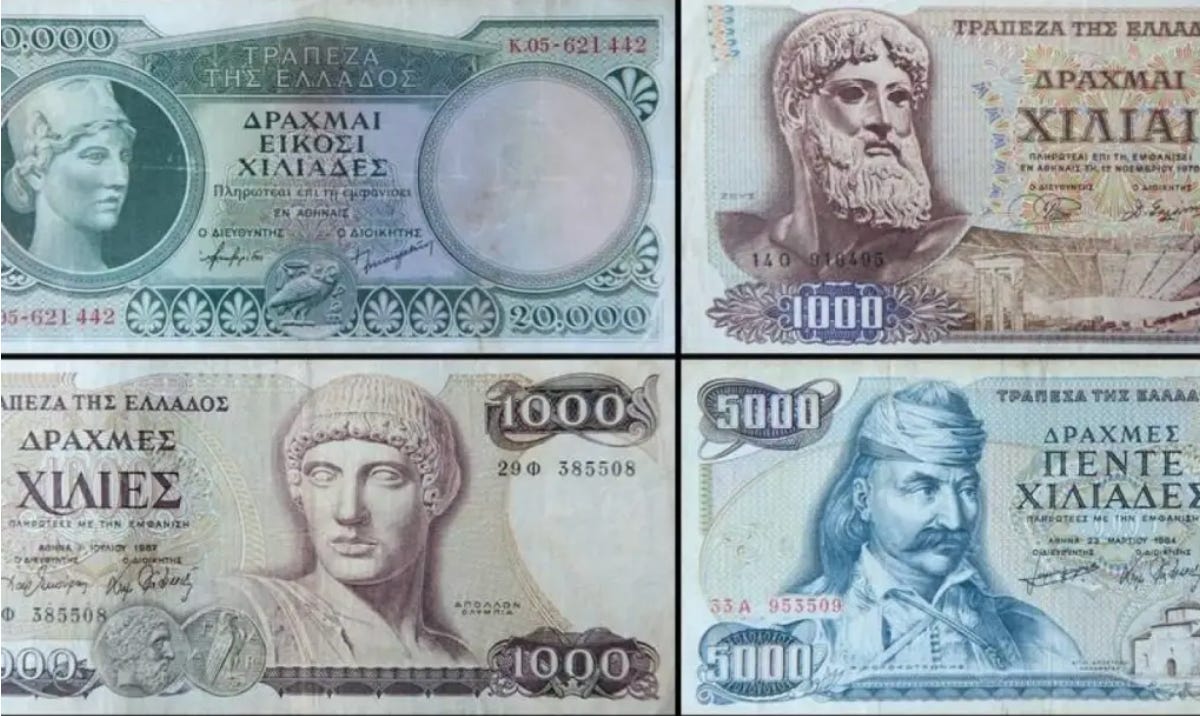
Likewise, salt occupied an important place in the economy of Ancient Rome because of its value in preserving food at a time when long-term preservation depended heavily on salting and other traditional methods. Traces of the cultural importance attached to salt remain in expressions such as “to be worth one’s salt,” while the modern word salary derives from the Latin salarium, a term historically associated with salt. Yet as monetary systems developed from commodity forms toward coinage and, eventually, the banknotes of modern nation-states, this vertical dimension did not disappear; it changed form. With whale teeth, grain or salt, symbolic meaning could arise partly from the nature and cultural importance of the object itself. With modern coins and banknotes, that meaning increasingly came to be carried by the images and symbols placed upon them. National currencies were adorned with rulers, writers, scientists, artists, monuments, landscapes, historical events and other symbols associated with the nation. Money therefore became not merely a means of communicating economic value, but also a surface upon which a people could represent its history to itself. Such imagery could reinforce common national memory and belonging while, in some cases, connecting the present generation with older historical, cultural and ancestral inheritances.
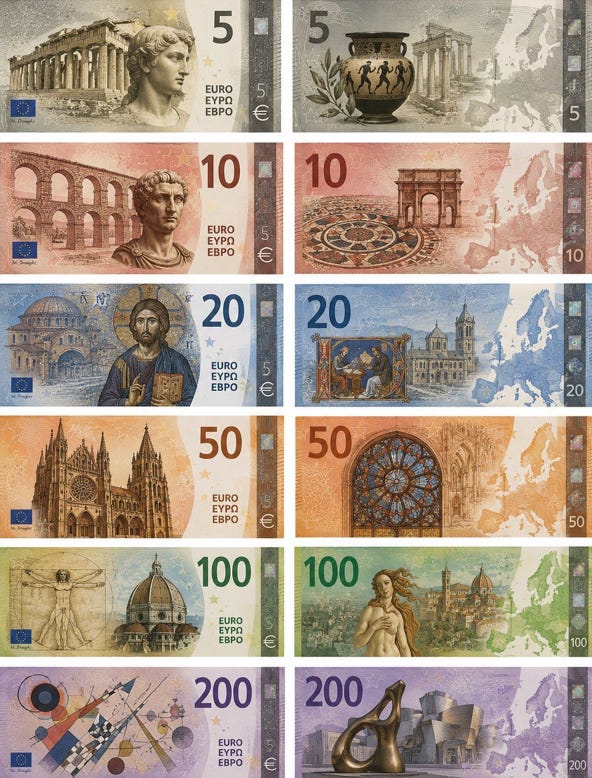
This three-layered civilisational monetary order could therefore become an attempt to bind a civilisation together through corresponding layers of identity, memory and belonging. At the highest level, the gold-backed euro could become a vertical vehicle of civilisational memory, allowing Europeans to represent their shared historical inheritance to themselves without displacing the national and local identities beneath it. Its banknotes could depict successive periods of European history that played a formative role in shaping Europe into the civilisation it is today, creating a visual journey through that inheritance from antiquity to the modern age. The euro would therefore communicate more than monetary value: at the civilisational level, it could become a medium through which Europeans encounter, remember and transmit the historical continuity of their civilisation.
READ MORE by Alexandros Dolgov in Arktos Journal:

The reintroduced national currencies would provide the second layer of this symbolic order, expressing national memory, historical continuity and belonging. Whereas the euro would represent the broader civilisational inheritance shared by Europeans, national currencies would preserve the particular historical memories of the nations composing that civilisation. Their notes and coins could once again depict national heroes, rulers, writers, scientists, artists, monuments, landscapes, historical events and other symbols through which a nation recognises its own past, much as many of Europe’s former national currencies once did. In some countries, this national memory could also reach further into older ethnic, cultural and ancestral inheritances. The national currency would therefore become more than an instrument of domestic monetary sovereignty: vertically, it could serve as a medium through which each nation encounters, remembers and transmits its own historical identity from one generation to the next.
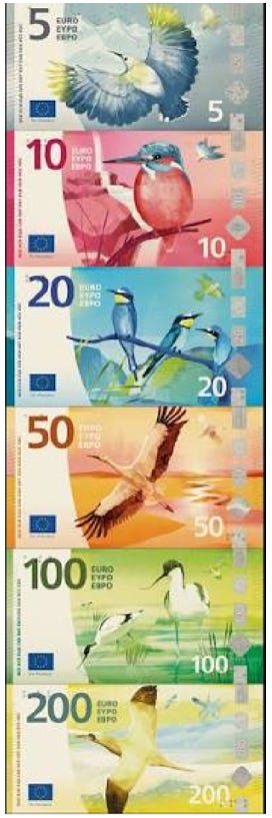
Finally, the optional local currencies would complete this symbolic order by binding money to place and local memory. If the euro speaks at the level of civilisation and the national currencies at the level of the historical nation, the local currencies would speak at the level of the lived locality itself. Their notes or tokens could depict local historical sites, regional heroes, monuments, churches, legends and natural landscapes such as lakes, rivers, mountains and forests. In this way, the local currency would become the most intimate layer of monetary identity, rooted not in an abstract collective but in a particular town, region or landscape that people know directly. The Brocéliande forest in Brittany, France, mired in Arthurian legend, comes to mind as an example of the kind of site that could be depicted at the local or regional level. The local currency would therefore become more than an instrument of local exchange: vertically, it could serve as a medium through which a community encounters, remembers and transmits the memory of its own place.
Of the three layers, European, national and local, the most unusual may be the local currency, since it is rarely considered part of modern monetary policy. Yet local currencies have been attempted at different points in history. One such example is the Wörgl experiment. In 1932, the Austrian town of Wörgl introduced a locally centred complementary currency experiment that continued until September 1933, when a legal challenge initiated by the Austrian National Bank brought it to an end. The experiment began during the Great Depression, when Wörgl was facing high unemployment, declining tax revenues, municipal debt and an urgent need for public works, while the Depression and widespread hoarding had reduced the number of Austrian schillings circulating through the local economy.
Inspired by the economist Silvio Gesell, Mayor Michael Unterguggenberger introduced labour-value certificates denominated at parity with the Austrian schilling and formally backed by schilling deposits held at a local bank. The municipality used the certificates to pay workers employed on public projects, local businesses accepted them, and residents could use them to pay local taxes, rents, water charges and other municipal fees. The principal monetary innovation was a demurrage charge: to keep a certificate valid, its holder had to purchase and attach a monthly stamp worth 1% of its face value. This encouraged holders to spend the certificates rather than retain them and thereby accelerated their circulation through the town. The certificates helped finance public works including roads, sewers, a bridge and street lighting. Contemporary and later accounts also reported that unemployment declined in Wörgl while continuing to rise across Austria. The Wörgl certificates did not replace the Austrian schilling but remained complementary to it, while the schilling continued to function as a store of value, a means of trade beyond the town and the currency in which external debts were settled. The success attributed to the local currency attracted interest from other towns and municipalities. This alarmed the Austrian National Bank, which regarded the certificates as an infringement of its monopoly over currency issuance. Following a legal dispute, the experiment ended in September 1933.
The Wörgl experiment illustrates how local currencies may strengthen economic resilience under particular conditions when national monetary conditions fail to provide sufficient liquidity for local exchange and investment. This does not mean that every local currency should follow the Wörgl model. Different communities could instead develop limited monetary rules adapted to their economic conditions and designed, where appropriate, to provide some protection against external shocks. Introducing local currencies as a third layer in Europe’s monetary reconstruction could therefore contribute to a more resilient European economy while creating space for local experimentation and institutional innovation.
The euro remains a controversial currency. If one asks northern and western Europeans about it, many are likely to describe it as a positive development, but among southern Europeans one is more likely to encounter negative views. Its achievements are nevertheless noteworthy, yet its functions do not necessarily need to remain concentrated in one currency and could instead be distributed across two or three monetary levels.
In the three-level version proposed here, however, the gold-backed euro could preserve continental power and serve as a beacon of stability in a multipolar world increasingly marked by currency disputes and competitive devaluations among the great powers. National currencies would restore monetary adjustment, responsibility and democratic control, while local currencies could create room for economic belonging, experimentation and local resilience in the face of economic crises.
Such a model is uniquely suited to Europe because Europe is not a nation-state, but a civilisation, and it may be uniquely positioned among potential great-power blocs to implement it, since Europe’s political and monetary order remains “under construction” when compared with the more consolidated political and monetary orders of China, the United States and Russia. This would allow the three layers to deliver permanence at the highest level, sovereignty in the middle, and experimentation and innovation at the lowest, thereby reflecting Europe’s organic plurality as a civilisation.
READ MORE from Arktos: