


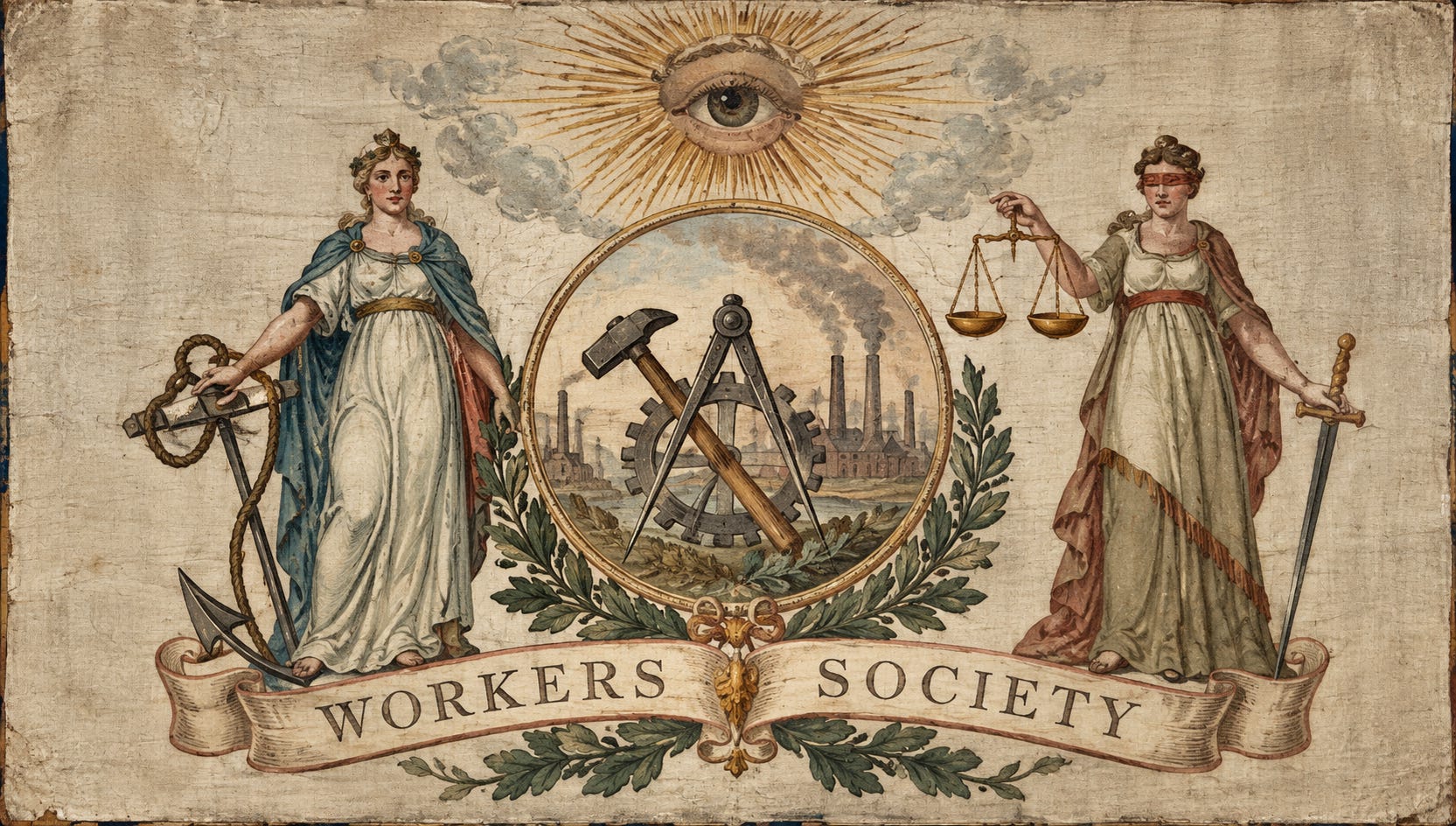
One of the standard institutions associated with labour today is the labour union. Labour unions have been around for almost 150 years, having emerged from three converging developments in the late nineteenth century. The first was industrialisation, initially in Britain and later in continental Europe. The second was the influence of Marxist, socialist, and even anarchist thought concerned with protecting the worker. A third component, which developed somewhat later, was conservative Christian social thought, in which empathy and social responsibility played a role in further shaping labour unions as institutions of worker protection.
Labour unions are therefore usually associated with the political Left, as much of their intellectual heritage stems from socialism and Marxism, and for most people unions are understood as left-leaning in one way or another. In unions’ own rhetoric and self-presentation, this association is largely correct.
Yet in their actual structure and operation, labour unions are inseparable from industrialisation itself, and industrialisation meant capitalism, and more specifically liberalism. The labour union was, in this sense, a response to liberalism, but one that remained embedded within a liberal framework. What is often missed is that labour unions possess a distinctly liberal metaphysics: despite their collectivist rhetoric, they focus on workers’ rights, and rights presuppose the liberal idea of the individual as a rights-bearing subject. In practice, therefore, the union does not transcend individualism so much as it aggregates individuals, organising labour through claims and rights made on behalf of the individual worker.
Thus, labour unions are focused primarily on a defensive posture: they are concerned with what one must not - or in some cases must - do to the worker. This is not in itself a failing. Few would wish to work in conditions lacking basic dignity, or to be treated as an expendable resource rather than as a human being. For this reason, one should not dismiss the importance of labour unions in the manner the political Right sometimes does, as they have performed an important role in preventing abuses against fellow citizens that might otherwise have taken place.
Having said that, rights and claims protect individuals from abuse and poverty and provide a measure of safety, but they do not concern themselves with the formation of the worker’s character, responsibility, skill, or moral and technical excellence in and of themselves. The worker’s actual competence, whether he is an experienced craftsman who has honed his skills over time, and his mastery of a craft become secondary, or even irrelevant. Moreover, responsibility is externalised to the state through regulation and law, as workplace disputes are resolved through legal mechanisms, courts, and regulators. This both expands state bureaucracy and produces an ever-growing legal apparatus, as the state becomes the final arbiter of workplace order. Under such conditions, accountability becomes procedural rather than moral.
This metaphysics of proceduralism may have its roots in industrialisation itself, insofar as labour unions assume that labour is interchangeable — much as liberalism assumes people to be, regardless of the culture from which they stem. This assumption emerged from the fact that industrialisation largely dismantled older forms of specialisation. Where once master carpenters produced end-to-end, small-scale works meant to last a lifetime, industrial production replaced this with segmented labour, in which multiple workers performed repetitive tasks. The worker no longer needed to understand carpentry as a whole, but only the narrow, specialised function he mechanically repeated. Mastery and skill were thus displaced by efficiency. Ironically, for a liberalism that prides itself on the individual, value came to be produced collectively, procedurally, and repetitively rather than through individual excellence. Labour unions, shaped by these conditions, therefore organise around job categories and tend to privilege seniority over mastery.
What is understood as mastery is, under these conditions, increasingly displaced to universities. Universities, however, have gradually lost much of their original institutional character, even prior to more recent ideological developments. Historically, universities were neither diploma mills nor primarily intended to serve the employability needs of future workers in multinational corporations. Industrialisation instead gave rise to a managerial class that came to rely on formal credentials, such as MBAs or similar degrees, as markers of advancement, sidelining the original purpose of the university in the process.
Technical fields, which historically had little or no place within the university, often lag behind industry practice, and the material taught to students is frequently out of step with the tools and technologies used by most firms. As a result, many students graduate believing themselves prepared for professional life, only to encounter job requirements they do not meaningfully understand. Universities thus come to distribute credentials that substitute for demonstrated mastery of skill. In doing so, the university as an institution is diminished: education shifts from the pursuit of truth and deep inquiry, once centred on disciplines such as philosophy, medicine, literature, history, and theology among others, toward a system that primarily signals the ability to complete a prescribed sequence of tasks over several years, rather than fostering genuine formation and intellectual inquiry.
In response to labour unions and their spillover effects into other institutions, conservatives should not position themselves simply in opposition to labour organisation as such. Instead, they should articulate and build labour institutions grounded in their own values, capable of being offered as a credible alternative. As noted earlier, labour unions, despite their collectivist language, are oriented toward individual entitlements and rights, reflecting their underlying liberal metaphysics. Prior to the industrial revolution, however, an alternative institutional form existed—one that centred not on rights but on skill, competence, and merit: the guild.
Where unions tend to treat work as a set of tasks performed within a defined job category and understand workers primarily as a class in conflict with capital, guilds organised around crafts and understood work as a vocation and as part of personal identity. They accepted hierarchies of competence acquired through sustained practice over many years. Entry, formation, character, culture, skill, and standards were central to the guild, traditionally structured through three stages: apprentice for those entering the craft, journeyman for those with established competence, and master for those who had attained full mastery. Authority within the guild was therefore peer-based and organic rather than procedural, exercised by practitioners who had themselves demonstrated excellence. Guilds were self-regulating institutions, relying on reputation, certification, and exclusion to maintain standards, rather than on external courts or regulatory bodies.
Those who attained mastery of a craft were themselves active practitioners, continuously familiar with the latest tools, techniques, and developments within their field, and they transmitted this knowledge through peer evaluation and the instruction of apprentices. Within a guild system, responsibility came first and rights followed; reputation and respect were earned through demonstrated competence rather than claimed by entitlement. Guilds therefore did not merely protect work, but actively shaped durable skills, professional identities, and confidence, while reducing the need for external arbitration and enforcement by the state.
Labour unions emerged and developed in a period characterised by interchangeable workers and highly centralised employers, in which skill, while still relevant, was secondary to the repetitive nature of most tasks. As technology now advances rapidly, most notably through artificial intelligence and autonomous systems, many of the tasks historically performed by unionised workers are increasingly subject to automation. Execution thus becomes cheap, while judgment, particularly the judgment of quality, error, and consequence, becomes scarce. Under these conditions, taste, restraint, and responsibility assume renewed importance.
This shift implies that automated systems will ultimately be directed and supervised by practitioners who understand the work itself, and who have demonstrated mastery of a craft. Peer recognition and reputation therefore regain centrality as markers of competence and trust. In this context, labour structures such as guilds become relevant once again, not as nostalgic restorations but as institutions suited to organising judgment-intensive work.
A contemporary neo-guild, however, would need to accommodate both older technical crafts and newer technological domains: alongside plumbers, masons, stoneworkers, and metalworkers, guilds could plausibly emerge in fields such as cybersecurity, robotics integration, smart contract auditing, and advanced systems engineering, areas in which execution can be partially automated, but responsibility cannot. Modern neo-guilds could use technological tools such as videos for apprentices to learn what does not require physical presence through recorded videos and have in-person meetings at the guild for personal mentorship and in-depth teaching of things that require physical presence.
Recreating guilds in such a way would also echo Guillaume Faye’s idea of Archeofuturism, combining an ancient idea or value with today’s technologies.

Moreover, since technical formation would move to guilds, this would mean that universities could focus again on their original purposes such as theory, philosophy research, and civilisational memory, thus shifting the funding from technical occupations taught at the university towards research and development instead.
Beyond skill and character formation, guilds historically also incorporated systems of mutual aid, and a contemporary or neo-guild framework could plausibly do the same as an extension of professional responsibility. Rather than relying on state-administered unemployment entitlements, guilds pooled resources through member fees and other revenues into internal insurance funds. These funds provided support in cases of illness, injury, temporary unemployment, periods of transition between engagements, and even death, with payments often extended to the widows of craftsmen to ensure basic security.
Support was typically temporary and conditional, aimed at reintegrating the member into productive work rather than sustaining indefinite dependency. Because assistance was administered within a community of practitioners, members were subject to indirect but real social pressure to remain active: prolonged withdrawal from work risked reputational damage among peers. This arrangement introduced a moral dimension to welfare, in which eligibility depended not only on need, but on continued commitment to the craft and its vocation. Unemployment solidarity thus became embedded within institutions that formed skills, cultivated discipline and character, and incentivised members to remain competent and engaged. Were a similar system implemented within a modern neo-guild framework, the role of the state would shift accordingly, from primary provider of unemployment benefits to guarantor of last resort, intervening only where professional institutions proved insufficient.
If neo-guilds were to become a normalised feature of labour organisation, this would imply a significant reduction in the scope of the state, particularly by removing large portions of bureaucracy associated with labour administration, retraining programmes, regulatory oversight, and arbitration. Under such conditions, the state would be recast less as a manager or caretaker and more as a guarantor, intervening where necessary rather than administering labour relations directly. This would not, however, eliminate the state’s responsibilities toward its citizens. Provision would still be required in cases of severe disability, old age, and systemic shocks that exceed the capacity of professional or communal institutions.
This implies not the abolition of welfare, but its reorientation. The role of the state would be to support a welfare framework that encourages responsibility within one’s own community, through the transmission of culture and knowledge, intergenerational continuity, and family formation, rather than substituting for these functions. In such a model, social protection is preserved, but it is anchored in institutions that form responsibility, rather than eroding it.
Neo-guilds could also become one of the institutional pillars of a broader remigration strategy through several complementary functions. First, they could help develop skills among the native population through apprenticeships in fields such as elder care, construction, and the skilled trades, with younger or less experienced members receiving practical instruction from experienced practitioners within their professional communities.
Second, technological development could reduce the amount of labour required for some routine and repetitive forms of work. Consider, purely as an illustration, a warehouse employing 100 workers in highly repetitive tasks: if advances in artificial intelligence, robotics and automated logistics allowed the same volume of work to be performed with 70 workers, labour demand would fall by 30%, while supervision, troubleshooting, and judgment would become relatively more important than the manual execution of the tasks themselves. This figure is hypothetical, since automation affects occupations unevenly and does not eliminate every task within an occupation. Nevertheless, structured warehouse activities such as picking, sorting, moving, and tracking goods are among the kinds of repetitive work particularly exposed to further automation. Administrative processes surrounding such work could also increasingly be automated through software and, where appropriate, technologies such as smart contracts.
At the same time, neo-guilds operating across Europe could help connect workers with opportunities beyond their immediate locality. Because members of the same professional community would remain in contact across borders, a guild could offer retraining, apprenticeships or employment opportunities elsewhere in Europe to, for example, an Italian in southern Italy or a Greek living in an isolated village. Labour mobility could therefore emerge organically through networks of practitioners who know where particular skills are needed, rather than depending primarily upon governments to coordinate employment and movement across Europe.
The scale of Europe’s existing labour potential makes this question particularly relevant. The European Commission estimated that approximately 51 million EU residents aged 20–64 were outside the labour market in 2024. This figure should not be mistaken for 51 million immediately available native European workers: it includes migrants, older people, people with disabilities, those with caring responsibilities and others facing barriers to employment, while only around 10 million reported that they would like to work. Nevertheless, it points to a substantial pool of labour-market capacity that exists alongside Europe’s reliance on imported labour and raises the question of how much more effectively Europe’s existing population could be trained, connected and mobilised before external recruitment becomes the default response to labour shortages.
For all of these possibilities, neo-guilds should not be treated as a panacea. They could become an important institutional pillar within a broader long-term remigration strategy, particularly by developing domestic skills, improving labour mobility and reducing the amount of labour required for some repetitive occupations, but they could not by themselves eliminate Europe’s immediate dependence on migrant labour. Guilds provide part of a labour, vocational, and technological policy; they do not constitute a demographic or family policy capable of sustaining the native population over generations and ensuring a sufficiently large future workforce.
This is where such institutions would have to be situated within a wider social framework, including the kind of conservative welfare state I have proposed elsewhere. From a Traditionalist perspective, but also even from a horizontal and purely economic one, policies that make family formation and child-rearing more viable could be understood partly as a long-term investment in demographic continuity and future productive capacity.
The argument is not simply that a larger population automatically produces greater prosperity, but that a sufficiently large, well-formed, and economically active future generation could expand the domestic labour supply, sustain public institutions and potentially enlarge the pool from which future entrepreneurs, craftsmen, and professionals emerge. Over one or two generations, such demographic renewal could therefore reduce Europe’s structural dependence on external labour.
The difficulty, however, is temporal. Demographic change operates over decades, while labour shortages exist in the present, and automation is unlikely to replace every repetitive or labour-intensive occupation at the same pace. Some continued reliance on foreign labour could therefore remain necessary during the transition. Rather than treating temporary labour migration and permanent settlement as the same phenomenon, one possible policy model would distinguish more sharply between them. Naturalisation rules currently differ substantially between EU member states and are determined principally under national law; there is no single EU rule under which every foreign worker automatically acquires citizenship after a fixed number of years. A more explicitly temporary labour framework could instead admit workers for defined periods in sectors experiencing shortages, while making clear that the labour permit itself does not constitute an automatic route to permanent residence or citizenship. Versions of temporary migration already exist in European law: the EU Seasonal Workers Directive, for example, provides for limited stays of between five and nine months within a twelve-month period, after which the worker normally leaves unless another lawful residence status has been granted.
Such a system could be used during the period in which automation, vocational reconstruction and demographic renewal have not yet reduced labour shortages sufficiently. If, over time, Europe’s domestic labour supply became capable of meeting a greater share of those needs, the scale of temporary recruitment could then be reduced or the system reconsidered altogether.
A durable civilisation cannot rest on individual rights alone. A society that focuses exclusively on rights lacks the institutions necessary to form people of skill, character, and responsibility; over time, this deficit is compensated for through bureaucracy, procedural control, and an expansive welfare state. Neo-guilds, understood as new institutional forms inspired by their predecessors but adapted to modern conditions, point toward a technological labour order that prioritises responsibility and mastery over entitlement, and continuity over fragmentation, through shared standards and vocation.
READ MORE from Arktos:
