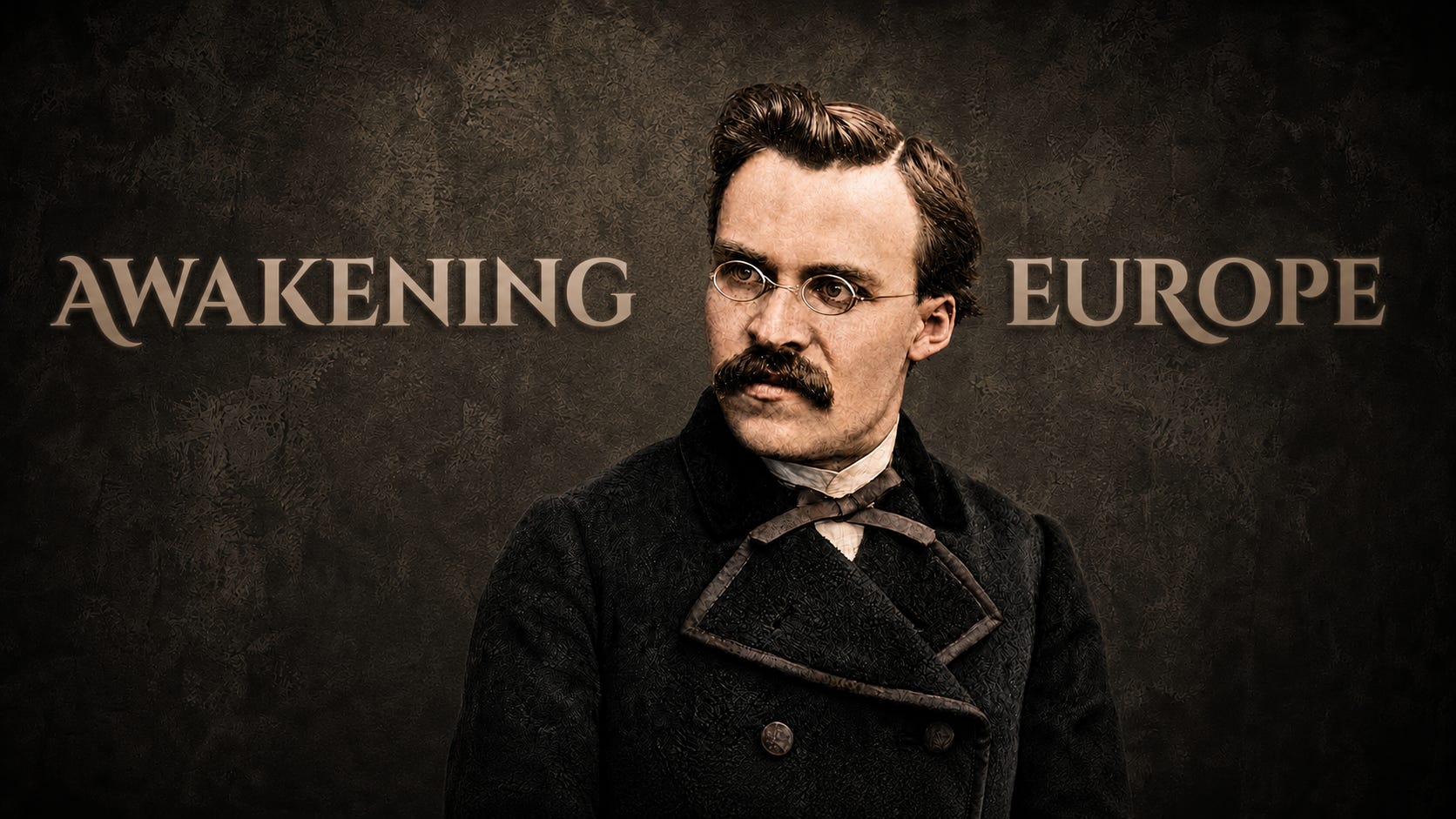
The Institut Iliade’s educational and networking seminars, known as Formations, traditionally choose an historic European figure as their “Promotion” to represent their “graduating class” and serve as an inspiration and a source of lessons for their ongoing endeavours. This year, the international Awakening Europe seminar preceding the Institut Iliade’s 13th Colloquium [read the Arktos report here] selected Friedrich Nietzsche. Arktos’s very own Editor-in-Chief, Dr. Jafe Arnold, authored the Promotional tribute [read it in French here].
“We are unknown to ourselves […] We have never sought ourselves — how could it happen that we should ever find ourselves? […] Present experience has, I am afraid, always found us ‘absent-minded’ […] ‘What really was that which just struck?’ so we sometimes rub our ears afterward and ask, utterly surprised and disconcerted, ‘what really was that which we just have experienced?’ and moreover: ‘who are we really?’”1
These words would have been familiar to the godfather of the Institut Iliade, Dominique Venner, for they open Friedrich Nietzsche’s preface to the Genealogy of Morality — the very book that Venner carried with him to war in the mountains of Algeria. Uttered in Nietzsche’s typically incisive questioning, these words thrust forth the intimate relationship between knowledge, identity, and memory, which is enshrined in the Institut Iliade’s maxim, “For a Long European Memory.” With respect to this memory, Venner wrote in his final testimony, Samurai of the West:
“I rebel against the negation of French and European memory. I owe to this memory examples of bearing, valour, and refinement hailing from the most distant past, that of Hector and Andromache, of Odysseus and Penelope. Threatened like all my European brothers with perishing spiritually and historically, this memory is my most precious possession. The one on which to rely in order to be reborn.”2
Furthermore, Venner believed that Nietzsche had rekindled and transmitted a primal element of deep European memory when he uttered “We Hyperboreans”— to which Venner applauded: “The memory had thus been transmitted!”3
But do we today — gathered around an institute that honours and carries on the task of memory championed by Venner — remember Nietzsche? Does Nietzsche figure in our memory? What does he have to say for us to recall? To invoke the words of Guillaume Faye:
“Nietzsche already prophesied, ‘The man of the future is he who will have the longest memory.’”4
Nietzsche is one of those memorable names designating more than a man or a particular idea — they name a momentous train of thought, a special kind of rupture, or a crossing from which the way to the other side is a leap that has not been mapped or bridged. Another such name, Julius Evola, who theorized the “rupture of level,” wrote:
“It has been rightly said that Nietzsche’s personality and thought also have a symbolic character.”5
As for the person, Friedrich Wilhelm Nietzsche was born in the autumn of 1844 in the village of Röcken, in the Prussian Province of Saxony, a short stroll away from the site of one of the most famous battles of the Thirty Years’ War that drastically altered Europe. His native landscape was in the orbit of one of the centres of German art and thought, Leipzig — the birthplace of the philosopher Leibniz and the composer Richard Wagner (with whom Nietzsche would later enter into a famous polemic).
Immersed and excelling in the precious faculties of European genius —music, classical and modern languages, theology — Nietzsche went on to study at the universities of Bonn and Leipzig, becoming a professor of classical philology at the University of Basel at the age of 24 (thus one of the youngest tenured professors in history). Twice Nietzsche put aside his academic career to be a soldier: once for voluntary service in the Prussian artillery, and then as a medical orderly during the Franco-Prussian War, from which he returned to witness the establishment of the German Empire.
The 1870s saw the steady emergence of Nietzsche’s decidedly unorthodox oeuvre (such as his famous The Birth of Tragedy, Untimely Meditations, and Human, All Too Human), but also the drastic confluence of numerous health issues that would eventually force him to resign from academia and made writing a particularly intense psychosomatic experience. Nevertheless, constantly moving with the weather between the Italian and French coasts in the winters and the Swiss Alps in the summers, the 1880s were the peak of Nietzsche’s writing, yielding works like The Gay Science, Thus Spoke Zarathustra, Beyond Good and Evil, and The Genealogy of Morality, as well as the notes that would later be assembled into The Will to Power. The year 1888 would go down as at once the most extraordinary year of Nietzsche’s writing — including Twilight of the Idols, Ecce Homo, and The Antichrist, — and the final year of his “career” and independent living.
Having pushed his critique of the modern age to its breaking point, Nietzsche himself collapsed: following a sudden episode of mental breakdown in 1889 Nietzsche was diagnosed as incapacitated and placed in the care of his family, fated to suffer much (including the loss of the ability to speak and walk) until his death in 1900. Although Nietzsche’s physical condition in the last years of his life was undoubtedly deplorable and the result of long-standing illnesses, some are tempted to see in his sudden “psychosis” an archetype of the “madness,” “mania,” or “crazy gnosis” known to ancient European traditions, including ancient Greek philosophy — or as an instance of the flight of genius that can no longer handle the contemporary material world of lesser order. For the record, Nietzsche signed many of his final letters (known as the “Delusion Notes”) as none other than the ancient Greek god of metamorphosis and madness, “Dionysus.”
Be that as it may, Nietzsche’s passage from academic and philosophical productivity to an uneasy state of madness symbolically parallels the rupture that he represents and registers in European ideational history. Nietzsche was not a system-builder like his compatriots, but a demolisher, as represented by the “philosophical hammer” he raised against “idols.” Nietzsche’s hammer unleashes a “genealogy of values”: he deconstructs and exposes the absurdity of the dead-end of European philosophy, discerning how the latter has detracted from the experience of life, will, and power in favour of concepts, abstractions, and universalisms. For Nietzsche, European man has become beholden to a “slave morality” driven by ressentiment, constantly seeking the “reality” of “truth” and “good” elsewhere rather than in man’s own undertaking to master and overcome the battlefield of wills. As Faye reminds us:
“In order to shape history it is necessary to unleash ideological storms by attacking – as Nietzsche correctly observed – the values that form the framework and skeleton of the system.”6
Giorgio Locchi and Antoine Dresse likewise read what is at stake in Nietzsche’s “active history”:
“The Nietzschean superman is one who assumes time without promise of redemption, who accepts that the past is not abolished, but can, in an instant, be taken up anew and reoriented. Becoming thus becomes an act of creation: it is no longer about enduring history, but about engendering it by fully exposing oneself to it.”7
Antoine Dresse (“Ego Non”) explores Italian philosopher Giorgio Locchi’s radical reinterpretation of Martin Heidegger’s work, positioning it as the philosophical culmination of what Locchi calls the “superhumanist myth” that rose with Wagner and Nietzsche and dared to envision a new beginning for European history and thought.
Through a stormy convergence of philosophical analyses, aphorisms, and mythopoetic flashes, Nietzsche diagnoses the hollow shell of Western Modernity: “God is dead,” that is to say the hitherto constructed foundation of man’s valuations has crumbled and been swept away, leaving an abyss of nihilism and a weariness of life. Nietzsche calls not for rebuilding the old, problematic foundation, but for action: for leaping over the abyss through a “transvaluation of values.”
This leap is the open-ended mission of the Übermensch, the man who becomes more than man, the one who goes beyond man, precisely by assuming the radical responsibility and daring for forging values previously offset to stale narratives of history or an alienated God. Through this imperative, there is no “school” of “Nietzschean philosophy” to be had, as Locchi highlights:
“Nietzsche is not a philosopher like any other… Nietzsche announces the end of the old philosophy. He announces the birth of a thought free, at last… [T]hey cannot keep him from speaking. Nietzsche’s work is there, provoking.”8
For Europeans today, Nietzsche is a symbol of radical independence — daring to become sovereign, to reconsider history and values not as fixed concepts, but as proactive projects. Nietzsche embodies a Europe capable of confronting itself without illusion. He offers no refuge, only a demand: to become creative and fiery once more — in thought, in art, in deed. The task of European memory — or “remembering”, even “re-membering”, “re-constituting” — today is, in an innermost way, Nietzschean: it is high time to topple old idols and relight the creative will that is at the origin of any living culture.
“A people,” Nietzsche writes, “is worth only as much as its ability to impress on its experiences the seal of eternity.”9
Throughout Nietzsche’s works, we find the recurring symbolic theme of the man who has “come too early,” whose recognitions and visions are “untimely.” Without a doubt, this is not only about Nietzsche himself, but about us: we who, in the 21st century, find ourselves faced with the task of re-calling and asserting the potentiality of our future beyond the ditch of the “end of history.”
This “superhuman” task was acknowledged at the Institut Iliade this April, when participants from 13 countries completed the international educational seminar “Awakening Europe,” the first of its kind organised by the Institut Iliade, and selected Friedrich Nietzsche as the promotional figure who serves as a critical reminder for our meditations — and actions. Remembering Nietzsche, we know that Europe is not behind us, but ahead of us, to be born out of our “overcoming” today.
— Dr. Jafe Arnold
Editor-in-Chief,
Arktos ; PRAV Publishing
Graduate of the Institut Iliade’s Awakening Europe Formation Seminar, April 2026
READ MORE by the Institut Iliade, brought to you in English by Arktos:
In my view, this post likely overemphasizes freedom as a teleological principle for Nietzsche and undersells the importance of value-creation and philosophical legislation. As Zarathustra impels his pupils, the "free for what" should call more strongly than the "free from what." Free "from what," defines freedom, first, as an ultimate good, which is ultimately hollow, but secondarily, by the negative - that freedom is good because of an absence of bad versus as a positive good in its own right. And this is because freedom is not a positive good in its own right (CR Gay Science 124-25 and TSZ 3."Before Sunrise"); rather, it is good as a removal of a fetter for philosophers, but this will happen anyway, as Nietzsche makes clear at the end of the third essay of Genealogy of morals, freedom from Christian dogmatism is inevitable. The question, then, is can he accelerate this decay in religious faith and control how the decay occurs, such that it will promote a new tragic age? This makes the mission both subjective and objective. It is subjective in reference to the value-creators (they must understand moral groundlessness to be able to be creative) and objective relative to the value-followers. Finally - briefly, but - any freedom is, of course, limited by sublimated values which cannot fully be extricated (CR TSZ 2."Redemption," TSZ 3."Convalescent"). There's insufficient space for me to elaborate on this here, but this should be further explored.





Thank you for such insightful examination and exploration of Nietzsche's thoughts.
In my view, this post likely overemphasizes freedom as a teleological principle for Nietzsche and undersells the importance of value-creation and philosophical legislation. As Zarathustra impels his pupils, the "free for what" should call more strongly than the "free from what." Free "from what," defines freedom, first, as an ultimate good, which is ultimately hollow, but secondarily, by the negative - that freedom is good because of an absence of bad versus as a positive good in its own right. And this is because freedom is not a positive good in its own right (CR Gay Science 124-25 and TSZ 3."Before Sunrise"); rather, it is good as a removal of a fetter for philosophers, but this will happen anyway, as Nietzsche makes clear at the end of the third essay of Genealogy of morals, freedom from Christian dogmatism is inevitable. The question, then, is can he accelerate this decay in religious faith and control how the decay occurs, such that it will promote a new tragic age? This makes the mission both subjective and objective. It is subjective in reference to the value-creators (they must understand moral groundlessness to be able to be creative) and objective relative to the value-followers. Finally - briefly, but - any freedom is, of course, limited by sublimated values which cannot fully be extricated (CR TSZ 2."Redemption," TSZ 3."Convalescent"). There's insufficient space for me to elaborate on this here, but this should be further explored.