



The American right continually fails to analyze our political systems through a lens of objectivity. Though the right claims its conservatism is in opposition to liberalism, they can’t seem to divorce their liberal principles from their perspective.
Liberalism is fundamentally trying to produce a system that is impartial to its operators. In its perfect and theoretical form, liberalism should be able to withstand any level of societal shift without ever requiring a structural update. It theorizes itself as the ideal framework for any civilization, totally irrespective of the people, place, or culture it actually governs.
As liberalism continues to strip away bonds, it seeks to return us to what it claims is the natural state of man. But much like how the modernist art movement’s pursuit for objectively beautiful art led to maniacs like Piet Mondrian tearing the stove out of his apartment because the burner coils were circular and not square, liberalism will also continue on its reductive quest unabated.

According to liberalism, there aren’t any limiting principles which would classify certain things or bonds as inherently off limits. The ideology promotes nothing but a strict adherence to its own neutrality. It is unable to recognize our duties as people. Liberalism could never demand that you hold an obligation to your parents, siblings, or any family member. Carl Benjamin concisely repudiates this with his instruction for you to simply ‘pick up the phone and call your mother’, because despite the prominence of this political ideology, we all realize that we do have certain and inherent non-consensual obligations.
If liberalism can’t recognize something as basic and fundamental to humans as family, then it clearly doesn’t have an accurate assessment of the natural state of mankind. Somehow, most people on the right are still unwilling to admit that there may be inherent problems with liberal theory. There’s a deep belief that these ideas are simply entitled to be true. They’re seen as being so beautiful, that the negative outcomes they continue to produce don’t need to be seriously acknowledged.
For example, our liberal system insists that every human is essentially perfectly equal and thus interchangeable. Following this logic, it shouldn’t really matter which groups of people come into our country. And yet, as we find our nation being flooded by immigrants who share neither our ethnicity nor values, our country is being destroyed. Even in the midst of this migration crisis, most Americans don’t even have the capacity to identify this invasion as a problem due to the underlying assertions of liberalism.

Since we are so religiously devoted to these systems which govern us, there’s almost no room for any dissent. With this mythology so deeply embedded into us, many Americans often forget that our systems were invented to help us prosper. They weren’t intended to be the final arbiter of everything. They certainly weren’t created to endlessly expand their prevalence without ever needing us to assess how they’re changing our reality.
We were not created to serve liberalism. It was devised to serve us. Just like capitalism, democracy, and any other general operating system of our society. We are not in service to any of them. They are in service to us. If they’re failing us, we have to be able to adjust, or we’ll perish.
Criticism of the US constitution seems to animate those who believe in the mythical version of America the most. Anytime I, or any of the actual prominent right-wing voices, reasonably mention the possibility that the constitution may not be an infallible document, there’s a reflexive repulsion to it. There are tons of Americans who truly believe that our founding documents are divinely inspired.
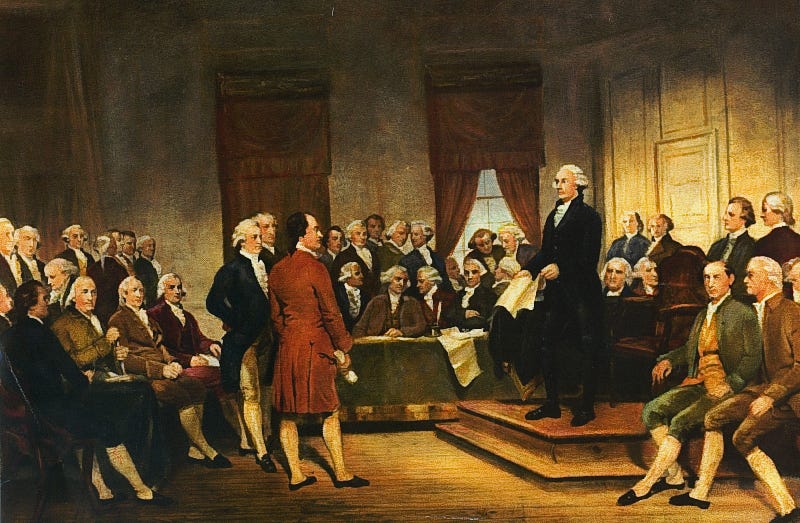
Auron Macintyre often warns about the deification of the constitution we see so often on the right-wing. Auron explains that this deification is the very thing that typically stops us from making genuine, productive modifications to our system. The idea that the way we structured our society, which was done prior to the industrial revolution, wouldn’t ever need a substantive update, is so absurd that it’s hard to believe it actually needs to be corrected.
Yet liberalism is pursuing a permanent, universal system that should never require adjustment. Couple that with a mythological trust in it, and the rabid aversion to modifying it becomes fairly predictable.
Our instinct for a permanent system is natural. We all would like the permanence of ideal conditions. However, we have to be able to recognize this as an impulse, and not as a virtue or legitimate strategy. What I see happening on the right-wing is this exact conflation. We treat the unconditional surrender to our system as a noble act. How many times have you heard someone that would describe themselves as a constitutional conservative say something along the lines of: ‘Well that’s up to the judicial system to decide. He’ll need his day in court.’
The implication here is that a trial by jury has some magical power to definitively decide on whether justice has been served. Now, I clearly concede that this type of system has the capacity to serve justice, but the important distinction is that we can’t exclusively defer to the outcome regardless of any other factors. For instance, if we decide as a society that Derek Chauvin is guilty of murder purely because of his jury’s verdict, we no longer have moral agency. We must fight against this enslavement to our systems.
The New Right has mostly adjusted their framework here. We understand and accept that our systems serve us, we do not serve systems. But I’ve seen many right-wing commentators concede on things like banning pornography, merely because someone, at some point, argued that it’s a form of free speech. This is a clear example of what I’m talking about. We’re pretending that our system is the thing that decides on what we put up with, rather than ourselves. It’s a paternalistic concession, literally based on faith, that trusts the system to be self resolving and essentially infallible. However, there is no system, no matter how perfect, that is self resolving. You will always be pulling weeds no matter how impeccable your garden looks at the moment. Once we properly rid ourselves of the notion that we need to trust the system to fix itself, we can actually work on adjusting the function of our program to serve the outcomes we want.
This shouldn’t be taken as an argument that the ends always justify the means. We’re still obligated to adhere to moral principles. But assuming that’s satisfied, we can change things. We shouldn’t just accept any sort of loophole as legitimate because some highly contested, definitional interpretation of a document said so.
We’re actually obligated to change an improperly performing system. The first step in taking truly corrective action is to accurately assess how that program actually works and why it’s failing. Niccolo Machiavelli was the most successful articulator of this process. Even still, many people don’t understand Machiavelli because he’s almost universally referenced in a negative way. But if you read ‘The Prince’, it’s very clear that Machiavelli hardly makes any value judgments on his perceptions. The book is a study on power and politics, not a manifesto. It’s political science, not political judgment

This is also the same approach taken by James Burnham in both his books ‘The Managerial Revolution’ and ‘The Machiavellians’. In the managerial revolution, Burnham exhaustively clarifies that his theory for how society looked to be evolving was not what he preferred, but what he saw as the likely progression of capitalism based on the existing evidence.
These types of analyses are an attempt to understand what is actually happening. They try to apply impartiality to their historical review to uncover the true operating mechanisms. If, for some reason, every King to ever take power had killed their brother, then it’s a reasonable conclusion to draw that the action is probably a prerequisite to the crown. There’s nothing wrong with evaluating something in this manner. It is in fact the most necessary approach to take. If you don’t diagnose the situation correctly, your proposed solution will almost never work.
It’s become obvious that our society has resulted in systemic failure. Now, we need to properly identify where it’s going wrong. We can only do this if we abandon the deification of our systems, like Auron and many others have advised. We also can’t keep pretending that an accurate analysis is always a value judgment.
A great example of the right’s inability to divorce value and analysis was put on display when Nick Fuentes made his seemingly positive comments about Josef Stalin on Tucker Carlson’s show. The histrionic response from Con Inc. was so embarrassing that I can’t tell if they’re all simply stupid, liars, or both.
Fuentes’ actual point about Stalin was that he’d probably amassed more power than any human ever has. That’s an impressive accomplishment regardless of his use of that power, or his underlying ideology. The achievement is stunning in objective terms. Just as Usain Bolt’s 100 meter dash time is undeniably spectacular. It’s not an endorsement or justification for Stalin’s actions to say this. The same can also be said about Gaddafi’s seizure of control over Libya at the age of 27. Just as any criticism of our liberal system is immediately written off as heretical, the achievements of these men are often denounced as worthless just the same, because their methods were not in line with the liberal ethics.
The immediate rejection and inability to assess these accomplishments is exactly the opposite of what Machiavelli’s analytical procedure would result in. There is zero downside to gaining a deeper, more factual understanding of how these men operated. If we are interested in winning, and not merely being proud of our virtue signaling as we shout condemnation for nearly unanimously unpopular leaders, then we need to study what makes a successful bid for power, regardless of what was done with that authority.
With that same objectivity, we also need to assess our systems in a manner that tells us what is genuinely going wrong, no matter which document happens to require criticism. Nothing is above this type of review. This consistent pearl clutching we see as a response to the critiques is now the most obvious indicator of someone who is incapable of having a serious conversation about actually moving forward.
These grifters either want to advertise themselves as good people, or they’re too propagandized to even attempt an objective review. Either way, if they fail to provide a legitimate assessment, their comments are irrelevant to the actual conversation we need to be having.
The Right Wing Coalition’ currently writes from Texas. After completing his undergraduate degree at the turn of the last decade, he moved away from the Pacific Northwest to escape his liberal home state. Though he has primarily worked in real estate development since completing college, he also did a short stint at Tesla and even published a novel. In addition to his career, he is earning a Master’s degree while also writing and recording political commentary for his YouTube channel, The Right Wing Coalition.
Youtube: https://www.youtube.com/@TheRWCoalition
X: https://x.com/TheRWCoalition
Sarumaaaaaan.
Real talk though, it's an excellent point that should be brought up more often that a major reason why discourse is so difficult to have these days is because every single thing is interpreted as a value judgement. Some part of the character of liberalism is afraid to even acknowledge the existence of things it deems heretical, I think that's because these things have the potential to show the weaknesses of and therefore undermine the system.
Well say that individual rulers do not usually transfer over into long term systems of change. North Korea is idolized but a horrible way to live and it will not last another few hundred years. It’s only possible in a microcosm. Short term power and long term power are very different. Though an actual loving king (more like Putin than many of those named in this article) could set up a system in which rulership is spread out among a Heirarchy of men and enable systems where people are reliant on and accountable to each other.
Stalin was powerful and not a liberal, but he did not create an adaptable system even if a more industrialized one. Gaddafi was only possible within the context of a trading world in oil, then tried to oppose the financial control of such trade. He did not create a system outside of it. Russia on the other hand is increasing its self reliance and its transition between the collapse of the Soviet Union and now is much more of a study I would make than the other examples.
People talk of collapses and something rising out of it but we have a living example of this right now. That’s an impressive feat and I would like to see how he structures society for one day when he passes on power. Going from a collapse to a world power in a matter of decades that’s fairly self reliant for energy and food is not common. It’s not perfect, but nothing is perfect.