


Is Judaism the ultimate source of Western civilisation? Such views have seen a revival in 2026: the Levant is supposed to have been the Cradle of Civilisation (12,000 BC) and the Hebrews gave the West its foundations, that is, “ethical monotheism”, human dignity (for those made in the image of God), an objective moral law, justice for the weak, and linear and redemptive history. Since Israel has lost support among the Western youth, chief scholars from the Tikvah Fund and others have been out in force to remind the West how much it owes to Judaism (e.g. here). I assumed this would spark a debate about the nature and heritage of Western civilisation, but there has been silence. Why?
We are individuals adrift, no crew or course, overboard with memory loss; the erosion of our grounding in Greece, the withering of our Roman roots, and our distraction from the divine have ensured it. In short, we have forgotten our own story, the one about our shared Romanitas, about who and what we truly are in the world. Not knowing our past, we are at risk of having our future written for us, even with us typecast as the villain. Below is the Roman version of our story, the one we must tell again.
The Noahide View of the West
Certainly, there is nothing new about the above debate. Western history is littered with interest in a Jewish perspective on our civilisation. The ethical monotheism outlined above is “Noahidism”, or the Rabbinic concept of a universal moral law and practice given to Noah for non-Jews, developed in the 500-600s AD; this consists of seven laws mandating justice systems, prohibiting cruelty to animals etc. So it goes, Western history should begin and end therein.
Of course, we are familiar with Freemasonry, founded in the early 1700s as a Noahide-influenced sect; this was a time of renewed interest in Kabbalistic and Rabbinic texts among European intellectuals. Note the explicit references to “True Noachidae” in their founding documents: James Anderson (a Presbyterian minister with Hebraic interests), in his Constitutions of the Free-Masons, the blueprint for modern Freemasonry, mandates they ‘be good Men and true, or Men of Honour and Honesty, by whatever Names, Religions, or Nations they may be distinguished’, but must ‘observe the moral Law as a true Noachida.’ In the same period, the York Constitution similarly requires obedience to ‘the laws of the Noachites’ as divine imperatives. This positions Noah as the ethical founder of the Craft and is a direct evolution from Rabbinic scholarship, according to Rev. Dr Herbert Poole and Alexander Horne, with Noah’s role predating the typical Hiramic legend of Freemasonry by decades, with perhaps a Rosicrucian influence which dramatised flood myths in the 1700s. However, this was a secret society, albeit a politically influential one in the modern West.
Today, those holding to the Noahidist narrative are more than overt — they are dominant players in US politics. Yoram Hazony, the President of the Herzl Institute in Jerusalem, leads the National Conservatism (NatCon) conference in the US, and evangelical Zionism gives it the support to promote ideas like Josh Hammer’s Israel and Civilization: The Fate of the Jewish Nation and the Destiny of the West, teaching that ‘Western civilization, as we conceive it today, began at Mount Sinai’ and that ‘without the Jews, there would be no West’. Note that Hammer spoke at CPAC 2026 on this topic. Of course, this frames Israeli national interests as synonymous with US interests; maintaining this narrative on social media has thus become ‘an eighth front [in the war with Iran] for the hearts and minds of people, especially young people in the West,’ as defined by Israeli PM Netanyahu (here). All the more reason for debate and perspective on this topic!
READ MORE on the modern Noahide movement and Christian Zionism:

Such views conflate too much of Judaism with Israel and too much of Israel with Western civilisation, and furthermore juxtapose this mix with Islam as the real clash of civilisations. Yet, Islam is itself an earlier iteration of Noahidism. Muhammad engaged with Jewish scholars and communities after his migration (Hijra) in 622 AD. This period coincided with a flourishing of Rabbinic scholarship, including the codification of the Babylonian Talmud (early 600s) which formalised the Seven Noahide Laws among other Jewish concepts. The Constitution of Medina (622 AD), an early political pact attributed to Muhammad, treated Jews as allies in a multi-religious ummah (community), reflecting Jewish legal traditions of communal covenants. This exposure introduced Muhammad to midrashic (interpretive) stories and halakhic (legal) principles which are found in Quranic parallels, such as the story of Abraham’s sacrifice (Quran 37:102–107 cf. Genesis Rabbah) or the golden calf (Quran 20:83–97 cf. Exodus Rabbah). Islamic prohibitions mirror Noahide ones, and Muhammad positioned Islam as a fulfillment of primordial revelation to Noah that is accessible to all peoples—much like Rabbinic views of Noahidism as Judaism’s universal arm. The hanifs, pre-Islamic Arabian monotheists praised in the Quran (e.g. 3:67, 6:79, 16:120) as followers of Abraham’s “pure” faith untainted by Christianity, are linked to the Jewish Theosebes or ger toshav (God-fearers), Gentiles who adhered to Noahide Laws without full conversion, which was common in synagogues of the 1st–5th centuries AD, like Zayd ibn Amr (a contemporary of Muhammad). According to David Friedenreich’s Jewish Muslims, many Eastern Christians viewed Islam as a relatively “Judaised monotheism” in the Near East, as did figures like Peter the Venerable in the West, who perceived it as reverting to Bronze-Age behaviours of the Old Testament outmoded by the Christian dispensation.
None of the Noahidist framing comports with my understanding of Western civilisation as a Roman Catholic. Roman civilisation has its own distinct life, which in fact supersedes 1st-century Judaism and which was made the main character in God’s grand redemption arc, having inherited the Kingdom of God. It is my sincere hope that Westerners come to love and declare their Roman identity, and rise to defend and debate our version of events when duty calls.
The Greek Miracle
Academic study of Western Civilisation has been all but eradicated. My book, The Uniqueness of Western Law, took its name from the work of Ricardo Duchesne, the last great defender of Western Civilisation as a subject, now subsumed into World History.

I concluded that the central principle of the West is its unique philosophy of law, a discoverable, God-given, universal order, superior to rulers and binding upon all. Other civilisations developed principles of moral life, yes, but not law in this profound sense. How did Greeks and other European peoples arrive at this? Duchesne’s work provides the only reasonable answer.
The West is the story of humans who see themselves as self-determining, free and rational agents, accepting only those norms congenial to that awareness. European jurisprudence germinated in the aristocratic culture of the Indo-European peoples, that restless, warrior ethos of self-asserting individuals who prized kudos and glory from equal peers and resisted despotic power.
From the Homeric heroes and the egalitarian war-bands of free aristocrats sprang the miracle of Greece: a competitive philosophical environment where virtue evolved from raw martial valour to rational self-mastery, sophrosyne, and the cardinal virtues. This was the portent of King Arthur’s Round Table. The inquiring Greek mind, rejecting the contradictory, priestly fiat of the Middle East, turned instead to identifying natural causes in a cosmos governed by intelligible order, an outlook hostile to oriental despotism but conducive to the rule of law in the Greek poleis. This Faustian struggle for a deontological jurisprudence can be seen from Greece to the Icelandic Sagas in the opposite corner of Europe.

Aware of this uniqueness, Alexander the Great was swept up by the imperial tide in the affairs of men. The prevailing “logic of empire”, as Philip Blond dubbed it, observes that peace requires a most powerful peacekeeper (empire) and that war likewise requires a most powerful winner to declare and enact said peace (empire). Alexander’s empire and the proliferation of the Western project would thoroughly Hellenise the Hebrew religion to produce the 1st-century seedbed from which Christ would emerge.
It has been argued, especially by New-Right thinkers, that pre-Christian Rome and later pagan fads best represent Western civilisation, and that Christianity was essentially alien and incompatible. On the contrary, Duchesne and I had independently drawn on the definitive scholarship of Martin Hengel to conclude that ‘Christianity is a Hellenistic Religion, and Western Civilization is Christian’ (article of the same title here).
READ MORE on the European New Right’s understanding of Paganism and Christianity in Pawel Bielawski’s monumental study, brought to you by Arktos:

Christianity emerged from a Second Temple Judaism already profoundly shaped by Hellenism, including religious doctrine (immortal souls, Hades etc.). Greek had been the language of trade, administration, and culture in Palestine for over three centuries. Even the Maccabean revolt did little to halt this process. Jerusalem had effectively become a Greek polis by 175 BC, and the Hasmoneans themselves continued the Hellenisation they had once resisted. Greek schools, bilingual coins, Greek architecture, public inscriptions, and the adoption of Greek words into Jewish vocabulary all testify to this deep integration. Contra Josh Hammer, one could argue that, without the West, there would be no Judaism as we know it.
Most significantly, this encounter produced a new emphasis on the individual before God in the West’s unique project of jurisprudence. The Old Testament knew little of the hero who dies for his city; that praise belonged to Greek poetry. Prophets showed faithfulness, but not martyrdom in the Greek sense. Only in the Maccabean period, under Hellenistic influence, does the glorification of the martyr and the value of the individual emerge, paving the way for the Messianic mission. Christ, let alone Christianity, represents the rightful successor to the burgeoning individual soul, their virtuous self-sacrifice for the common good, which is the Sacred Heart of Western civilisation. St. Paul, with his Greek education, embodied this synthesis, as did the early Church. St Justin Martyr explicitly identified Christ with the logos, the divine reason of the Stoics and Greeks, and saw Greek philosophy as a preparation for the spread of the Gospel throughout the Greek-speaking world.
Thus, the tradition of Indo-European thought flowed directly into Christianity, and the Roman Catholic world found great comportment with the jurisprudence of Northern European tribes. Far from being an alien imposition, Christendom gave Europe its distinctly personalistic individualism, combined with a sincerely corporate view of our families, communities, cities, countries and our continent, this dynamic being the great hallmark of our European culture.
Roma Aeterna
The Pax Romana was built in the aftermath of the Greek empire, having the political benefit of lessons learned. The Romans would revolutionise empire forever, crafting the template of politics still used today, and making the notion of a global empire and international peace possible. As St. Cyril put it, our philosophical patrimony came from Athens, but our ‘practical philosophy’ came from Rome, the res publica.
The genius of Rome as the model of future empires came from its deliberate constitution of both nomadic and peasant peoples (Indo-European and Old Europeans) into one body politic, breaking the cyclical arms race of empires past in the borderlands between the two (see the work of Peter Turchin on imperiogenesis). Nomads, typifying the youthful, pioneering and innovative spirit of the aristocratic individual, are only one side of the human story; that fluid minority of thought leaders allows our species to be so uniquely adaptive, building new cultures and civilisations around which the majority of followers and settlers solidify. It is that propensity to the former, that Faustian spirit which allowed Romans, Europeans, the West, to transcend the dynamics of decline, to unite classes of peoples as members of one social organism, to harmonise their goals toward the common good. The world stage was set for the Eternal City to inherit eternal life, the prophetic fulfilment of God’s Kingdom conquering the world through charity.
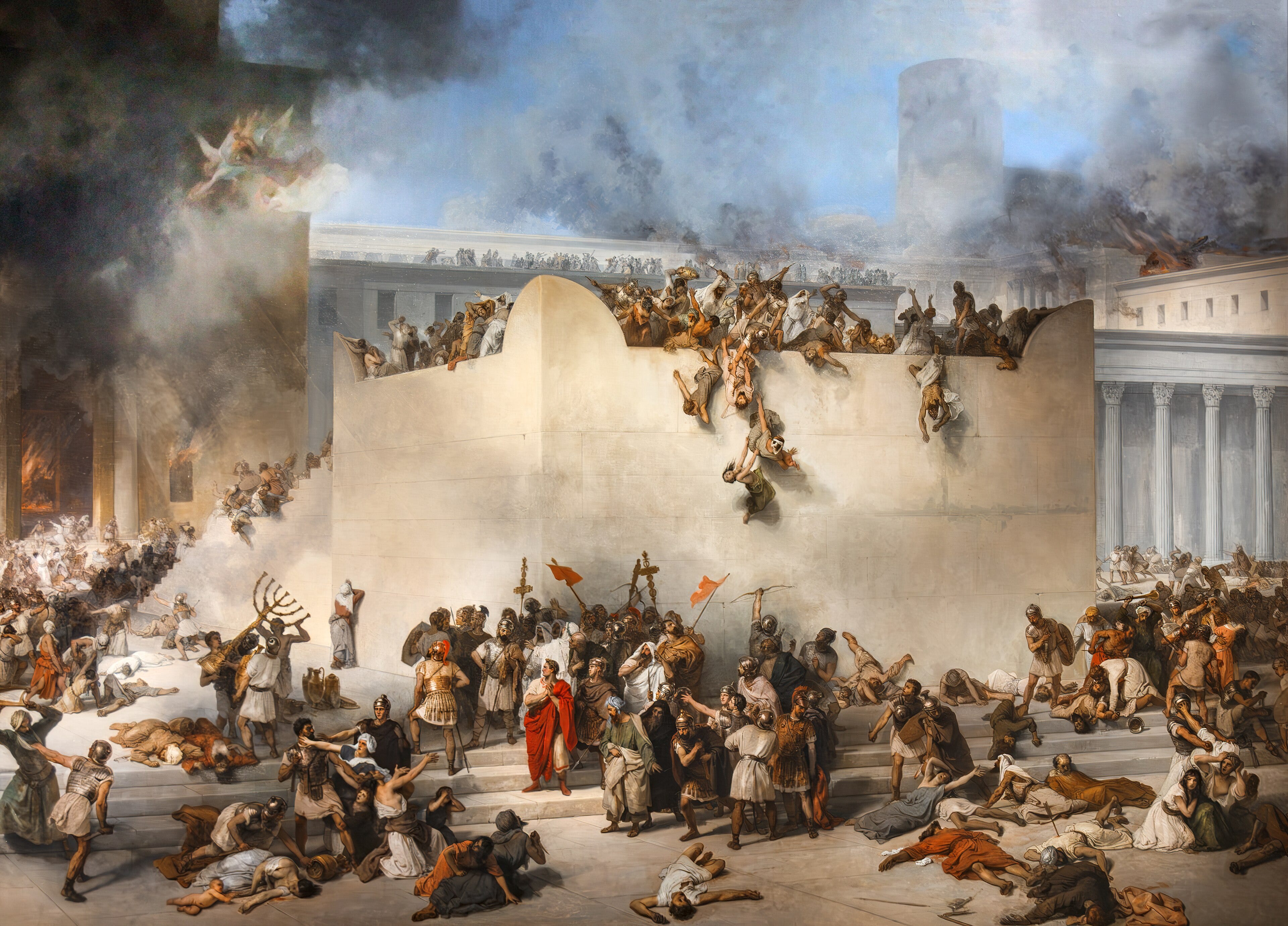
When Christ said, in Matthew 21, that the Kingdom of God would be taken away from his wayward countrymen and given to another nation (ethnoi in the Greek), it was always understood by the Church that the Roman Empire was intended. When Christ spoke of the destruction of the Temple at Jerusalem, Daniel’s prophecy was brought to mind, specifically the coming Kingdom of the Son of Man, which would reform the final pagan kingdom of Rome, depicted as a soulless, iron-fanged, all-devouring beast. This beast would become a man, upright, an analogue of God; i.e. the Roman Empire would become a Holy Roman Empire. Whereas God reached down to the Jews and, tragically, many of them rejected the prophets and the Messiah, the Greeks were reaching out to Him, fumbling in the dark, and the Romans accepted His Kingdom of light. Europeans thus became God’s chosen vehicle, educating the world in this faith and pursuing our destined goal of international law and order.
The brilliant Alan Fimister outlines the Church’s historic understanding of herself in The Iron Sceptre of the Son of Man: Romanitas As a Note of the Church. To paraphrase a key passage, to be Roman is to be Catholic; to be Catholic is to be Roman. After all, the Byzantines were Roman and understood themselves as such and, for this reason, Moscow claims to be the Third Rome even today. To say that the West is Rome is not a larp, nor is the Roman Catholic identity as its spiritual continuity. All of Western civilisation is fleshing out a Latin skeleton. Even Netanyahu views the West as Rome and the US as the ‘new Rome’ (here). So, we can and must proclaim the shared Romanitas of the West; we should not perceive the dominant US as a separate civilisation, but as the primus inter pares (first among equals), America first in a fraternity of shared Romanity.
Tertullian famously asked, ‘What does Athens have to do with Jerusalem?’ As we have seen, Jerusalem owes an unpayable debt to Athens. The real question is: What does Jerusalem have to do with Rome?
To the Romans, the Church and Europe are the Katechon, the good guys preventing the rise of the Antichrist and ushering in the apocalypse. Contrariwise, when asked why he was reading Barry Strauss’ 2025 book, Jews vs. Rome, Netanyahu declared that ‘we have to win’ against Rome (here). There are significant differences between Judaism and Western civilisation in all the key pillars of a civilisation—religion, culture, ethics, politics, economics and technology—despite the contributions Jewish citizens have made to the West in each of these areas. It would serve both to acknowledge these differences in an honest yet charitable spirit of debate.
Overused, “Judeo-Christian” is thus a novel and politically-motivated term, ‘advancing the Judeo-Christian foundations of Western civilization’, as the Judeo-Christian Zionist Conference put it in February this year (here); it does not reflect theological or social accuracy about the distinctly Roman characteristics of Western civilisation, a fact recognised by Jews and Christians alike in academic discourse (here, here and here). Nathan and Topolski (2016) conclude, ‘if one should choose to use this term (in spite of all the reasons not to do so), then it is imperative that we qualify what we mean when doing so.’ Regardless, last month, Israel Advocacy Day saw hundreds of rabbis and pastors gathered in the US capital to ‘stand for Judeo-Christian values, Western civilization’, as though these are synonymous, without qualification (e.g. here). For such reasons, some geopolitical figures prefer to distinguish Judeo-Protestant civilisation from a Catholic-Orthodox one (e.g. here).
In conclusion, whilst Christendom looks on Jews as those who kept the faith in the one transcendent creator God, preparing the way for the Messiah and the redemption of the world, we cannot ignore the bigger and fuller picture of Western civilisation and our central role in it as Europeans. We must know and be emboldened in our Roman heritage and identity, get comfortable and confident with this terminology, and uphold our God-given stewardship of the future. We can start with some healthy debate on the topic.
READ MORE from Arktos:
