


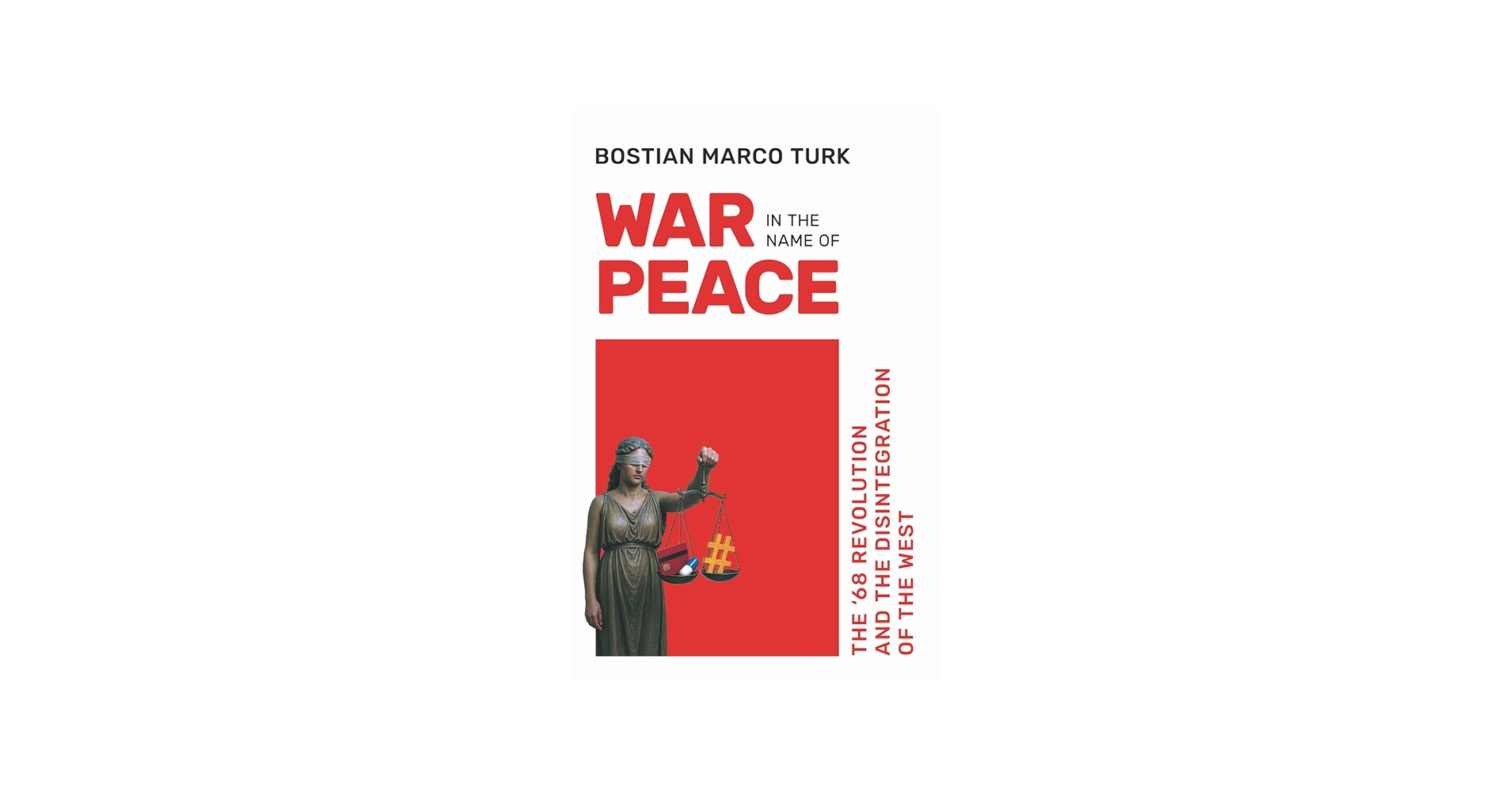
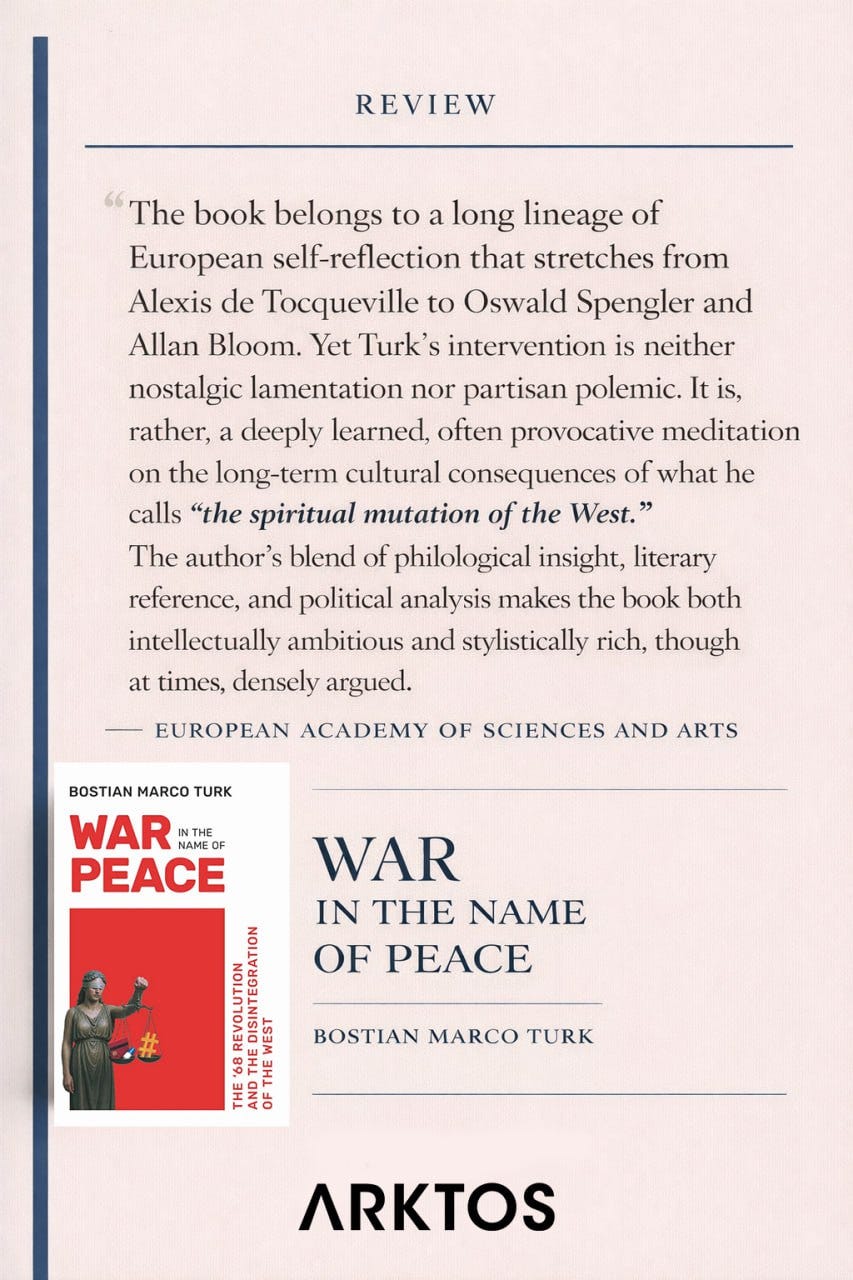
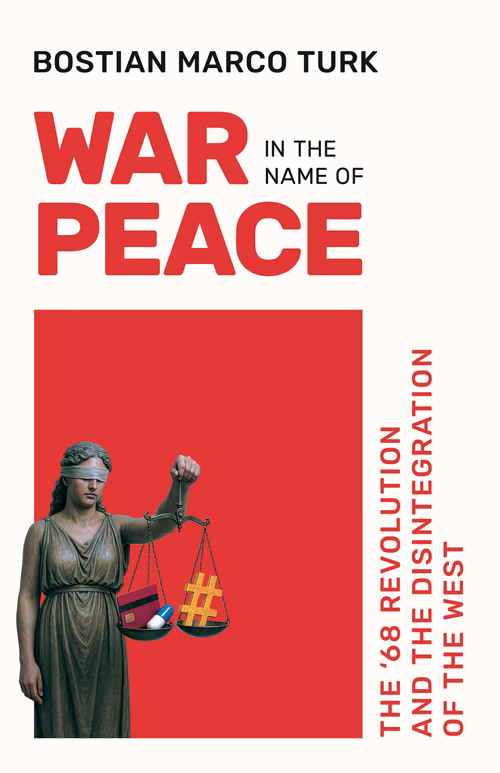
The book War in the Name of Peace (English edition), recently published by Arktos in London, offers a critical reflection on the ideological foundations of “Brussels Europe” and on the false illusions of the Western universe. The work argues that the modern world remains confined within an intellectual framework inherited from the nineteenth and twentieth centuries, when Marxism and Freudianism established themselves as dominant paradigms for understanding the human being.

Although distinct doctrines, they converge in the same reduction: that of the human being stripped of spiritual essence, inner freedom, and transcendence. Marx conceives of man as a product of social relations and economic forces, while Freud defines him as a being governed by instincts and unconscious drives. From this dual denaturation emerges the ideological structure of modern Europe. What, indeed, is Brussels if not an administered, technocratic, and culturally nihilistic apparatus? And, consequently, what is Europe if not a continent in which man has been amputated of his metaphysical dimension?
This loss of transcendence finds a clear echo in the crisis of political authority, illustrated by the concept of the “two bodies of the king,” theorized by Ernst H. Kantorowicz. Inspired by the Christological dogma of the two natures—divine and human—coexisting in Christ, this model attributes to the sovereign a physical, mortal body and a mystical, immortal body, embodying the continuity of the state and the common good. The regicide of Louis XVI in 1793, described by Albert Camus as the “desacralization of history,” shattered this metaphysical authority, paving the way for a modernity in which particular interests prevail over the collective interest.
With the death of Elizabeth II in 2022, the West lost one of the last figures embodying this vision: a sovereign whose reign symbolized unity and the defense of national interests, transcending political contingencies through historical legitimacy. Can you recall a single action she undertook for herself, in her own personal interest? No. But advance one or two generations. King Charles has become notorious for his erotic affairs, from Diana to Camilla. What has he so far done for the monarchy? As for Prince Harry and Meghan Markle, they appear to concern themselves solely with their own interests.
Following this pattern, contemporary leaders—often perceived as conduits for the agendas of Brussels, multinational corporations, or influences such as that of George Soros—prioritize supranational interests while neglecting the peoples they are meant to serve.
It is precisely in this perspective that the counterpoint of Göbekli Tepe becomes decisive. What does an archaeological site have to do with all this? A great deal, as will become clear. Göbekli Tepe is a historical site located in southeastern Anatolia, more than 11,000 years old, and considered the oldest known sanctuary in the world. Its powerful T-shaped pillars, adorned with animal reliefs, demonstrate that already in the early Neolithic period, human beings gathered for religious rituals and the worship of the divine, rather than for practical needs of survival. Its importance is immense, for it transforms our understanding of the beginnings of civilization: it was not agriculture, but faith and the symbolic world that first united human beings into an organized society.
From this we conclude that the essence of man is not material, but spiritual. This discovery directly contradicts the Marxist thesis according to which “economic relations determine individual consciousness, that is, spirituality.” Archaeological evidence shows the opposite: consciousness—namely the symbolic and spiritual perception of the world—is what creates the economy and social structures. Culture precedes production; faith engenders community.
Klaus Schmidt, director of the excavations, summarized this inversion in a famous phrase: “Man first built temples, then houses.” In other words, human society was initially constituted around the sacred, before organizing itself around necessity (the economic sector, mutatis mutandis). The error of Marxist materialism lies in its attempt to explain spirituality through matter, forgetting that it is spirit that renders the world intelligible. At Göbekli Tepe, the Marxist relationship between base and superstructure is entirely reversed: the base is not economic, but symbolic; the superstructure does not arise from faith—it is faith itself, the constitutive principle of human existence.
And where are we today, lost in consumerism and saturated with every possible poison: tranquilizers, sleeping pills, antidepressants; alcohol, cocaine, marijuana, or worse still? And with Marxism, combined with consumerism, having become the official doctrine of the European Union? The former President of the European Commission, Jean-Claude Juncker, a native of Luxembourg, thus—albeit on somewhat unsteady legs—symbolically inaugurated a monument to Karl Marx in his country of birth. This gesture provoked strong reactions, as it was interpreted as an acknowledgment of the Marxist heritage that today shapes Brussels’ politics.
This ideological influence manifests itself concretely in several areas: centralized economic regulations, standardized social policies, harmonized education, and, above all, the implicit or explicit repression of all religion. Brussels today appears more atheist than Tirana under Enver Hoxha, atheism in both cases being the fundamental practice of everyday life, anticipated and regulated by laws and legislative acts. The result is a framework in which member states find themselves increasingly constrained by supranational norms, to the detriment of their autonomy, cultural diversity, and the spiritual freedom of their peoples.
READ MORE:
The '68 Revolution and the Abortion of Freedom

Bostian Marco Turk analyzes the deep-cutting, long-running effects of the 1968 Revolution that forever changed the West by unleashing a project of dismantling identity and reducing the human being to a disposable object at the whims of wokeism and transhumanism.
For this reason, transposed into the contemporary context, the great archaeological lesson sheds light on Europe’s current drift. The European Union, through its technocratic, bureaucratic, and rationalist governance, reproduces the same fundamental error: the substitution of spiritual order by administrative order. Brussels now embodies the figure of power without transcendence, a procedural authority devoid of substance. Under the banners of “progress” and “inclusion,” historical continuity, national identities, and religious traditions are eroded. This loss of transcendence recalls the regicide of Louis XVI, which, according to Camus, marked the rupture with the metaphysical authority of the king, whose mystical body guaranteed social and spiritual order. By eliminating the sovereign, the path was opened to a modernity in which particular interests—today represented by the agendas of Brussels or multinational corporations—prevail over the common good.
This crisis is intensified by the absence of figures capable of embodying national unity, a role that the last British queen fulfilled until 2022, in contrast to current leaders, often perceived as conduits of supranational economic or ideological influences. This ideology, founded on faith in technical reason and secular humanism, in reality prolongs the legacy of Marxism: the conviction that man can be redefined by severing all ties to transcendence.
Such an enterprise leads less to emancipation than to dispossession. The individual loses the sense of his being and becomes—according to the formulation used in War in the Name of Peace— “an economic category in a posthumanist catalogue.” This uprooting extends even into political language, which celebrates values without roots: solidarity without memory, equality without difference, inclusion without culture. This discourse, which Habermas describes as “procedural rationalism,” reflects the spiritual emptiness of a civilization that has lost its sense of meaning. This loss resonates with Kantorowicz’s analyses, which showed how the mystical body of the king guaranteed a social hierarchy founded on transcendence—a principle now absent among modern leaders, who prioritize economic or ideological interests over the peoples they govern.
François Furet had already observed this in The Passing of an Illusion (1995): the ideologies of the twentieth century, particularly Marxism, bequeathed to Europe a political formalism devoid of spiritual substance. He wrote that Europe no longer believed in God, but no longer believed in man either. This tragic paradox finds its confirmation today in European bureaucracy, the symptom of a civilization that has forgotten the sacred source of its humanity.
The influence of Freud on contemporary culture adds another dimension to this crisis. The idea that human thoughts and actions are the product of unconscious impulses engenders a civilization devoid of moral responsibility. When the Freudian model combines with Marxist collective logic, a cultural framework emerges in which individual freedom has no place. This fusion reduces man to a function—at the service of the economic system, sexual identity, or a social role. More generally today, the Freudian sexual drive is transformed into a drive to consume: man becomes the prey of his insatiable appetite for purchasing. Society—through advertising, from which one can escape only beneath the surface of the sea—constantly urges him to acquire more.
In such a world, pleasure becomes meaningless and emancipation empty of soul. “Woke” culture, with its rhetoric devoid of ontological content, appears from this perspective merely as the late symptom of the same process: the Marxist politicization and Freudian psychologization of man. The major crisis of authority, in which man is deprived of his spiritual verticality, stands in stark contrast to the ideal of the sovereign, whose mystical body guaranteed a transcendent responsibility toward the people—unlike contemporary leaders, who seem subject to the dictates of global economic or ideological powers.
In response to this, an alternative has taken increasingly clear shape over the past decade, which might be called the “Central European Renaissance.” This is a political, cultural, and spiritual movement embodied by the states of the Visegrád Group—Poland, Hungary, the Czech Republic, and Slovakia. These nations, having faced totalitarian regimes for centuries, have developed a profound awareness of historical continuity and spiritual resilience. Poland, with its Catholic identity and the memory of John Paul II, has become the symbol of what might be termed “the Europe of transcendence.” Hungary, with its policy of cultural sovereignty and family protection, offers a model opposed to Brussels: a rooted civilization, founded on concrete foundations rather than abstract values. This movement recalls the importance of authority anchored in transcendence, as illustrated by the concept of the “two bodies of the king,” where the sovereign embodied the common good rather than external agendas—a role that modern leaders, often perceived as intermediaries of Brussels or multinational corporations, can no longer fulfill.
In this sense, the Visegrád Group represents the concrete political manifestation of the anthropological truth revealed by Göbekli Tepe: man cannot exist without sacred order, without a shared symbol, without transcendent purpose. Where Brussels sees “progress,” Visegrád perceives the “survival of the spirit”; where Europe proclaims “inclusion,” Visegrád insists on the importance of culture and faith as the foundations of human identity. These states thus act as a historical corrective—demonstrating that modernity cannot endure without tradition, and that freedom without transcendence leads to disintegration.
Marx and Freud attempted to remove this dimension from European man, but each time it was suppressed, it reemerged—in religion, art, language, and national culture. Man who renounces transcendence loses his verticality; a civilization that replaces it with ideology loses its future. The regicide of Louis XVI, by shattering the mystical body of the king, initiated this process of desacralization, and the disappearance of a figure such as Elizabeth II marks the end of an era in which leaders still embodied the common good.

In the conclusion of War in the Name of Peace, it is asserted that Europe will survive only if it rediscovers its original character as a sanctuary—not of the market, nor of bureaucracy, but of the altar, mutatis mutandis. While Brussels embodies the Europe that has forgotten its soul, Visegrád represents the Europe that remembers it. And this memory—the memory of the sacred, of transcendence, of man as a spiritual being—constitutes the necessary foundation for rebuilding the future.
Europe can endure only if it succeeds in combining these two dimensions: the archaeological truth of man as a religious being and the political wisdom of peoples who have preserved this truth. In this sense, War in the Name of Peace is not merely a work about the past, but a call for the metaphysical renewal of Europe—a return to what Göbekli Tepe revealed from the very beginning: civilization does not arise from the production of material goods, but from the sacred, just as true authority, once embodied in the mystical body of the king, cannot exist without a connection to the divine and to the common good of peoples.
Read Bostian Marco Turk’s War in the Name of Peace, brought to you in English by Arktos:
I understand and agree fully with this writer's objectivity & sentiments. However, in light of Elizabeth II's long reign, I'm wondering as to why she never attended to the demographic concerns of her people (i.e. national interests).
Neither did her husband as king.