


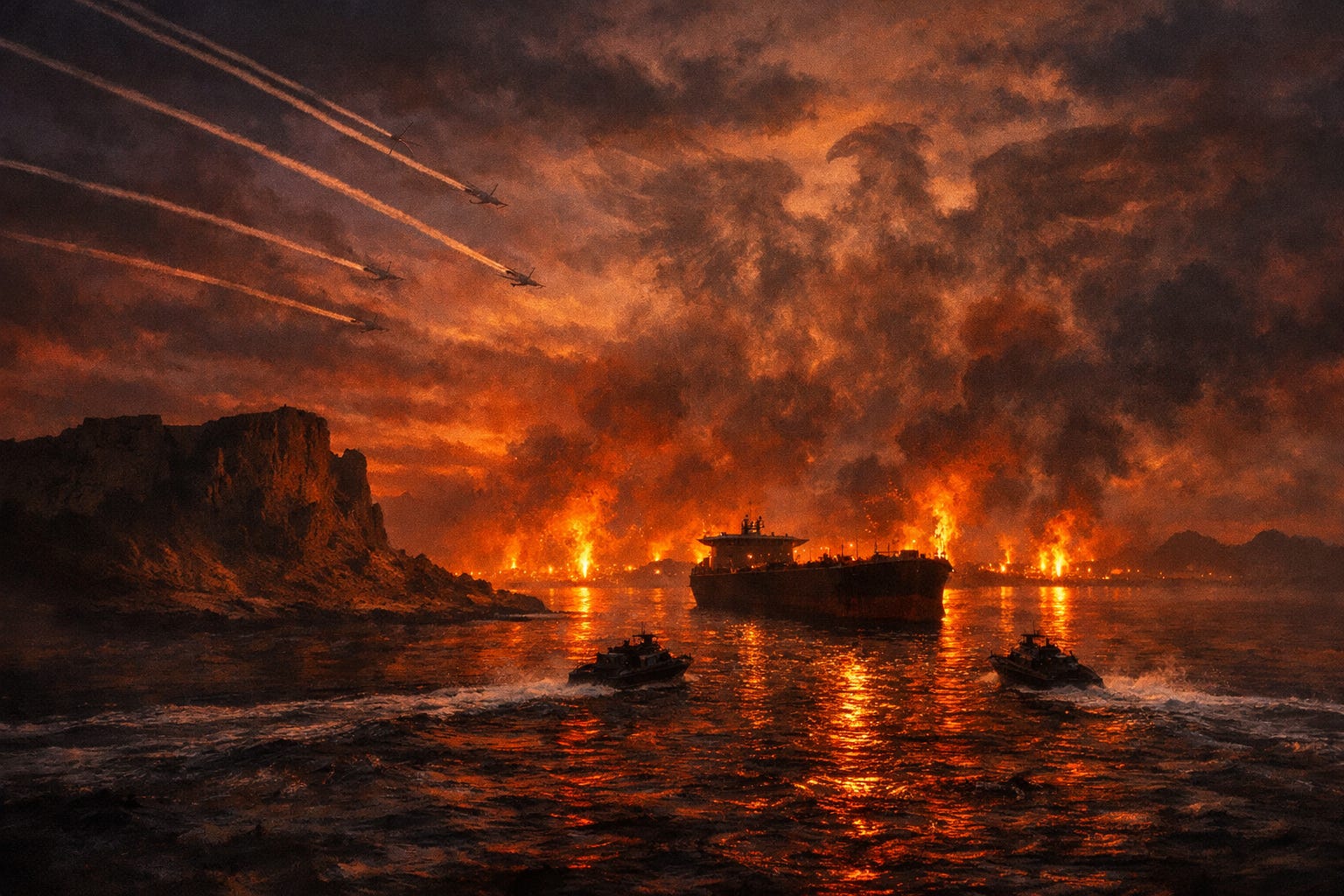
While more at home on the golf course than in the Persian Gulf, Donald Trump had initially presented the war against Iran as a "little excursion." Not known for his strategic patience, he wanted results fast. The original objectives were the fall of the Islamic regime and the complete destruction of its military capabilities. Now, four weeks since hostilities began, none of that has come to pass.
The Iranians have taken control of the Strait of Hormuz, and their coastline — stretching 1,600 kilometers — is bristling with missiles, drones, and military speedboats. The Houthis of Yemen are threatening to close in turn the Strait of Bab-el-Mandeb, which locks access to the Red Sea. In Lebanon, where one million people have been displaced (one in ten inhabitants), the Israelis make no secret of their intention to militarily occupy the south of the country up to the Litani River. The price of crude oil has surpassed 100 dollars a barrel, a rise from which Vladimir Putin is the principal beneficiary. European countries, which the European Commission forced to cut themselves off from Russian hydrocarbons, are now facing gas and oil shortages that are driving a surge in petrol prices at the pump.
Though severely and lastingly weakened by the massive bombardments they have endured, the Iranians have not yielded — quite the contrary. What we have witnessed is an escalation that looks very much like a headlong rush. The American-Israeli military movements, the contradictory statements from the White House, the continued Iranian strikes, the destabilization of energy markets, the announcement of a ground invasion (special forces?) — all of this sketches out a scenario whose consequences no one can foresee, but which evokes the “oil shocks” of 1974 and 1979: economic and financial crisis, global recession.
The United States, which had hoped for a lightning victory, no longer knows how to extract itself from this hornet’s nest. The Iranians, who were supposed to collapse within days, are holding the initiative in every domain. The balance sheet of Operation “Epic Fury” is a disaster.
How Did We Get Here?
And first of all — why this war? An “imminent threat” justifying a pre-emptive strike? Which one? The nuclear threat? It will soon be forty years since Israel has been announcing, year after year, that Iran will have the atomic bomb “within a few months” — an assertion that has by now generated the same skepticism as the “weapons of mass destruction” attributed to Saddam Hussein’s regime. Tulsi Gabbard, Director of National Intelligence, announced on 18 March that Iran had not resumed the nuclear enrichment activities destroyed in June 2025. Trump himself had at the time trumpeted that the Iranian nuclear program had been “totally obliterated.” Rafael Grossi, Director General of the International Atomic Energy Agency (IAEA), confirmed on his part that there was no immediate Iranian threat in this domain.
Why did Trump launch into this adventure — one that nothing in the current situation justified — displaying a degree of unpreparedness that left all serious military observers dumbfounded? Why did he choose, a few months before the midterm elections (midterms), to risk alienating his electoral base, which has no appetite for such a war — a war that the vast majority of Americans likewise condemns? Marco Rubio has perhaps provided the answer by letting slip that Trump yielded to Israeli pressure applied on him by Benjamin Netanyahu on 11 February in Washington. But that merely shifts the question: why did he yield?
On 17 March, the unexpected resignation of Joe Kent, Director of the National Counterterrorism Center, came like a thunderclap. In his letter of resignation addressed to Trump, he wrote: “I cannot, in good conscience, support the ongoing war against Iran. Iran did not represent an imminent threat to our nation, and it is clear that we launched this war under pressure from Israel and its powerful American lobby.”
The war thus began on 28 February — Two days before the feast of Purim (which commemorates, as recounted in the Book of Esther, how the Hebrews escaped a planned massacre at the hands of the Persians) — with a targeted assassination (Supreme Leader Ali Khamenei) and the death under bombs of 165 schoolgirls aged 7 to 12 (daughters of Revolutionary Guards), even as negotiations were underway between the Iranians and the Americans which, according to the Sultanate of Oman, were on the verge of succeeding (”a deal was within reach”).
Mark Twain said that “God created war so that Americans would learn geography.” Apparently, they have not yet learned it. Trump has gravely underestimated his adversaries. He underestimated the power and resilience of Iranian nationalism. He underestimated Iran’s military strength, its organizational solidity, and its strategic orientations.
READ MORE:
U.S. Political Theology: Weaponizing the Bible

With regard to the ticking time bomb in the Middle East and the Gulf, it is misleading to pin the blame solely on President Trump or Israeli PM Bibi Netanyahu. Many experts on the Middle East overlook a significant factor: the century-long American, Bible-inspired mission to regenerate the world—today playing itself out in Iran. This messianic mindset s…
Iran is not Venezuela, nor the Principality of Monaco. Nor is it an Arab country: Iranians are ethnically closer to Europeans than to Arabs, Turks, or Palestinians. Iran is a country of 90 million people, three times larger than France, endowed with a triple identity (Indo-Iranian since Antiquity, Muslim since the 7th century, modern since the 19th century), with a complex society, a high-level academic class (Ali Larijani, Secretary of the Supreme National Security Council, killed by Israel on 17 March, was a specialist in Kant and Descartes), a vast population of engineers (Iran trains 230,000 of them each year), a 3,000-year history, and internal dynamics that escape the comprehension of most Westerners. It is, in the Middle East alongside Egypt and Turkey, the country with the richest cultural heritage. It also holds the world’s 3rd largest proven oil reserves and the world’s 2nd largest proven gas reserves. And in geopolitical terms, the Iranian plateau constitutes the essential pivot territory of the Eurasian landmass.
An Existential War
Having a purely transactional vision of power relations, Trump does not grasp that the Iranians are waging an existential war against him — which is not the case for the Americans. He does not understand their “irrational” refusal to capitulate. He does not understand that there are situations in which no deal is possible. He does not know that the doctrine of martyrdom has been at the heart of Shia Islam (counting 200 million believers) since the massacre of Karbala in 680 CE and the death of Imam Hussein and his companions, and that in the eyes of Iranians, Ali Khamenei weighs far more in death than he did in life.
Bombardment alone cannot enable the Americans and Israelis to prevail. Ground troops are necessary, even when the targeted regime harbors a solidly structured opposition — which is not the case in Iran (let us not even speak of Reza Pahlavi, the son of the former dictator, a veritable puppet of the Mossad and the CIA, who has support only within the Diaspora).
The Iranians, for their part, have understood very well that they do not have the means to confront American military power directly, even if they have landed devastating blows against American bases in the region. They therefore adopted from the outset an asymmetric strategy consisting of targeting the weak points of the economy and energy production, with precision strikes against the oil and gas production and storage infrastructure of the Gulf states. To this was added the seizure of control of the Strait of Hormuz, linking the Persian Gulf to the Gulf of Oman — a strategic passage through which 20 million barrels transit daily, representing 20% of global oil supply, as well as 20% of liquefied gas.
Dragged into a war they never sought, the Gulf monarchies (Saudi Arabia, Kuwait, the United Arab Emirates including Dubai), which had built their prosperity model by entrusting their security to the Americans, now find themselves at a loss. Their security guarantor has become a source of insecurity, since the war also threatens their economic model. They observe with bitterness that the Americans have done nothing to protect them from Iranian strikes, that those strikes target an oil infrastructure that is their only real wealth, and that their image as financial and tourist paradises has been badly tarnished. If the escalation continues and the desalination plants on which their populations depend are destroyed, these countries could even become uninhabitable.
The de facto disappearance of international law has brought with it the disappearance of the laws of war. The targeted assassination of the entirety of the ruling apparatus of a sovereign state and member of the United Nations, at the outset of a war that was never declared, of which no allied country was informed, and which did not even receive Congressional approval (rendering it unconstitutional), is without precedent. It is also a flagrant violation of the 1949 Geneva Conventions, which stipulate that “it is prohibited to kill, wound, or capture an adversary by resort to perfidy” (Art. 39). The elimination of nearly a hundred Iranian military and political leaders — carried out by the Israelis using intelligence provided by the Mossad — was spectacular, but did not produce the expected effect. By the very next day, they had already been replaced, and for each of those replacements, the names of the next two successors had already been designated.
The only perceptible consequence is that the effective leadership of the Iranian regime has passed from the hands of the mullahs and ayatollahs into those of the Revolutionary Guards, who have their own army and their own economy and who hold firmly to a hard line, declaring themselves prepared to continue the war for as long as necessary. For them, non-surrender is equivalent to victory.
In fact, the Iranians had been preparing for precisely this kind of attack for twenty years. It is this preparation that allowed them to put in place a “decentralized mosaic defense,” a strategic doctrine elaborated by Tehran in the wake of American failures in Iraq and Afghanistan: the 31 command centers (one per province) were equipped with autonomous weapons capabilities and strategic independence. In the event of a first strike decapitating the central command, all command centers switch to autonomous mode and continue to fight. In the meantime, Iran’s military capabilities have been considerably strengthened — notably through precision ballistic missiles and sophisticated drones.
Strategy and Tactics
Mao Zedong, in his writings on revolutionary warfare, observed quite rightly that “the view that strategic victory can only be achieved through tactical victories is wrong.” The United States has, at all times, confused strategy with tactics. They have tactics — consisting of a list of targets to be struck — but they have no strategy, because they have not the faintest idea of the “day after”: that is to say, the kind of peace they wish to establish. “We do not know how to translate our military gains into a political settlement,” Ami Ayalon, former head of Israeli domestic intelligence, declared these past days. This is why, since 1945, the Americans have not won a single war. And it is also why their interventions in Afghanistan, Syria, Iraq, and Libya have not brought “democracy” and “freedom,” but civil war and chaos.
Another perennial failing of the Americans is their belief that military and technological superiority automatically confers victory. This is simply false. At the height of the Vietnam War, the number of American soldiers deployed on the ground reached half a million — which did not prevent their defeat.
The cost of the war with Iran is enormous. American air power excels against large fixed targets, but struggles to neutralize small mobile units. Shooting down $20,000 Shahed drones with $4 million missiles is hardly the most economical approach! The United States has used more Patriot interceptors in the first three days of the war than it supplied to Ukraine over four years of conflict. The first two weeks of the war alone have cost twelve billion dollars. The White House now seeks to unlock an additional 200 billion dollars to sustain its offensive. While the Israelis are short of soldiers, the Americans are short of munitions, guided missiles, and air defense systems (they have already recalled systems deployed in East Asia and diverted arms originally destined for Ukraine).
The Birth of an Anti-Western Axis
By launching a war without legal justification, without a solid coalition, and without attainable objectives, Israel and the United States have opened Pandora’s box. Their decision will accentuate the world’s multipolarization and foster the formation of an anti-Western axis oriented toward China and Russia.
One of two things must now follow: either Donald Trump finds an honorable exit allowing him to dress up his defeat as a “great military victory” — in which case it is likely that Israel will wish to continue the war, if not in Iran, then at least in Lebanon — or he seeks to annihilate a country that is heir to a three-thousand-year-old civilization, with all the risks of escalation and quagmire that this entails. In either case, the risk of chaos spreading across the entire Middle East is severe.
READ MORE:
The War Party

Alain de Benoist argues that a reckless "war party" of European leaders and institutions is pushing the continent toward a catastrophic armed confrontation with Russia over Ukraine.
Let us not forget, finally, that in this affair, while the attack on Iran was conducted jointly by Israel and the United States, their objectives have never been the same. Donald Trump’s initial plan was to destroy Iran’s military power in order to then conclude a peace agreement, while Netanyahu seeks both a regime change and the dismemberment of Iran, so as to secure unchallenged hegemony over the Middle East. In other words: Trump does not exclude peace; Netanyahu does not want it. He wants only to continue bombing and killing. For the moment, the State of Israel — which has just reinstated the death penalty for Palestinians alone — is concerned by the emergence of a Saudi Arabia–Turkey–Pakistan–Egypt axis hostile to it. On 1 April, Donald Trump threatened to send Iran “back to the Stone Age.” Calm is not about to return to the region.
Originally published in Éléments
Translated by Alexander Raynor
From current geopolitical analyses to deep philosophical reflections, the essential works of Alain de Benoist, the leading light of the European New Right, are available in English from Arktos:

exuse’mva it is 7000 years old civilization. And why are you referring to Trump as that he is the one making decisions and planning? He is no more then showman of this muppets show and never a plan maker…
It’s more like Elites 100 / Humanity 0.