


Giorgio Locchi reviews the French reissue of Oswald Spengler's Man and Technics, reading it alongside the philosopher's late posthumous fragments as the unfinished culmination of a resolutely anti-egalitarian vision rooted in Nietzsche.
The last century nonetheless bequeathed to us another mode of thought—one situated beyond Marx, beyond the two-thousand-year-old discourse of egalitarianism. The philosophical work of Nietzsche and the artistic and metapolitical work of Richard Wagner inaugurated this new thought, the only thought that may call itself truly revolutionary, since it represents, in the cyclical perspective of History, the return of a first origin wholly forgotten—hence lost, and consequently never given—but also, in the linear perspective, the overcoming, the opening onto an exhilarating unknown destiny.
This thought, by virtue of being Urdenken, originary thinking, expresses itself in forms that belong to myth, and—being a generator of myths in its historical youth—summons us to a genuine creation, leading us consciously to accept the possibility of a mutation of man. Non-egalitarian, anti-egalitarian, it is today proscribed or, when that proves impossible, deliberately abandoned to falsifications and abusive interpretations.
But it is plain that our age will not be able to confine itself to Marx, to the mere repetition of an instant already surpassed, and that it is already seeking, more or less consciously, to reconnect with the “opening” that lies in the prolongation of the thought of Nietzsche and Wagner. One will therefore not be unduly surprised by the appearance of a French translation of Oswald Spengler’s L’Homme et la technique [Man and Technics], with a publisher (Gallimard) and in a series (Idées) that have, until now, served above all as the vehicle of quite different currents of ideas.

On the cover, moreover, a descriptive note draws the reader’s attention to the fact that Spengler “attempts to show that the privileges enjoyed by the Whites are going to be wrested from them by the peoples of the Third World, who will use technics as a weapon against Western civilization.” Quos deus vult perdere…1
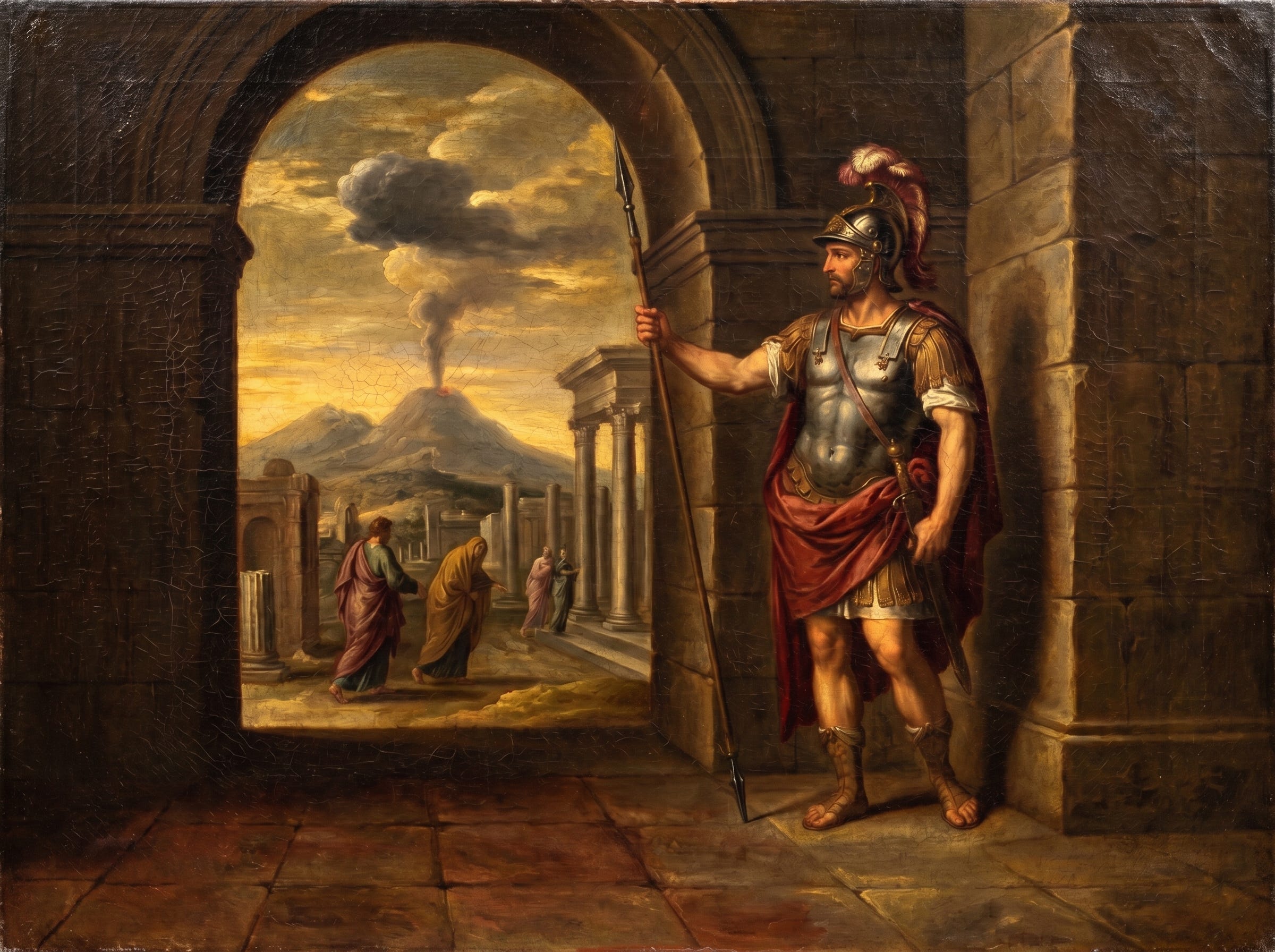
Pessimist that he is, Spengler does indeed assert that Western civilization is fatally condemned. And yet he in no way invites us to give up, to accept passively a degradation held to be inevitable, but, quite the contrary, to hold fast—”to stand, after the example of that Roman soldier whose skeleton was found before a gate of Pompeii and who, during the eruption of Vesuvius, died at his post because no one had remembered to come and relieve him.”
Those Who Take the Decline Upon Themselves
A work of mythic thought, Spengler’s oeuvre takes on its full importance not in the immediate statements imposed upon it by the logical—necessarily logical—form of his discourse, but in the position he takes up before History, in the value judgments that ground his vision. This does not mean that his prophecy is false. The instant from which he speaks to us, quite the contrary, remains inexorably open onto the decline of the West. But the attitude he proposes, even as it entails the heroic sacrifice of the “Westerner” within us, is also the guarantee of a new dawn for that which, within us, already lies beyond the “egalitarian West.”
Spengler himself never tires of recalling that his thought stands rigorously within the Nietzschean frame, that it seeks only to answer the Fragestellung, the problematic posed by Nietzsche. What must not be lost sight of here is the fact that Spengler, within this frame and placed before this problematic, takes on—and wishes to take on, in keeping with his “Prussian” temperament—only the restricted perspective of the moment he himself lived through, that is, those first three decades of the twentieth century which, in Nietzsche’s millennial vision, represent only the beginning of a European nihilism wherein lies the sine qua non of the mutation of man into overman. Nietzsche had written: “I love him who lives in order to know, and who wills to know so that the overman may be. And who, therefore, wills his own going-under (Untergang).” Spengler knowingly willed to be one of those necessary men who take the decline upon themselves.
Within Spengler’s oeuvre, Man and Technics corresponds to the beginning of a culmination of his thought—one that is very poorly known, since it remained largely in the state of sketch and fragments, published since 1966 in two volumes by the publishing house C. H. Beck (Urfragen [Primordial Questions]; Frühzeit der Weltgeschichte [The Early Days of World History]).

At first sight, the vision Spengler develops in Man and Technics may surprise those who know nothing of him but his The Decline of the West. It is a “universal” vision, apparently contradictory with respect to the anti-universalist vision of the Decline, and one that proposes several specific histories, each of them the work of a very particular Hochkultur (a great “culture”), the expression of a type of man that constitutes, so to speak, a species apart. But this contradiction is merely apparent. Spengler clearly subsumes the first vision within the second, the incompleteness of the proposed subsumption being due solely to the incompleteness of the work as a whole.
Two Characterizations
According to the “second” Spengler, humanity has, since its origins, undergone four great “mutations.” Its history is thus made up of four essential moments: a, b, c, d. But Spengler does not always state his thought very clearly, and these four moments sometimes seem to reduce to only three. This is precisely the case in Man and Technics, which we now know (thanks to the edition of the posthumous works by C. H. Beck) to constitute the first sketch of a thought still in the course of development.
In his Dispositions for the Urfragen, Spengler characterized the four fundamental moments of History as follows: a) Liberation from the constraints of the species / appearance of the races / formation of the human type / emergence of consciousness (Bewusstwerdung); b) Crystallizations of low-density population into local complexes / from −15,000 onward, cultural barycenters possessing their well-defined field of action; c) “Particular cultures” (Einzelkulturen; Spengler uses the term Kultur in opposition to Zivilisation) dispersed across a world over which man has spread everywhere / “Amoebas” of organic structure from −5,000 onward; d) Hochkulturen (great “cultures”) with fully formed “life-courses” (Lebensläufe) around −3,000 / transformations of cultures—dynamic—into civilizations—rigidified (”the fellahs as ruins”).
This division postdates the one in Man and Technics, which has three periods and may be summarized thus: 1) Origin of man / the hand and the tool / Schauen und Ahnen (a formula one might render as “the capacity for anticipation, for divinatory vision”); 2) Language and enterprise—the latter being “concerted collective action” / Sprechen und Denken, language and thought; 3) Final age: the advent and dissolution of machine culture.
It is difficult to situate the two characterizations in relation to each other. At first glance they appear to overlap: moment 1 corresponds, more or less exactly, to moments a and b; moment 2 to phase c and the Hochkulturen of phase d (see The Decline of the West); while moment 3 covers only the final phase (of civilization) of Western Faustian culture. On the other hand, the correspondence is not perfect, for the perspectives differ. All of this, in any case, is of only secondary importance relative to what is essential: the resolutely anti-egalitarian finality of Spengler’s work. This is why it is altogether pointless to dwell upon certain ideas owing to the “scientific language” of the period in which it was written. The fact, for example, that Spengler relates “humanization” to the appearance of the hand-tool pairing tells us nothing of his conception of man.

We must therefore direct our gaze elsewhere, to where the author explicitly situates the value of man in relation to the non-human. And here Spengler is very clear—and very Nietzschean. Man, he asserts, is “a beast of prey,” but an animal sui generis, generis unici, since he is the only one to have “freed himself from the constraints of the species.” Man may be regarded as such when, alongside “a species-instinct perpetuating itself ever in full force,” “thought and reflective action detach themselves and assume their autonomy with respect to the species.” Each man (here it is the creator-man who is meant) is a species unto himself. The soul of primordial man “is deeper and more passionate than that of any other animal”; it “entrenches itself in an attitude of intransigent opposition toward the whole world, from which its own creative power has excluded it.” Spengler adds:
“And this soul advances constantly, in an ever more accentuated separation from the whole of Nature. The weapons of beasts of prey are natural, but man’s armed fist, with its artificially fabricated, imagined, and chosen weapon, is not. Here begins art as a concept antinomic to nature… (Here, too,) begins the tragedy of man: for of the two, Nature is the stronger… The struggle against Nature is hopeless; and yet it will be carried on to the end.”
Man Against Nature
It follows clearly from the foregoing that, for Spengler, History is founded upon man’s revolt against Nature—a revolt already wholly contained in his emancipation from the constraints of the species. It is this affirmation that is fundamental. On the other hand, one may, and one must, regard as insufficient the explanation Spengler gives for the cause of that emancipation (the appearance of the hand-tool pairing)—an attitude all the more legitimate in that Spengler was the first to doubt his own “explanation,” very often seeing in it only one cause among others, or the prior material condition, though not the sufficient one, of hominization.
In fact, as his posthumous writings show, Spengler was preoccupied until his death with the problem of man’s origins, with that “first moment” which he managed to divine through the dazzling intuition of his poetic genius but which always eluded his philosophical efforts. In Man and Technics, the description of this “first moment” remains vague. Spengler speaks to us of the soul of this first, “solitary” man, freed from the constraints of the species, yet never specifies the concrete forms of that emancipation; he invokes a “total opposition” between man and Nature, yet never indicates in relation to which Nature primordial man defines himself concretely through his action—what is the concrete object of his struggle and his domination.
To our eyes, what we have here is a limitation unconsciously willed by Spengler himself, since it is what allows him to bring his tragic vision of history to a halt, to “hold fast” within a restricted present that he wholly takes upon himself. The inevitable consequence is that the elements making up the entire definition of the human, instead of all being placed at the moment when history begins, come to be distributed across all the phases indicated above. For it is quite true that man’s revolt against Nature can only be catastrophic.
But if this revolt is already present, in its entirety, at the first moment of history, from the very “first historical act,” then man’s tragic destiny must likewise be found, also in its entirety, at each moment—as if borne by a will to history eternally reaffirmed, eternally vowed in one and the same gesture to the epic of creation and to the final catastrophe that is logically inscribed in the attainment of the goal. If, on the contrary, the catastrophe is not present from the first moment, then it becomes the property of a final moment, and it is a parabola that leads history to the ultimate tragedy. Spengler wills the tragic destiny of humanity, but, out of an immense Promethean pride, he claims the experience and the passion of that tragedy for his own civilization alone, for Faustian man—that is, for “the Vikings of the spirit.” He expresses this opinion implicitly, perhaps without realizing it, in a passage whose contradictions and lacunae are full of significance.
“Faustian culture, that of the European West is probably not the last, but it is certainly the most powerful, the most vehement and—as a consequence of the inner conflict between its comprehensive intellectuality and its lack of spiritual harmony—the most tragic of all. It is conceivable that some epigone might come to succeed it (a culture may see the light of day somewhere in the plains, between the Vistula and the Amur River) in the coming millennium. But it is here, in our own culture, that the combat between Nature and man (whom historical destiny has led to rise up against her) is brought to an end once and for all.”
The contradiction is very clear. If man’s historical destiny is fulfilled in his revolt against Nature, and if that revolt must come to an end in our Faustian culture, then it is with that culture too that history as a whole will end. What, then, would this “epigone,” this “culture between the Vistula and the Amur,” be, if not the return of man into Nature, his relapse into the constraints of the species—that is, his re-animalization? A history after history is no longer history.
Let us return to the second moment described in Man and Technics, in order to draw out the elements that belong by right, contra Spengler, to the original definition of man. The first is “language,” which intervenes with what we now call the “Neolithic Revolution.” For Spengler, the solitary man of the first moment, even if he had words and gestures at his disposal, did not yet possess language in the proper sense (neither grammar nor syntax). Language appears, in fact, only insofar as it is objectively imposed by “concerted collective action” (enterprise), whose first manifestations are agriculture and stock-raising. Here again we shall not dispute this “conjunctural” assertion, and shall instead turn our attention to the way Spengler sees this constitutive element.
The Problem of Alienation
Within enterprise, Spengler draws a fundamental distinction between “creation-planning” and “execution,” between the born creators—the only true successors of the solitaries of the preceding moment—and the executants, the leaders and the led. Citing Goethe’s Faust, he even indicates that, in his eyes, the led are nothing but the tool in the thinking hand of the born creators:
“When to my chariot my fortune harnesses six coursers, are their limbs not mine? And is it not I who tread, like lightning, the glorious course? The four-and-twenty limbs are mine, and mine all the powers that I have joined.”2
Man, then, domesticates nature; but the creator-man also domesticates the led-man, who is a fragment of Nature. Here we recognize the distinction Nietzsche draws between Herrenmenschen (”master-men”) and “slaves,” though with one essential refinement: the “slave” pertains not so much to the truly human, to the historically human, as to Nature—at once the instrument and the object of the creators’ enterprise. The problem of alienation, which so sorely torments Freudians and Marxists, here receives the illumination that may permit its solution: alienation is the necessary counterpart of the expansion of the “creator”—a beast of prey freed from the constraints of the species—when he organizes and appropriates, as tools and instruments but also as a part of his own body, the led-men who are themselves an integral part of Nature. Only the man who expresses himself in creating can be free. Alienation never concerns the true man, the one who becomes such insofar as he creates, but only the man who remains within Nature without being able to free himself from it, and who therefore constitutes merely some species or other among the rest. The historical fact par excellence is not alienation but the contrary of alienation—that is, the appropriation of all Nature, the human included, by the creator-man.
Considering that the language-enterprise and leaders-led pairings are not original elements, Spengler associates the advent of the machine with the decline of the creator-men. The creators, in fact, have never seen in technics anything but a mere means. They have always willed the effort of creation more than the profit of creation, the hunt more than the prey. But the machine, once created, paralyzes the creative inspiration. “Faustian thought begins to feel a nausea at machines”; “a lassitude spreads, a kind of pacifism in the struggle against Nature (becomes general), the flight of the born leader before the machine has begun.” In parallel, the led “mutiny against their destiny, against the machine, against standardized life, against everything and against nothing.” An age of masses takes shape—”but the mass is nothing more than a negative residue (specifically, the negation of the concept of organization) and by no means something viable in itself”; “an army without officers is never anything but a horde of humans, disordered and useless.” Moreover, there has been a “betrayal of technics” on the part of the Whites: they have handed it to the colored peoples, who will inevitably make of it a weapon against them, before letting it fall into ruins.
Pursued down to the smallest detail, Spenglerian pre-vision, applied to our own age, is impressive in its exactness. Like that of Nietzsche, it makes a mockery of the “scientific”—yet ever false—prophecies of a Karl Marx. And yet Spengler does not know, does not wish to know, whence his power of anticipation comes. This is what leads him to see in the machine the cause of the decline of the West and, by the same token, of all historical humanity. While making allowance for the period in which this text was written, we shall not share his point of view. Western civilization is condemned not because of technical progress, but because the egalitarian utopia that has inspired it for two thousand years has come into contradiction with the demands of modern societies. Won over to this utopia, European man is no longer in a condition to take upon himself the destiny of the world, to be the “creator” of a new future.
But it is also in Europe, and in Europe alone, that a new mutation remains possible, that the refusal of egalitarianism and of the return to the species has manifested itself, and manifests itself still, beyond what for two millennia of spiritual “decadence” was Good and Evil. Spengler’s thought is one manifestation of this refusal.
“Prussian Socialism”
It is not without interest to recall here what Spengler’s attitude was toward Hitlerian National Socialism. It was frankly hostile, and at times venomous, even if this hostility was situated within the anti-egalitarian dialectic (in his Konservative Revolution [Conservative Revolution], Armin Mohler places Spengler among the “Trotskyists of National Socialism”).
In the posthumous writings of the author of the Decline, allusions to the “stupidity” of certain National Socialist ideas are frequent. He mocks in particular the notion of race, stressing—contrary to what was professed within the NSDAP—that “race always merges with selection, with elite,” and that it is therefore “the work of a class,” not of a people. His reservations were those of a social aristocrat, a partisan of “Prussian socialism,” who saw in National Socialism a “democratic” and plebeian mass movement. In this he joined the opinion of the other proponents of the Konservative Revolution, for whom the “anti-egalitarian revolution” could only be the work of a solitary elite, resolutely cut off from the masses, and who violently reproached Hitler for having put himself at the service of the plebs when, in the aftermath of the tragic experience of November 1923,3 he decided, with the NSDAP, to make the masses his tool.

Originally published in Nouvelle École no. 13, May 1970.
Translated by Alexander Raynor
The Latin proverb Quos deus vult perdere, prius dementat (”Those whom a god wishes to destroy, he first drives mad”); Locchi gives only the opening, trailing off.
From Goethe’s Faust (Part One; the lines are generally given to Mephistopheles in the “Studierzimmer”/Study scene). Locchi quotes a French verse rendering, not the German; I have rendered that French faithfully. The German reads: “Wenn ich sechs Hengste zahlen kann, / Sind ihre Kräfte nicht die meine? / Ich renne zu und bin ein rechter Mann, / Als hätt ich vierundzwanzig Beine.”
Source: “aux lendemains de la tragique expérience de novembre 1924.” The Beer Hall Putsch occurred in November 1923; Hitler was imprisoned through 1924 (released December 1924) and the NSDAP was refounded in February 1925. I decided to render it as 1923, referring to the Beer Hall Putsch as was likely his intent.
Has everyone perused the comprehensive empirical and logical extrapolation of the Spenglerian Hypothesis offered at www.noodynamics.org?
I hope not for revivals but for resurrections. There are many days I look to ancient Egypt. I see something there, waiting! It is quite beautiful.