


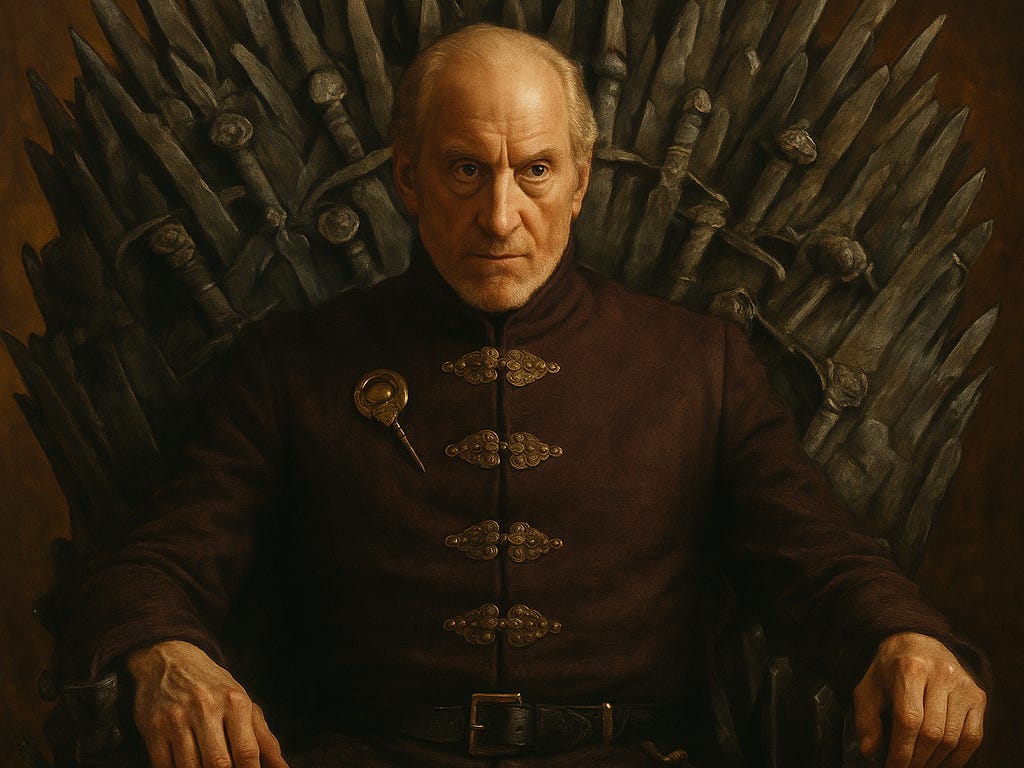
James Doone portrays Tywin Lannister as the true statesman of Westeros: a Machiavellian realist who, unlike the noble but doomed Ned Stark, understands that power, not virtue, secures rule.
“Lannisters don’t act like fools.” Thus were the words spoken by the Lord of Casterly Rock, Warden of the West and Hand of the King.
I remember watching Game of Thrones years ago (there are only seven seasons!) and as much as I admired, and still do, the honourable character Ned Stark, the pillar of justice, oathkeeping and true speech, I couldn’t help but begin to think, what good is honour if you lose? Soon another character came onto the screen, a man with a strong sense of his possession of authority, power, command and used to being obeyed, but also a man who is cunning, smart, money bet on the winning side, a Machiavellian prince but not a cruel man, and that man is none other than Tywin Lannister, the Bismarck of Westeros. If there is any man who political realists can admire and look to as a statesman, a ruler, a theorist in the true art of power, then it is this great lord of the Seven Kingdoms. He has no time for idealism when it doesn’t help and certainly not when it conflicts with the cold reality of life and the situation before him. As Alexander the Great kept a copy of the Iliad of Homer under his pillow during his campaign to conquer the Persian empire of Darius, so too I imagine that Tywin keeps a copy of Machiavelli’s il principe under his pillow.
We political realists can see a fellow student of the Italian School of Elite Theory (ISET) in a man such as Tywin Lannister. I bet he has read Mosca’s On the Ruling Class (Elementi di Scienza Politica) for he has truly distilled the lessons of power in his rule of the nation. Unlike cruel sadistic persons like Joffrey, or brutish dogs like Gregor Clegane, or stupid ferrets like Amory Lorch, Tywin is not a cruel man. He has no like of brutality, but he is at the same time not a man who will shy away from sheer utter brute force when required (the Red Wedding). Hypothetically, if a band of rebellious peasants marched on the capital of his fiefdom, someone like Ned Stark would go down in person to speak with them and listen to their concerns, which is the honourable and just thing to do, which I certainly admire and want all lords to do, but a man like Tywin would, if he was in a merciful mood, order them to disperse and consider themselves lucky (the ringleaders would probably be hanged as an example to the rest) but if they didn’t, then he’d, like Napoleon, give them a whiff of grapeshot; in the medieval case, a hail of arrows.
Do not misunderstand me, dear readers, I like Ned Stark and I’d want him to be my lord 10/10 times before all other men, for he is just, merciful, kind, loyal and honourable. He is a good man, but Ned’s idealism and ethical nature got him, his men and his family killed and tortured, not his intention but that was the brute facts and consequences of his actions. Whereas Tywin did not and would not allow such a fate to befall him or his family, hence why Ned Stark’s head was on a spike and Tywin’s was not. Honour is good, until it isn’t. Cersei literally told Stark, “If you play the game of thrones, you win or you die.” If Ned had been smart, he would have arrested the Lannisters in the night with the Baratheon guards as Renly told him to do and thereby his coup (against the usurpers) would have been successful, but he didn’t. He tried to do the honourable thing, and Payne cut his head off for it.
“You really think a crown gives you power?” Tywin being the richest man in Westeros knows that he, as the money man, has the real power. Kings bow to money, like Emperor Maximilian to Fugger, though kings can choose to expel them by raw power. Tywin is a man who often is scarier when silent for he is a man with power, so all men know who he is, what he is, what he can and will do (remember the Raynes of Castamere), so if Tywin sits silently staring at you after you make a wrong comment, everyone knows there is danger there He doesn’t have to say a word, whereas Joffrey, a boy everyone hates, has to shout, “I am the king!” to which Tywin replies, “Any man who has to say ‘I am the king’ is no true king.” Here Tywin is expressing the fact that a truly powerful man doesn’t have to say he is powerful, everyone will know it de facto. Everyone knows the Godfather, Don Corleone, is the boss; he doesn’t have to speak.
Tywin, being both a scion of Machiavelli and Sun Tzu knows that power is top down, and as he famously said, “The lion does not concern himself with the opinions of the sheep”, and then began to speak about how if someone can take a Lannister prisoner, it shows the other houses that his house is weak, to which Jaime quipped back, “So the lion does concern himself with the opinions of the sheep”, to which Tywin scolds Jaime for not understanding that the lion concerns himself only with the opinions of other lions, that is to say the other great houses of Westeros — Stark, Tully, Baratheon, Tyrell, Aryn and Martell, for the greatest threat to a lion is other lions. Elites should fear other elites, not the goats chewing their cud in the fields.
Now it is time to speak of the Red Wedding. This scene is by far one of the most tragic, horrific, cruel and immoral acts that Tywin (and the traitorous Walder Frey and Roose Bolton) carried out. It went against the religious and honourable teaching that giving someone bread and salt is an act of trust and safety and to betray this is horrendous. It was immoral and I condemn Tywin for this immoral act myself, but, once again, Tywin understands power and its nature and as I do. I totally get why Tywin had the Stark host put to the sword. It saved his regime and ended the war and saved the lives of hundreds of thousands of normal men.
“Explain to me why it is more noble to kill ten thousand men in battle than a dozen at dinner. The price was cheap by any measure.” — Tywin Lannister
It is hard to argue that many men who went home to their families should rather have died on the field for something as abstract as chivalry. What good is that to a son without a father, or a wife without her husband? Moral dilemma.
Tywin strikes me as a man who has a moral compass, but unlike Ned, he won’t let it cause him to fail, lose a battle, or fall from power. In short, the winner of a war decides what is legal and what is illegal, what is true and what is false — no winner of war gets put on trial or hanged. Tywin strikes me as a man who is tough but fair. I imagine the peasants who live under his rule may not love Tywin, but they respect him and know where they stand with him. If they work hard and obey the law, then Tywin protects them and if they break the law then Tywin executes them. I imagine life in Tywin’s fiefdom is stable, peaceful and ordered well. Men love Ned Stark, men fear Tywin Lannister; as Machiavelli said, “… men have less scruple in offending one who is beloved than one who is feared, for love is preserved by the link of obligation which, owing to the baseness of men, is broken at every opportunity for their advantage; but fear preserves you by a dread of punishment which never fails.” Or in short:
“It is better to be feared than loved.” — The Prince.
At the end of the day, the question of right and wrong, though valid and important, is merely academic when it comes to the realities of power. For in the end, Tywin won, and the Starks lost, as Sandor Clegane said to Arya when she said Syrio was the greatest swordsman to have ever lived: “The greatest swordsman who ever lived didn’t have a sword haha … your friend is dead and Merryn Trants not, because Trant had armour — and a big f***ing sword.”
If I was a lord of a fief on the island of Westeros, then I would do my best to rule and live as Eddard Stark to be a man of honour, justice and mercy, but if the situation called for it, I would become Tywin Lannister.
Tywin is a man in the same vein as a true man of history, a great ruler and man of Rome: SULLA — who did nothing wrong, and whose character can be summed up as:
“No friend ever served me, and no enemy ever wronged me, whom I have not repaid in full.” — Lucius Cornelius Sulla
Ultimately to be a ruler is to be a student of Realpolitik regardless of one’s Weltanschauung. Whether a ruler is one such as Frederick the Great, Richard the Lionheart, Tsar Alexander III, or Lord Tywin Lannister, the lessons and ways of power do not change. To truly understand power, the necessary reading list is:
On the Ruling Class by Mosca, Mind and Society by Pareto, Managerial Revolution and Suicide of the West by Burnham, Political Parties: A Sociological Study of the Oligarchical Tendencies of Modern Democracy by Michels, and On Power: The Natural History of Its Growth by De Juvenel.
There are more works and many by these authors but these are the primarchs of the school. If you want to understand these by having a summary in toto, then check out the book by the man who brought the ISET to the mainstream in modernity, Dr Neema Parvini’s POPULIST DELUSION.
“A Lannister always pays his debts.”
Addendum
If you like works of politics, then check out my published works of Western civilisation on Amazon: The Lives of the Twelve Caesars by Suetonius of Rome, Patriarcha by Sir Robert Filmer, The Life of Cesare Borgia by Rafael Sabatini, An Essay On the Principle of Population by Thomas Malthus and many more — found under the name James Doone.
And in particular: The Law of Civilization and Decay by Brookes Adams on Amazon under the name James Doone.
Gratias tibi ago.