


The Belgian historian David Engels has spent a decade arguing that the European Union stands roughly where the Roman Republic stood in the first century BC — and that what follows such a moment is not reform but civil conflict and Caesarism.
David Engels’ What Is To Be Done? Living with the Decline of Europe is coming soon from Arktos.
Réfléchir & Agir: David Engels, you are an historian, and yet your discourse is also strongly political. How did this concern for the political come to you?
David Engels: My interest in the political follows naturally from my work as a historian, marked as it is by a fascination with civilizational cycles. Born in 1979 in Verviers, in Belgium, within a German-speaking community, I grew up with a hybrid identity, halfway between the Francophone and Germanophone worlds, which led me to adopt a resolutely European perspective: instead of an attachment to a nation, I feel a deep and visceral love for European civilization.
My studies in history, philosophy, and economics at Aachen then forged my comparatist vision of history, notably through the discovery of the work of Oswald Spengler — a vision I tried to integrate even into my university teaching once I had been appointed professor of Roman history at the Université libre de Bruxelles in 2008.
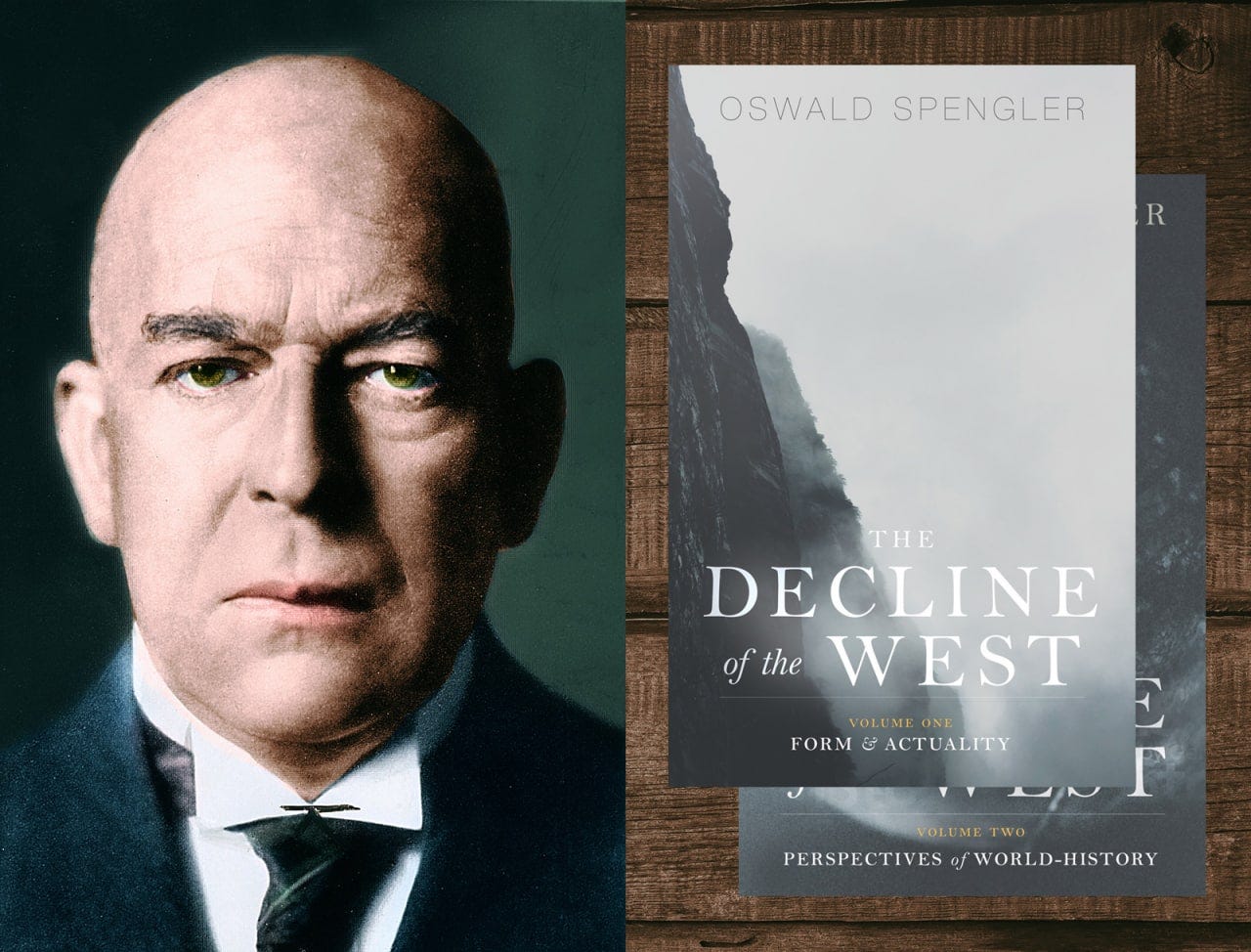
The publication of my book Le Déclin (The Decline) in 2013, which compared the crisis of the European Union to that of the Roman Republic, then marked a real turning point in my biography, for I was increasingly solicited by the media to speak about current politics and about my view of identitarian questions. My emigration to Poland in 2018, where I worked as a political analyst at the Instytut Zachodni, multiplied the occasions to intervene in public debate, because the European identitarian crisis, which I have long observed with disquiet, made itself felt above all in the stormy debate between the conservatism of the Visegrád states and Brussels’ attempts to impose a woke ideology throughout the European Union; and it is in this context that I developed the idea of hespérialisme1 — Hesperialism — in order to defend what remains of our civilization.
R&A: You rightly speak of the globalist project of métissage2 of our Western societies, an obligatory stage in the coming establishment of a world state. Your assessment is harsh but lucid: “Yes, we are heading straight into the wall — and afterwards will come the beginning of the civil wars.” Like us, do you think the electoral path is hopeless, and that only a civil war can pull us out of this long process of decadence?
DE: First, I confess I do not much believe in the imminent advent of a genuine world state, since great powers such as India, Russia, or China will always resist it fiercely. In the Western world, however, the globalist project, borne along by a materialist universalism, does indeed accelerate the disintegration of identities and leads to the rise of opaque supranational institutions weaving an inextricable web among all the states integrated into this system.
From this point of view, my comparison with the Roman Republic in Le Déclin reveals striking parallels with the past: mass migrations, asymmetrical wars, social polarization, the collapse of tradition, the transformation of political systems into oligarchies, and so on. These dynamics led Rome into civil wars, followed by a conservative authoritarian regime. Will we follow the same destiny? It is probable.
That said, I do not see this civil war as a deliberate choice or a desirable option, but as a regrettable fatality — inevitable though it be — flowing from present tendencies. To be sure, the electoral path, rigged though it is by elites largely disconnected from civilizational realities, is not entirely without hope, but it would demand an ideological awakening and a mobilization around European identity (in its true sense, of course, and not in its globalized Brussels version).
Hesperialism, the European civilizational patriotism that I defend in numerous books, seeks to encourage such an awakening by restoring a genuine identitarian pride — but time is pressing.
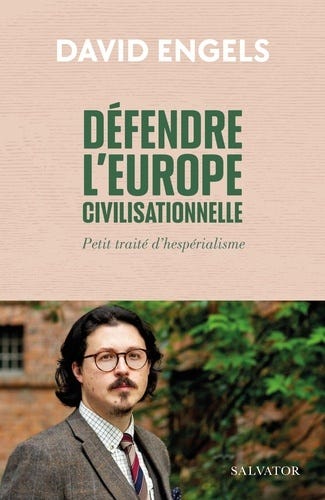
R&A: Precisely: what is this Hesperialism you propose in your book Défendre l’Europe civilisationnelle (Defending Civilizational Europe)?
DE: Hesperialism means a third way between globalist Euro-federalism and nationalist sovereigntism. It proposes a civilizational patriotism, unifying Europe around its cultural and spiritual identity without denying the nations. Faced with the “great confusion” — the erosion of traditions, wokeism, multiculturalism — Hesperialism advocates a rational return to transcendence, embodied in Christianity, and to European pride. Concretely, it is a matter of strengthening European cooperation in strategic domains (defense, borders, research) while restoring the subsidiarity of the nations.
Inspired by the thousand-year ideal of the Sacrum Imperium, the “Holy Roman Empire,” which allied unity and diversity, Hesperialism seeks to make European identity an enviable ideal, like the Romanitas under Augustus, which transformed an ethnic identity into a civilizational one.
Hic et nunc, this demands above all a genuine cultural revolution, without which a political transition will be impossible: reviving the faith, reappropriating our culture, uniting patriots in all the European countries, creating exemplary “parallel societies” such as I describe them in my book Que faire? (What Is To Be Done?), and above all by forming a true elite for the future before it is too late.

R&A: Will it not take a still greater crisis — empty refrigerators — for the white European peoples to rise up? But are they still capable of it?
DE: Indeed, the current political system excels at pushing back collapse from year to year by accumulating colossal debts — financial, migratory, demographic — and deferring them onto future generations, all while maintaining a surprising docility among the citizenry. This inertia is explained not only by propaganda, but also by European civilization’s slow entry into “post-history,” where the individual, deprived of the civilizational life force (élan), concentrates on his daily comfort, without higher ideals. This phenomenon, observable in all great civilizations in their final phase, singularly limits the capacity of Europeans to rise up. As in Rome, a few awakenings will always be possible, but they risk being confined to a mere change of elites rather than a collective remaking.
Certainly, a major crisis — “empty refrigerators,” for instance — could trigger reactions of that kind, but spiritual and identitarian disintegration renders European peoples’ capacity to unite behind a positive common project uncertain. Moreover, in order to give a framework to such an awakening, a patriotic elite would have to be formed, a bearer of a vision such as Hesperialism, so as to guarantee that a future upheaval might lead to that “rational return to tradition” which I defend in my new book Défendre l’Europe civilisationnelle.
R&A: This decadence has been recounted in minute detail alongside that of the Roman Empire… Juvenal has not aged a day, and neither have historians like Gibbon or MacMullen. Your book Le Déclin showed this very well, comparing the end of the Roman Republic (first century BC) with our own era…
DE: The Republic, like present-day Europe, was marked by mass migrations, demographic collapse, a decline of traditional religiosity, unprecedented social polarization, a crisis of the family, a first form of globalization, and, of course, the transformation of a participatory political system into an oligarchy, thereby provoking the rise of populism. These parallels, which were moreover already rather well intuited by Spengler, rest upon a progressive loss of transcendence and tradition in favor of a destructive materialism and individualism.
And if we widen our field of vision, similar parallelisms can be found with the late phases of most of the other great civilizations — for example the Warring States in China, or the Mazdakite disturbances in Iran. Each time, civilizations emptied of their true essence and identity see the ideals of a materialist pseudo-humanism driven to absurdity, undergo the advent of Caesarism, and tip over into civil disturbances that systematically usher in an authoritarian and conservative regime — that of Augustus, for instance, or of Han Gaozu, or of Khosrow.
R&A: You point to the attacks suffered by every traditional model. It is a veritable enterprise of generalized demolition… Scipio Africanus did no better at Carthage…
DE: Indeed, in my book Défendre l’Europe civilisationnelle, the chapter “The Great Confusion” describes in detail a profound identitarian crisis touching every aspect of our existence. This “confusion” is not unique, but Europe, borne along by its Faustian spirit — an unbridled quest for the infinite, once toward God, today toward matter — pushes self-destruction to an unprecedented degree. The deep cause is the abandonment of transcendence, replaced by a glorification of human omnipotence.
This reversal engenders multiple symptoms: the deconstruction of national and European identities, the erosion of traditional values (family, religion, community), and the rise of a materialist universalism embodied in wokeism. This ideology, far from being an accident, is the logical result of a rationalism pushed to absurdity, one that denies civilizational specificities. Only a reconstruction founded upon transcendence and civilizational patriotism can counter this dynamic and thus inaugurate the final phase of our civilization.
R&A: Concerning the family, one often speaks of LGBT propaganda, of abortion, and so on, but you rightly point out that the increasingly frequent separation of adults accustoms children to an affective relativism and to the absence of a father figure…
DE: Precisely. Frequent separations, encouraged by an individualistic and hedonistic culture, shatter the emotional stability of children, exposing them to a dangerous emotional relativism. The absence of a father figure, often bound up with these ruptures, deprives the young of a model of authority and responsibility, which is essential to social cohesion, as well as deprives children of the experience of a lasting polarity — or rather complementarity — between a masculine and a feminine familial pole.
To this are added ideological pressures, such as LGBT propaganda or the trivialization of abortion, which further relativize traditional family structures. These tendencies, unthinkable without the abandonment of transcendence and the desacralization of marriage, weaken the family cell, that true pillar of European civilization. That said, we find similar crises in just about all the other great civilizations, as well as the political will to “restore” the family once the crisis has been surmounted. Alas, this would require a return to values of duty and permanence impossible to impose politically and in the short term…
R&A: What will your next book be?
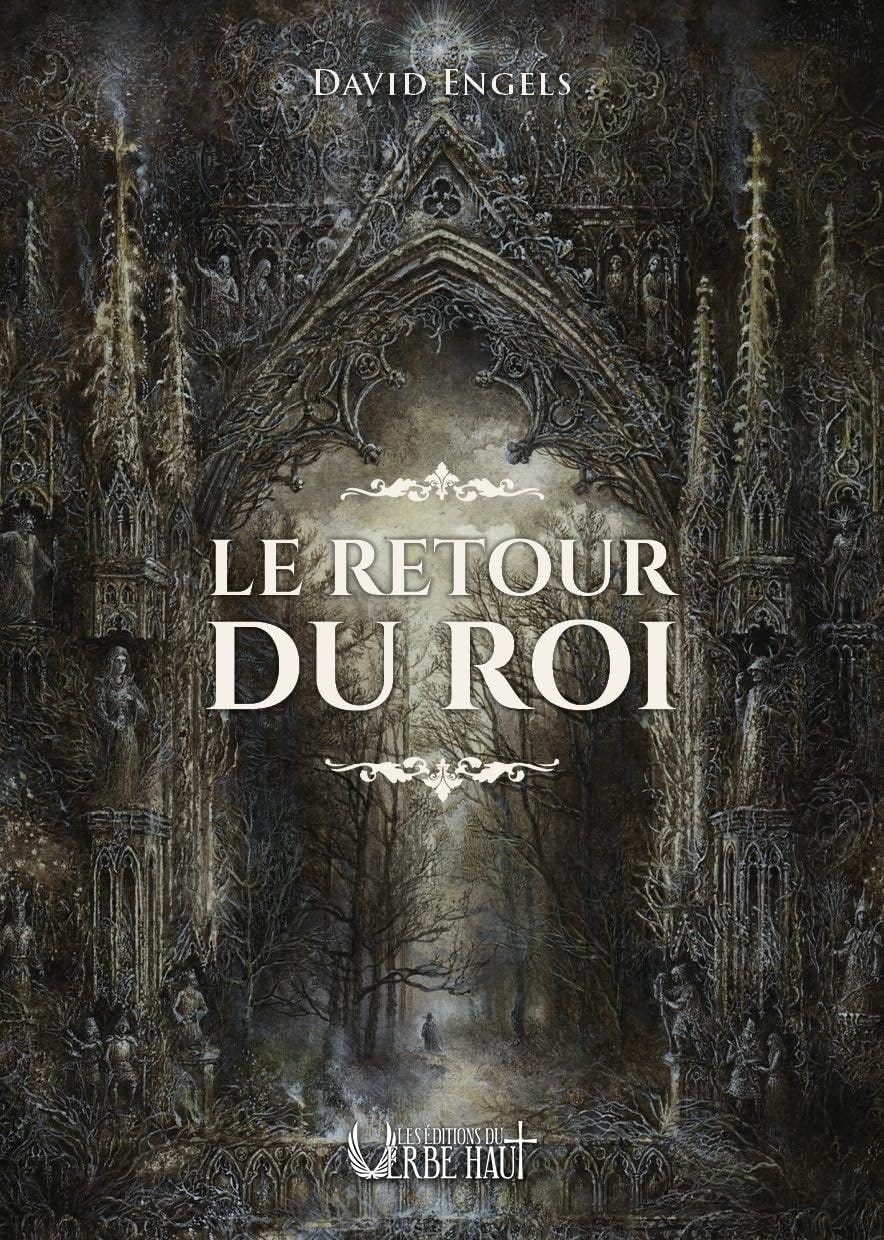
DE: My next book will be a novel exploring a future Europe in full decomposition. The narrator, wrongly accused and hunted, crosses the continent from Poland to France, by way of Germany, Italy, the United Kingdom, and Belgium, meeting idealists, activists, traditionalist influencers, and cynical politicians. A blend of travel narrative, satire, and introspective meditation, it offers a critical — though not unsympathetic — autopsy of the European right, overwhelmed by the identitarian crisis…
Originally published in Réfléchir & Agir no. 88, Winter 2025
Interview conducted by Pierre Gillieth
Translated by Alexander Raynor
David Engels’ What Is To Be Done? Living with the Decline of Europe is coming soon from Arktos.
READ MORE from Arktos:
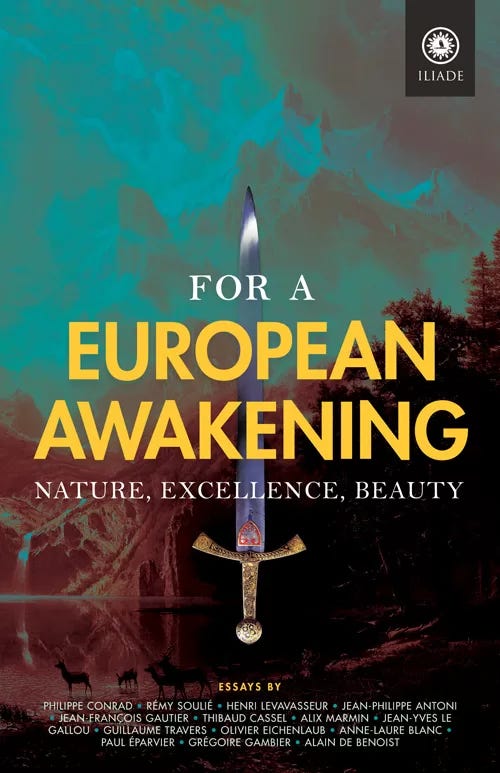
For a European Awakening is a selection of well-argued essays from the French New Right, where identitarian authors wrestle with ideas about ecology, history, and beauty. However, it is not simply an exposé of important themes and responses to key issues of our day but a call to action.
These essays explore questions about man’s relationship to his land, and how that territory shapes and defines him; questions about man’s role in nature as one of her children ‘shaped by thousands of years of long patience’.
In these pages, the authors point out the necessity for beauty in our world, to ‘re-enchant the world’ instead of slumbering in the dull muck of utilitarianism. As we rise to this task, should we grow discouraged by the naysayers and ‘deconstructors’ of European culture and tradition, we are called to remember Hölderlin’s words that ‘where danger lies, salvation grows’.
Essays by Philippe Conrad, Rémy Soulié, Henri Levavasseur, Jean-Philippe Antoni, Jean-François Gautier, Thibaud Cassel, Alix Marmin, Jean-Yves Le Gallou, Guillaume Travers, Olivier Eichenlaub, Anne-Laure Blanc, Paul Éparvier, Grégoire Gambier, and Alain de Benoist.
TN: hespérialisme — Engels’s own coinage, from Greek Hesperia (”land of the evening/West”).
TN: métissage — “mixing,” denotes the deliberate demographic blending of populations.

Great interview, David is on point. Looking forward to the English edition of What Is To Be Done!