


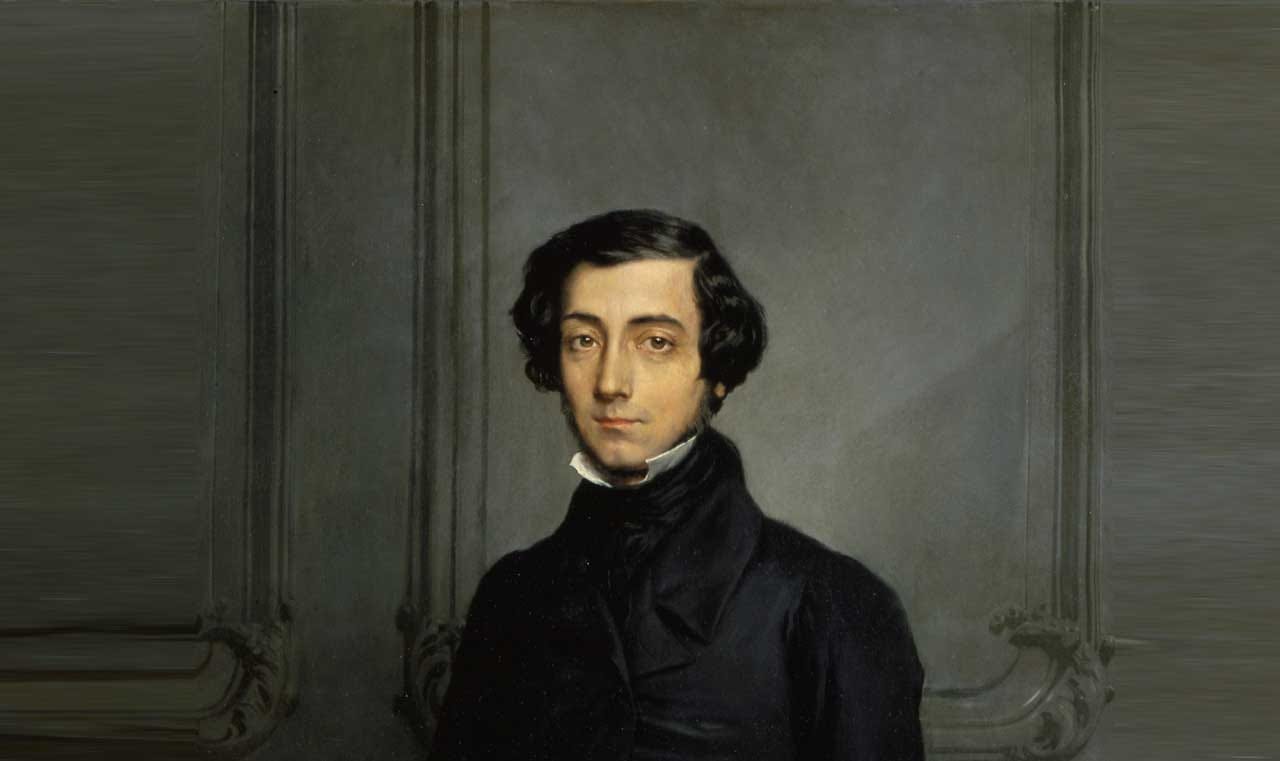
Antoine Dresse (”Ego Non”) revisits Alexis de Tocqueville’s prophetic insights into the unstoppable march of democratic equality. Writing nearly two centuries after Tocqueville’s journey to America, Dresse examines how the French aristocrat’s “religious terror” at witnessing democracy’s advance has proven remarkably prescient.
The democratic and egalitarian process has become the unsurpassable horizon of our time. Such was, in any case, the firm conviction of Tocqueville nearly two centuries ago, and the most immediate current events seem to prove him right. Not a day passes without this hypertrophied demand for the recognition of equal rights making itself heard. And this movement toward ever more democracy, understood as “equality of conditions,” is not limited to the most advanced edge of the Western world, but is progressively gaining the rest of the world.
But how can we explain the force of this phenomenon? To attempt to understand it, we must once again examine the major and founding work of Alexis de Tocqueville, De la démocratie en Amérique (Democracy in America).
Tocqueville is often presented as a “liberal” thinker, as if this simple label sufficed to summarize his thought. Yet, as Pierre Manent notes, the entire originality of his position lies in the fact that he adopts a liberal position while simultaneously accepting and radicalizing the reactionary diagnosis of the dangers of democracy: democracy is ineluctable, therefore we can only accept it, but it may well lead us to the worst of despotisms.
As he himself acknowledged, his book was written
“under the constant preoccupation of a single thought: the approaching, irresistible, universal advent of democracy in the world. Let one reread it: one will encounter on every page a solemn warning that reminds men that Society is changing form, humanity its conditions, and that new destinies are approaching.“
And indeed, from the very first phrase of his original introduction, Tocqueville admits that what struck him most during his stay in the United States was the march of the equality of conditions upon society. This equality, he said, “gives to the public mind a certain direction, a certain turn to the laws; to those who govern, new maxims, and to the governed, particular habits.“
Each of his words must be read seriously. Tocqueville, let us recall, was born just a few years after the Revolution, into a noble family descended from a very old lineage, and which would forever keep in mind the obsessive specter of the Terror. Several members of the Tocqueville family were actually assassinated at the time. In this particular milieu, of legitimist sensibility, people questioned the causes of the Revolution. And the general idea that reigned then in this familial and social context was that the Revolution was an extraordinary catastrophe that one must endeavor to erase from history.
Yet, Tocqueville does not believe in this possibility. The French Revolution was not an accident of French history nor of world history in general, an accident that could be repaired. The Revolution was an episode of a great, irresistible democratic revolution, which has in truth been progressively operating for a very long time. Democracy appears to him in its purest form at the beginning of the 19th century in the United States, because this country had no prior aristocratic tradition. Having no hierarchical edifice to topple beforehand, democracy thus establishes itself more “naturally” there than in Europe. But this does not mean that the old continent will not follow the same “democratic” path as America. Quite the contrary, in writing his book, Tocqueville invites his reader to look into the mirror that America holds up to him. The French reader will then see the already perceptible effects of advancing democratization in French society.
Striving primarily to convince the men of his aristocratic milieu that the counter-revolutionary fight goes against the current of history, Tocqueville works on the elaboration of a new political science, thus aiming to tame this ineluctable destiny that is democratic political life rather than launching into rearguard battles.
It is in this sense that we must understand the multiple references to “Providence” that pepper Tocqueville’s text. He indeed addresses himself first and foremost to the readers of Bossuet, the author of the Discours sur l’histoire universelle (Discourse on Universal History), whom Tocqueville himself had read well, and to the readers of Joseph de Maistre, the great counter-revolutionary author par excellence, whose critique of the revolution relied in large part on a providentialist reading of history: the Revolution is only an illusory and necessary time, an apparent disorder at the end of which the divine arrangement will reclaim its rights with greater force. Tocqueville thus precisely takes the opposite stance by turning this providentialist argument on the inevitability of democracy:
“The gradual development of equality of conditions is therefore a providential fact, it has its principal characteristics: it is universal, it is durable, it escapes each day from human power; all events, like all men, serve its development. Would it be wise to believe that a social movement which comes from so far back could be suspended by the efforts of one generation? Does one think that after having destroyed feudalism and vanquished kings, democracy will retreat before the bourgeois and the rich? Will it stop now that it has become so strong and its adversaries so weak?“
Indeed, wherever we turn our gaze, we perceive the same revolution perpetuating itself throughout the Christian universe, says Tocqueville. Let us go back to France seven hundred years ago, he writes: we then find it divided among a small number of families who possess the land and govern the inhabitants. In the meantime, equality has gradually installed itself throughout all of society, whether through the influence of the Church, the centralizing and leveling politics of kings, the multiple wars ruining the nobles, the enrichment of the bourgeois through commerce, the development and propagation of science, etc.
Tocqueville’s observation is thus extremely strong: when one peruses the pages of our Western history, one encounters almost no event which, for seven hundred years, has not turned to the benefit of equality. If the revolutionaries of 1789, like instruments of God, killed each other, as Joseph de Maistre would say, all men for seven centuries have nonetheless been acted upon by divine will for the benefit of democracy. Tocqueville concludes: To want to stop democracy would then be as vain as to struggle against the will of God himself.
Democracy, this permanent tendency toward the equalization of living conditions, does not therefore come from nowhere in Tocqueville’s eyes. It is a very ancient process against which it is vain to struggle. But for all that, Tocqueville does not rejoice in it. As he himself admits at the beginning of De la démocratie en Amérique (Democracy in America), his book was written under the impression of a sort of religious Terror at the sight of this irresistible revolution which has been marching for so many centuries and which may well carry away everything of value in his eyes.
For democracy designates less a form of government than a state of society, an egalitarian substrate founded on individualism, a total state of society that exercises its grip on all human things and, consequently, marks all institutions and all laws with its imprint. Yet, Tocqueville is fundamentally, anthropologically, an aristocrat. With the legitimist right, he admires the France of the Ancien Régime, he loves that ancient aspiration to greatness that formed the bedrock of old France rather than the mediocre ideal of equal well-being for all.
Tocqueville therefore did not “betray” his own, as certain members of his family accused him of doing. Simply, in his eyes, the alternative is no longer the same. The development of history carries us toward democracy and equality and all we can do is make the best of it. We no longer have the choice between democracy and aristocracy; we have the choice between a democracy tempered by liberal principles, a democracy which certainly has no grandeur, but which guarantees a certain order and liberty, or an unbridled democracy, which turns into the most infernal egalitarian despotism.
Such is therefore the alternative before which Alexis de Tocqueville placed his contemporaries at the beginning of the 19th century. The question that arises today, however, is the following: faced with the egalitarian surge that seems to carry away everything in its path, does the ideal of tempered liberal democracy not also become a mirage as unrealistic as a return to the Ancien Régime?
Originally published in Éléments no. 204, October-November 2023
Translated by Alexander Raynor
Buy Antoine Dresse’s book Political Realism
de Tocqueville did not 'turn on his own.' He simply recognized the difference between British/American democracy and French democracy. British/American democracy is grounded in natural rights and individualism, whereas French democracy is grounded in codes and legislation. Simply a choice between natural laws and the laws of man & men. France is now on its Fifth Republic and is still trying to legislate their vision of utopia.
In the case of the country he wrote that book about, well, we haven’t been system that can be described being primarily a lower case “d” democracy in at least fifty years, but you have to go back to pre WW2 to very firmly say we were; most all people of almost all kinds are locked out of any meaningful system decision making. Are you guys referring to another country?
Also, Tocqueville also seemed to think America would be soon turning Catholic? And he barely mentions the Bank War despite being in the country right in the thick of it, weird. And the few fleeting times he does mention he seems to think its great just because most “educated” people supported it, despite just a couple years after him leaving most of them turning against it too once it had been thoroughly proven that even many of them had been getting, in various ways, often quite tailored to specific sectors and circumstances, being worked over by the network it was a part of, he wasn’t too perceptive in some regards…