


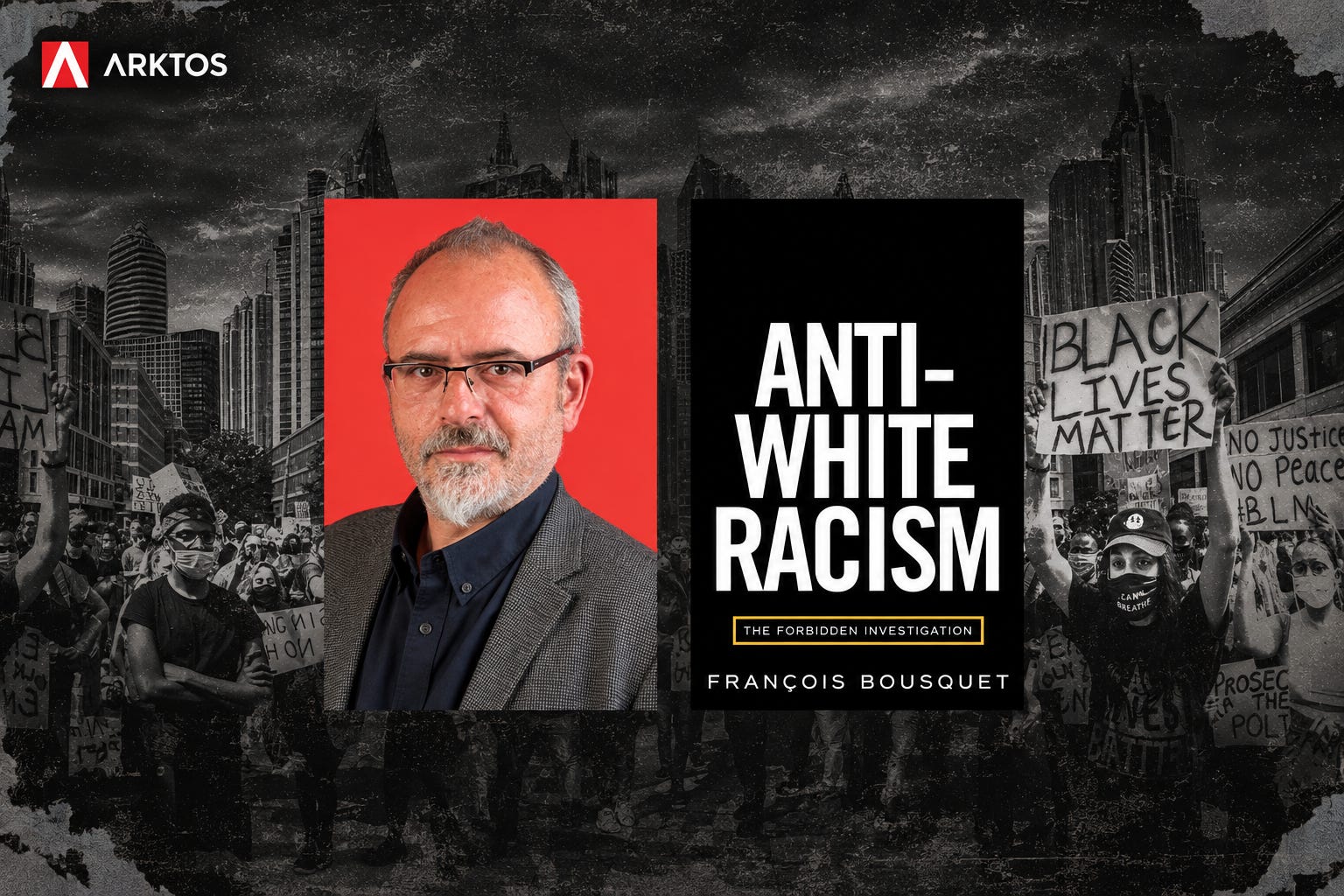
While the debate on discrimination remains locked down by a one-sided view of racism, François Bousquet, director of La Nouvelle Librairie and editor-in-chief of Éléments, dares to break a taboo with his latest book: Anti-White Racism.
In this unprecedented investigation, he begins by dismantling the dogma of systemic racism, which has become an ideological lock preventing any recognition of the suffering of the petits Blancs or “little Whites”1. He then gives the floor to those who are never heard: middle and high school students, residents of relegated neighborhoods, people assaulted and humiliated, often in silence. The result is a chilling collection of testimonies — voices stifled for too long by a detached progressivism.
In this exclusive interview with Breizh-Info, François Bousquet discusses his approach, denounces the blindness of the elites, and warns of the widening fracture between real France and official France.
Breizh-info.com: To begin with, there are three books on anti-white racism published in the early 2000s and 2010s, and then nothing: one by Hervé Ryssen, another by Gilles-William Goldnadel, and one published at the time by Une Autre Jeunesse and the Identitaires. What has happened since?
François Bousquet: The theory of systemic racism happened. It is a muddled, delirious, hegemonic theory imported from the United States. It has petrified the debate as if after a nuclear winter. Frozen debate = sterilized thought. In the days of communism, people spoke of the Soviet glacis2, a belt of vassalized countries that prevented any form of dissidence. The decolonial glacis works the same way. At its center is a Manichaean vision of the world: wicked Whites and nice “racialized” people. The French Trofim Lysenko of this racial fiction is Éric Fassin.3 From the height of his university chair and his many Franco-American op-eds, he has decreed that the earth is flat and that, as far as the “social sciences” are concerned, anti-White racism does not exist. Merely mentioning this reality, which I document extensively in my investigation on the basis of some forty shocking testimonies, immediately condemns you to academic and media excommunication. That is how the debate has been locked down. For on top of this leaden ideological blanket comes de facto censorship: publishers back away, and researchers don’t research. Anti-White racism has become a willful impensé,4 something deliberately left unthought.
Breizh-info.com: Your book opens with a quotation taken from an online forum. Why did you choose this source rather than an institutional or academic one?
François Bousquet: Truth may come out of the mouths of babes, but even more out of the mouths of adolescents. They are the ones who take the hostile looks, the racial slurs, the bullying on playgrounds and football pitches. They are the ones who, more and more often, have to lower their eyes and hug the walls. That is what you find on discussion forums. They are the cahiers de doléances of the young.5 Journalists, educators, and adults should consult them more often. They would discover an abandoned youth exorcizing its malaise in the registers of language proper to adolescence: not pathos, but sarcasm, sneering, provocation, which seize the hand that is not held out to them… in order to bite it.
Why follow institutional discourse? Having deserted reality, it no longer has any credibility. It has taken refuge in ideological bubbles where any empirical approach is disqualified. In such cases, you have to start again from the ground up. Take France’s pulse not on the terraces of the gentrified cafés of the big cities, but in YouTube comments, on online gaming forums, on the networks where an invisibilized youth expresses itself. In an age when the great voices have fallen silent or become complicit, we must learn again to listen to the small ones.
Breizh-info.com: The heart of your book is the testimonies. Why did you choose this direct method? What impact did it have on your own perception of the phenomenon?
François Bousquet: They are the ones who tell us what reality is, unfiltered, unsweetened, and it does not match the dominant narrative at all. If I chose this method, the raw spoken word, it is because there had been virtually nothing until then. No serious fieldwork, no public report, no academic study worthy of the name. Nothing. A desert. This documentary void allowed activist researchers to decree that anti-white racism did not exist, for lack of evidence. And so the loop was closed: we don’t look, so we don’t find, so it doesn’t exist. I made the opposite wager. I went out to meet society’s stifled chorus: teenagers, students, employees, teachers, parents. By turns I was shaken, moved to tears, outraged by these accounts. Not only as a journalist, nor only as a man, but as a Frenchman, as a European, and, dare I say it, as a white man. All of a sudden it was no longer a matter of concepts, but of betrayed trust, of abandonment, of contempt. It was at that moment that I became not their spokesman but their megaphone: I do not speak in their place; I speak so that they may be heard.
Breizh-info.com: Why does anti-White racism remain such a tenacious taboo in the media, in the university, and in the political sphere?
François Bousquet: Anti-White racism is the taboo of taboos because it threatens the entire ideological edifice of victimhood. It breaks the monopoly on grievance. It disturbs the symbolic balances on which the mental architecture of post-national societies rests. In these societies, the historic peoples are ordered to fall silent, to submit, or to resign. To acknowledge the existence of anti-White racism is to blow apart this asymmetrical logic, which is the logic of multiculturalism: oppressors on one side, the oppressed on the other.
Breizh-info.com: You distinguish the “big Whites” or grands Blancs from the “little Whites” or petits Blancs. Is this fracture at the heart of the invisibilization of this form of racism?
François Bousquet: Absolutely. Anti-White racism strikes the petits Blancs, not the commentators at Radio France. There are two kinds of Whites in France: the big and the small. The first has the words, the positions, the networks. The second has contempt, silence, belittlement. The grand Blanc campaigns for open borders, but not in his own building, still less in his children’s school. He celebrates diversity, provided it remains theoretical. If there is such a thing as White privilege, it is only ever his own: a caste privilege (progressive, leftist, metropolitan, sanctuarized) that opens every door. The grand Blanc campaigns for the unconditional welcome of others, but it is the petit Blanc who must bear the consequences. He is the one insulted in the schoolyard, abused on the football pitch, humiliated on the school bus. This fracture is not anecdotal. It explains why anti-White racism remains taboo: it affects those who have neither megaphone nor relay.
Breizh-info.com: Can we say that this racism targets the most vulnerable first, geographically, socially, educationally, in places the state seems to have deserted? And what does this say about the divorce between the elites and the people?
François Bousquet: No one is safe anymore: the death of Élias at the start of the year, in Paris’s 14th arrondissement, was a tragic reminder of that. But in fact anti-White racism strikes the working classes first. That is what emerges from the only survey on the subject, conducted jointly by Insee and Ined in 2008–2009; there will never be another.6 One non-impoverished French person in seven belonging to the “majority population” (whether we like it or not, the Français de souche7) says they have been a victim of racism (in this case, anti-White), but among impoverished French people it is one in four. You can see the gap. Anti-White racism strikes where the state has withdrawn: in zones of relegation, forgotten margins, abandoned schools. The further down the social ladder you go, the more exposed people are, and the stronger anti-White racism is. Put another way: the fewer means you have for segregation (spatial, social, racial), the more exposed you are.
Sheltered behind his flights of rhetoric about social mixing (mixité), the grand Blanc practices segregation, a muffled segregation, behind the walls of gentrification and the social codes he masters better than anyone. Mixing is a farce that only the poor live for real, at their own expense. They do not have the luxury of choosing it or measuring it out. They take it head-on, in environments where one no longer speaks of coexistence but of confrontation. They have the means neither of avoidance nor of separatism.
Here we are at the heart of the hypocrisy and the pretense: those who proclaim that anti-White racism is a fantasy are precisely those who have the means never to be confronted with it. They live in a fictional France; for everyone else, it is a frictional one.
Breizh-info.com: Do you think this should be made a universalist struggle, even at the risk of falling into the fashionable tendency of victimization?
François Bousquet: Universalist? Certainly not. It was precisely in the name of an abstract universalism and of a Republic supposedly blind to differences that antiracist ideology came into being more than forty years ago, only to drift into a war machine against indigenous peoples and legitimate forms of belonging. The point is not for us to resort in turn to a mirror-image victimization, but to expose the perverse effects of multiculturalism imposed from above, without consent, and to give ourselves the concrete means to respond to it, starting from a diagnosis of failure.
Breizh-info.com: The book also describes a Balkanized, demographically fractured society. Can anti-White racism really be separated from the effects of mass immigration?
François Bousquet: The one does not go without the other. The taboo on anti-White racism will not fall so long as people refuse to see what feeds it: the massive demographic imbalance produced by out-of-control non-European immigration. Anti-White racism is not a spontaneous emanation of the spirit of the age. It is the product of a fractured, Balkanized, archipelagized society, in which the majority element becomes a local minority, often amid the indifference, or even with the blessing, of the elites. A multicultural society without a common culture becomes a battlefield. Multiculturalism is not an enrichment; it is a powder keg.
Breizh-info.com: Will SOS Racisme8 one day add an “s” to “Racisme” to make it plural, as Desproges suggested? In other words, do you see a broader political awareness emerging, including on the left? In a word: is the taboo falling, or will reality have to impose itself even more brutally before it breaks?
François Bousquet: The government spokeswoman, Sophie Primas, stated on CNews that she has no qualms with speaking about anti-White racism. On the same channel, Aurore Bergé, the minister in charge of equality between women and men and the fight against discrimination (quite a program in itself), said the opposite. Though she has been called a “dirty White woman,” with spitting to boot, she does not recognize that anti-White racism exists. Clearly, ethnomasochism still has fine days ahead of it.
The good news, nonetheless, is that a crack is appearing in this bleak panorama. The Crépol affair and the death of Thomas marked a turning point. Not because the justice system saw clearly. On the contrary, it is working to avoid any finding that the crime was racially aggravated, at the cost of a biased investigation. The turning point came because public opinion is increasingly aware that these are not “random incidents” but rather are “social facts” (faits divers vs. faits de société9), expressions of an anti-European rage cultivated and channeled by years of resentment.
The wall of silence around anti-White racism is thus beginning to crack. More and more people are speaking about it freely. One cannot indefinitely take refuge in denial, delinquency, and delirium (the law of the three Ds, to which I am particularly attached) without inviting a violent return of the repressed. Welcome to reality!
Originally published on Breizh-Info. Interview conducted by YV.
Translated by Alexander Raynor
READ MORE:
François Bousquet’s Anti-White Racism: The Forbidden Investigation is hot off the press from Arktos and available on Amazon and Barnes & Noble:
TN: petits Blancs / grands Blancs: colonial-era terms (Saint-Domingue, the Mascarene Islands) for poor whites versus the planter elite. Bousquet transposes the pair onto the metropolitan class division.
TN: glacis: the military and geopolitical term for the Soviet buffer belt.
TN: Lysenko / Fassin: Trofim Lysenko was a Soviet agronomist whose pseudo-genetics was imposed as state orthodoxy. Éric Fassin is a French sociologist who writes on race and gender.
TN: impensé: “the unthought,” a term of art in French theory.
TN: cahiers de doléances: the grievance registers of 1789, revived as a gesture during the Gilets jaunes (Yellow Vests) period.
TN: Insee/Ined survey: Trajectoires et Origines (TeO). “Majority population” (population majoritaire) is TeO’s category for people who are neither immigrants nor children of immigrants.
TN: Français de souche: “French of old stock” or “native French.”
TN: SOS Racisme: a prominent, left-wing “anti-racist” NGO. The French equivalent of the SPLC or Hope Not Hate.
TN: faits divers / faits de société: the contrast is between isolated crime incidents and social phenomena.