


Beneath Frankfurt airport, buried in the thickness of concrete, somewhere between the parking lots and the underground business center, a nightclub has been built. Under Johannesburg airport, there’s exactly the same one. In Oslo, the same again. In Tokyo and Chicago, the same. Soon, in Nairobi, Athens, Rio, Rome…
In this same nightclub, you hear the same music everywhere, played on the same turntables, scientifically selected by the same music marketers.
Let’s go back to the surface: in the great global cities and, gradually, in the surrounding provinces and countryside, the landscape is changing. The planetary traveler feels less and less out of place: he finds the same blocks of glass and steel. People are dressed in the same jeans, the same anoraks. The same cars crisscross the same roads, lined with the same shopping centers, where you find roughly the same products.
In individual living cells, you are greeted by television. Obviously, the programs change from one world city to another. But soon, the Time-Life program, broadcast by geostationary satellite, will unify all of them. Sitting in front of the TV, someone is reading a newspaper. No, he’s not reading. He’s looking at the images of a comic strip. It’s Popeye. He closes his newspaper, he looks at you: he’s Japanese, Norwegian, Italian or French. It doesn’t matter. He explains to you, in a very soft voice, in basic English, with an accent from nowhere, that he has some Western citizenship and is seeking happiness. He has two children, a boy and a girl. They look terribly bored. The girl hums advertising slogans. The boy, somewhat dazed, taps on an electronic football game.
You leave the cell; you cross the lawn (you saw the same one yesterday, around the same dwelling, ten thousand kilometers from here). You get into your rental Toyota (you had the same one yesterday). You turn on the car radio: music. The same as in the nightclubs. Your memory, a marvelous machine, has now recalled every note. The music stops: advertising slogan. Well, it’s the same as earlier; but it’s also the same as the day before yesterday, when, in a Holiday Inn, you had turned on the television in the room. But, by the way, what does the advertisement say? It’s about a book. The title reminds you of something: a love story that takes place amidst a disastrous adventure. You think for a few seconds at most; but your neurons don’t need to function, because you’ve just passed by a cinema, where the poster announces exactly the same title as the book. That’s it, the image has stimulated your brain: you saw this film four days ago, very far from here, in… well, in another city, in another country, which doesn’t really matter that much after all. But what was this film about? It’s silly not to remember: it now comes back to you that you saw it a second time, on the plane that brought you here. No matter: it was an American film, which was roughly about a story of love and disaster, exactly what the advertisement just said.
Moreover, the music in the advertisement is — it comes back to you — the same as the one that set the rhythm of the film, obviously, the same as the one from the nightclub, the other evening in… well, it doesn’t matter.
This world tour, paid for by your company, X.X.X. and Co, for you to visit its clients around the world, is instructive indeed.
You could wake up; all this could be a nightmare; but it’s no longer one. In Africa, the last tribal communities are disappearing. In Latin America, in the favelas produced by the Western commercial order, young people are rapidly forgetting their ancestral culture. In the European countryside, popular dance balls increasingly resemble the clubs of the Rive Gauche.
But you’re not reactionary. Peasant women in headscarves and rugged dialects are not eternal. One must be in favor of the modern world. But which modern world? Where has modernity gone? Futuristic dreams have vanished. Television, social security, human rights, traffic jams on the A86 ring road, fake Formica beams, the mini stereo system on credit — is this the modern world? We’ve stopped wanting to go to the moon. If you’re lucky enough not to be unemployed, everything around you exudes comfort. Comfort… it’s comfortable, obviously, but it’s not exhilarating. Don’t you find this modern world somewhat boring? But to entertain yourself, there’s always cinema and television. There, the modern world becomes exciting. Technology shows its full potential; we set off on adventures to planets on space cruisers. But you know well that all this doesn’t exist, that it’s all just a simulacrum. Yes, that’s it, you live in a simulacrum. A simulacrum of happiness, of adventure, of love, of violence, of religion.
One thing at least is reassuring: you have your personality, perhaps a bit narcissistic, but if nervous depression is lurking around the corner, a psychiatrist will help you rediscover yourself. If your home looks like your neighbor’s, if your clothes resemble your neighbor’s, at least your mind resembles no one else’s. And then, you are respected. You are free. Your neighbor is too, by the way. Their self is respected, like the millions of little “selves” of all Westerners, your neighbors and your brothers, who have, of course, nothing to do with yours.
Certainly, you have the same musical tastes as your neighbors: you all buy the same cassettes. Certainly, they all fear, like you, nervous depression… or cancer. They all become passionate, like you, at 8:30 PM, about the same TV series. But isn’t the meaning you give to your existence fundamentally original?
Original?
Acquiring a comfortable situation, having pleasant vacations, being able to do DIY on weekends, managing to pay the installments for the dining room set, the stereo system, the 11-horsepower car, being able to practice windsurfing — is this really original?
Look at what you aspire to for your children: there, you distinguish yourself from your neighbors. You want your children to resemble you, just one notch above, quite simply.
If you still have doubts, tell yourself that you are French. That’s something. A stroke of luck. Most Westerners, your neighbors, and non-Westerners who will soon be Westerners like you (you’re not racist) don’t have this luck.
French: we have a particular VAT (value-added tax) regime, the growth of our GNP (gross national product) is not exactly the same, and above all, we have a very different history: the history of France, Joan of Arc, Saint Louis, Louis XIV, etc. Okay, agreed, it’s in the past, but it counts.
No, decidedly, you doubt your originality. Your mind, your clothes, your menu, your car, your hi-fi system, your dining room, your vacations, your urban landscape, your office, your 8:30 PM TV programs, your hobby, your musical tastes, your idol artist, your favorite actor, your shaving cream, your smell, your fears, your nervous depression, your administrative procedures, your social status, your retirement plan, your sexuality, your news magazine, your professional ambitions, your glasses, your desires, your standard of living, your refrigerator — are they so different from those of your millions of neighbors?
What are you saying? That you’re afraid of originality? You don’t want to step out of the uniform to find yourself alone, without roots, without belonging. You don’t want your neighbors to point fingers at you and your children to reproach you for not doing like everyone else. No, decidedly, you’re not foolish enough to stand out…
From Civilization to System
How should we designate this vast planetary enterprise of massification and depersonalization? Optimistically, Marshall McLuhan spoke of a “global village.” But can we still speak of a village, of a (world) society or (Western) civilization? Aren’t we deluding ourselves by using these reassuring old words that refer to the already known while we are entering into the unknown, the never before seen?
What is being born before our eyes, after a long maturation in Western egalitarian ideology that appeared in the 17th century, no longer has anything to do with civilization. The antagonism between cultures and civilization, dear to Friedrich Sieburg, Norbert Elias, and Oswald Spengler, is now surpassed. Today’s reality consists of ethno-cultural and national entities threatened with disappearance, of peoples gradually emptied of their substance by a supra-continental macro-structure.
Without territory but installed everywhere, this giant octopus is primarily based on the organization of technology and economics. Cultures, nations, regions — all collective entities shaped by history are its potential prey. This macro-structure currently being installed over the world through a metamorphosis of Western civilization displays all the characteristics of a system. A civilization, even a world civilization, is always founded on a cultural past and aims, more or less, to perpetuate itself into the future. A civilization remains human. A system, on the other hand, has something mechanical and timeless about it, even if it is alive. A machine, a bacterium, a human organism, a cancer cell are, in various ways, systems. They lack what Ludwig Klages called a soul. In the famous debate that pitted him against Jürgen Habermas and the philosophers of the Frankfurt School, the German sociologist Arnold Gehlen had already drawn his readers’ attention to this transformation of civilization into a system: while liberal society persuades itself that it has built a world of prosperity, liberation and progress, social reality reveals an inorganic environment — that is to say, dead, without inner life, closer to machinery than to a growing organism.
The Invasion of Technology
Western societies are becoming machines before our eyes. Technology penetrates social and individual life so deeply that institutions eventually become technologies themselves, technological apparatuses. Through the extensive use of techniques — administrative, computing, industrial, commercial, etc. — institutions fade before these instruments. The large administration comes to function for itself, so that its own gears can turn. The computerizing firm ends up bending to computing itself. Nineteenth-century technology did not have this particularity. Today, traditional institutions have lost their weight: Justice, School, Army increasingly merge with the “technical gears” of a macro-administration comparable to a machine, powered by multiple technologies.
From this convergence between institutions and the techniques that animate them, a system is born; institutions are “swallowed up” and progressively undifferentiated. For Gehlen, modern societies increasingly resemble an immense integrated technical ensemble that groups together science, technology, industry, the military, culture and administrative technocracy. A common structure, comparable to an enormous “social engine,” digests institutions that were once functional and specialized. Managing a municipality increasingly resembles managing a firm. The interdependence between economic decisions and family lives increases. The army functions partly as a testing ground for military exports. Cultural products depend on commercial strategies.
Technology, in the form of management techniques, information, mechanization, takes charge of activities traditionally produced by human processes and vital efforts. Contrary to what the proponents of liberal technocracy claim, techniques are not neutral and do not constitute simple adjuncts to institutions. Arnold Gehlen highlighted the absorbing character of technology that emerges as soon as it is not subject to rigorous will. Techniques do not extend institutions, they modify them; they merge with society’s institutional framework. Administration, which should reflect the collective will of a people, achieves a social and political purpose, becomes a technique, “administrative technique.” This diversion of function experienced by institutions marks a retreat of civic consciousness. Institutions, organs of collective discipline — that is to say, transmission of a code of values endowed with conscious meaning — degenerate into mechanical procedures. “Models” and “programs,” computerized or not, obscure voluntary projects and traditions. Instead of imprinting institutions, collective will and consciousness are imprinted by them.
This phenomenon is not solely sociological; it is also metabiological. A “new human mutation” has occurred; it has given rise to a second human nature, entirely original: a new anthropological complex has been born that brings together and homogenizes culture and society. “The apparatuses of technology,” writes Gehlen, “are now part of the human organism just as the shell is part of mollusks.” Can we still psychologically and physiologically do without social security — which is an administrative “technique” — heating, media, rapid transport, telephone? This is not a criticism, but a simple observation.
This mutation is not necessarily regressive, contrary to what Gehlen suggests. It is simply risky, and we must know this. It constitutes a formidable challenge that Western industrial society has not perceived and has not wanted to take up…
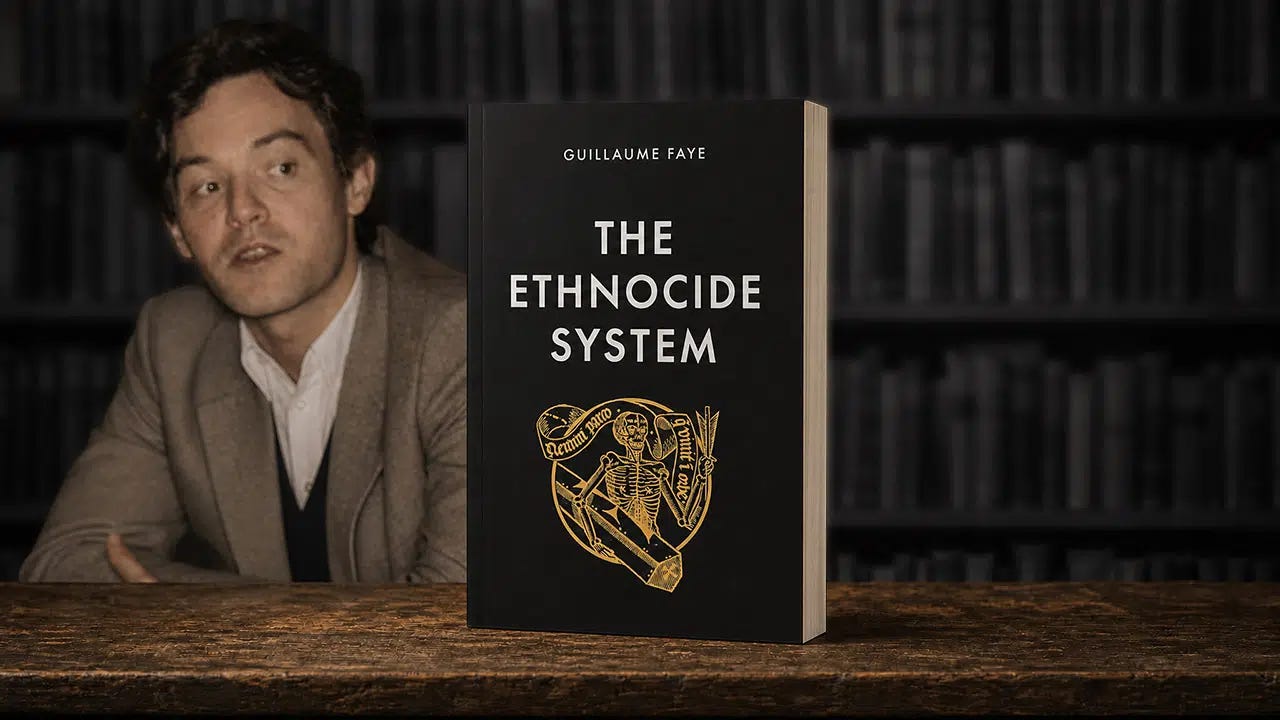
This is an excerpt from The Ethnocide System, by Guillaume Faye, brought to you by Arktos:

In the new global era, the peoples of the Earth find themselves under the monstrous tentacles of a techno-economic system which sees only numbers. Spawned by the American mercantile order but now supplanting it, this system uproots, domesticates, and homogenizes national identities, replacing them with an anonymous global society under “scientific” management. Instead of nations and cultures, histories and visions, only consumers and “standards” remain. This mindless, self-serving system gnaws away at consciousness and the will to live. In exchange for cubicles, cars, and TV shows, it kills peoples, deletes history, and smothers destiny.
Faced with this totalitarian spectacle, which dresses itself in the virtues of human rights and socio-economic well-being, Guillaume Faye summons us to pinpoint the system’s workings, decode the pitfalls of modern ideologies, and defend the right of peoples to be themselves and go their own ways.
The Ethnocide System, the first magnum opus of one of the most provocative and inspiring masterminds of the New Right, now translated into English for the first time, is a tour de force of the desperately needed showdown between the peoples of Earth and the globalist machine.
The Murder of Territories
The nature of the System is mysterious. It is not, like an institution, a nation, or a specific culture, definable by positive criteria. It corresponds to no legal reality. It breaks with all previous forms of collective life based on the dual reality of history and territory. Human groups have until now always gathered around the representation of a common origin and a space that one “inhabits,” in the “poetic” sense that Heidegger gives to this term. Even medieval Christianity, which claimed to transcend borders, did not succeed and could only survive because it took root in European peoples or used the idea of empire to its advantage, thus operating with a reinterpretation of history. The System, on the other hand, performs this considerable upheaval of bracketing both the historical-national principle and the political-territorial principle which constituted the modern translations of the spatial imperative and “tradition.”
The criteria of belonging chosen by the System are economic and technical. The “Westerner” is not defined by nationality, ethnicity, past, or territorial origins, but by lifestyle, type of consumption, rhythm of existence, the purposes of their “professional sector,” etc. A bank executive from Singapore will be more “Western” than a Breton farmer who still speaks his language and follows his ancestral culture. One will be part of the System, the other will not.
Our planet, Earth, is not experienced as space, but as a set of zones. It is perceived as an instrumental and depoeticized platform from which goods and services are drawn as if from a machine. The Earth, put into exploitation, is no longer put into conquest. A people, on the other hand, experiences Earth under the mode of territorial control, even when it comes to extracting mineral wealth or exploring oceanic mysteries; but today such research is no longer understood as adventure, but instead is relegated to the prosaic and pragmatic degree of technical exploitation. The space of the Western system falls under a mechanical architecture of networks and deterritorialized transfer currents; its function is to provide comfort, but not to dominate space.
There are two consequences to this state of affairs: nations caught in the System’s nets no longer control their geopolitics; on the other hand, the collective feeling of territorial habitat, ethologically indispensable to human groups, tends to be lost.
While peoples think “in terms of continents” and remain attentive to their territorial integrity or protection, the Western system strips “national territories” of any significance other than formal and legal; it abolishes economic, cultural and mental borders in favor of a commercial and “zonal” conception of geographical divisions. The idea of geopolitical mastery of space then declines; territorial power is interpreted only as an instrument of economic and commercial security (preservation of exchange networks and centers of raw materials extraction) or maintenance of market zones to sell the products of the merchant economy.
The United States, which inspires the Western system’s vision of space, does not behave as an empire (maritime or continental), as Raymond Aron believed, but as a “commercial thalassocracy,” according to Jordis von Lohausen’s expression. Under these conditions, the System becomes geographically vulnerable; despising territories, it risks military conquest; supported by “zones” rather than specific spaces where peoples live, it does not conceive that its “currents,” its “networks” and its “markets” might harm territorial sentiments that are still alive. The example of Iranian nationalism, or of African nationalists who, outraged by Western capitalism’s disregard for Africa’s territoriality, were thus tempted to join the Soviet orbit, is telling of this forgetting of peoples’ spaces that characterizes the System.
An internal uprooting of populations then occurs. We no longer know where we are; European governments lose all will for protection and geopolitical domination, Europe as a space no longer exists, as countries and regions have ceased to exist. It is certain that this absence of habitat — from the village level to that of the continent — has psychological consequences that we still know little about, but which factor into the biological exhaustion, manifested by demographics, of Western populations.
These populations suffer from an affliction that could be called “territorial dispossession.” Inhabiting is an existential and ethological function that Heidegger and Lorenz have described, each in their own language, as indispensable to the psychological balance of individuals and groups. However, the system makes us residents rather than inhabitants. The hypocritical maintenance of territorial differences on the legal level and on that of individual customs controls, like the transformation of national borders into toll booths or police checkpoints, deprives us of the sensation of occupying our specific group space. The planet is instrumentally experienced and perceived as a juxtaposition of specialized zones: the vacation-sun zone, the oil zone, the West-Europe zone, etc. As a result, a pathology of lived space appears: terrestrial nature loses its mystery and becomes, according to these ideologies, a “park” (ecologists), a garbage dump, or a mine for exploitation. Even space conquest, commercialized and accounted, lost in the years 1975–1980 its power of adventurous evocation on which, fundamentally, all its dynamism rested. We barely know our planet, and already the sense of spatial-territorial curiosity that was one of the driving forces of the European adventure shows its decline. Exploration is now supported only by the imperatives — fundamentally fragile — of economic profitability and energy prospecting.
At the level of national territories, the System operates a double action of definitively fixing borders while disrespecting territories through economic invasion and the internationalization of production and consumption markets. The two phenomena are logically concomitant: the insistence on the legal fixity of borders legitimizes their de facto disrespect by multinational firms, the Americanization of customs, linguistic uniformization, etc.
But the techno-economic principle of belonging to the System, while transcending spatial and historical borders, takes care not to directly confront the institutions and mentalities it intends to make disappear. National and territorial realities are always legally guaranteed: they “subsist” and slowly fossilize. Western political classes even have the compensatory function of insisting redundantly on principles that are concretely disappearing, such as homeland, nation, national culture, region, etc., even as these political classes compromise with the System’s technocracy, submit to the ukases of transnational economics and open their doors to mass sub-culture.
The apologetic discourse of ideology masks, as often happens, a radically opposite practice: today in France, no one questions the national idea anymore, but everyone puts behind this concept their party’s program, which serves as proof that the idea has become neutral. The appeal to homeland, to regional roots, etc. becomes an empty discourse that legitimizes and seals economic and cultural cosmopolitanism; the decline of European languages in Europe in favor of basic English and the growing Americanization of national radio and television programs have never been seriously fought by political powers, because the latter continue to lack will and means in the face of the worldwide network of economic interests, and an international “logic.” Letting pass, letting things work out, and obeying the gears and programs always remains the easiest solution. In this way, benefiting from so much practical complicity, the System does not impose itself on territorial and ethno-national realities (im-pose in the sense of posing within, by force); rather, it super-poses itself, that is to say it “sits on top of them,” leaving them only the choice of sinking into the soil of oblivion or becoming marginalized.
Territoriality, for example, is not repressed by an explicit ideology since, despite their globalism, international institutions guarantee national sovereignty and inviolability. It’s simply that these concepts are gradually emptied of their meaning. National legal sovereignty is “circumvented” by the System’s de facto economic interference; respect for military integrity is worth nothing if one encourages a people to consume American “culture” through pressure from economic logic, or if their original language gradually becomes that of the dominant power, as is the case with Holland and Scandinavian countries.
An unofficial praxis — economic, cultural, diplomatic and financial in nature — empties national and ethnic realities and their territorial roots of their content. Mass tourism, food uniformization, and the depersonalization of musical and cinematographic merchandise make people lose any notion of roots, territorial origin, and the “spatial situation” of things and men. The System justifies this psychological uprooting by presenting it as an “opening” to other peoples, to everyone’s customs, to the “world.” This is the argument developed by Guy Scarpetta. In reality, this cosmopolitanism does not lead to knowledge and respect for the other, but to the destructive negation of their specificity. It is indeed a cosmopolitanism of integration: one integrates elements of all origins into one’s dietary, clothing or cultural menu, all kneaded in the same transatlantic sauce.
Modern electronic music, that of the hit parades heard from Johannesburg to Tokyo, music composed by computers, has ingested Celtic, African, Caribbean elements, etc. The example of reggae remains famous. The same method for the world cinema industry: the screenplay is “international”; it synthesizes all cultural elements and stimuli, the “culturemes” of most diverse origins in order to sell the product, which is thus reduced to the lowest common cultural denominator to reach the greatest number of consumers across the world.
The System’s globalism, therefore, does not proceed by conquering or repressing territorial and national entities, but by slow digestion; it diffuses its material and mental structures by installing them beside and above national and territorial values. One “establishes oneself” like a Quaker, but does not govern; one parasitizes the values and traditions of rootedness. Consciousness of the phenomenon then proves difficult. Alongside their “national” training, young executives worldwide now need a diploma from an American school to sell and value themselves. There is nothing mandatory about this procedure, but, little by little, the value of this American and “Western” diploma supplants national training, whose credibility withers. A single world economic education then emerges. It quite naturally conveys the System’s ideology.
In this regard, the System uses the same procedures as the Church which, through syncretism, superimposed its dogmas and rites on particular pagan religions, which were progressively ingested and forgotten. In the same way, people today will forget their nations, without betraying them, the latter attitude requiring too much effort. The dominant forms of life will slowly marginalize values of belonging, of rootedness, of lineage, which may even be attributed a certain formal prestige in public speeches. Political ideologies never cease to refer to regional specificities or to praise the family. The rediscovery of “roots” is successful on television when people become passionate about peasant serials. These are most often only ornaments, masks, compensations: a smoke screen that hides the progress of cultural homogenization.
The man of the System occupies a dead space, while the man of a people “dwells poetically,” that is to say as a founder, according to Heidegger’s word. The man of the System is no more than a resident who situates himself on a chessboard; his “address” is nothing like a place, but resembles mathematical coordinates. Populations thus delocalized have lost the sense of time and history.
READ MORE:
Guillaume Faye’s The Ethnocide System is available from Arktos and on Amazon


The uniting of people across the globe has led to a process of homogenisation that we view with horror. Today, whatever becomes universal is invariably superficial, trivial and indifferent. People strive for this homogenisation as if it were to create unity amongst people. Films from the capital cities are screened on tropical plantations and in northern fishing villages. Clothing is the same everywhere. The same manners, the same dances, the same sports, the same fashionable expressions; a mishmash composed of concepts from the Enlightenment, Anglo-Saxon positivism and theological tradition prevails across the globe. Expressionist art was the same in Madrid as it was in Moscow and Rome. World congresses serve to reinforce this levelling, as they strive not for the communication of diversity, but for a commonality of religion and worldview. Races are intermingling. Historically established cultures are breaking away from their roots and rushing headlong into a world of technologically advanced economies and empty intellectualism.
— Karl Jaspers, 1931