The Glacial Period
It is not definitely known how long Sweden has been inhabited, but it is fairly well known how long it has been habitable. There was a time when a thick covering of ice spread over all northern and central Europe, such as we still find in Greenland. This time is known in geology as the Ice Age or the Glacial Period.
Sweden’s First Inhabitants
This ice covering gradually melted away so that today only a few remains of this perpetual ice may be seen on the highest mountain tops in Sweden. Some 15,000 years ago, this ice covering had disappeared from the southern part of the Scandinavian peninsula, making it fit for human habitation, and sometime after this we find the first traces of human life there. As evidence of this, roughly wrought flint implements have been found in the soil of Skåne. Earlier remains of hoes of reindeer’s horns have been found in certain parts of Denmark. The layers of earth in which these remains were embedded were formed shortly after the passing of the Ice Age as proved by geological research.
These finds indicate that the earliest inhabitants of Sweden came by way of Denmark. For a long time after the end of the Ice Age the Scandinavian peninsula and the Danish islands formed a continuous land mass with the peninsula of Jutland, making the Baltic Sea a fresh water lake. The earliest inhabitants of Sweden were most likely of a race different from that of the Swedes of today, whose earliest ancestors seem to have arrived at a later date. Thanks to archaeological research we know tolerably well how these ancient ancestors lived. Let us take a look at the country as it appeared four thousand or more years ago. Nearly its whole surface was then covered with dense forests, teeming with wild animals of the chase. Lakes and rivers were then larger and more numerous than now.
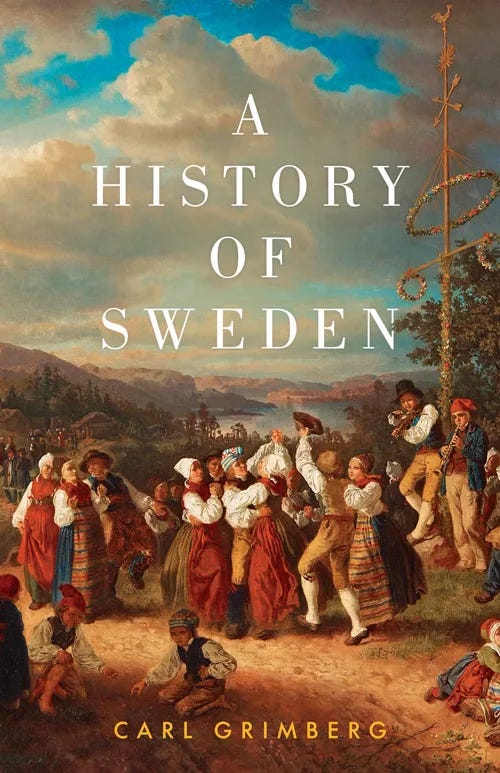
This is an excerpt from Carl Grimberg’s classic A History of Sweden — brought to you in English by Arktos, also available on Amazon:
Inlets of the sea extended farther into the land. Large stretches of its present fertile lands were then sea bottoms or sandy wastes. The cultivated spots were small, and it required many days to go from one village to another. The Dwellings of the Stone-Age People. The best known village site from the early stone-age days lies in a field near Alvastra, which at that time was a shallow arm of a lake. Here have been found remains of a large raft of logs, and brushwood, which people more than four thousand years ago pushed out some three hundred feet into the marsh. On this artificial island they found protection against enemies and wild beasts. For whoever attempted to approach the place would sink helplessly into the mire, and the water was too shallow for the use of boats. Only on footbridges could anyone reach the huts. Such bridges could readily be taken up at night, or upon the approach of an enemy. Remains of such bridges have actually been found near Alvastra. In the same layers, archaeologists have also found remains of utensils, tools, and weapons of stone as well as offal or remains of meals. From the latter, one may learn what sort of animals, tame and wild, the stone-age people lived on and hunted. Thus have been found the bones of four kinds of wild animals, now extinct in Sweden: the wild boar, the aurochs, the wild cat, and the beaver.
From the hard and tough bones of the wild cat, excellent bodkins were formed, and the long and sharp tusks of the beaver furnished splendid chisels. On this artificial island, then, the people erected their huts, made of a framework of poles intertwined with twigs or reeds and plastered with mud or covered with sod. Near the shores of many of the lakes in central Europe remains of similar villages have been found. The huts have, however, been built, not on rafts, but on piles driven into the bottom of the shallow waters. Generally, however, the stone-age people erected their dwellings on solid ground. For protection against attack, they constructed as an entrance a long, low, covered passageway, through which one had to crawl to get in. Such an entrance to the hut was a valuable invention. It served as a protection against wintry winds as well as against attack. Should an enemy come crawling through the dark passage he would not be in position to use his weapons to advantage and would be met by fierce dogs, the faithful family guards.
Let us make an imaginary visit to these huts. The most important piece of furniture in the hut is a stone used for a seat and which may also serve for a table. Bundles of fine twigs also serve for seats and at night for beds. The glowing fire on the stone hearth gives the place a cheerful, homelike appearance. At the one end of the hearth is a deep depression to rake the ashes and coals into. Fire was kindled by the stone-age people in various ways: by striking flint and iron pyrites together and collecting the sparks in tinder or dry leaves and blowing them into a flame, or by rubbing rapidly and patiently two dry pieces of wood against each other, or by using a stick as a drill against a dry piece of wood and whirling it rapidly between the hands or by means of a cord.
Karl-Olov Arnstberg’s The Sweden Syndrome: How Elites Commit National Self-Destruction — available from Arktos and on Amazon:
Food, Clothing, and Occupation
The village huts are now empty. It is the time of late summer. Most of the men are out on a hunt. Others have just returned with some fine fish, caught in the lake with bone hooks. Near the shore we see a few cows of stunted growth grazing, and near by a flock of sheep and goats feeding. In the adjoining woods a herd of grunting swine are feasting on a rich supply of fallen acorns. A few small, shaggy horses also add to the wealth of the village. On the small cultivated clearings we see the ripening barley waving in the breeze. On other clearings the wheat has been harvested. A woman is busy grinding meal by crushing the grain in a stone mortar. As evidence that the early stone-age people in Sweden practiced agriculture, there have been found on their village sites charred grains of the small variety of barley still cultivated in the most northern parts of Lapland. Remarkable, too, are the charred pieces of crab apples that have been found in various places. The apples were gathered in the fall, cut in sections, dried, and kept for winter use. Another of their means of sustenance during the long winters was hazelnuts. Large masses of shells found bear testimony to this fact. There has also been found a stone with a hollow in it in which the people evidently cracked the nuts with smaller stones, which have likewise been found in the same place.
In another part of the village we see a group of women making garments of skins, or pelts. With bodkins made of the tough bones of the wild cat, they pierce holes near the edges of the skins and bind them together with fine threads or thongs of sinews, or tendons. This is their way of sewing. There is also another workshop in the village where an elderly man is engaged in making flint tools and weapons for war and the chase. Other kinds of stone he has shaped into axes. Some tools are sharpened and polished by rubbing them against other stones and applying sand and water. So excellent are these stone implements that men today have used them to fell trees and build a cabin with considerable ease. Most of the flint used by the people of these villages came from Skåne and Halland, where it was quite plentiful.
In Skåne many people were engaged in hacking loose with picks of deer-horn clear lumps of flint from the large chalk beds found there. From these two provinces large quantities of flint were carried to the northernmost part of the peninsula by a system of traffic known as barter, or the exchange of goods, for money had not yet come into use.
Suddenly there is a stir in the village. Some hunters have returned with a valuable catch. The object of the chase had not now, as ordinarily, been the deer or the wild boar of the neighborhood. The quest had been the powerful and stately aurochs. In the meantime, however, the hunters had encountered a pair of bears, and a life-and-death struggle ensued. To sustain life they were compelled to risk life. The hunters triumphed and brought home two fine bearskins and a large supply of meat. The women now bestir themselves to kindle fire in the huts and prepare the feast. The meat is cooked in a large earthen kettle suspended over the fire. The kettle appears to us coarse and clumsy, but not so to the village people, who have even tried to ornament it by engraving and various zigzag lines. Members of the family sit around in an expectant mood. When cooked, the meat is cut up into smaller pieces with flint knives. For forks, fingers are used.
Race Connections
The people thus described were the ancestors of the modern Swedes. They belonged to the great Teutonic race, which in the course of time has differentiated and developed into the German, Dutch, English, Swedish, Norwegian, and Danish nations. By way of Denmark they entered Sweden and settled along the coast and along rivers and lakes; for there travel was easier than over the trackless land stretches, besides the fishing along the water routes furnished an abundant supply of food. Such travel was done by means of canoes, or boats, made of logs hollowed out by burning and hewing with stone axes.
READ MORE from Arktos:
“Our world will not be saved by blind scholars or jaded erudites. It will be saved by poets and warriors, by those who will have forged the ‘magic sword’ of which Ernst Jünger spoke — the spiritual sword that makes monsters and tyrants turn pale.”
30,000 Years of Identity lays out the reflections of a historian who witnessed the defining events of Europe’s new dark age. Through an exploration of thirty millennia of history, it poses the questions Europeans are now compelled to ask themselves: What is Europe? Who are we, and where are we headed?
For Dominique Venner, Europe did not begin with markets, treaties, or ideologies. It arose from a cultural community whose roots stretch back into the depths of prehistory. It is an ancient civilization, enriched by its many peoples, a common spiritual heritage, and a noble ethos that has often had to be defended.
Returning to these roots and restoring long European memory is the purpose of this book, which presents nothing less than a metaphysics of history. Here, readers rediscover what is uniquely our own: from the cave art of the Stone Age, the Homeric epics, Celtic and Norse legends, and the Greek and Roman legacy to the medieval imagination and the ideals of courtly love.
Venner masterfully uncovers the depths and continuity of European identity, encouraging us to rediscover authentic European tradition’s distinctive way of confronting life, death, love, and destiny.