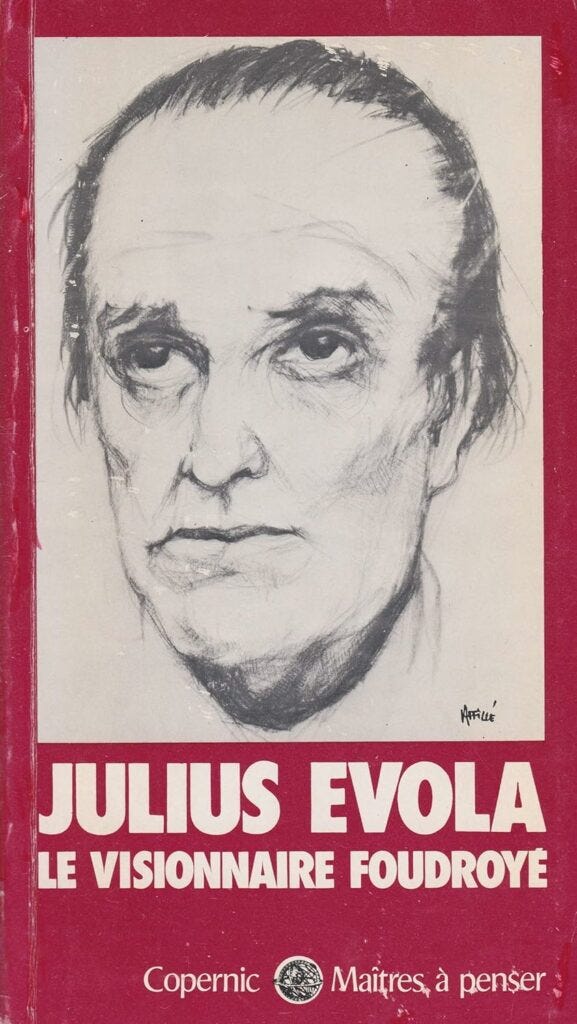
In this essay, originally published as L’itinéraire spirituel de Julius Evola in the book Julius Evola: Le Visionnaire Foudroyé (Julius Evola: The Thunderstruck Visionary [Copernic, 1977]), Jean Varenne traces Evola's trajectory from precocious Dadaist provocateur to the doyen of Radical Traditionalism.
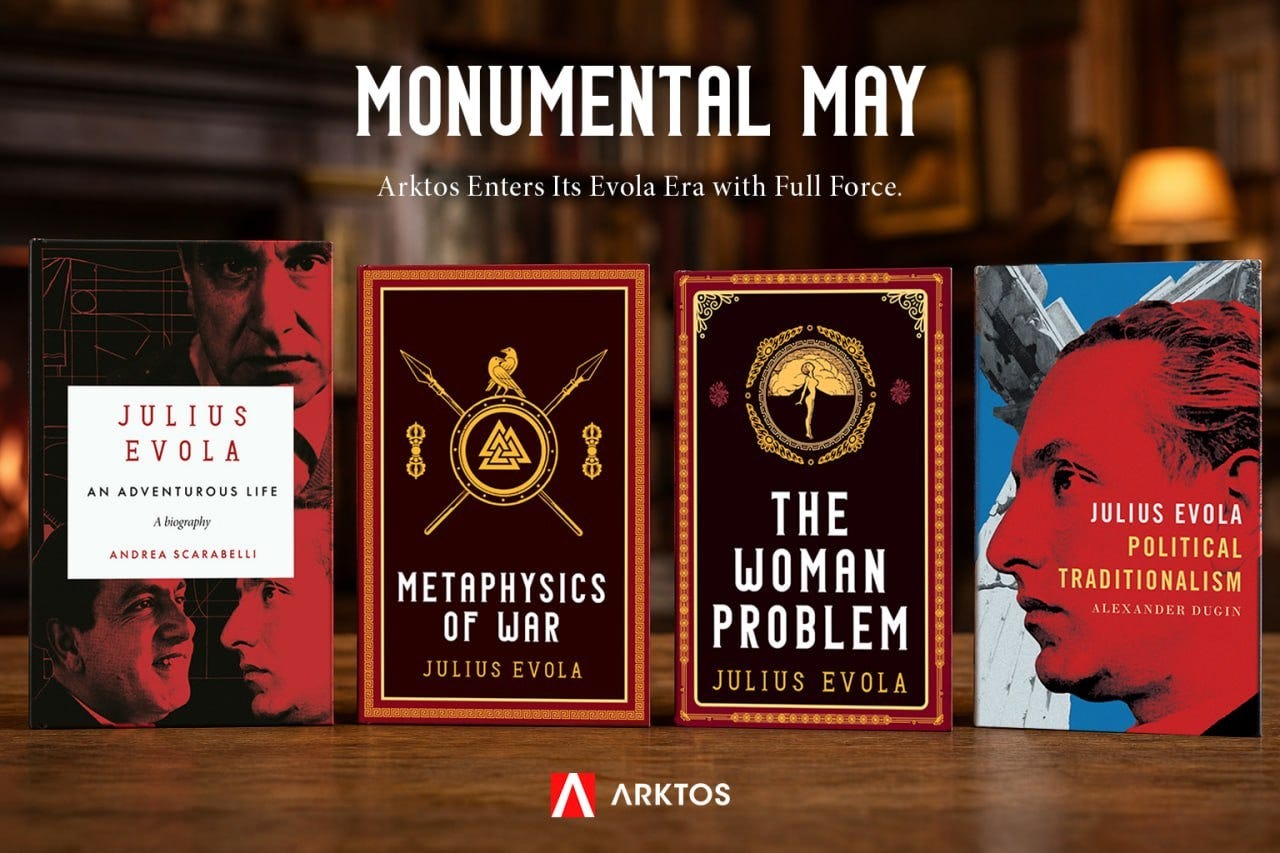
The spiritual journey of Julius Evola is unfolding in English, brought to you by Arktos:
Preorders and notifications are available at Arktos.com/shop
It was at the moment when Italy entered the war on the side of the Allies, during the First World War, that the young Julius Evola (born in Rome in 1898) began to manifest his creative activity. At that point in his life, he intended to be a painter and a poet, even though his family was urging him to take up engineering studies.
In 1917, he was at the front, and would forever be marked by the horrific spectacle of the deadly battles in which he took part as an artilleryman. In the immediate post-war period, when he was only twenty years old, he gave his paintings and his poems a decidedly “modern” turn. In fact, it was toward the most extreme intellectual contestation that he felt drawn, since he soon joined the Dadaism of Tristan Tzara, of which he became — along with a few others — the Italian representative.
From 1919 to 1922, he took part in several exhibitions, ran groups for artistic research, and published an essay, Abstract Art (Rome, 1920). That same year, a four-voice poem, La parole obscure du paysage intérieur (The Obscure Word of the Inner Landscape), appeared in Zurich, and one might have thought at the time that the young man would never be anything more than an artist, somewhat decadent, of the sort there were so many of in that era.
In reality, Evola’s life was soon to take a quite different direction, since as early as 1923 he announced his resolution to renounce all artistic activity. For a long time, in fact, he had been interested in philosophy and occultism, reading — somewhat haphazardly — a great quantity of works, mainly German and French. He would later acknowledge his debt to the Theosophists and to Rudolf Steiner, as well as the passionate discovery he made of late nineteenth-century German idealism. Otto Weininger and Giovanni Papini also held his attention, but it was Nietzsche who marked him definitively.
At twenty-five, he felt that his years of apprenticeship were over and began to elaborate his personal body of work. This was the time of the Essays on Magical Idealism (Rome, 1925) and of works on man as power, the individual and the becoming of the world, etc. He founded a circle for esoteric research (the “Ur Group,” later “Krur”) which would disappear shortly afterward (1929). During the forty-five years he had still to live, Evola would in fact prefer to keep his independence — despite a few attempts at political action, he would nonetheless always retain a nostalgia for an organization, more or less secret, in which his traditional doctrines would have been taught. But it seems that he never managed to lead any such Order, as his correspondence with René Guénon in the wake of the Second World War shows.
His first truly original work appeared in 1928: it is an essay on pagan imperialism in which he opposes the ideology of the Roman Empire to that of Christianity. The book ought to have pleased Mussolini, who was striving to present himself as the heir of Caesar; but the concordat circles,1 then enjoying the wind in their sails, could not accept the Nietzschean overtones of the work. Thus emerges for the first time the ambiguity that would mark Evola’s work throughout its development: although a sympathizer of the Fascist regime — and recognized as such — Evola would always remain a marginal figure in interwar Italy. When, for example, he attempted to found a journal (La Torre), it did not survive beyond the tenth issue; and his articles in the regime’s doctrinal newspaper concerned only “matters of the spirit” (Diorama filosofico: 1934–1943).
In reality, Pagan Imperialism constituted the culmination of the young Evola’s intellectual evolution. His passage through Dadaism was already a revolt against the clerical culture that then held sway in Italy, and his rallying to the theories of Nietzsche and Schopenhauer (such as in his book Man as Power, 1925, [later published as The Yoga of Power], and Theory of the Absolute Individual, 1927) must have appeared to him both as a prolongation of his poetic action and as preparation for a political work — one of which he never ceased to think his whole life long, but which remained very modest owing to the circumstances.
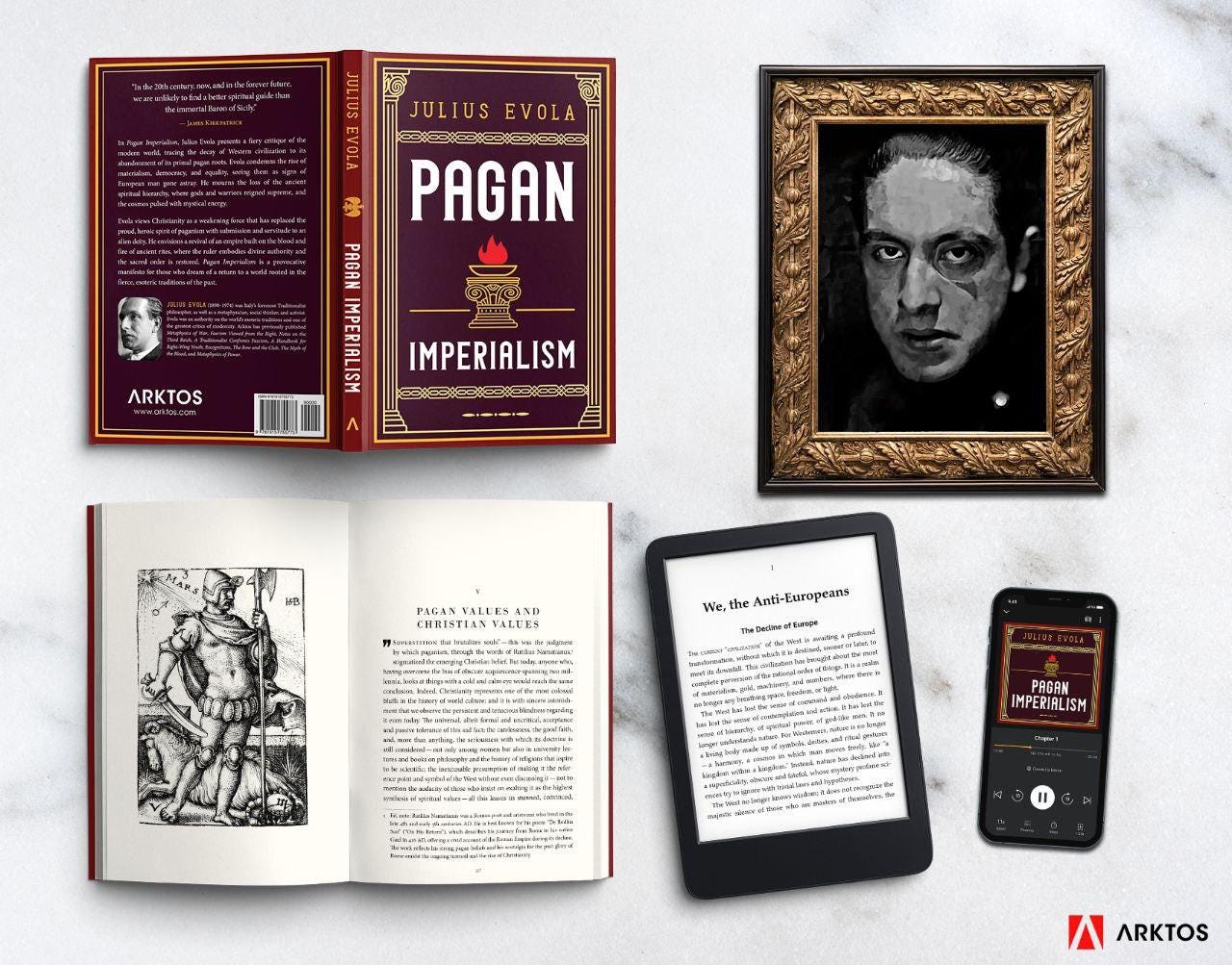
The first definitive English edition of Pagan Imperialism is available from Arktos — in hardcover, paperback, ebook, audiobook, and a special leather-bound collector’s edition:
The atrocious wound he received in Vienna in 1945 (which left him paralyzed in the lower limbs for the thirty years he had still to live) was probably felt by him as a sign of failure: in Men Among the Ruins (1953), one perceives the echo of his bitterness in the face of a world taking a path contrary to the one of which he had dreamed. It is not, however, a matter of despair in the full sense of the term, insofar as, for him, it is regression and not progress that conforms to natural laws. Evola — similar in this to René Guénon, with whom he maintained friendly relations — believed in the traditional theory of the continuous decay of the universe.
Where modern science is inclined to see an evolution, he discerns on the contrary a permanent involution which leads, in Hesiod’s vocabulary, from the (primordial) Golden Age to the Iron Age (in which we live), or — to speak as the Indians, to whom Evola also refers — to the Kali-Yuga (the demonic age), the worst of all, that which will end inexorably in a return to the original chaos. It is therefore normal that traditional values should be decaying in our era, and one consequently understands why Evola’s pessimism could not be accepted by the Mussolinian State, which claimed to be “dynamic” and “turned toward the future.”
Already in 1934 he had risen up against the world in which he lived with Revolt Against the Modern World, but it was then by placing the emphasis on the forgetting of spirituality. In doing so, Evola — like Guénon in France with The Crisis of the Modern World — illustrated the doctrine of universal involution by attempting to demonstrate that the West had lost even the sense of true spirituality, since the so-called contemporary spiritualism was, in his eyes, only a parody (see his TheMask and Face of Contemporary Spiritualism, 1932, and, from the same period, Guénon’s works against theosophy and spiritism). Both, however, were convinced that there subsisted in the West a sense of traditional metaphysics in certain secret societies (which they did not name), and that the ritual and doctrines of one or another institution attested to its survival, often unbeknownst to their faithful.
This position led Evola to take an ever-greater interest in Western esotericism (see his The Hermetic Tradition, 1931; The Mystery of the Grail, 1937) as well as in Eastern traditions, notably Hindu (as in The Yoga of Power, 1949) and Buddhist (The Doctrine of Awakening, 1943). But this interest also bears the mark of the originality of Evolian thought as compared to that of his French counterpart. Intuitively, the Italian senses that ideal sovereignty must have two faces: that of a priest-jurist and that of a warrior. Not through the juxtaposition of two autonomous figures (symbolizing, if one will, the legislative and the executive), nor through the hierarchical subordination of the second to the first (the spiritual authority imposing its views on the temporal power), but rather through the intrinsic union of these two aspects in the person of a single chief — the sovereign-sacrificer, of whom, in his eyes, the emperors of Antiquity were the incarnation. Yet history clearly shows that the appearance of such a type of institution is extremely rare: most often the two powers are separated, opposed, in permanent conflict. The Indian tradition, too, bears witness to this, since the first two functions there (that of priesthood and that of empire: the castes of brahmans and kshatriyas) are clearly distinct, and even the most ancient Sanskrit texts are already strongly “Brahmanized.”
READ MORE:
Julius Evola’s masterpiece on the warrior spirit in the ancient and modern worlds, Metaphysics of War,is available in a special leather-bound collector’s edition from Arktos for readers in the United States and in Europe:
It is in this clerical literature that Evola is able to recover the ideas dear to him: Tantrism and, in a certain sense, Buddhism are in fact the only two schools where the values of dominion, power, and glory are brought to the fore. In both cases, it is taught that the individual must make himself master of himself in order to be able, should he so desire, to act upon beings and things. And since the acquisition of these powers is necessarily accompanied by a deepening of the metaphysical and religious knowledge transmitted by the masters, one may say that the Tantric man and the Buddhist sage are, in a sense, the very image of that ideal sovereign-sacrificer of whom modern societies want no more.
One sees that such a reading of the Indian texts leads back to what the West calls magic, and for Evola (as for Guénon) this can be no accident: these various currents of thought are nothing but the multiform, contingent expression of a “primordial Tradition,” unique by definition and “Hyperborean” in origin.
It is therefore legitimate, in such a perspective, to treat any given theme by analyzing the symbolism, the ritual, the practices, the mentalities of cultural universes as distant — in space and in time — as Hermeticism, the Arthurian cycle, or Tantrism. Insofar, Evola explains, as these movements accept the true metaphysical bases, they cannot but be in perfect harmony and complement one another, even if circumstances have led them to insist on one aspect rather than another.
As an example of this method of analysis, one may cite Evola’s Metaphysics of Sex (1958), a work readily considered Evola’s masterpiece. In this essay, he endeavors to present love as the “absolute norm” in the domain of human relations. But such a norm is lived only when the lovers recognize in eros the earthly expression of the cosmic union of the male and female principles. The yin and yang of the Chinese, the purusha (”spirit” = male) and the prakriti (”nature” = female) of the Indians, the dry and the moist of the alchemists, etc., are present within each individual at the same time as they are embodied in the human race in the complementary forms of the masculine and feminine sexes.
Lovers, when they unite, thus realize, in their own way, the union of Heaven and Earth, by virtue of which our universe subsists. Moreover, thanks to an ever-greater “interiorization” of the sexual instinct, the partners progressively conquer mastery over these forces — apparently opposed, but in reality interdependent. At the end of this difficult progress lies inner harmony, source of infinite power. One can sense that it is this aspect of the “metaphysics of sex” that seduced Evola: his book is built around this central idea, and the elements it contains all converge toward bringing into evidence the unity that must be realized within oneself, so that the individual may become “master of himself as of the universe,” in the Cornelian phrase. This once again serves as an occasion for Evola to refer to the “Ghibelline tradition” (and to Dante’s fedeli d’Amore) as opposed to Christianity, which he holds to be a factor of social disorder: the “cellular family,”2 the free choice of spouses, ignorance of sexual metaphysics — all of these appear to him as further signs of that universal involution of which he wishes Western man would become conscious.
It is certain, in this connection, that Evola believed that a recovery — at least a provisional one — was possible before the coming of the “end of times,” and that he thought the most concrete political action could be a factor in the recovery in question. But we know what came of that, and it is clear that Evola will endure only through his doctrinal work (above all in the domain of esotericism and the history of religions). There is nonetheless a paradox here, of which one must hope that it will not prove prejudicial to the interest that a profoundly original body of work ought to arouse.
Embark on the spiritual journey with Julius Evola, brought to you in English by Arktos
Translator’s Note: milieux concordataires (”concordat circles”): The Italian Catholic-aligned milieux that supported, and benefited from, the Lateran Pacts of 1929 between the Holy See and Mussolini’s regime.
TN: “cellular family” (la famille cellulaire): The literal translation is preserved because the polemical force of the term lies precisely in its biological-atomizing connotation i.e. the family reduced to an isolated cell, severed from larger ethnic and traditional community. “Nuclear family” is the standard English equivalent but loses this critical nuance.