


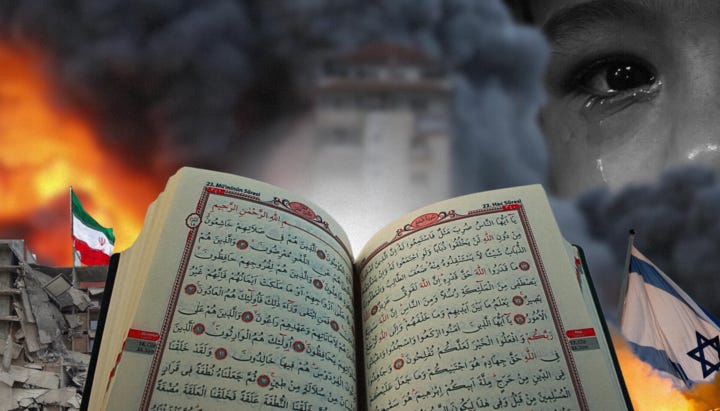
The below transcript is from Prof. Alexander Dugin’s latest episode of the Radio Sputnik Escalation Show.

Radio Sputnik Host, Escalation Show: The topic of today’s programme is inevitably tied to the Middle East. Whatever global context we consider, every issue today—be it the economy or high politics—is, in one way or another, tied to events in this region. Let’s start with the most hotly debated aspect at the moment: the likelihood of a ground operation by US forces against Iran. We are no longer talking just about the islands. Predictions of a possible attack on the coastline or even on strategic targets directly on the mainland are becoming increasingly common. The situation is paradoxical: from a military standpoint, Iran’s leadership has repeatedly stated that they are literally ‘waiting’ for this invasion so they can deliver a decisive blow. Tehran’s political leadership is projecting confidence, emphasising that it is not afraid of direct aggression. In your view: how realistic is a US ground operation in Iran? Is this a deliberate plan, a bluff, or a risky game with extremely high stakes? And, if it actually takes place, what fundamental purpose might such an attack serve?
Alexander Dugin: Here, one must consider the broader context. American operations involving invasion and regime change in recent decades have succeeded only under one condition: there had to be a layer within the leadership of the target country that had already concluded a traitorous agreement with the Americans. Without this, they never succeeded in anything — such operations did not even begin.
The scenario is always the same: first, threats are issued, troops are deployed, and air strikes are launched. Then — whether by the Americans, their local allies, or ‘their own’ hands — the figure embodying resistance, sovereignty and consolidation is eliminated. They are either discredited or physically eliminated.
And then comes the inevitable betrayal. I am referring to what I call ‘the sixth column’. This is not the ‘fifth column’ that takes to the streets to protest — in repressive regimes, such as China or Iran, they can simply be arrested, and that is the end of the matter. The ‘sixth column’ is the Americans’ main strategy and the greatest danger. These are people in the highest echelons of power, close to the sovereign state ruler. There is always someone ready to strike a deal with Washington in order to rise from second or third in command to first. Since the Americans declare war specifically on the leader, those next in line enter into negotiations in order to drastically change their social status.
That is the only thing that has ever worked. Ever.
In Iran, however, the situation is different. Ironically, the potential ‘sixth column’ — those who, in theory, could have struck a deal with the Americans — was swept away by the very first strikes by the US and Israel. There is simply no one left in the leadership who is prepared for separate negotiations.
Identifying the ‘sixth column’ is extremely difficult: formally, these people are absolutely loyal; they swear allegiance to the state, yet in reality they play secret games with the enemy. It was precisely on them that Washington relied in Iraq, Libya and Syria; all the ‘colour revolutions’ from Venezuela to the Middle East were built on this principle. But today, there is no such scenario in Iran. For the first time in a long while, the Americans will have to fight for real.
They face a country with a population of 90 million and a landscape even more impassable than Afghanistan’s. The Iranians will not forgive the deaths of their leaders and children — the killing of 165 girls by missiles has united people against the aggressor, even those who disliked the regime. Defeating such a people in high-altitude terrain, following such monstrous crimes by American imperialism, seems an impossible task. America simply lacks such experience. If they decide on a full-scale invasion, it will become a second Vietnam for them, only far more terrible and protracted. This campaign will drag on for years and is highly likely to end in disaster.
Moreover, the US has virtually no allies for a ground operation. Israel is on the brink: the IDF is suffering colossal losses in Lebanon, the ‘Iron Dome’ intercepts only a small fraction of the rockets, and the country’s territory itself is gradually turning into a version of Gaza under a barrage of strikes from Hezbollah and Yemen. Israel is on its last legs; a mass exodus of the population is about to begin there – they have no time to help an ally. As for the Arab monarchies, their infrastructure has been undermined, and they themselves are too accustomed to a life of luxury and financial speculation to go to war. Some of them, such as Qatar, may well refuse to get involved in this adventure altogether.
Resistance in support of Iran will flare up in at least four major hotspots: Iraq, Yemen, Syria, and the Lebanese Hezbollah. What the Israeli occupiers are doing today in southern Lebanon is provoking revulsion not only among the Shia, but also among the whole of Lebanese society, which was previously prepared to make any deal with the West. In Syria, the situation is no less tense: even if al-Sharaa was brought to power with the involvement of the CIA and Mossad, he is compelled to respond to the people’s aspirations, and the Syrian ‘streets’ are fiercely anti-Israeli.
This anti-Zionist sentiment is capable of stirring up the Sunni world, particularly in Saudi Arabia, Egypt or Algeria. All it takes is a spark — for example, an attack on the Al-Aqsa Mosque. Yesterday, the Latin Patriarch Pierbattista Pizzaballa was barred from entering Jerusalem on Palm Sunday. This is an unprecedented act (the first in a thousand years), which has sparked a wave of outrage across the Catholic world. If the Zionists take radical steps against Islamic holy sites, Israel will find itself at a critical juncture. How can there be any talk of a ‘Greater Israel’ when the very existence of the state is in question?
And so, in this catastrophic situation, having failed to protect its allies in the Middle East and secure its ‘Oil-Epstein’ Gulf monarchies, Trump’s America is preparing to launch a ground operation. This is taking place against the backdrop of a global energy lockdown. The closure of the Strait of Hormuz is dealing a colossal blow to the economies of China, Japan, India and Europe. We, too, cannot — and, to put it bluntly, we have no burning desire to — supply our enemies with resources.
Trump is trying to justify the invasion with the need to ‘open’ the strait, but the reality is far more dire. Last night, Iranian forces struck desalination plants in Israel which supplied 47% of the country’s water. In the Middle East, water is more valuable than oil, and now similar facilities in Kuwait and the UAE have also been put out of action in response to the strikes on Iran’s energy infrastructure.
Launching a ground operation under such conditions is geopolitical suicide. Trump lacks consolidated support at home: he faces opposition not only from the Democrats but also from a significant portion of his own electorate. His approval ratings are at rock bottom, and once the first coffins start arriving in America, the political context will become utterly unbearable for him.
Host: I fully share your scepticism about the success of such an operation. If we look at the figures: in Afghanistan, the peak strength of the US contingent reached 110,000 troops, and we know the outcome. Here, however, the force barely numbers 50,000, and yet Iran is a task many times more complex, both strategically and geographically. It looks like a deliberately unsolvable equation. In the context of your remarks about the Tomahawk strikes on civilian targets, a logical question arises: surely Washington could not have failed to understand what reaction this would provoke in Iran. The whole country came together in a single outpouring of grief at the funerals of the children who died, and hatred for the aggressor became absolute. So, is this strike not a mistake, but a matter of clear logic? Was the true aim not to provoke the very total chaos in the Middle East that we are now witnessing, following Tehran’s retaliatory actions? In your view, is this conflagration an end in itself for the US and Israel, or have they simply lost all control over the consequences of their actions?
Alexander Dugin: That is precisely the case. But I would like to add one more factor that makes any ground operation today extremely problematic: it is the radical change in the very technology of warfare. Over the past four years, we have realised from our own experience that unmanned systems — both in the air and, no less importantly, at sea — are completely altering the balance of the use of traditional means.
Today, an army of 50,000 men, with modern drones at its disposal, can effectively be reduced to the capabilities of a 5,000-strong unit. We’ve encountered this during our Special Operation: this is war for which no one was prepared; it is changing its parameters right before our eyes. Where are those much-vaunted Abrams tanks that everyone was counting on so much? They were burnt out in a couple of weeks; nothing remains of them. And now they are keeping quiet about them. Why send multi-million-dollar ‘iron’ to its doom against a small plywood drone?
The same applies to the navy. Modern underwater drones allow a multi-billion-dollar destroyer to be sunk for a paltry 10,000 dollars. This technology was used against us, and we, much to our regret, suffered losses. But this is a game for two. The Iranians are studying our experience closely. It might well be possible to capture Kharg Island, but on the Iranian shore, American troops would be as plain as day. The number of casualties they would suffer is incalculable. We ourselves went through something similar with Snake Island: it is easy to capture, but to hold it means suffering losses that are incomparable to the benefits of maintaining a presence there. It is suicide.
Moreover, Trump has no positive objectives in this war, apart from attempting to ‘open’ the Strait of Hormuz, which he himself closed. Even if one were to imagine this dubious success, it is difficult to call a situation a victory when you first break everything and then, at the cost of colossal expenditure, try to repair it just a little. Trump, of course, will count anything as a success.
I have been asked to assess the actions and statements of the American president with restraint, and I am complying with this request. I think our people have enough metaphors to describe his behaviour appropriately. We shall adhere to diplomatic norms, but everything Trump does seems less like a ‘cunning plan’ and more like the systematic suicide of the West.
Some Western analysts, among Trump’s opponents, have suddenly remembered ‘Russiagate’. They say: ‘We warned you that Trump is Putin’s agent! Look at what he’s doing: he’s destroying the Western economy, undermining the power of the United States and turning the very institution of the presidency into a laughing stock, mocked by the whole world.’ I do not wish to pass personal judgement on him — that is what his opponents say. Perhaps some consider him a great man, worthy of worship, but it seems that today no one thinks so at all — neither in America nor in the rest of the world.
In fact, under the guise of strengthening American hegemony, Trump is destroying it once and for all. The question arises: how did this become possible? I have only one explanation: an eschatological factor has come into play. This is what in the West is called prophecy. Today, a huge number of serious analysts are using this term to analyse the geopolitical situation in the Middle East.
Netanyahu and his entourage, especially radicals like Ben-Gvir, sincerely believe that the coming of the Messiah is near. They are preparing the ground for the Third Temple and the ‘Greater Israel’ project — and this is no metaphor, but a direct call to action. In America, Christian Zionists have succumbed to the same impulse: for them, the war in Israel is the final battle before the Second Coming of Christ. Pete Hegseth, head of the Pentagon speaks openly about this. He tells the troops: ‘You are going to die for the Second Coming; you are going on a Crusade.’
Most of humanity — including many Americans and Israelis — does not believe this. But it becomes an irrational, powerful motivation for key forces in the West. The geopolitics of prophecy is the only factor that explains a host of inconsistent moves. If one accepts this factor, everything falls into place: chaos and destruction are not to be feared, for they are a necessary stage of the tribulation (another term from Christian Zionism). From the perspective of Christian Zionists, a cataclysm besetting humanity is a necessary prologue to the Second Coming of Christ, and for Jews, to the first coming of the Messiah.
Host: The exchange of strikes against critical infrastructure is not merely continuing; it is intensifying: according to the latest reports, an oil refinery in Haifa is on fire, Iranian petrochemical facilities have sustained serious damage, and yesterday one of the largest aluminium plants in Bahrain was attacked. But what is truly alarming is that university buildings in Iran have become targets. Tehran has already promised a tit-for-tat response against similar educational centres in the Gulf states. Against this backdrop, a highly resonant statement was made by Iranian MP Alaeddin Boroujerdi: he emphasised that Iran’s membership in the Treaty on the Non-Proliferation of Nuclear Weapons (NPT) no longer makes sense, given that the US and Israel are effectively ignoring any international norms. This raises a logical question: if Iran is serious about withdrawing from the treaty, does this not mean that the ‘nuclear threshold’ has already been crossed? After all, logic suggests that one withdraws from an agreement when it begins to hinder the realisation of existing potential. Do you believe we are on the verge of officially recognising Iran as a nuclear power?
Alexander Dugin: Here are questions to which no one has been able to give a direct answer for decades.
Only very recently did Donald Trump openly acknowledge Israel’s possession of nuclear weapons, although analysts had been discussing this for years, whilst Tel Aviv itself had merely hinted at it. Whether Israel will use them or not — nobody knows. Nuclear status may remain in a ‘grey area’ for a long time, until certain circumstances force the cards to be laid bare.
Does Iran possess nuclear weapons? We can see that Tehran possesses excellent missile systems with a vast range. Technically, it would not be particularly difficult to transport one, twenty or a hundred nuclear warheads by sea from North Korea, whilst this route is not yet under total control, or to transport them across the Caspian Sea from our territory, or to deliver them from Pakistan.
If the Iranians were a backward people fighting with bows and arrows, one might argue about the time needed to develop the technology. But with such a powerful military infrastructure, superb missile technology and a deeply layered security system, it is merely a matter of will. The war has been raging for a month; the airspace is largely controlled by the Americans, yet missiles are methodically raining down across the entire Middle East from concealed mountain tunnels, and Iran remains unshaken.
For a long time, the fatwa of the late Imam Khomeini banning the possession of nuclear weapons remained in force. The Iranians are a wise, spiritual people; they understood that this is a hellish weapon, a weapon of Satan, bringing only self-destruction. They had compelling spiritual reasons not to resort to it. But in a critical situation, when the very existence of the country is at stake, they will either retrieve the warheads already hidden away or obtain them at any moment. Attaching a ready-made warhead to an Iranian missile, which is guaranteed to reach its target, is a matter of ‘an arm’s length’.
I do not possess classified information, but as an analyst and philosopher I’ll venture a guess: they have them. And they will use this weapon if the need arises. It will most likely not reach US territory, but a strike will be launched against American bases in the Middle East – which are already half-destroyed – and against Israel. Tehran is capable of ensuring that for a hundred years there is nothing left on this land but Chernobyl and mutants. They are capable of this – if not now, then in time.
Those people in the US and Israel who are pushing for escalation have no positive prospects whatsoever. Even if one were to imagine a local victory over Iran — which I doubt, given Iran’s defences — the outcome would be catastrophic: the Middle East and Israel in ruins, the global economy in a coma, and the image of America evoking nothing but the deepest revulsion in mankind. Israel is hated by everyone. In the US itself, a storm of antisemitism has arisen the likes of which was not seen even in Henry Ford’s day.
The level of hostility towards the Israeli lobby, AIPAC and Christian Zionists is unprecedented today.
What has Trump gained? — Instead of strengthening Greater Israel and his own hegemony, he has been dragged into a war he has already lost — morally, politically and economically. Pete Hegseth, head of the Pentagon, floated the idea of Greater America, including Greenland and Canada — apparently to divert attention from the Middle Eastern fiasco. But this is a scandal with no basis in reality.
Instead of solving domestic problems, Trump has found himself in a trap. Unless one believes the hypothesis that he is deliberately undermining the foundations of Western dominance, there remains only one explanation: he and his entourage have become hostages to a prophecy. These are suicidal actions. There are successful wars, such as the short-term capture of Iraq, although even that turned into a protracted dejection. The destruction of the Iranian leadership was a tactical success, but the backlash has exceeded all expectations. In the long term, there is not a shred of positivity here for the US.
It is self-destruction. If we recall ‘prophetic geopolitics’, then all the current catastrophes fit logically into the eschatological scenario of the dispensationalist Protestants who are now in charge in the White House. The place is run by people like Paula White – a female pastor who speaks in demonic tongues and practises hypnosis. These fanatical figures, in alliance with Israeli politicians gripped by messianic mania, are creating a completely irrational bloc at the head of the collective West. Europe recoils in horror from this: even such loyal politicians as Viktor Orbán admit that barring Cardinal Pizzaballa from entering the temple is simply beyond the pale.
Host: Incidentally, Netanyahu did eventually issue a permit allowing the cardinal into the temple. Admittedly, he did so only the day after Palm Sunday.
Alexander Dugin: For Catholics, today is already Holy Monday, the first day of Holy Week, whilst our Orthodox Easter this year will be a week later than the Catholic one. But in spiritual matters, it is vital to do everything at the right time. If a person is not allowed to attend the holiday feast or, say, is promised access to the Holy Fire the following day — that is a cold shower.
To explain what is happening by anything other than maniacal ‘prophetic geopolitics’ is, in my view, simply impossible. But look: there is an internal logic to this madness. If one sincerely believes in the messianic moment — as do the Christian Zionists, such as those surrounding Trump, like Pete Hegseth, Paula White and Lindsey Graham, or as the Israeli radicals around Netanyahu believe — then every action they take is justified.
They are living ‘on loan’ from the coming eschatological times. They are spending the ‘capital of the Messiah’, who, in their deep conviction, is about to appear. All their actions are performed on the verge of a foul. It is like jumping from a high tower in the hope that they will be caught at the last moment. Remember how Satan tempted Jesus Christ: ‘Cast yourself down, for it is written: He will command His angels concerning you, and they will lift you up in their hands’.
What Trump and Netanyahu, America and Israel are doing now is precisely that leap from the tower. They believe that the angels of hell will catch them in their fall and grant them world domination. This is a very real satanic temptation. Therefore, the geopolitics of prophecy is not fantasy, but an active and extremely dangerous force.
Host: Let us turn to a figure whose stature is incomparably lower than that of the aforementioned leaders of the West and the East, but who constantly tries to stay on the news agenda. I am referring to the outgoing President of Ukraine, who suddenly travelled to the Middle East and even signed certain agreements in the United Arab Emirates — ostensibly concerning the supply of diesel fuel and other matters. It is clear that on a global scale this issue is far less significant, but for us, for Russia, in the context of the ongoing Special Military Operation, it remains relevant. What is your opinion on Zelensky’s appearance in the Middle East — at this very point of global upheaval and bifurcation? Why did he go there, and what political goals is he pursuing in the current situation? And most importantly — will he achieve them? After all, many experts agree that people have simply stopped paying attention to him against the backdrop of global upheavals.
Alexander Dugin: Firstly, people have certainly stopped paying attention to him. When the giant demons entered the fray, nobody cares any longer about the minor devils and non-entities like Zelensky. He is trying to fit into the coalition of these big demons by reminding people of his existence, saying that he too can cause trouble and kill. But these are merely desperate attempts. Previously, when the main forces were only just approaching, a huge magnifying glass was placed before him; he was projected like a hologram onto the world’s screens; parliaments applauded him. That was just a warm-up. Now, however, with the arrival of the big demons, he has, of course, proved to be insignificant in comparison to them.
His ‘help’, of course, has no effect whatsoever. Some drones arrived — the Iranians immediately destroyed them along with the Ukrainian crew.
It is one thing to fight us on familiar territory, where they have been digging in for years in defiance of the Minsk Agreements. In the Middle East, the landscape is different: there they are as plain as day; there, eliminating their experts and Zelensky himself is easier than easy. After all they have been through, the Iranians have dispensed with unnecessary formalities.
You have touched on an important topic: why are the Americans and Israelis, like true butchers and maniacs, striking at universities, destroying thinkers, scholars and students? Because this is a war of the spirit, a war of darkness against light. They understand: Iran’s strength lies not only in missiles, but in hearts and minds, in education and culture. We too should take note of this. The enemy is well aware that sovereign science and education are the fundamental resources of society, upon which everything rests.
Attacks on universities are not merely madness or a breach of conventions. The enemy strikes at the very heart, because this is a war of ideas. On one side lies their prophecy; on the other, the Iranian, or our own vision of where Russia should stand in this critical era of the end times. The idea of prophecy is no empty concept. They have framed it one way; the Iranians another. We, however, have our own mission: the role of the Katechon, the one who holds back the coming of the Antichrist. Our rulers inherited this role from Byzantium.
Every participant in the current conflict — both in Ukraine and in the Middle East — has their own map of this final battle. And if the enemy is targeting universities, it means that independent thought is a crucial component of this war. We need to draw many conclusions from the events in the Middle East, but this one — about the significance of thought and spirit — is, in my view, of paramount importance.
Host: And finally, an interesting question that has come to us via our Telegram channel. It concerns the possibility of a so-called ‘Easter truce’: What do you think, Alexander Gelyevich, could this great holiday — be it Catholic Easter, which is currently being celebrated in the West, or our Orthodox Easter — have any impact on the intensity of the fighting? Are any gestures from Iran or Israel connected with these dates possible, or are such respites now unthinkable given the current eschatological tension?
Alexander Dugin: I don’t think so. Absolutely not. As for Orthodoxy — it is our faith, the faith of our peoples, and Orthodox Christians are not directly involved in this particular escalation in the Middle East. As for Catholics, they condemn this war, and persecution against them is now effectively beginning in America. Catholics are once again being accused of antisemitism, being turned into a sort of scapegoat within the framework of the US’ new radical-messianic policy. Hence the bans, hence the mockery directed at them.
The Pope recently issued a strict ban on praying for those who unleashed this carnage.' ‘Their hands are stained with blood,’ said the pontiff, ‘we do not pray for them.’ This is a very important point: the universal Christian tradition implies prayer for all, for the soul and heart of a person are a mystery, and it is the Lord who must judge, not us. But if the head of the Catholic Church – the largest denomination, uniting one and a half billion believers – has acknowledged that it is forbidden to pray for Trump, Netanyahu and the Zionists who started this war, then this is an extremely serious signal. In such an atmosphere, there can be no question of any ceasefires.
Host: So, to summarise: Easter will not stop Iran’s strikes on Israel, and we should not expect any lull?
Alexander Dugin: The Jewish tradition fundamentally rejects Christ, so Christian holidays have no bearing on that side. Muslims, for their part, do not celebrate Easter — they have their own calendar and their own holy sites. Thus, the key players in this process are not mentally or spiritually connected to Easter. And ‘the civilisation of Epstein’ in the form of the modern United States has absolutely no connection whatsoever to this great holiday. I am convinced that Easter does not hold any sacred significance for any of the direct parties to this conflict. Within their frame of reference, there is no point in ceasing hostilities in this context. The Christian calendar is by no means a factor for this war.
READ MORE by Prof. Alexander Dugin, brought to you by Arktos:

Dugin is correct, it is about Eschatological workings that most people including Christians in this country are largely unaware of...the hypocrisy of Jesus words juxtaposed to Gaza genocide was something I could not let slide, nor any other human being let slide....as for the inverse term of antisemitism.....seems the occupiers genociding their neighbors is the REAL anti-semitism.....