


Marco Romano presents the rediscovery of the Indo-European legacy as not only a restoration of origins, but as a source for spiritual and civilizational renewal.
Most scholars — historians, linguists and archaeologists — now agree on one irrefutable fact: there was an original people, or Urvolk, from which other peoples branched out, in a process of conquest that spanned millennia, and settled across the world, from Europe to India. This geographical expansion is what gave rise to the name by which we refer to them today: Indo-Europeans. We now know that they even reached the borders of present-day China. However, once this “Indo-European fact” has been established, a crucial question arises: What should we do with this historical truth?
The interest that many people have in their ancestral homeland, or Urheimat, stems from a deep desire, especially among Europeans, to learn about their history from the very beginning. However, understanding one’s past is not merely an academic exercise. In a sense, it means embodying it again, learning its legacy, and breathing new life into it. This is done with the awareness that our identity cannot be denied or forgotten, but is destined to re-emerge in different and unexpected forms.
From this perspective, history is not a linear narrative of progress, but rather a perpetual struggle between peoples and ethnic groups with a different ethos. Today, Europeans tend to identify with a cultural koine that can be traced back to Greco-Roman civilization — or, more specifically, to its dissolution and subsequent reinterpretation by the Frankish kingdom and the Carolingian dynasty. The result is a predominantly Franco-German Europe, rather than a union of peoples aware of a shared history and, above all, a common sense of belonging.
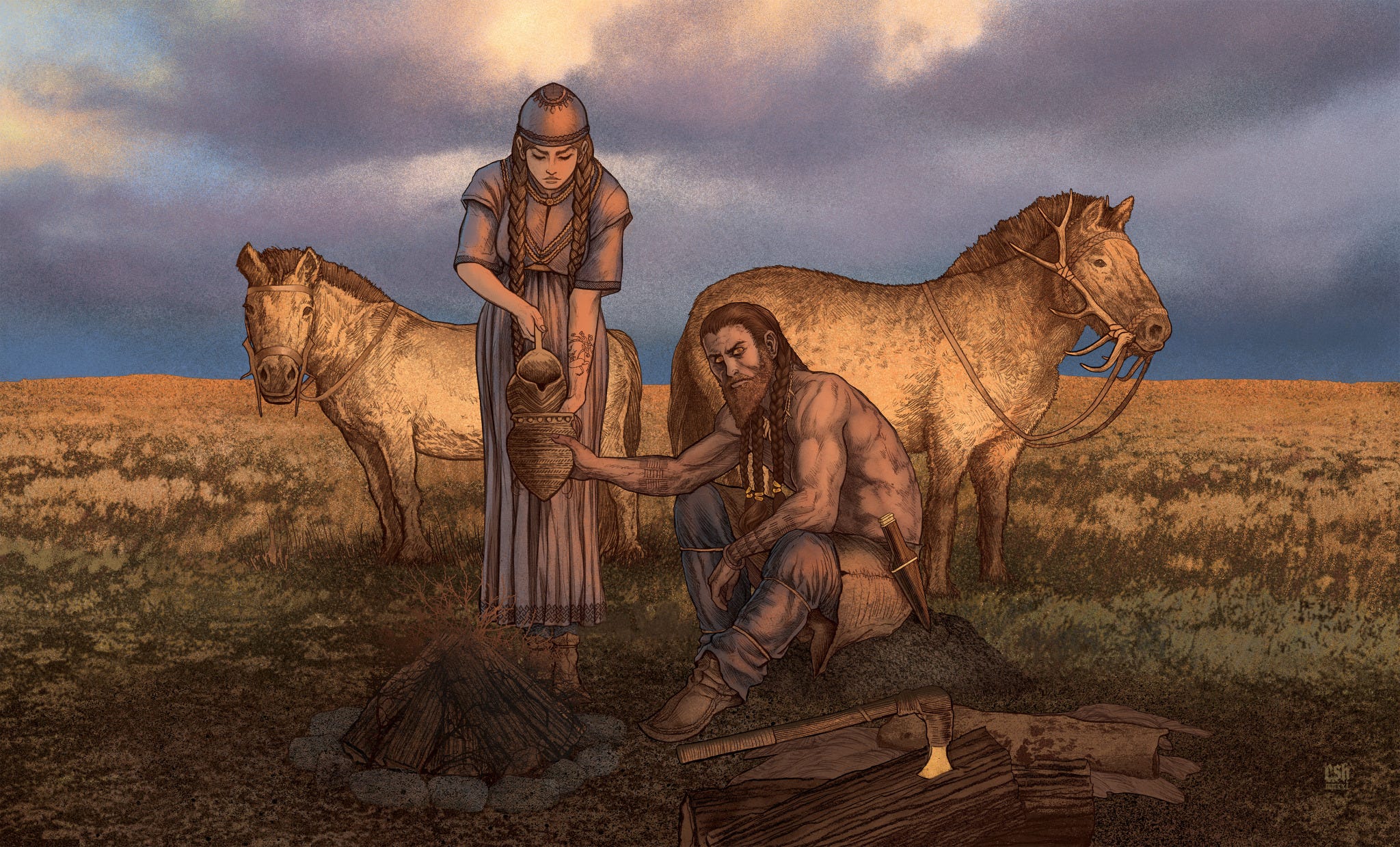
But who were the Indo-Europeans? The linguist Émile Benveniste offered a powerful definition of these original people, describing them as follows:
“Small groups of highly organised, fearless individuals who build their order on the ruins of pre-existing structures [...] They will retain all […] the distinctive features of their community of origin, including an aristocratic style, a society comprising priests, warriors and farmers, royal sacrifices (the most significant of which is the Vedic asvamedha sacrifice involving a horse), a conquering instinct, and a love of open spaces.”
The main tool used to explore the world of our ancestors is comparative linguistics. By comparing languages that are similar in terms of their structure and vocabulary, such as Latin, Greek, Sanskrit, and the Germanic, Slavic, and Celtic languages, it is possible to reconstruct Proto-Indo-European, the mother tongue. Through language, and with the support of archaeology, we seek to reconstruct the Weltanschauung – the worldview – of these people. This is how the principle of the trifunctional division of their society emerged clearly, divided into three fundamental castes: the religio-legal, the martial, and the productive, a pattern that we find in almost all derivative societies.

Faced with this reconstruction, we realize that we are not dealing with mere historical curiosity, but with an ontological battlefield. What emerges from the mists of the past is not just an artefact, but a spiritual weapon. What we need is a mythical foundation, in the Lockean sense of the term, on which to rebuild the European nation. We need a myth capable of unleashing a metaphysical war, a polemos, against the dying principles of the modern era.
In this sense, the discovery of the Indo-Europeans was not a linear progression of knowledge, but an exaiphnes – a moment of sudden rupture in European historical consciousness. From the ruins of the Judeo-Christian myth emerged an antagonistic principle: a pagan world no longer based on sin and redemption, but on the sacrality of life and conflict. This world was hierarchical and celebrated qualitative differences between people and roles, standing in opposition to egalitarianism, which levels everything to a common denominator of mediocrity. This same world was circumscribed by blood and gens, standing in radical, irreconcilable opposition to atomizing individualism and abstract universalism.
This principle does not propose evolution, but revolution. It is a return that is not nostalgic, but heroic, breaking the progressive and nihilistic timeline in order to affirm spherical time. According to this vision, the Indo-European past is not a stage in the past, but an eternal center of gravity and a reservoir of meaning that is always accessible — one whose circumference is nowhere, because its principle can manifest itself at any moment in history to those who have the will to impose it.
The Indo-European heritage is not a refuge for spiritual archaeologists. It is a call to arms. It provides the foundation for a total counter-narrative that challenges the dying koine of a Christian-egalitarian-universalist Europe.
Accepting this legacy means embracing a heroic and tragic worldview: one of a Europe that, conscious of its genetic and spiritual identity, cannot and must not allow itself to give up a single inch of ground, on penalty not of political defeat, but of utter extinction. It means replacing universal compassion with tribal pride; the search for perpetual peace with the competitive tension of life; faith in linear progress towards nothingness with fidelity to a spherical time where every moment is charged with eternity and can become the center of a new configuration of the world.
The discovery of the Indo-Europeans does not offer us truth alone, but a choice: We can continue to wander the desert of flat time like the ‘Last Men,’ administrators of a present without glory or destiny. Or we can make the present moment our exaiphnes: a turning point at which the existing order of being stumbles and a new, ancient yet futuristic order bursts forth with the force of a reawakened myth.
The challenge is to embody those “highly organised, fearless individuals” and to build our order on the ruins of existing structures. Not to escape into the past, but to unleash the rebellion of Spherical Time in the heart of the flattest present. The principle is here and now. It only awaits a new aristocracy of the spirit with the courage to impose it.
Translated from Italian, originally published in Identitario
