


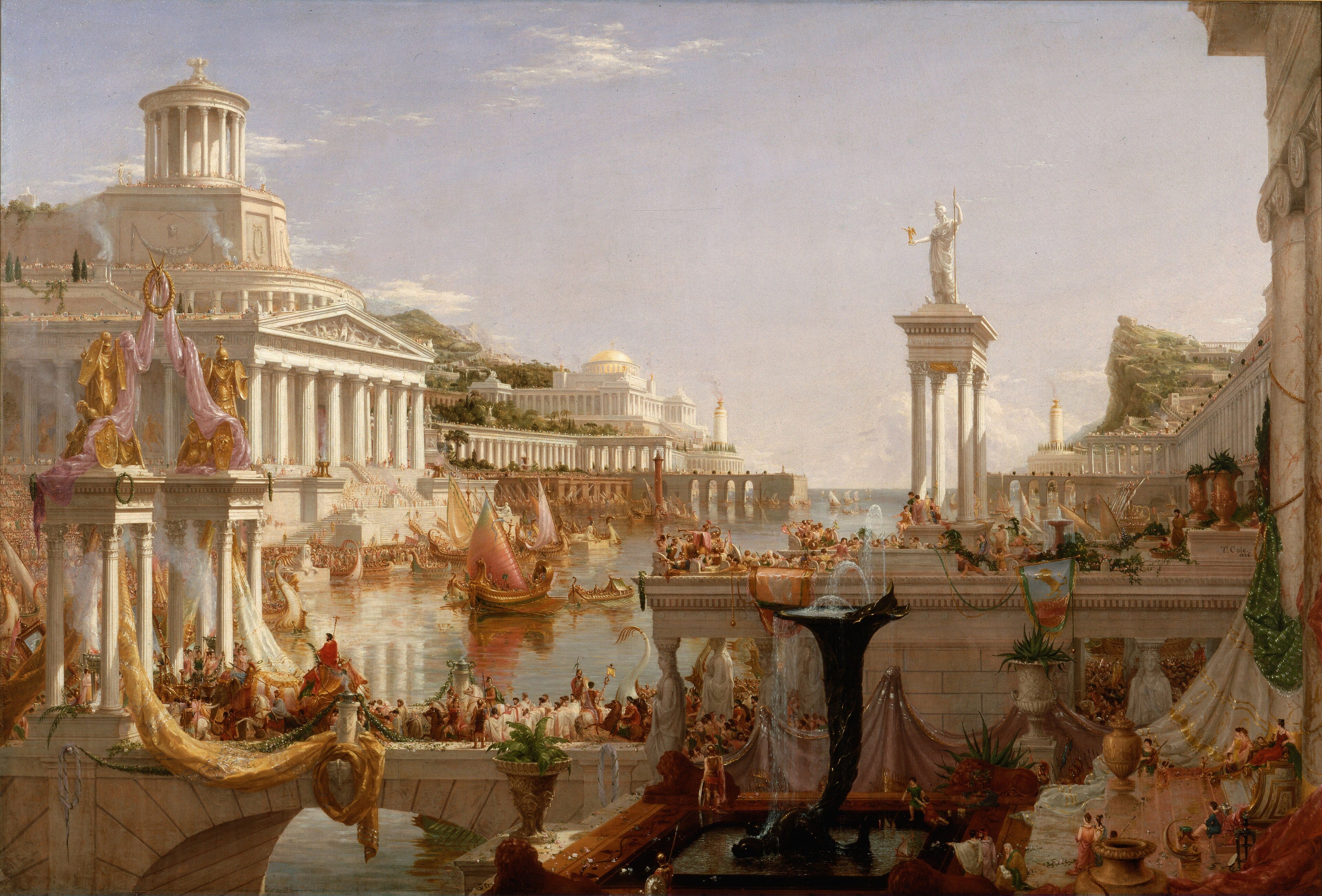
In 27 BC, following a long period of civil wars, the Senate bestowed upon Octavian, who was already both imperator for life and princeps, the title of Augustus, meaning ‘the most illustrious one.’ In a world where authority held an eminently sacred character, the adopted son of the divine Caesar became the pontifex maximus only a few years later, thus assuming the highest office in Roman public religion. He was the holder of auctoritas, i.e., the wielder of a power founded on a moral superiority of an almost supernatural nature, surpassing the mere exercise of legal power (potestas).
According to Virgil, Jupiter had promised Venus this favourable status for all descendants of Aeneas, who had fled Troy to reach distant Latium. As for Augustus, he claimed to be a descendant of this mythical lineage. The connection established with the Greek epic did not simply link Rome to the immense prestige of Hellas, but also indicated that the benevolence of the gods responded to the conquests of a people. Indeed, Rome dominated a large part of the known world and, to that extent, its sovereign proved universal. Despite its many transformations, the imperial model remained the supreme foundation of political legitimacy for the central powers of our continent until the start of the 20th century. In a dormant Europe forgetful of its own identity and destiny, it is undoubtedly worthwhile to reflect on the enduring nature of the imperial idea, an idea linked from the very beginning with the sacred dimension of the City-State’s destiny.
The Consecration of Power
The Empire would enshrine an enduring ascent of power, albeit one that was marked by temporary setbacks and internal divisions: since its founding in 753 BC, Rome had conquered the Italian peninsula, the Mediterranean Basin (renamed Mare Nostrum), and then Gaul. In the centuries that followed, an incredible mosaic of peoples, unified in the crucible of the Greco-Roman civilisation, found themselves subject to the prestige of the City. This exceptional feat seemed to herald an apogee of eternal permanence - which, however, was not to be. Although the Empire did persist in the East until 1453 AD, it had collapsed in the West as early as 476 AD, fragmenting into ‘barbarian’ kingdoms. This Roman eclipse would only end in 800 when, crowned in Rome on Christmas Day by Pope Leo III, Charlemagne undertook the first renovatio imperii.
Such is the great lesson of Antiquity: as a political construct, the Empire is subject to the life-cycles of ascent and decline; the model towards which Empire strives cannot be definitively attained in this world, since history can have no end. And yet, the Empire is also an ideal and a quest; this ceaselessly renewed effort to achieve rebirth thus constitutes a major element of the imperial notion itself.
As was the case with the Romans, a long rise to power established the Frankish legitimacy to restore the Empire. A victorious war leader, Clovis was baptised in 496, thus inscribing the Merovingian dynasty into the Roman Christian tradition. In 732, the Pippinid Charles Martel acquired immense prestige thanks to his victory over the Arabs at Poitiers. The Frankish domination of the West, now acknowledged by the Papacy, ultimately led to the Carolingian imperial renaissance. The old opposition between the earthly city and the heavenly one, as advocated by Saint Augustine, faded in the face of the concept of a Christian empire.
Upon Charlemagne’s death, the empire would crumble once again. On either side of a short-lived Middle Francia, two major political entities would emerge: the kingdom of the West Franks, whose kings were crowned by the archbishop of Reims, and that of the East Franks, whose rulers would soon lay claim to imperial dignity and receive their crowns from the pope. These twin powers would continue to rival one another at the heart of Western Christendom: from the 13th century onwards, the king of France would aspire to be ‘emperor’ in his own kingdom.
As for the second renovatio imperii, it would be the work of Otto I, crowned in 962 following his defeat of the Magyars in 955. Once again, military success would pave the way for a renewal of power. Indeed, the Holy Roman Empire was not only German: Italy, Burgundy and Provence anchored it in the Latin world, and it also extended eastwards, incorporating significant parts of the Slavic and Baltic worlds.
Ancient City-State, Imperial Model and Nation-State
In Rome, the empire was first born of a city: such was, indeed, the political and archetypically Greek form of the young Roman Republic, forged by heroic aspirations. The ancient city was founded on a demanding type of political organisation: the duties and sacrifices imposed upon its citizens preserved its freedom, which was the supreme common good. When the Republic finally collapsed under its own weight, despite already dominating the Mediterranean world in the 1st century BC, the Emperor became the cornerstone of a work of art of colossal proportions. Two centuries after Augustus, Marcus Aurelius would still cultivate the noble servitude of being merely the first among all citizens. The civic devotion of both the Senate and the Roman people, in whose name the Emperor acted as commander, gave full substance to imperial political order. Any occasional setbacks - and the folly of certain emperors - were thus offset by a political vitality wherein authority and responsibility fuelled each other.
The decadence of Roman civic values inevitably led to the decline of the Empire. The Edict of Caracalla, which, in 212 AD, granted citizenship to all free men of the Empire, constituted a significant step in this regard. By establishing itself in the provinces of the East, which had been superficially Hellenised by Alexander the Great, Rome left itself open to influences that would profoundly alter its political organisation, as well as the very values upon which its civilisation rested. The imperial state gradually became an apparatus that was as overwhelming as it was vulnerable.
READ MORE:
This article is an excerpt from the newly released Institut Iliade volume What We Are: The Sources of European Identity, brought to you in English by Arktos:

After the fall of the Western Roman Empire, a surprising fusion would take place between classical heritage, Christianity and the contributions of Celtic and Germanic cultures. Following a long period of sedimentation, this melting pot would give birth to the feudal system, which would re-erect political order upon a new foundation: that of the nobility of the sword. Indeed, the services offered by knights marked a return to the commitment of the ancient citizen. Throughout the West, the ultimate guarantor of this hierarchy was none other than the Emperor.
The Holy Roman Empire also stands as a continuation of the ancient City-State, insofar as it placed the elective principle at the very heart of political order, with the Imperial Diet thus replacing the Senate of Rome. The authority inherent in the imperial function was separate from that held by the sovereign over any particular people, as the empire was not synonymous with the kingdoms or principalities that it comprised. This situation remained unchanged well into the modern era in the Austro-Hungarian Empire, where loyalty to the Habsburg dynasty prevailed over ethnic or religious ties - for imperial power is rooted in a principle of subsidiarity and tends to federate political entities rather than oppress, homogenise or level them. From this perspective, the notion of empire is not synonymous with the notion of imperialism. While always centring and organising, an Empire is not incompatible with the existence of ‘nationalities’ in the ethnic and cultural sense, nor with nation-states (defined as geopolitical entities inherited from a long history), yet it does stand against the ‘ideological’ conception of the Jacobin nation that emerged from the French Revolution.
The revolutionary fatherland, in fact, constitutes an abstract entity within which equal individuals avail themselves of the same universal rights. In the name of allegedly ‘immortal principles,’ it aims to spread the light of reason among different peoples. Such discourse is also that of the young republic of the United States of America, whose ‘manifest destiny,’ rooted in biblical and Protestant culture, takes on a full-fledged messianic dimension.
For its part, the imperial notion remains inseparable from the acknowledgement of a type of sacredness that is inherent in the sovereign function: rooted in long European memory, it stands at the antipodes of the secular and universal religion of perpetual progress and against the cult of the great global market.
The Spiritual Principle of Sovereignty
More than to a governmental system or the exercise of sovereignty over a given geographical area, imperial political order relates, first and foremost, to a spiritual principle. He who assumes an imperial title is invested with the sacred power of auctoritas. A transcendent force that proceeds from Jupiter himself, the imperium was thus associated with the right to consult the auspices (ius auspicium), that is, to ask the gods for answers; it bestowed power, whether of a military, legal, or religious nature. The Emperor’s authority manifested the power of both the Senate and the Roman people, all of whom were nothing in the absence of the pietas that conformed to the requirements of the mos maiorum, the ‘way of the ancestors’: the sacrality of a pious city was thus manifested through the very person of the emperor. Such was the origin of the imperial cult imposed upon conquered nations, who, incidentally, were allowed to retain their religious identity.
During the Late Roman Empire, the decline of Roman piety contributed to the erosion of institutions and the blurring of traditional values. The foundations of the religion of the Fatherland were gradually undermined, while the Eastern cults of Mithras and Sol Invictus enjoyed ever-increasing success. They thus paved the way for the adoption of a universal religion, a religion which would become dominant from the 4th century onwards with the triumph of Christianity.
By restoring Roman imperial dignity in the West, Charlemagne remained nonetheless faithful to the Roman conception of imperium transposed into a Christian context. As a sacred institution, the empire closely united the principles of spiritual and temporal authority. Otto I’s renovatio was also consistent with this tradition, which bestowed upon the Emperor a distinct spiritual aura that remained independent of the papacy. At the beginning of the 11th century, this rivalry between two titles, each laying claim to spiritual authority, logically led to the Investiture Controversy, which continued under the Hohenstaufens with the conflict between the Guelphs and Ghibellines. Through the Gregorian Reform, the Church strove to establish a clear distinction between temporal and spiritual power, clearly subordinating the former to the latter, over which it claimed absolute monopoly. The Holy Roman Empire was thus stripped of a part of its sacred dimension, even though Dante still considered the emperor to be ‘Roman’ in the spiritual sense, i.e., to be the successor of Caesar and Augustus. Although weakened, imperial dignity did not entirely lose its pre-eminence within the respublica christiana represented by mediaeval Europe.
Renewal on the Brink of the Abyss
As a result of the Wars of Religion and the Thirty Years’ War, the spiritual unity of Europe found itself shattered, with the Empire managing to survive itself. The Westphalian system, however, would allow for a certain balance of power to be maintained until the end of the 18th century. By contrast, the events of 1789 would usher in the era of nationalism while dealing a fatal blow to the old Romano-Christian edifice: heir to the Revolution, a certain French general would then himself claim imperial dignity before precipitating the demise of the Holy Roman Empire in 1806. Following the Napoleonic Wars, the Austrian Empire, the Russian Empire and Prussia—destined to give rise to the German Empire a few decades later—proceeded to unite as part of a Holy Alliance that guaranteed the prevailing European balance of power. This would be followed by the trauma of the First World War, which would ultimately sweep away the last vestiges of imperial tradition. Although Italian fascism and German National Socialism did, to some extent, lay claim to the legacy of ancient Roman civilisation and the mediaeval Reich, these modern totalitarian experiments had very little to do with their historical models.
As for today’s Europe, it seems to be renouncing its own destiny. Indeed, most of the states it comprises openly deny the identity of our civilisation, taking credit for a European construct utterly devoid of spiritual reference. It is thus more urgent than ever to recall the historical periods during which our peoples, united by a shared sense of identity, successfully hearkened to the call of the sacred and wielded instruments of power. Let us rekindle the nostalgia for the imperial ideal in the hearts of the sons and daughters of Europe, so that our nations may reconnect with their own unique genius and acquire the ability to join forces in laying the foundations of a political order on a continental scale! For it is as Nietzsche once predicted: Europe will be forged on the brink of the abyss. In anticipation of such a moment, let us continue to erect the citadels of our inner empire...
What We Are: The Sources of European Identity, fresh off the press from Arktos, features essays by leading lights of the Institut Iliade:
Philippe Conrad / Henri Levavasseur / Jean-François Gautier / Thibaud Cassel / Éric Grolier / Jean-Louis Voisin / Christopher Gérard / Lionel Rondouin / Édouard Chanot / François Bousquet, Grégoire Gambier / Jean-Yves Le Gallou.

There is a key event that most commentators have missed. One which still resonates today IMHO.
And that is the fact that in the late C15th/early C16th, after the fall of Constantinople in 1453, Russia arrogated to itself the status of "Third Rome" and the title "Czar" meaning "Caesar".
In my view this did not meet with approval from certain Italians who wanted to preserve the Roman legacy themselves.
I also believe that they have historically been causing trouble for Russia ever since and are part of the reason for the current hostility.
They began their 'attack' on Russia with the creation of the London Muscovy Company in 1555 under Sebastian Cabot (of Venetian descent but based in England). They tried to use this body to annex parts of Russia in the C17th. And so it goes on ...
Same malevolent forces helped communism take down Russia in 1917 - and then, when that failed, backed Hitler who launched Operation Barbarossa in 1941.
The communists and Hitler were both funded by Wall Street and supported by elements in the British establishment