


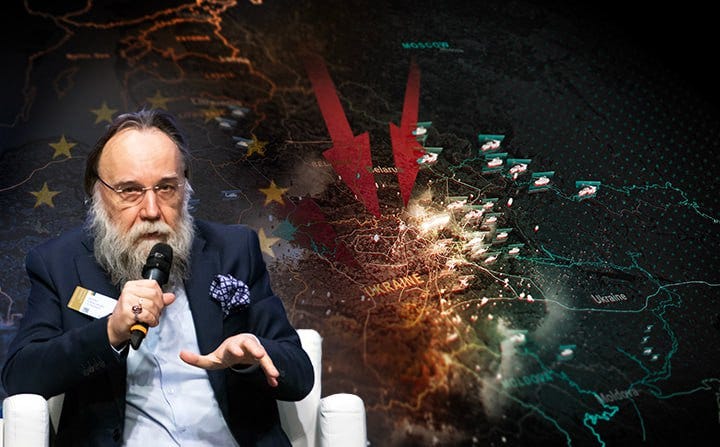
On the Escalation show of Radio Sputnik, Alexander Dugin suggests that the “fog of diplomacy” in ongoing US-Russia negotiations over Ukraine conceals a far grander and deeper process: as Trump seeks to withdraw the US from conflict with Russia to focus elsewhere, Russia is emerging as a full-fledged civilization-state focused on spiritual valor and the restoration of its historic ethnic identity.
Radio Sputnik, Escalation Host: Let’s start with the hottest topic currently being discussed in global media. It concerns the recent negotiations between the American delegation and representatives of Ukraine in Florida, and the fact that we are expecting Steve Witkoff to visit Moscow to continue the negotiation process with us. From your point of view, what might Witkoff bring with him, and what can we expect from these negotiations going forward?
Alexander Dugin: This is, of course, an extremely important topic, and no one knows the true state of affairs. Just as there is the concept of the “fog of war,” there is also, apparently, the “fog of diplomacy.” In this case, it is particularly dense. Any leak, any announcement, any analysis that appears in the press is immediately denied by the parties involved. Therefore, it is extremely difficult to understand what is really going on. This is perhaps the main point.
Nevertheless, through this thick fog, several fundamental points can still be discerned, which, in my opinion, can be considered constants in the situation.
First, Trump, by all accounts, really wants to get out of this war. He intends to stop it and present himself as a peacemaker — that is his main goal. It is quite obvious that he is deeply indifferent towards Ukraine itself; he has no serious interests there. He is now preparing for intervention in Venezuela and I wouldn’t rule out that he hopes to carry such out quickly and effectively to demonstrate how such issues are resolved with real big players; and, at the same time, to poke [at Putin]: “Hey, strong leader of Russia, Vladimir Vladimirovich, what’s taking so long messing around with Ukraine?” In other words, Trump has no desire whatsoever to fight for Ukraine to the bitter end, let alone inflict a strategic defeat on Russia. He does not want this and sees no opportunity for it. He is focused on peace. That is the first constant.
The second constant. Over the course of the meetings in Anchorage, the negotiations with Witkoff, and other high-level contacts — those conducted on behalf of Russia by a group of individuals authorized by President Putin — the outlines of what might be minimally acceptable to us have already emerged. We do not know the details, but the essence is clear: the return of four new entities, their recognition as part of Russia by the entire international community, the lifting of sanctions and harsh restrictions on the post-war existence of the remnants of Ukraine. In essence, we demand recognition of the defeat of the Kiev regime. Yes, this is not a complete victory — Odessa, Kharkov, Nikolaev, and other territories remain under the control of this Nazi-terrorist entity that we are fighting. But we have set a certain minimum threshold, beyond which, with a great deal of stretch, this could be passed off as a victory. This is our red line, our bottom line.
Trump, I repeat, doesn’t care. He is quite capable of saying: okay, let’s do it your way, just finish quickly, and we’ll figure it out later. However, we must realize that even if such agreements are reached, they will remain incomplete and unreliable. They can be revised at any moment by Trump himself, his successor, the European Union, or anyone else. This is not a lasting peace, but only a respite. We have not yet achieved a convincing enough victory to dictate final and irreversible terms. It is a respite, and the question is who will use it more effectively.
Even if Trump accepts all of our Anchorage conditions, even if he says, “I agree to everything, just stop,” it will still only be a respite. In the current state of war, we are simply not in a position to achieve a firm, long-term, and sustainable peace. We are only postponing the next stage. Meeting Trump halfway, who wants to go down in history as a peacemaker, is a serious step on our part, because it removes the immediate threat of nuclear war with the United States that has been hanging over the world in recent years. There is reason here, and the reason is precisely this: a temporary truce on this front so that humanity can have a little more time to simply exist.
Now Trump seems to be saying to the Russians: OK, you have your reasons, let’s meet you halfway; all that remains is for Europe and Ukraine to accept this. But Europe and Ukraine are responding: no way, under no circumstances. They will definitely insert at least one or two, or even a dozen points into the document that are absolutely unacceptable to Moscow — whether it be foreign troops, moving towards NATO, accession to the EU, not recognizing territories, etc. One such point, and the negotiations will immediately break down. This is exactly what is happening now.
Therefore, the peace offered to us is not the one we passionately desire. It is just a respite before a new war, and they are even trying to deny us this respite. It turns out somewhat like this: we are being persuaded to go to a show that we categorically do not want to see, the tickets have already been bought, we reluctantly agreed, and now it turns out that we have to pay three times as much and stand in line for three hours. That’s exactly how it feels.
Witkoff will arrive, we will once again underscore our red lines with a thick marker, and they will leave to think further. For Zelensky and his European patrons, signing such a plan would mean political death, the complete collapse of all their inadequate expectations. For us, it is not a victory. Trump will claim victory: he will say that he has stopped another major war. For the Kiev regime, such peace is indeed akin to death. And for us, it is not desirable either. We are focused on complete victory and on eliminating the underlying causes that made this war inevitable.
That is why the fog of diplomacy is particularly thick right now: everything is literally hanging by a thread. Peace on our minimum terms is an acceptable lesser evil, but still an evil. It is much better to continue the offensive and achieve the goals of the Special Military Operation in full. Especially since Trump is clearly not in the mood for nuclear war.
Host: Sometimes it seems that Kiev itself is not very eager to sign anything, given the composition of the negotiating team. Initially, the main negotiator was Yermak, about whom there are now many rumors. Umerov is also part of the delegation, and he is also involved in a corruption scandal. Could it be that the goal is to later say: these are corrupt officials, they had no right to sign anything?
Alexander Dugin: You can expect anything from the Kiev regime, but initially there was not and is not a single person there who is not simultaneously a corrupt official, a terrorist, a Nazi, or simply a mentally deficient maniac. They were selected precisely on this principle. That is why we say: there is no legitimate authority there and there cannot be — it will only appear after complete liberation and the creation of a new, future government. The question of legitimacy is secondary here. The main thing is the balance of power.
The US does not want a direct war with us right now. We respect this decision and are ready to support it. As for how exactly to avoid war with the United States, all means are good. After all, they also negotiate with terrorists: they give them a bus, food, sometimes even a plane — until a certain point, and then they hunt them down and destroy them like rabid dogs. The same can be done with the leaders in Kiev: sign some papers today, and tomorrow, when the opportunity arises, eliminate this entire terrorist gang.
They have taken an entire country, the Orthodox Church, their own population, and Europe’s largest nuclear facility hostage. This is one of the most massive and monstrous terrorist attacks in modern history — on par with ISIS and Al-Qaeda, which are banned in Russia. Whether Umerov is corrupt or not is completely irrelevant to us. They are terrorists, period.
America is now abandoning this regime in the same way that it once abandoned ISIS and Al-Qaeda, which it had created itself: first they nurture, arm, and finance them, and then, when the project becomes unnecessary, they bomb and destroy them. Therefore, it is completely irrelevant who exactly will sign the papers on their side.
For us, a truce is an unpleasant but possible pause that will only delay the escalation, but in no way remove it from the agenda. It is much better to continue liberating Ukraine by direct military means — the ones that, thank God, we have finally begun to succeed at.
We have fought with the West on this territory more than once before: during the Time of Troubles, with Mazepa against the Swedes, with Skoropadsky against the Germans, and with Bandera against Hitler. About once a century, a significant part of Ukraine sides with the next Western aggressor. Such is this frontier people, this traitorous people, this Judas people. Not all of them, of course — there are heroes, saints, and righteous people among them. But among scoundrels, terrorists, and murderers, there are no legitimate or uncorrupted leaders.
And since this country does not and never has existed as an independent historical entity, it is now simply a battlefield between Russia and the collective West. That’s all.
Host: Let’s wrap up the topic of negotiations. We’ve talked about America’s reasons and what we want. But what if Europe steps in and another Johnson comes along and says: we’re not signing anything, everything’s going according to plan, let’s keep fighting?
Alexander Dugin: It’s entirely possible, and to be honest, I even hope that’s what will happen. Until we liberate the whole of Ukraine and look truly menacing in the direction of European capitals, they won’t understand anything and won’t want to understand. For them, even a partial defeat will be an absolute disaster, the ultimate political suicide. For us, it will be just an inconvenient, painful compromise, essentially, a Minsk-3.
If we don’t use this respite for the complete, total militarization of society and the economy, we are finished. The West is using its time with guaranteed efficiency. So let them tear up the agreement, let another Johnson or anyone else interfere — this is just another, very convenient excuse not to go to this hateful spectacle, which no one could have forced us to attend of our own free will anyway.
Host: Returning to the topic of top-level Ukrainian scandals: who, in your opinion, could take the place of the head of the office or the head of state? The media are naming various candidates.
Alexander Dugin: It’s hard to say. They’re just a bunch of terrorists, nothing more. There are no normal, decent people there. It doesn’t really matter who pushes whom out, who eats whom alive. Zelensky might stay — he is cunning, changes his position every five minutes, a real bloody comedian, a jester, and a drug addict to boot. It doesn’t matter to us. Only one thing matters: the daily advance of our troops to liberate our own historic lands. Everything else is just petty infighting among a pack of hyenas.
Host: Dmitry Peskov has just confirmed that tomorrow Vladimir Putin will hold talks with Steve Witkoff, the special envoy of the President of the United States. In the last part of our program, I warned that I had one question that I would definitely ask. It concerns the corruption scandal currently unfolding in Ukraine and the related reshuffles in local politics. I have a very clear feeling that everyone is now actively trying to whitewash themselves at the expense of a man who has already completely discredited himself. Suddenly, publications appear: Yermak’s closest associates allegedly created a secret chat room to overthrow the “bad man” who stole state money. There is a whole wave of texts in the classic spirit of “the tsar is good, the boyars are bad”: we knew nothing, how could this be, the closest person betrayed us... Don’t you feel that this is exactly what is happening now?
Alexander Dugin: I think we are witnessing a fairly routine, banal, and extremely straightforward operation to force Zelensky to accept the Russian version of the peace treaty. This time, as I see it, it is the work of Trump’s administration. Having inherited power, he took control of a number of special service structures — the National Anti-Corruption Bureau of Ukraine, the Specialized Anti-Corruption Prosecutor’s Office, and others — which had been created long before as instruments of external pressure on the Kiev regime. Now these instruments are being used to their full potential.
The essence is simple: to force Zelensky to sign what we have formulated. Of course, everyone there is corrupt to the core, and any configuration can be built: today the main corrupt official is Zelensky, tomorrow it will be Zaluzhny, the day after tomorrow it will be anyone else. All these terrorists can be declared corrupt at any moment. Which of them is “good” and which is “bad” is a completely meaningless question.
The main thing now is that Trump has gained leverage, including over the Ukrainian special services, and Ukraine is a completely dependent territory, just a farm for the big white master from Washington. Now these unruly scoundrels, who have been running wild like at a wedding in Malinovka, are simply being brought to their senses: some are quietly shot in the backyard, others are scared to the point they wet their pants. External control has long been firmly established there, with zero sovereignty. No one has ever been interested in the opinions of their politicians, society, or newspapers, and no one is interested now.
Trump, as a businessman, is auditing his assets: he is simply shutting down or reformatting those that are unprofitable and useless. The principle is the same everywhere: if you want to weaken or remove a figure, you strike at their immediate circle, imprison their assistants, accuse them of corruption, and at the same time either look for a more obedient successor or force them to keep quiet and follow the instructions of their senior comrades.
Therefore, there is no “Ukrainian society” and there never has been. There are no Ukrainians as a historical entity either — there are only mercenaries of a terrorist brigade and their hostages. Globalists deliberately created this networked anti-Russia from our own people or those close to us — solely to cause us maximum pain. And, it must be admitted, they succeeded. An artificial state is a truly terrible thing.
So this whole “corruption scandal” is as transparent as glass, and corruption has nothing to do with it. Trump just needs Zelensky to quickly sign our terms. Zelensky, of course, is resisting — he understands that this would mean political and possibly physical death for him. The Europeans are encouraging him: “Hang in there, we’ll confiscate Russian assets and throw in some more.” It turns out to be a sinking ship or a thieves’ den surrounded by riot police: inside, there are also internal squabbles — who said what, who looked at whom the wrong way, informers running around screaming.
Will Trump force Zelensky to sign everything we demand? For us, I repeat, these are not the most favorable conditions. It’s like going to a show that we hate more than anything else in the world. For various complicated reasons, we are being lured there, and obstacles are being put in our way. Therefore, each new obstacle is a relief for us, another plausible reason not to watch this hateful “peace” play.
Peskov has just confirmed that Russia is ready for negotiations. The diplomatic fog continues — and rightly so, because there is no other way in such a situation. But we will not be fooled by these corrupt games. We understand clearly: Ukraine is corruption incarnate, only worse — it is terrorism, active terrorism, murderers and maniacs. Who to judge, who to pardon, who to rehabilitate — that’s their internal business, it doesn’t concern us at all. Let them continue stealing, let them steal everything, let them choke on those dollars — as long as they stop killing people: both ours and theirs.
Host: Let’s move on to our internal Russian affairs. A very important document has been released — “The Strategy of the State National Policy of the Russian Federation for the Period to 2036.” It contains two key quantitative indicators: at least 95% of citizens should feel a pan-Russian civic identity, and at least 85% should positively assess the state of interethnic relations. Question: Can these indicators be objectively measured using sociological surveys?
Alexander Dugin: You know, sociology is an extremely complex subject. I am a doctor of sociology and can say with certainty that it is deeply wrong and simply impossible to consider sociological surveys to be accurate measurements, as in physics or mathematics. Any formulation of a question in itself allows for a multitude of interpretations, nuances, and contexts. Nevertheless, it is possible to obtain some approximate, albeit not absolutely accurate, representations based on correctly conducted research. This is, in general, a useful thing, a very useful tool, but it is not a mathematical science. When we try to translate social processes into numbers, we immediately understand that these numbers are not entirely accurate values, but rather trends, vectors, directions of movement. Therefore, it is impossible to strictly and rigorously calculate the level of Russian identity or the real balance of interethnic relations with a calculator in hand. However, it is not only possible but also necessary to identify trends and general directions.
But let’s return to the document itself. In my opinion, this document is truly historic and epoch-making. It contains so many wonderful, profound, and fateful ideas that it has become one of the central worldview texts of our time, along with Decree No. 809, the Foreign Policy Concept, and Decree No. 314 on historical education.
What is the main point here? First, at the level of an official document, at the level of a state concept, it is stated directly and unequivocally for the first time: Russia is a civilization-state. While this thesis had already been enshrined in the Foreign Policy Concept, it has now entered domestic policy as well.
Russia is a civilization-state both externally and internally. This is fundamentally important. It is not just a nation-state in the Westphalian sense, but a civilization-state that unites many different peoples, that is supranational (if you will) and, undoubtedly, a supra-ethnic entity with strategic unity. This is stated in the very first lines of the document. It is extremely important. Now the term “civilization-state” has acquired full legal significance.
The second fundamental point is the affirmation of the central, system-forming role of the Russian people. The Russian people are the core, the heart of our identity, the guardian of our cultural code, the bearer of our entire civilization. It is clearly emphasized: never alone — fraternal peoples and other ethnic groups also participated in the development of this code, but nevertheless, it is clearly and unequivocally stated that the Russian people are the most important, the center, the core.
This is no reason for pride—pride is not in the Russian character at all. Our identity is open, oriented toward love, not domination. And this, too, is deeply Russian. But specifically Russian, mind you. Let all other ethnic groups embrace the Russian identity with openness, love, depth, courage, and patriotism—embrace it and love it—and then, based on respect for the core of our historical identity, for the great Russian God-bearing people, we will build truly fraternal interethnic relations and that harmonious balance of ethnicities of which the concept speaks.
The concept is magnificent, and it is especially important that we are gradually and consistently moving away from the concept of “nation.” Not yet completely—there remain two or three traces of previous documents in which liberal provocateurs attempted to destroy our civilization-state by introducing alien constructs like “civic nation” or “all-Russian nation.” These remnants, it seems, have been retained for the sake of formal continuity. The previous concept was liberal and Russophobic; the current one is genuine, full-fledged, and Eurasian. As someone who studies ethnology, who wrote the textbook Ethnosociology, taught courses for many years, and essentially institutionalized this field in Russia, I am deeply versed in the subject.

Since the 1990s, our academic community has been populated by individuals who ostensibly studied ethnology and anthropology, but in reality simply worked for Western centers, transmitting conflict monitoring data to them. Unfortunately, their influence was enormous, but now it has sharply diminished, and the new concept barely reflects their presence—only a few traces, mined by the West, from the era of liberal and Westernized dominance in our academic field.

Most importantly, we are abandoning the concept of “national.” It still remains in the Constitution, but after every “international” or “multinational,” there is now “interethnic” or “multiethnic” in parentheses. Because nation = political sovereignty. The word “nation” essentially means “state.”
If there is a nation, then there is a claim to statehood. This is a direct undermining of Russia’s unity.
When we speak of “ethnos,” we are speaking of culture, origin, language, history, and sometimes the ethnoreligious identity of a community. This is our flourishing complexity, our wealth, the foundation of harmony and strength. But tying ethnicity to political sovereignty is absolutely unacceptable. It is what constitutes a nation. The concept of “nation” always, conceptually, scientifically, and, most importantly, legally, implies some degree of political sovereignty.
Therefore, the very use of the word “nation” within the multiethnic, multiethnic Russian civilization-state inevitably presupposes the existence of certain sovereign political entities and lays a ticking time bomb under Russia. Yes, as long as we have a strong patriotic leadership and a unique historical leader who saved the country from disintegration and is restoring its sovereignty, there is no danger. But it was precisely because of the concept of “nation” in the union republics that the Soviet Union collapsed. That’s why we’ve now taken a huge step forward: after every “national” we’re putting “ethnic” in parentheses, emphasizing that we’re talking about culture, language, traditions, and everyday life—not politics and sovereignty.
And yet, even in this brilliant document, there remain certain provisions that could cost us dearly. For example, the mention of a “single civic nation” is a direct annihilation of the Russian people and the depersonalization of all other ethnic groups, a unification according to a liberal standard, including migrants. It undermines the foundations of identity. I understand perfectly well why such formulations have persisted: the Western lobby in our humanities, alas, is still very much alive—despite four years of the Special Military Operation, despite the course toward a new worldview. They somehow managed to sneak into the text the subversive concepts of “civil society,” “Russian nation,” and the very word “national.”
National = politically sovereign. That’s what it means. In France, nationality is a matter of belonging to the state: you’re French, and that’s it. It doesn’t matter whether you’re Algerian, Moroccan, African, Arab, Chinese, or Russian—if you’re a French citizen, your nationality is French. Wherever the word “nation” appears, the issue of sovereignty immediately arises.
Therefore, calling our republics “national” is wrong—it would be a recognition of their right to sovereignty. Today, the government is strong—no one would dare. But should it weaken even slightly, the fate of the Soviet Union will be repeated in Russia. Political terms in state documents cannot be treated lightly or arrogantly: incorrect definitions cause wars, conflicts, and disintegration, while correct names guarantee prosperity, security, stability, friendship among peoples, and interethnic harmony.
We must put an end to the word “nation” once and for all. There is no such thing as a nation—there is a civilization-state. This is a different context, different terms, a different political and legal philosophy.
Therefore, the work of aligning all regulatory acts, documents, and concepts with the fundamental principles of a civilization-state must continue—as consistently as the work on traditional values, historical education, and the implementation of these two truly magnificent concepts: foreign policy and domestic national policy.
Host: And finally, a question about the new law: starting March 1st, a mechanism will be introduced to revoke or deny distribution certificates to films that discredit traditional Russian spiritual and moral values. Will this help streamline the legislative framework we discussed?
Alexander Dugin: Of course it will, and very much so. This is a truly wonderful, long-awaited initiative. If we openly proclaim traditional values as the foundation of the state, then demanding their unconditional respect at the level of culture and art is not just logical; it is a basic ethical, social, and cultural requirement for all who consider themselves creative. Anything that goes against these values directly destroys our people, poisons their soul. It is toxic, it is absolutely unacceptable.
All films—and any work of art—should be made with the primary goal of the triumph of spirit over matter. If a hero, even in a TV series or an advertisement, is depicted as a being driven solely by material enrichment, profit, and consumption, this should be met with harsh criticism. The dominance of spirit over matter is one of the fundamental, deepest traditional values of our people. It is from this spiritual principle, as from a pure source, that all others flow: justice, love of country, healthy family, and true patriotism.
And the bearer of this spirit, its primary guardian and exponent, is, first and foremost, the Russian people. This is our most fundamental, sacred traditional value, our civilizational core.
READ MORE by Prof. Alexander Dugin, brought to you in English by Arktos:

Wow !
A Civilization-State !
God speed for the Russian Federation
Grazie per questa intervista veramente molto interessante!