


Note from the Institut Iliade:
Three thousand years after their composition, the Iliad and the Odyssey remain the living source of European literature and the European imagination. From the wrath of Achilles to the return of Odysseus, from Hector’s farewells to Penelope’s cunning, Dominique Venner rereads the Homeric poems as the founding legacy of a vision of the world — courage in the face of destiny, excellence as an ideal, man aligned with the order of the cosmos — handed down from century to century until reaching us.
“When I was in khâgne,” recalls François Jullien, one of the sharpest minds of our time, “a friend and I were called the Homerizers… And I have become more and more convinced that, if one is looking for the decisive categories of European thought (the categories of ‘action’ as well as the categories of ‘knowledge’), it is in Homer or Hesiod that one must look, well before Plato… Join the Iliad and the Odyssey together and you obtain the decisive orientations of Greek philosophy1.”
REMINDER:
Dominique Venner’s 30,000 Years of Identity: The History and Tradition of Europeans is coming soon from Arktos — now available for pre-order.
To celebrate this imminent historic release, all Venner titles in the Arktos Shop are 20% off until August 31st!

The European Bible: (Re-)Reading the Iliad and the Odyssey
The founding poems contain the first expression of historical thought. At the beginning of The Peloponnesian War, Thucydides refers back to the Iliad to sketch in rapid strokes the ancient history of the Greeks, thereby crediting Homer with having laid its foundations. But this merit was small beside the rest. Inspired by the gods and by poetry — which are one and the same — Homer bequeathed to us the forgotten source of our tradition, the Greek expression of the entire Indo-European heritage, Celtic, Slavic, or Nordic, with a clarity and formal perfection without equal. This is why Georges Dumézil reread the Iliad in its entirety every year.
Who was Homer? Let us set aside the debates of the scholars. All that matters is what the Ancients thought. For them, the reality of the divine poet was beyond doubt. Nor did they ever doubt his dual paternity of the Iliad and the Odyssey.2
The Currency and Transmission of Homer
Homer’s continuing relevance was recalled in 2007 by the exhibition organized by the BNF (the National Library of France).3 It presented for the first time the rich collections of its Cabinet des médailles. As Patrick Morantin, the exhibition’s curator, wrote:
“One must first marvel that, at a distance of 3,000 years, a corpus of such scope has come down to us. What veneration must have surrounded the work of the Poet, in every era, for this poetic mass to have passed through wars, acts of vandalism, accidents, censorship, ignorance! How many works of late Antiquity have been lost, while today we can read the Iliad and the Odyssey in their entirety!”
And Morantin added:
“The Iliad is perhaps, along with the New Testament, the work known to us through the greatest number of sources.”
We know that Plato said Homer was “the educator of Greece.” He was therefore ours as well. The work, at first entirely oral, goes back to the eighth century before our era. Two centuries later, three Athenian statesmen, notably Pisistratus, had a first written edition established, which thus dates to the sixth century BC. Later, the exhibition’s curators specify, between the third and second centuries before our era,
“at the Museum of Alexandria Homer was the most studied author; he was also the first to be the object of a true critical edition. This critical activity begins with Zenodotus of Ephesus in the first half of the third century before our era, and culminates with Aristarchus of Samothrace, in the first half of the following century. (…) From the second century before our era onward, the text becomes uniform. The work of the Alexandrian scholars had fixed a norm to which everyone henceforth referred.”
The common source was the edition established in Athens in the sixth century BC at the behest of Pisistratus.
From the Middle Ages to the Renaissance
The memory of the poems suffered from the fall of the Western Roman Empire without, however, disappearing:
“If, in the medieval West, the link with Homer’s original text was broken, the name of the Poet never ceased to be venerated, and the memory of his heroes and their adventures was kept alive. Homer continued indirectly to nourish the imagination of the Middle Ages through the classical Latin poets such as Virgil, Ovid, and Statius, the Latin summaries of the Iliad, the apocryphal works of Dares the Phrygian and Dictys of Crete, the medieval romances such as the Roman de Troie (Romance of Troy) [by Benoît de Sainte-Maure] and their prose adaptations (…) so much so that the heroes and the matter of the epic were known to the cultivated public when, in the Renaissance, the Iliad and the Odyssey were rediscovered in their original text [in Greek].”
Paradoxically, despite its Christianization, the Byzantine Empire
“saw to the transmission of the ancient authors. The classical tradition was thus maintained at Byzantium, where, from 425 to 1453, the schools of Constantinople remained, as it were, its pillars. This is why it is inaccurate to speak of a ‘renaissance’ in the Eastern Roman Empire. In the West, by contrast, the rediscovery of Homer was a landmark event for the first Italian humanists.”
At the request of Petrarch, who did not read Greek, the first Latin translation of the Iliad was produced in 1365–66.
The decisive event was the fall of Constantinople in 1453. Shortly before, numerous learned Byzantines had taken refuge in Italy. Thus it was that the first editio princeps in Greek of the Iliad and the Odyssey appeared in Florence in 1488. The first French translation of the Iliad was produced in 1577, published by Breyer.
In an interview that opened the BNF catalogue, Jacqueline de Romilly stressed that the Iliad and the Odyssey reveal a high degree of civilization in the sense of refinement of manners. The historian added:
“My teacher Louis Bodin, a great specialist of Thucydides, told me shortly before his death: ‘Now, for me, there is nothing left but Homer.’ And it is somewhat the same for me now; one returns to the essential, to the wholly pure.”
To Always Be the Best
Through these poems flows the sap of eternal youth. They are the source of our literature and of an important part of our imagination. Their prodigiously inventive style may at first seem somewhat disconcerting, with its repeated epithets, which served as bearings for the listeners of Antiquity.4 But one must enter into the text, and soon one is spellbound.
In composing the Iliad, Homer made himself the creator of the first of all tragic epics, and with the Odyssey, of the first of all novels. Both place the individuality of their characters at the center of the narrative — something found in the tradition of no other civilization. As André Bonnard emphasized, the Iliad is a world peopled with countless characters, each distinct from the others. To bring them to life, Homer does not describe them; it is enough for him to lend them a gesture or a word. Hundreds of warriors die in the Iliad, but by a single specific trait the Poet gives each of them a singular life at the instant of dying. “And Diores fell in the dust, on his back, stretching out his arms toward his comrades” (IV, 524). A single gesture, and we are touched by this unknown Diores and his love of life.
Then comes the death of the Trojan Harpalion, a brave man who cannot master a movement of terror: “Turning about, he fell back on the group of his comrades, all the while glancing in every direction, lest a bronze point strike his flesh.” He sank into the arms of his companions and, on the ground, his body expressed its revolt by writhing “like a worm” (XIII, 654).
Almost all the characters of the Iliad, apart from the women, the children, and the old men, are warriors. Most are brave, but they are not brave in the same way. The bravery of Ajax, son of Telamon, first among the Greeks after Achilles by his imposing stature, his strength, and his fearless courage, stubborn as a rock, awe-inspiring: “So goes prodigious Ares [god of war] when he makes his way to battle… So prodigious Ajax, rampart of the Achaeans, sprang forward, a smile on his fierce face. And his feet beneath him went with great strides while he brandished the long-shadowed javelin. At the sight of him the Argives [Achaeans] were filled with great joy. A terrible trembling entered the limbs of every Trojan, and even Hector’s heart pounded in his breast… Ajax drew near, like unto a tower…” (VII, 208–219). A single combat, a duel, was joined between Ajax and Hector, full of fire, and Hector, after many an assault, was wounded in the neck. “The javelin made the black blood seep forth.” As night fell, heralds of arms stepped between the two combatants to separate them. Homer lets us discover to what degree combat obeys chivalric rules. The two adversaries agree to suspend the contest until the following day, showering each other with praise, even exchanging their arms (VII, 303–305). Stubborn as he is, Ajax yielded, with the feeling of having triumphed in this duel.
Different is the bravery of young Diomedes. He has the ardor and the impetus of youth. He is the youngest of the heroes of the Iliad after Achilles. He is never weary. After a hard day of fighting, he still volunteers for a perilous night expedition into the Trojan camp, in the company of Odysseus, a warrior as brave as he is cunning and circumspect.
Diomedes is also one of the chivalric temperaments of the Poem. One day, joining furious combat with a Trojan, he suddenly learns, at the moment of striking him with his spear, that this is Glaucus, son of a guest-friend of his father: “Then brave Diomedes was seized with pleasure and, planting his spear in the nourishing earth, addressed to his noble adversary these words full of friendship: In truth, you are a guest-friend of my father’s house, and our ties are of long standing… By your father and by my father, let us henceforth be friends to one another. So spoke Diomedes…” Thereupon the two warriors leap from their chariots, clasp hands, and seal their friendship (VI, 229).
Homer honors rooted individuality, and not the individualism that is its perversion. Together with respect for the adversary, despite implacable combat, these are the foundations of our tradition. One finds their trace in that modern Iliad which is Ernst Jünger’s In Stahlgewittern (Storm of Steel). These living foundations dominate the entire European psyche, tragedy, and philosophy alike. They enter into art beginning with Greek statuary; they irrigate political institutions and law.

Homer does not conceptualize, as the philosophers will do; he gives us things to see, he shows living examples, teaching the qualities that make a man a kalos agathos, noble and accomplished. “To always be the best,” Peleus says to his son Achilles, “to prevail over all others“ (Iliad, VI, 208). To be beautiful and brave, for a man; to be gentle, loving, and faithful, for a woman. The poet bequeathed in condensed form what Greece would offer to posterity: nature as model, the striving toward beauty, the creative force that drives one always to surpass oneself, excellence as an ideal of life.
The Iliad, Poem of Destiny
The Iliad is not only the poem of the Trojan War; it is the poem of destiny as our Borean ancestors perceived it5, whether Greek, Celtic, Germanic, Slavic, or Latin. In it the Poet speaks the nobility that stands against the scourge of war. He speaks the courage of the heroes who kill and die. He speaks the sacrifice of those who defend their homeland, the grief of the women, the father’s farewell to the son who will carry him on, the despondency of the old. He speaks of many other things besides: the ambition of the chiefs, their vanity, their quarrels. He speaks, too, of bravery and cowardice, of friendship, love, and tenderness. He speaks the taste for glory that draws men up to the height of the gods. This poem where death reigns speaks the love of life — and also honor set higher than life, which makes one stronger than the gods.
In 16,000 verses and 24 books, the Poem recounts a brief episode at the end of the ten-year siege of Troy, most likely in the thirteenth century before our era. Troy, otherwise called Ilion (whence the Iliad), is a powerful fortified city, built at the entrance of the Dardanelles, on the Asian shore of the Hellespont, the perennial frontier between Occident and Orient. No more than the historians of today did those of Antiquity — Herodotus or Thucydides — doubt the reality of the events that frame the Iliad. The Trojans are Boreans (Europeans) of the same race as their Greek adversaries, the “fair-haired“ Achaeans, also called Argives (natives of the Argolid) or Danaans (descendants of the mythical Danaus). With this one difference: the Trojans are associated with Asia, and not only for geographical reasons. Their army includes barbarian contingents (foreign to the Greek world), a point that would be confirmed by the twentieth century’s archaeological discoveries concerning their relations with the highly composite Hittite Empire.
According to tradition, the conflict had a mythical origin involving the gods, who divide themselves between the two camps. Out of vengeance, Aphrodite (Venus among the Latins) grants to Paris, a young royal prince of Troy, son of the old king Priam, the power to seize Helen, the most beautiful of women, already married to the “fair-haired“ Menelaus, an Achaean, king of Sparta. The abduction of a royal wife by a foreigner is a crime that strikes at all the Achaeans. At the wedding, each of the Greek lords had sworn to uphold the union of Menelaus and the all-too-desirable Helen. And so an army gathered at Aulis with its swift ships, comparable to the drakkars of the Vikings to come, and set out for the Asian shores of the Troad. Troy will be punished, and Helen brought home. So begins the war: “All the earth, far and wide, laughed with the gleam of bronze…“
The Wrath and Reversal of Achilles
After ten years of a very long siege, accompanied by raids in the surrounding countryside, a quarrel sets Agamemnon, chief of the Achaean coalition, against Achilles, the most famous hero of his camp. Abusing his power, Agamemnon seizes Briseis “of the fair cheeks,” a young captive beloved of Achilles. Such is the pretext and the beginning of the poem: “Sing, goddess, the ruinous wrath of Achilles…” This goddess who sings the epic is the Muse, whose interpreter the Poet is — which underscores his ties with the divine world.
Gripped by a just anger, and after copiously insulting Agamemnon, Achilles decides to abandon the battle and “withdraws to his tent” (the phrase would become proverbial), together with his men (the Myrmidons).6
This wrath of Achilles — the principal hero of the Iliad, together with the Trojan Hector — is the pivot of the poem. His withdrawal and that of his men have the gravest consequences for the Achaeans. Victory deserts them. On the plain, beneath the walls of Troy, they suffer three defeats, each more disastrous than the last. From assailants they are reduced to the defensive. They must even build an entrenched camp around their ships. This entrenchment is soon forced by the Trojans led by Hector, the most famous of Priam’s sons. The enemy prepares to set fire to the Greek ships and drive the Greeks into the sea.
Throughout these harsh battles that fill the poem with carnage and exploits, the absence of Achilles is nothing other than the shining sign of his strength and his power. The bravest of the Achaean chiefs — massive Ajax, impetuous Diomedes, skillful Odysseus — try in vain to replace him.
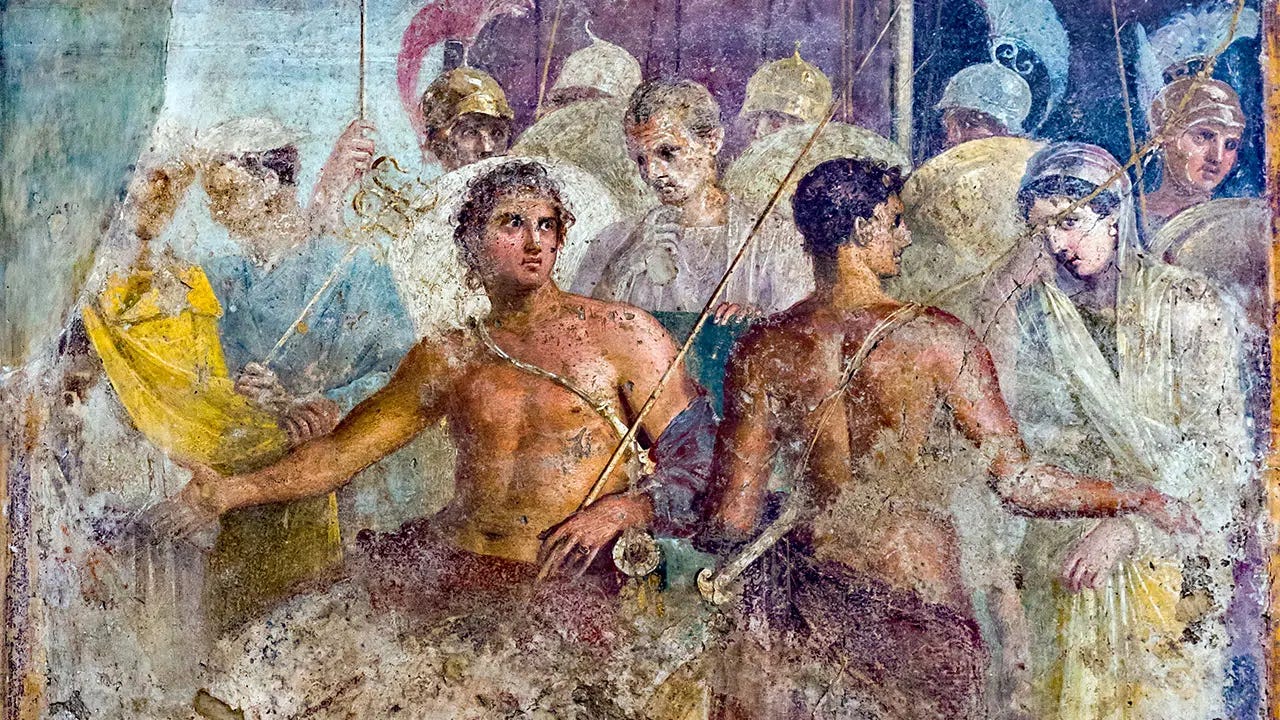
On a night of black tragedy, between two disasters, while Achilles, in his tent, gnaws at himself in the inactivity to which he has condemned himself, he sees an embassy approach, led by the two greatest chiefs of the army, Ajax and Odysseus. They are joined by old Phoenix, who tries to make him hear his father’s voice. In the face of danger, Agamemnon has repented. He restores Briseis and offers sumptuous gifts by way of reparation. The embassy fails. Achilles persists in his rancor, putting himself in the wrong in his turn (Book IX).
The next day, the Trojans force the Greek defenses. Hector is already setting a ship ablaze. At the other end of the camp, Achilles sees the flames rise. Despite his obstinacy, he cannot remain unmoved by the entreaties of his friend Patroclus, another self. He agrees to send his troops back into the battle and clothes Patroclus in his own armor. This counter-offensive drives back the Trojans. But Patroclus is killed by Hector. Achilles’ grief is terrifying, but it restores him to life, unleashing in him a fury and a rage for vengeance against Hector, the slayer of Patroclus.
Thus is accomplished in the Poem a complete reversal of the dramatic action, which had been frozen by Achilles’ withdrawal. Mad with grief, the Achaean hero returns to the fight: “As a prodigious fire rages through the deep valleys of a parched mountain, the forest burns, and the wind, driving it in every direction, makes the flame whirl — so in every direction leapt Achilles. He went on, like unto night…“ (Book XVIII). After a ferocious duel, he kills Hector, then vents his fury on the corpse, dragging it endlessly through the dust behind his chariot.
Achilles and Helen Facing Destiny
To the grief of his friend’s death is added, for Achilles, the certainty of his own fate. An ancient prophecy holds that he will be killed as soon as he has taken Hector’s life. This Achilles has always known. Unlike other heroes fallen in battle, he knows his destiny in advance and has chosen it. He does not submit to it as a fatality, in the manner of the Orientals; he confronts it. In his earliest youth, the choice was offered to him between a long and peaceful life far from battle, and an intense life, cut short in the blaze of combat. And it is the latter that he willed, bequeathing to the men of the future a model of tragic greatness. Free of illusions, he knows he will have no other life: “A man’s life,” he says in Book IX, “cannot be won back; never again can it be carried off or seized, once it has passed the barrier of his teeth…” It is a thought that speaks to us.
Compared with the sacred texts of other peoples and other cultures, the freedom and sovereignty of Homer’s heroes are unique. The gods intervene in the Iliad, to be sure, in season and out of season, but without truly weighing on the autonomy of men. Their numerous interventions do no more than hasten what would have come to pass in any case. And one senses clearly that Homer does not take them altogether seriously (except perhaps Athena) — which would scandalize Plato, that stiff and moralizing spirit. In reality, the gods of Homer are allegories of the forces of nature and of life.
The last book of the Iliad is the theater of a reversal: when old Priam comes to beg for the return of the body of his son Hector, we see Achilles gradually open himself to compassion. Transformed by his own suffering, the hero proves more complex than his savage violence had suggested.
There are not only heroes and warriors in the Iliad; there are also women (Helen, Hecuba, and Andromache), children (Astyanax), old men (Priam). Nor are there only the brave. There is Paris, whose strange loves with Helen are at the origin of the Trojan War. Executing the will of Aphrodite, he was Helen’s seducer and abductor. The involuntary author of the war, he is also the one who will close it by killing Achilles with a treacherous arrow — an episode the Poem does not recount, and which is merely intimated by the prophecy Hector utters at the moment of his death (XXII, 359–360).
Paris — the pretty-boy, so often cowardly and vain — is the antithesis of his brother Hector, who despises him. Hector is the pure hero, protector of Troy, while Paris is the “scourge of his fatherland.” The woman he abducted and seduced, Helen, despises him and does not hesitate to abuse him: “So you are back from the battle! Ah! how much better it would have been for you to perish there under the blows of the mighty warrior who was my first husband!” (III, 428–436). She detests him, but, by the will of Aphrodite, she is enslaved to his sexual magnetism. Once again, Homer does not explain; he narrates, and what he says is full of a complex truth.
Helen is the opposite of Paris. She is moral where her lover is amoral. She revolts against the physical subjection Aphrodite imposes on her. Her nature was made for order. She never ceases to mourn the time when everything in her life was in its place: “I left my bridal chamber, my kin, my beloved daughter… And so I languish in tears.” Nothing predisposed her to play the role of the adulterous wife, the instrument of the ruin of two peoples. Nothing, except the intervention of the gods — that is to say, of fate.
With a great truthfulness that moves us, the Iliad thus displays several antagonistic natures: Helen and Paris, Achilles and Hector.
The Stoicism and Patriotism of Hector
Achilles is the incarnation of youth (he is under thirty). He is also the incarnation of Force. He is Force radiant and untamed, before which everything bows. A Force in thrall to passion. Achilles masters nothing; he suffers everything — Briseis, Agamemnon, Patroclus, Hector. Circumstances unleash in him one tempest after another. Everything in him defies death. He never thinks of it, though he knows it is near. He loves life enough to prefer its intensity to its duration. Strange destiny! His love of glory, his impatience, and his wrath keep him apart from the action for the first eighteen books of the Poem, to the point of putting his own people in danger. To save the army, it would suffice for him to rise — as Odysseus tells him: “Rise up and save the army…”
Awakened by the death of Patroclus, the Force rises: “Achilles rose… A great light shone from his head up to the sky, and he advanced to the edge of the ditch. There, standing, he uttered a cry, and that voice raised among the Trojans an unspeakable tumult” (XVIII).
Everything opposes him to Hector, to whom Homer’s sympathy implicitly goes. The Poem of the Achaeans thus holds up as an example their principal enemy. Do we know the equivalent of such nobility in our national narratives, or in the sacred books of the Far or Near East? Though he is as brave as Achilles, Hector’s bravery is not blind. He embodies the very figure of stoic courage. He is not ignorant of fear. He overcomes it. Sensing that all is lost, he will fight to the last of his strength.

Hector is also the incarnation of patriotism. Honor, for him, is one with duty. He is ready to die, not for his own glory, but for his country, his wife, and his child. He will defend them against all hope, for he knows that Troy is lost.
Nothing is more carnal than Hector’s love for his fatherland, of which his wife and son are the concrete images. He does not hide his forebodings from Andromache before leaving her to return to the fight: “I know a day will come when holy Troy shall perish, and Priam, and the people of Priam. But neither the future misery of the Trojans, nor that of my mother, of king Priam, and of my valiant brothers, grieves me so much as yours, when some bronze-armored Achaean shall rob you of your freedom and lead you away weeping… May the heavy earth cover me dead before I hear your cries, before I see you torn from this place…” (VI, 447–465). At these words, he stretches out his arms toward his son. But the child bursts into sobs, terrified by his father’s gleaming helmet. Laughing, Hector sets the helmet down and hands the child back to Andromache, who takes her son in her arms “laughing through her tears.” A scene in which the poetic genius of Homer bursts forth. Out of delicacy, Hector then softens his dark predictions: “Cease to grieve,” he says to Andromache. “No man can send me under the earth before the appointed hour…”
A moment before, Andromache was begging Hector not to expose himself. Now she thinks of it no longer. She has understood that he is defending her freedom and their mutual tenderness. There is in this last conversation of husband and wife something unique in ancient literature: a perfect equality in love. One never ceases to discover the incomparable richness of the Iliad, which closes with the preparation of Hector’s funeral — without the episodes of the death of Achilles or of the “Trojan horse,” which will be only briefly evoked in the Odyssey (Books XI and VIII).
The Odyssey: Man’s Place in the Cosmos
The second of the great poems recounts, in 12,000 verses and 24 books, the difficult return of Odysseus to his homeland — a return thwarted by a thousand fearsome snares. The Odyssey is thus the poem of the return, and the poem of just vengeance.
But the Odyssey is more than that. Under narrative pretexts different from those of the Iliad, the second poem suggests the “view of the world” proper to the Hellenes. It shows what man’s place is within nature, and his relation to the mysterious forces that command it.
The bringing of mortals into harmony with the cosmic order is at the heart of the Homeric poems. But Homer’s Heaven stands beyond the primitive epochs of the founding of the cosmos evoked by the old myths, whose content would be given form in Hesiod’s Theogony: the clash of Uranus and Cronus, the battle of the Olympian gods and their victory over the Titans. Of all this, the Poet retains only the Olympian light, without troubling to build a coherent system. In Homer, coherence is not in the discourse. It is in him.
The rupture and then the return to the cosmic order form the warp of the Odyssey. Involuntarily, Odysseus provoked the wrath of Poseidon by blinding his son, the Cyclops Polyphemus. So it is with the destiny of men. Without willing it, they provoke disasters and the anger of the gods (figurations of the natural forces). Then they must struggle and endure torments to recover the lost harmony. Such will be the lot of Odysseus. Facing the terrifying trials imposed by Poseidon, who has hurled him into the world of chaos — the world of monsters (Charybdis and Scylla) and of possessive or perverse nymphs (Calypso, Circe, the Sirens), not to mention a visit to the kingdom of the dead — the navigator battles tirelessly to escape the snares and recover his place in the order of the world. Flung from trap to mortal peril, he will take ten years to come home. This is not merely a pretext for Homer to charm his audience with fantastic tales. Odysseus’ long voyage is strung taut by the invincible desire to escape chaos and to regain the ordered cosmos of men who are “eaters of bread.” No doubt love for Penelope and longing for Ithaca lie at the heart of this desire for return. But they only translate the hope of being once more adjusted to the order of the world. Having found and reconquered his homeland, Odysseus will be able to take his place again in the chain of the generations, like a fragment of eternity.
In the final sequence, each episode of the reconquest of Ithaca imprints itself on the memory, up to the massacre of the “suitors” (the usurpers of Ithaca). How the hero makes himself known to his son Telemachus, and how together they weave the meticulous plan of vengeance. How Odysseus arrives at his manor disguised as a beggar, recognized only by his old dog Argos, who dies of joy at the sight. How he is recognized by his old nurse, Eurycleia, at the sight of an old scar, memento of a memorable boar hunt. And now comes Penelope — troubled, anxious, questioning. Then comes the moment of just vengeance in an orgy of blood. And, at last possible, the reunion with Penelope. Then Athena intervenes, delaying the arrival of “rosy-fingered” Dawn so that the night of the return may last long…
In the Odyssey, Homer does not sing only the memory of heroes. He glorifies Eurycleia, Odysseus’ old nurse, and Eumaeus, his swineherd — two subaltern figures nevertheless held up as examples for their intelligence and their fidelity. Their role is capital in the reconquest of Ithaca. Thanks to Homer, they have not ceased to live, down to our own day.
The Poem of Femininity Respected
Because of the assertive presence of Penelope, the Odyssey is also the poem of femininity independent and respected. When Penelope appears in the great hall of the palace of Ithaca — tall and beautiful, her shining veils drawn over her cheeks, like unto golden Aphrodite — the knees of the “suitors” give way and desire floods their hearts (Odyssey, XVIII, 249).
Lover, wife, and mother, Penelope has charge of the little kingdom of Ithaca in Odysseus’ absence — a sign of the regard in which femininity was held. Many other women are present in Homer. In the Iliad: Helen, Andromache, Hecuba, and Briseis. In the Odyssey: Helen again, Calypso, and the charming Nausicaa. But Penelope eclipses them all, except perhaps Helen, who stands apart. Compelled, like the women of our own time, to invent the art of remaining feminine in a social world dominated by masculine values, she often suffers but never abdicates. She knows how to keep herself beautiful and desirable in spite of age. She, too, knows the importance of modesty for living in the society of men. When she is too sorely tormented, she takes refuge in sleep, watched over by Athena. Faced with the greedy pack of suitors, she does not join battle on the masculine terrain of violence. She uses cunning, smiles, invents the stratagem of the web forever to be rewoven, turning to her advantage the covetousness of which she is the object — and which perhaps does not displease her.
On Odysseus’ return, though he is the most cunning of men, she outwits him a little as well, feigning not to recognize him, even after he has massacred the “suitors” with the help of their son, Telemachus. He must first prove his identity by the test of the secret of the conjugal bed before she consents to give herself to him. In what sacred narrative of other cultures would one find the equivalent of Penelope and her radiant femininity?
The Political Order of the Shield of Achilles
Behind the narrative there also emerges a vision of the world and of life that awakens the memory of a lost wisdom. In Homer, the forests, the rocks, the wild beasts have souls. The whole of nature merges with the sacred, and men are not set apart from it.
If Homer’s world takes the cosmos as its model, it receives an ordered social description in the allegory of the shield of Achilles (Iliad, Book XVIII), forged by Hephaestus. Depicted upon it are two cities, one at peace, the other at war — the two faces of life. One discovers that the Greek city to come, with its citizens, its institutions, its reciprocal duties, is already present in the Homeric world. Hector says explicitly that he dies for the freedom of his fatherland (Iliad, VI, 455–528). The foundation of social organization and of civil peace is the ethnic unity of the city and respect for the laws, guaranteed by the elders. Men are happy in a happy society — one that always resembles itself, where one marries as the ancestors married, where one plows and harvests as one has always plowed and harvested. Individuals pass away, but the city endures.
As Marcel Conche has emphasized, a society that can read its future in its past is a society at rest, without anxiety. On this permanence is founded the feeling of security. By contrast, novelties — “progress” — will bring trouble. When one dreams of the ideal city and of better tomorrows, contentment with oneself is killed in each of us. From then on, discontent with oneself and with the world holds sway. What is figured on the shield of Achilles is, on the contrary, a happy society, wholly given over to the joy of living as it has always lived. The weddings are joyous, equity reigns, civic friendship is general. When war comes, the attacked city stands fast, the whole people mans the ramparts, the enemy has no ally within the walls. What peace for the soul!
Destiny Commands Gods and Men
Homer’s heroes are nevertheless not models of perfection. They are subject to error and to excess in the very proportion of their vitality. They pay the price for it, but never are they subjected to a transcendental justice punishing sins defined by a code external to life. Neither the pleasure of the senses, nor that of strength, nor the play of sexuality is equated with evil.
In Book III of the Iliad (III, 161–175), the all-too-beautiful Helen is invited by the old king Priam onto the walls of Troy, to describe for him the two armies facing each other, a truce having just been concluded. Well aware of being the involuntary cause of the war, Helen laments, saying she wishes she were dead. Priam then answers her with an infinite gentleness that surprises us: “No, my daughter, you are guilty of nothing. It is the gods who are guilty of everything!” What delicacy and what loftiness of vision on the part of the old king, all of whose sons will be killed. But what generous wisdom, too — a wisdom that frees human beings from the guilt with which other beliefs so often burden them.
In placing these words in Priam’s mouth, Homer is not saying that men are never guilty of the misfortunes that strike them. Elsewhere he shows how much calamity can be caused by vanity, envy, anger, stupidity, and other failings. But in the precise case of this war, as in many wars, he underscores that everything escapes the will of men. It is the gods, chance, or destiny that decide.
History has taught us how sound this interpretation is. How can one fail to be struck by its wisdom, when so many religions blame human beings and their supposed sins for all the disasters that befall them — earthquakes included?7

But Priam’s words have a still wider bearing. They suggest that, in human lives, many faults that we imagine to be such are often the effect of chance. This distance with regard to the mysteries of existence, this respect for others, are a constant in the Homeric poems. One may see in it proof of the very high level of civility and wisdom of the world Homer describes — to such a degree that, by comparison, our own might often appear barbarous.
Homer thus bequeathed to us, in their unaltered purity, our models and our principles of life: nature as foundation, excellence as goal, beauty as horizon, in the mutual respect of the feminine and the masculine.
The Poet reminds us that we were not born yesterday. He restores to us the foundations of our identity, the primordial expression of an ethical and aesthetic patrimony that is “ours,” which he himself held as an inheritance. And the principles he brought to life through his models have never ceased to be reborn, down to our own day — proof that the secret thread of our tradition could not be broken.
Originally published on July 1, 2007 on Dominique Venner’s Blog, dominiquevenner.fr; republished by the Iliade Institute.
Translated by Alexander Raynor

François Jullien, interviews with Thierry Marchaisse, Penser d’un dehors (la Chine). Entretiens d’Extrême-Occident (Thinking from an Outside (China): Conversations of the Far-Occident), Le Seuil, November 2000, p. 47. A philosopher and sinologist, François Jullien is a professor at the University of Paris-7. He is a member of the Institut universitaire de France and director of the Institut de la pensée contemporaine. In order to recover the authenticity of European thought, he undertook to confront it with the wholly other thought of China, which had developed autonomously, without any link to the Indo-European languages. [Translator’s Note: khâgne: the French preparatory class in humanities for the École normale supérieure; no English equivalent.]
Jacqueline de Romilly, Homère (Homer) (Que sais-je?, PUF, 1985).
The BNF (National Library of France) exhibition “Homère. Sur les traces d’Ulysse“ (”Homer: In the Footsteps of Ulysses”) was accompanied by an excellent catalogue published by Le Seuil, produced by its three curators, Olivier Estiez, Mathilde Jamain, and Patrick Morantin.
No French translation is truly satisfactory. To steep oneself in the Iliad, the translation of Paul Mazon is to be preferred (Gallimard, Folio Classique — an edition to which P. Vidal-Naquet’s preface adds nothing). For the Odyssey, one should turn above all to the poetic translation of Philippe Jaccottet (La Découverte, 1982; pocket edition 2004). The volume in the Bouquins collection, Homère. L’Iliade et l’Odyssée (Homer: The Iliad and the Odyssey), translated by Louis Bardollet, includes a useful critical apparatus. One will profitably consult Jacqueline de Romilly’s essay Hector (Éditions de Fallois, Livre de Poche, 1997), as well as Marcel Conche, Essais sur Homère (Essays on Homer) (PUF, 1999). See finally Dominique Venner, Histoire et tradition des Européens (History and Tradition of the Europeans) (Le Rocher, 2004, chapters IV, V, VI).
The neologism Boréen (”Borean”) has a broader sense than Indo-European, which is of a linguistic order. It refers to the Greek myth of Hyperborean origins.
[TN: se retirer sous sa tente is a French idiom for sulking withdrawal, born of this very episode; hence Venner’s parenthetical remark]
One thinks of the celebrated interpretations of the tidal wave that destroyed Lisbon in 1755, inspired by what the Bible says of Sodom and Gomorrah, destroyed, it is said, on account of the immorality of their inhabitants…
This was excellent. Spell binding. Can't wait for '30,000 Years of Identity' to be published. But wait patiently, I will.