Alain de Benoist sees the US kidnapping of Venezuelan president Maduro and the escalating tensions around Greenland as marking the end of the world order based on state sovereignty, a dramatic shift which Europeans are neither willing nor ready to accept — at their own peril.
Recent events in Venezuela have been commented on in a purely partisan manner. Those who detest Nicolás Maduro applauded his kidnapping, while those who appreciate him cried out in outrage. Both are equally detestable ways of losing sight of the essential point.
The key issue, in fact, is not whether Maduro is a “good guy” or a terrible dictator, but to understand that with this kidnapping we have definitively entered a new era: one in which the sovereignty of states is no longer recognized by the dominant power.
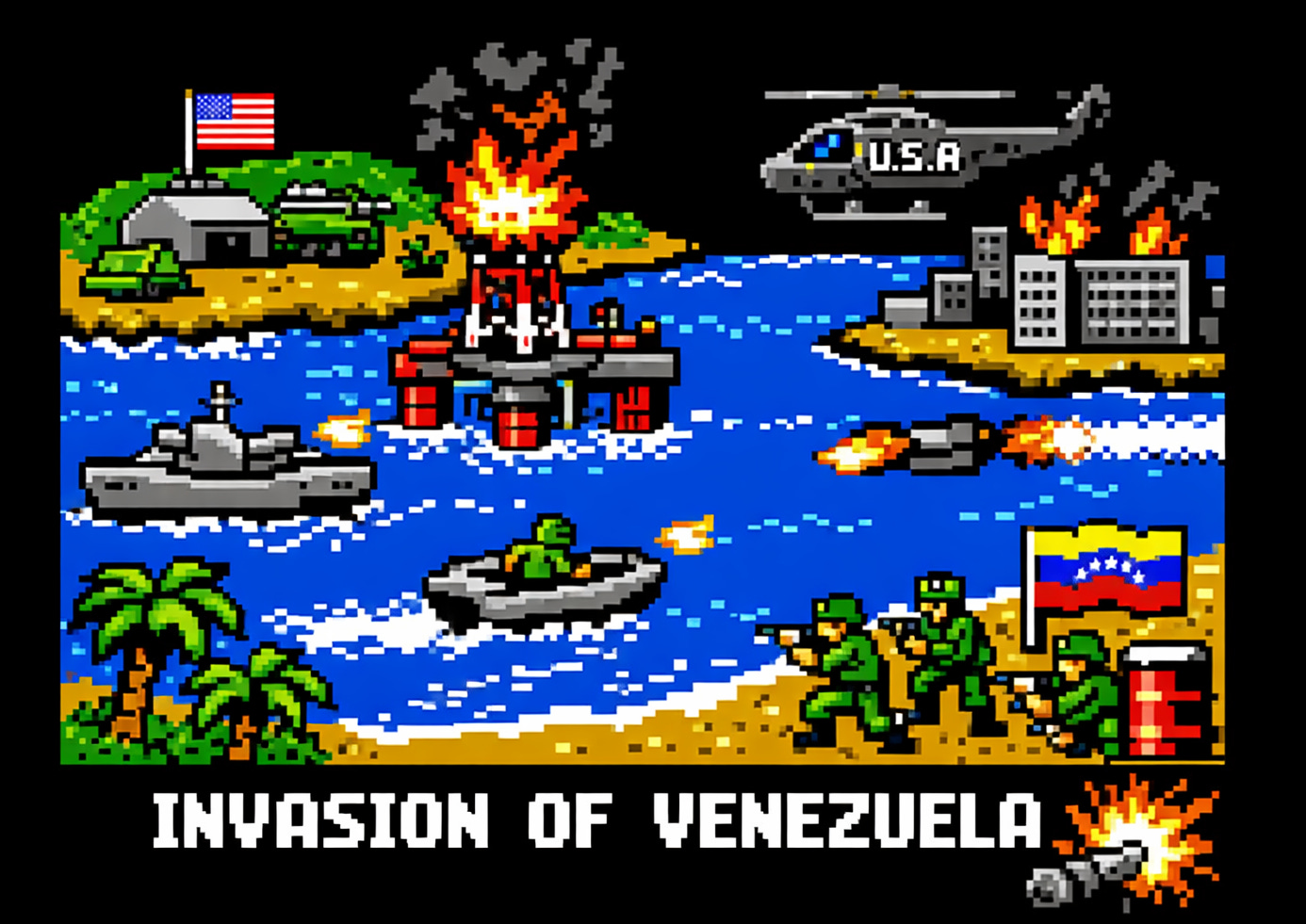
Maduro’s kidnapping took place on January 3, thirty-six years after that of Panamanian president (and former CIA informant) Manuel Noriega. But also, a month after Donald Trump himself granted clemency to former Honduran president Juan Orlando Hernández, who was sentenced in 2024 to forty-five years in prison for drug trafficking by a New York court. Donald Trump decided on this military intervention, called “Absolute Revolve”, without considering international law (admittedly, much abused for several decades) and without even consulting Congress, as the Constitution required him to do in principle. This allowed him to carry out the kidnapping of the sitting president of a sovereign state.
The real lesson of this kidnapping is that Washington now claims the right to act unilaterally wherever it wants, even against sovereign states or allied countries. Since its founding, the United Nations has defined itself as a “league of sovereign states”. If there are no longer sovereign states, it no longer has a reason to exist.
On closer examination, this is also a blow to democracy, since this democracy is based on popular sovereignty: Venezuela belongs neither to Trump nor to Maduro, but first and foremost to the Venezuelan people. Trump has not called for new elections in Venezuela but has instead chosen to announce to Venezuelans that from now on he will be the one to govern their country.
Trump’s European supporters are generally sovereigntists. From now on, they will have to settle for a president who, when it comes to sovereignty, recognizes only his own. While Italian and Spanish populist parties openly rejoiced at Maduro’s removal from office, only Marine Le Pen had the courage to declare:
“There is a fundamental reason to oppose the regime change that the United States has just brought about in Venezuela. The sovereignty of states is never negotiable, regardless of their size, power, or continent. It is inviolable and sacred. To renounce this principle today for Venezuela, or for any state, would be tantamount to accepting our own servitude tomorrow.”
The “Narco-Terrorism” Alibi
The allegation that Maduro is one of the leaders of “narco-terrorism” has not convinced anyone: Venezuela is not a cocaine producer, and no Latin American country produces fentanyl. The accusation that he is the head of an alleged “Cartel de los Soles” was quietly dropped when he was indicted. To explain Maduro’s kidnapping, the US ambassador to the UN invoked another reason: the United States, he simply states, “cannot have adversaries who control the world’s largest oil reserves”!
Venezuela has the world’s largest proven oil reserves (303 billion barrels, equal to 17% of the world total). Their exploitation is certainly in a deplorable state, as the current world prices make neither extraction nor refining profitable. But an oil infrastructure can be rebuilt when you have the keys to it. Even though the United States is self-sufficient in this sector, strategic control of Venezuelan oil is of primary importance. Even more so since China has been the main buyer of Venezuelan oil (between 55% and 90% depending on the month).
Maduro’s removal from office demonstrates above all that Donald Trump’s policy is not isolationist. Isolationism in the United States has its origins in George Washington’s famous speech in 1796, when he left office, urging Americans “not to engage in any form of permanent alliances (no entangling alliances) with any foreign country”.
“Our great rule of conduct towards foreign nations is to have as little political connection with them as possible, while developing our commercial relations [...]. Europe has a series of fundamental interests that do not mean much to us [...]. It would therefore be foolish on our part to commit ourselves with artificial ties to participate in the vicissitudes of its politics or the multiple combinations generated by its alliances and enmities.”
Trump does not share this position at all. What he takes from Washington’s speech is that the United States should not engage in alliances that are not advantageous to them.
This is hardly any news. The United States has long been accustomed to intervening in world affairs. Since 1947, it has participated in over 70 regime changes, in gross violation of international law! Pascal said that force without law is unjust, but law without the force necessary to establish and enforce it is just a mirage or wishful thinking.
Trump is interventionist, as were almost all of his predecessors, but in a new way. On the one hand, he wants to limit himself to rapid interventions (a few weeks for Iran, a few hours for Maduro), knowing that his electoral base will not accept a prolonged involvement like that in Vietnam or Afghanistan. On the other hand, and above all, he unscrupulously abandons the ideological or moral facade to which Americans have been accustomed until now. Abandoning all hypocrisy, he does not pretend to fight to impose “liberal democracy and freedom”. And without any concern for ideological or moral justification, he claims an almost sovereign right over the political destiny of all the states he does not like.
Trump announced that the United States will now “govern” Venezuela. He did not specify how (Marco Rubio as governor?). In the immediate term, Maduro’s kidnapping sets a precedent that China could exploit when it invades Taiwan and that Putin could use to ridicule the West’s claims to lecture him on respecting borders. In Kiev, Zelensky has already suggested to Donald Trump that he kidnap the Chechen president!
This tactic is perfectly in line with the guidelines of the New National Security Strategy published by the White House on December 5. The United States declares without hesitation that the Western Hemisphere is now its exclusive zone of influence, its fiefdom. The United States’ “networks of alliances and allies” are mentioned in the section “What Are America’s Available Means to Get What We Want?”, which has the merit of clarity. The words used by Stephen Miller, Trump’s political advisor, to justify American intervention in Caracas are revealing:
“We live in the real world, a world governed by force, power and authority.”
This clearly means that human rights, moral considerations, and the rule of law do not belong in the “real world”.
Arktos Journal survives because readers choose to sustain it. Every purchase and subscription goes directly toward taking risks on new authors, translating neglected thinkers, and publishing work that would never make it to you through institutional or commercial frameworks.
We publish work rooted in archaic values, civilizational memory, and long-form thought, and have been doing so since 2009.
The editors do this work pro bono, driven by conviction rather than careerism. If you value independent intellectual production that is willing to publish what others will not, support this project and make its continuation possible.
Business First!
Trump thinks like a businessman, in terms of deals and profits. Abandoning even the doctrine of free trade, he uses customs and duties as instruments of politics and geostrategy. In all sectors, the United States now takes a brutal realist approach: only the balance of power counts. One could call this the “law of the strongest” or the “law of the jungle”, or even a return to the “state of nature” conceived by Thomas Hobbes. But one might also wonder whether this radical shift simply marks a return to a realistic conception of what politics really is, whose driving force and hallmark has always been enmity.
The fundamental shift is therefore this: Washington still wants to be able to intervene anywhere in the world it wishes but no longer claims to act as the guarantor of a universal regulatory order. It no longer acts as the defender of the liberal international order established after 1945, but only in accordance with its own national and regional interests. No matter what the borders and friendly or allied states may be, only America’s interests matter. As former Secretary of State Pierre Lellouche wrote, “this America has voluntarily abdicated its role as leader of the ‘free world’ and, even more so, as guarantor of a rules-based international order. What matters are its interests.” In this context, international law is just another tool, like the dollar or the extraterritoriality of American law.
Who will be next? Will the next American intervention target Iran, Cuba, Greenland, Colombia or Mexico? Greenland is a constituent territory of the Kingdom of Denmark (it was already so before the United States declared independence!). It hides 1.5 million tons of “rare earths” (compared to 2 million in the United States). In addition to its obvious geostrategic interest, its annexation by Washington would allow the United States to become the most populous country on Earth (22 million km², compared to 17 million for Russia and 9.5 million for China). Why Greenland? Trump’s answer: “Because the United States needs it.” It’s that simple. Denmark is also a member of NATO. So what?
Trump already talks about “my hemisphere” as he would say “my wife” or “my car”. To claim all rights in Latin American countries, which he considers his backyard, he invokes the famous “Monroe Doctrine”. But his interpretation does not correspond to historical reality.
A Distorted “Monroe Doctrine”
In his speech on December 2, 1823, President James Monroe did not intend to give the United States the right to intervene at will in the Western Hemisphere or to interfere excessively in the affairs of Latin American countries. His “doctrine” simply consisted of rejecting any European intervention on the American continent. It was the Europeans he was referring to when he stated, “as a principle concerning the rights and interests of the United States, that the American continents [...] cannot be considered as objects of future colonization by any European power.”
It was precisely for this reason that Carl Schmitt had spoken out in favor of a “European Monroe Doctrine” that would prohibit Anglo-Saxon countries from any military presence or intervention on European territory, including the seas.
READ MORE by Alain de Benoist, brought to you by Arktos:
Carl Schmitt Today examines the persistent claim that Carl Schmitt inspired American neoconservatism and the war on terror, and shows why this reading collapses under scrutiny. Through a Schmittian lens, Alain de Benoist demonstrates that US policy abandoned the traditional laws of war, moralized conflict by casting enemies as absolute evil, and pursued global hegemony, whereas Schmitt anticipated a multipolar world order grounded in the recognition of legitimate political enemies. The book concludes that Schmitt’s realism was historically vindicated, while neoconservatism has only shown its strategic and conceptual poverty.
Trump certainly cannot be blamed for wanting to defend his country’s interests first and foremost. Rather, we should ask ourselves why Europeans are not primarily concerned with defending their own interests. The answer is simple. Because European integration has been linked to transatlantic relations from the outset, they fail to understand that Europe could also be built without them.
The Failure of Europe
Europeans continue to repeat that they need the United States and want to remain allies at all costs, even as the latter makes it clear that it has no need for them. Accustomed to behaving like submissive vassals, they are paralyzed by fear at the idea of openly opposing the White House. While we are witnessing a historic “decoupling” within the Atlantic Alliance, they refuse to learn from it. They cling to Washington like a dog demanding to negotiate the length of its leash. Instead of seeking the means to become an autonomous power, they are ready to accept being humiliated as Ursula von der Leyen was when she visited Trump’s private golf club in Scotland on July 27 and yielded without protest to his demands on the tariffs imposed on Europe.
Relying on the Americans to guarantee their defense, something Europeans have been doing for decades, already implied a surrender of sovereignty on their part. Now that the American guarantee has disappeared, far from wanting to regain their sovereignty, they are redoubling their efforts to proclaim themselves vassals more than ever. Whether it is data, artificial intelligence, software updates, or means of defense, Europe remains at the mercy of American goodwill, just when the United States is coldly declaring that it can no longer be counted on for protection that costs it too much. They invoke international law, which has practically disappeared. They talk about Western solidarity while the “West” has also disappeared; they insist on remaining in NATO while it is about to crumble. Not yet understanding that the world (the Nomos of the Earth) is changing, they cling desperately to the old world that is disappearing before their eyes.
In the event of Greenland’s annexation, they will protest, but they will refrain from retaliation. However, Danish Prime Minister Mette Frederiksen could very well, for example, reverse her recent decision to purchase American F-35 fighter jets instead of European aircraft (when France expressed surprise at this, she replied that her country would always feel closer to Washington than to Paris! The Europeans will raise their voices and spit, but nothing more. Once again, they will be non-existent, due to a lack of means and, above all, a lack of will.
This brings us back to the observation made more than 2,000 years ago by Thucydides:
“The strong do what they will, and the weak suffer what they must.”
Today, the weak are the Europeans.
Alain de Benoist
Translated by Andrea Falco Profili
Originally published in Éléments on January 16th, 2026
Get vital insights from our other authors on this topic, brought to you by Arktos Journal:
Alexander Dugin argues that the US attack on Venezuela and kidnapping of Maduro was deliberately staged as “meme” political theater to demonstrate Trump’s harsh, rapid, no-holds-barred approach, signaling the de facto end of international-law norms in favor of raw power and compelling other powers to prove their sovereignty through might.
Nicolas Gauthier dissects the muted reactions in France and Europe to the bold US military intervention in Venezuela, questioning whether ideals like international law still hold weight in a world where brute force and strategic interests reign supreme.
Naivety at its finest. The author is flabbergasted that Europe didn’t come to the rescue to save a “democracy” because Maduro was “elected” by the people of Venezuela.
Note he barely spent one sentence articulating his “narco-terrorist alibi” point. A telling obfuscation of the facts if there ever was one.
The narco-currency financed destabilization of the United States has come to an end.





Naivety at its finest. The author is flabbergasted that Europe didn’t come to the rescue to save a “democracy” because Maduro was “elected” by the people of Venezuela.
Note he barely spent one sentence articulating his “narco-terrorist alibi” point. A telling obfuscation of the facts if there ever was one.
The narco-currency financed destabilization of the United States has come to an end.
Non poteva essere spiegato in modo migliore la decadenza europea e la nuova geopolitica dettata da Trump.